Get the AI Restaurant Quick-Start Guide — Free
The 5 AI tools independent US restaurant owners are using right now to cut labor costs and answer every call.
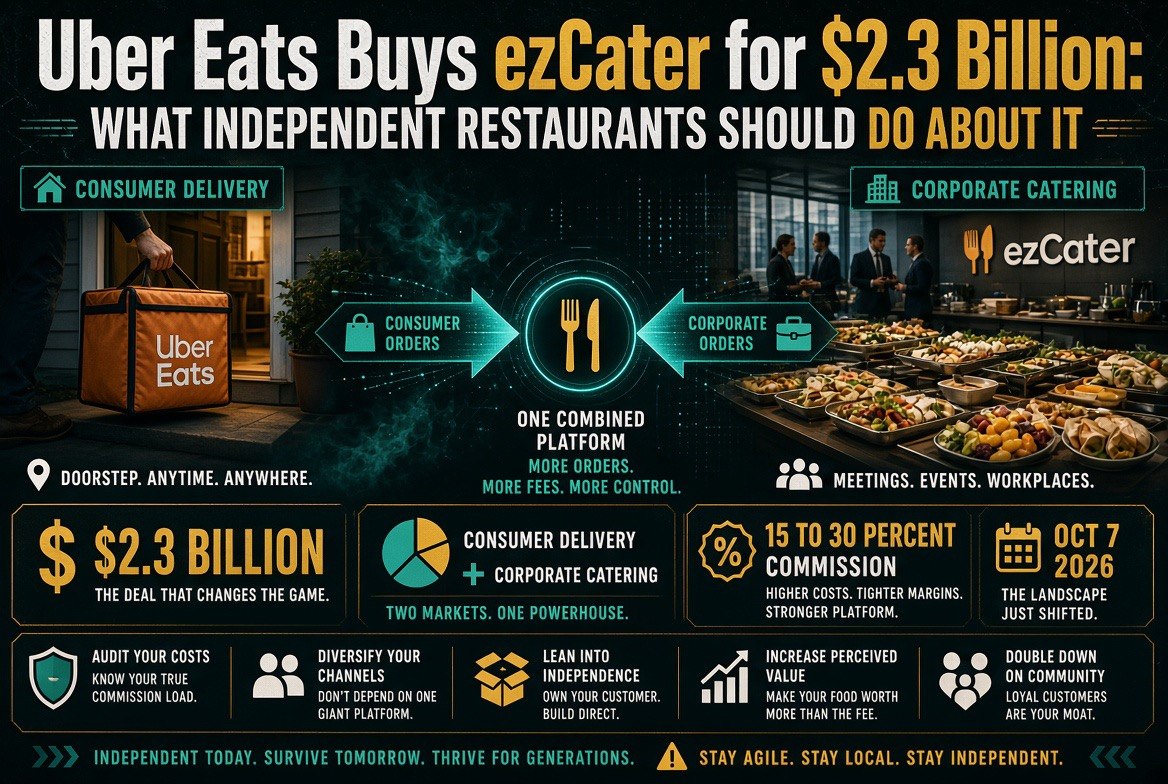
Uber Eats Buys ezCater for $2.3 Billion: What Independent Restaurants Should Do About It
⚡ Expert Summary: Uber Eats is buying ezCater for about $2.3 billion, and the deal hands one company your two biggest off-premise channels: consumer delivery and corporate catering. Corporate orders are higher ticket, higher frequency and far less price-sensitive than consumer delivery. That makes your catering relationship the single most valuable asset this deal touches — and the one you have the most control over.
If you run an independent restaurant, a $2.3 billion acquisition between two platforms you probably do not buy anything from still changes your economics. Here is what is actually happening, and what it means for your catering book, your delivery margin and your customer list.
What Was Announced
Uber Eats agreed to acquire ezCater in a deal valued at roughly $2.3 billion. ezCater built its business on a simple, durable idea: workplaces need food, reliably, at scale, on a schedule, with invoicing that a finance department will actually accept. It serves corporate customers — offices, hospitals, schools, sales teams, event organisers — and routes those orders to local restaurants.
Uber Eats built its business on the opposite motion: consumer demand, immediate, high volume, thin margins, driven by discounts and delivery fees. The two companies sell food to different people for different reasons. That difference is the whole story.
For a restaurant owner the practical reading is this: the corporate catering channel has just been consolidated into the same corporate family as your consumer delivery channel. Two contracts, two fee schedules and two sets of platform rules may eventually become one relationship with one counterparty that holds far more leverage than either platform held alone.
Why Corporate Catering Is a Different Business
Independent operators often lump all off-premise revenue together. That is a mistake, and this deal is a good reason to stop.
Corporate catering orders are typically planned days or weeks ahead, sized for groups, repeated on a schedule, and paid by a company rather than a consumer. Nobody is comparing your price to a discount code. The buyer is judged on whether the food arrived on time and whether their colleagues were happy — not on whether they saved three dollars.
Consumer delivery is the inverse. It is immediate, individual, comparison-shopped, and heavily influenced by promotions the restaurant does not control. Margins are squeezed by commission, and the customer relationship belongs to the platform.
That asymmetry is why the catering book at an independent restaurant is usually its most profitable off-premise revenue — and why losing direct access to corporate buyers is expensive in a way that losing a few delivery orders is not.
| Factor | Consumer Delivery | Corporate Catering |
|---|---|---|
| Typical order size | Single household | 10 to 500+ covers |
| Lead time | Minutes | Days to weeks |
| Buying decision | Price and speed | Reliability and invoice terms |
| Repeat behaviour | Opportunistic | Scheduled and recurring |
| Who owns the customer | The platform | Shared — often yours, if you work it |
| Margin pressure source | Commission and discounts | Menu pricing and labour |
What Changes for Your Restaurant
Nothing on day one. Acquisitions of this size take months to close and longer to integrate, and no platform is going to switch off a working order pipeline mid-quarter. The risk is not immediate; it is structural.

Four things become more likely over the next year or two.
Fees are the first thing to watch. When two channels sit under one company, the company can price them together. A package that bundles delivery visibility with catering placement is attractive to sell and easy to justify internally — and it is harder for a small operator to unbundle than two separate contracts were.
Data terms get more valuable to the platform. Corporate orders reveal who the buyer is, what the company buys, when they buy and what they spend. That is the most commercially useful dataset in off-premise food. Integrated platforms tend to tighten data terms rather than loosen them.
Exclusivity clauses matter more. A catering platform that wants to keep its corporate accounts will push for commitments on availability, hours and capacity. Those clauses quietly remove your ability to serve the same client directly at a better margin.
Direct relationships become the hedge. Anything you own — a client list, a signed standing order, a phone number, an email list of office managers — is unaffected by this deal. That is your insulation, and it is worth building while the deal is still being digested in boardrooms rather than in your dining room.
The Fee Question, In Numbers
Platform commissions on third-party orders commonly run in the range of 15% to 30% of the order value, with catering arrangements typically negotiated separately and often structured as a marketplace rather than a delivery commission. The exact terms are commercial and vary by market and by volume.
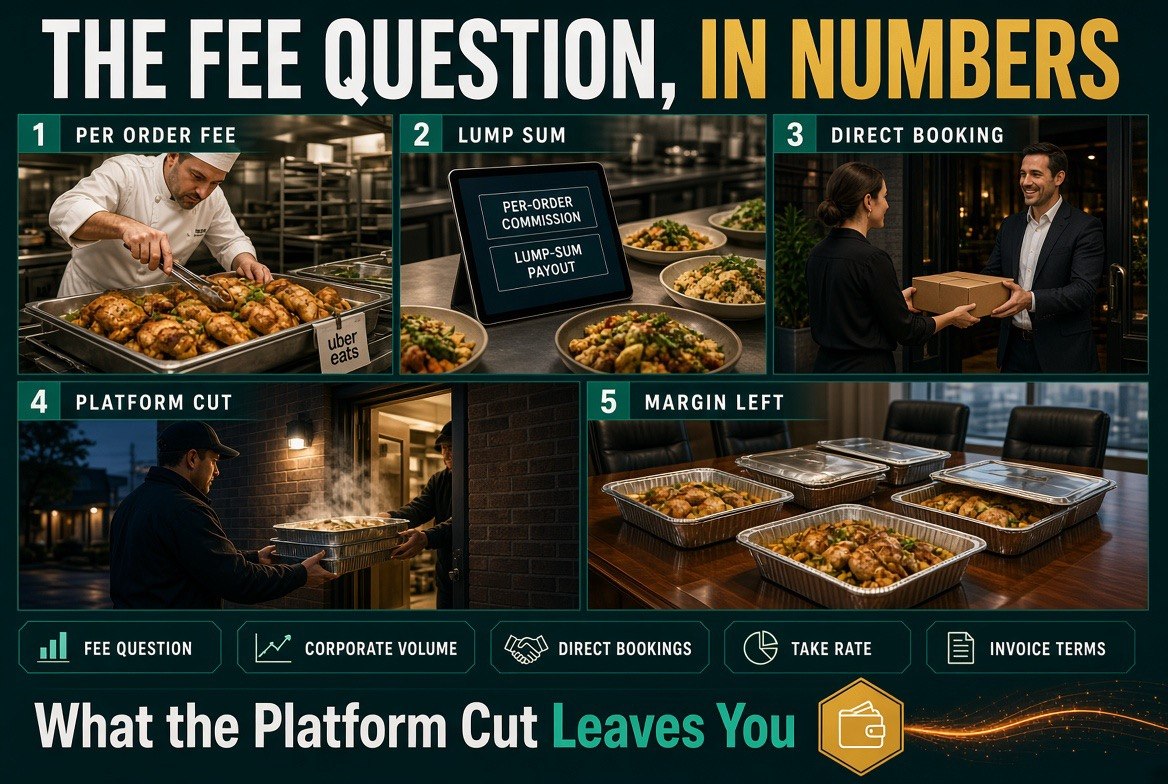
The point is not the precise number. It is that a 3% shift in off-premise commission is a bigger swing in profit than most operators realise, because it comes off the top of revenue you have already spent money to produce.
Work the arithmetic on your own book: take your monthly off-premise revenue, apply a realistic fee, then ask what a three-point change does to your monthly profit. For most independent restaurants with a solid catering line, the answer is larger than any single food-cost saving they could negotiate in the same month.
What Independent Restaurants Should Do Now
The correct response is not to pull out of platforms. It is to reduce how much of your future depends on someone else’s decisions.
Build the direct list. Every corporate client your restaurant serves has an office manager, an EA or a team lead who ordered the food. That person’s contact details are the asset. Collect them with permission, and keep them somewhere you control.
Quote direct whenever you can. If a client is happy, the next order should not require a marketplace in the middle. A simple repeat-order page, a standing weekly slot, or an emailed order form converts a platform transaction into a direct relationship.
Read your contracts before renewal. Exclusivity, availability and data terms are where the real cost hides. It costs nothing to ask for a catering agreement with no exclusivity and a clear data clause, and platforms negotiate more often than operators assume.
Spread the channel mix. Direct orders, catering platforms, consumer delivery and walk-in trade should each carry a share, so no single change in policy can remove a third of your revenue.
Protect service standards, because that is what wins catering. Corporate buyers switch on a late delivery or an incomplete order, not on a price difference. Reliability is the moat an independent can build and hold.
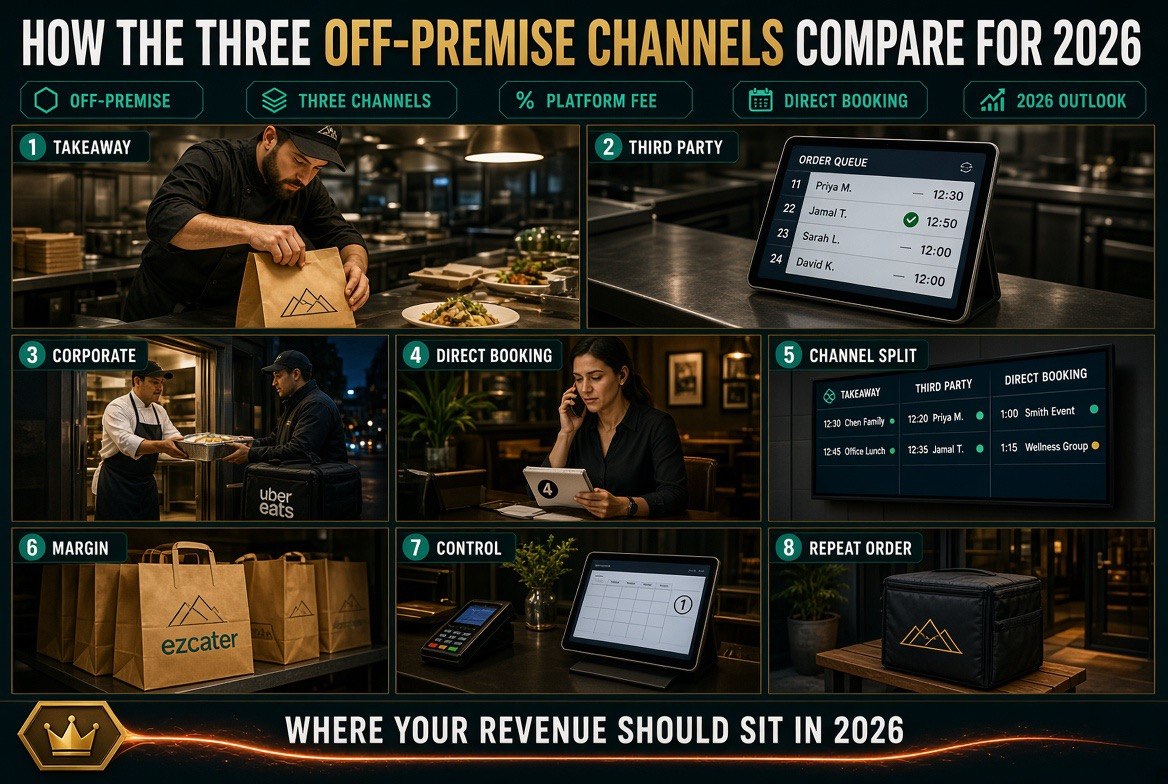
How the Three Off-Premise Channels Compare for 2026
The strategic question is where to spend effort, and the channels do not pay the same way. This is the comparison worth running once a quarter.
| Factor | Direct Ordering | Catering Marketplace | Consumer Delivery |
|---|---|---|---|
| Commission | None beyond your own processing | Negotiated, often marketplace-based | Commonly 15% to 30% |
| Customer data | Fully yours | Shared | Platform-controlled |
| Volume potential | Limited to your reach | High — corporate accounts | High — consumer demand |
| Order value | Varies | Highest | Lowest |
| Exposure to platform policy | None | High | Highest |
| Effort to grow | Consistent, compounding | Front-loaded onboarding | Low — demand is rented |
Why This Deal Signals Where Restaurant Revenue Is Going
Read the acquisition as a bet, not an event. Uber Eats is paying $2.3 billion for access to corporate food buyers because it believes the future of off-premise food sits in scheduled, repeatable, business-funded orders — and because it already owns the consumer side.
If that read is right, the platforms are moving toward managing the food supply chain for workplaces, not just delivering dinners. Independents that hold direct relationships with those workplaces will be negotiating from a position of strength. Independents that only exist inside a marketplace will be, at best, a menu option and, at worst, a line item to be optimised.
That is the entire strategic case for treating your catering book as a business, not a favour you do for a good client.
Frequently Asked Questions
Did the Uber Eats and ezCater deal close?
The acquisition was announced at a valuation of roughly $2.3 billion, subject to regulatory review and closing conditions. Deals of this size typically take months to complete, and platform terms for restaurants do not change on announcement day.
Will Uber Eats raise my catering fees?
Nobody can promise otherwise. What owners should watch is not a fee line but a package: bundling delivery visibility with catering placement is the easiest way to raise effective cost without raising a headline fee. Read any renewal carefully for bundled terms and exclusivity.
What should an independent restaurant do right now?
Nothing drastic. Start collecting direct contact details for every corporate client, quote direct for repeat orders, review your platform contracts for exclusivity and data clauses, and make sure no single channel carries more than a third of your off-premise revenue.
Is catering still worth pursuing if platforms take a cut?
Yes. Corporate catering carries the highest order values and the most predictable repeat volume in off-premise food. The goal is not to avoid platforms entirely but to make sure the direct relationship sits alongside them, so the platform is a channel rather than the owner of your client.
How much commission should I expect on catering orders?
Catering arrangements are usually negotiated separately from consumer delivery and are often structured as a marketplace with flat or tiered fees rather than a straight percentage. Consumer delivery commission commonly ranges from 15% to 30%, but catering terms vary widely by market and volume — which is exactly why they are negotiable.
Does this affect which POS or ordering system I should use?
Indirectly, yes. The value of an ordering system now depends on how well it helps you keep direct customer records and repeat orders, not just how well it pushes tickets to a delivery platform. When you evaluate tools, weigh ownership of the customer data above convenience.
How Restaurant Operators Can Use AI to Protect Direct Catering Revenue
The defensive work this deal calls for is mostly administrative, and that is exactly the kind of work a small team never gets to. This is also where AI tools genuinely earn their place in a restaurant — not by cooking, but by keeping the boring, high-value parts of an operation from slipping.
Three practical uses stand out for independent operators protecting a catering book.
Keep the client list clean and current. Corporate catering clients turn over as people change jobs. A simple recurring review of your contact list — flagging addresses that have bounced, companies that have gone quiet, and accounts that have not reordered in 60 days — is the difference between a list and a dead file. AI assistants are good at this kind of routine sweep because it requires attention, not judgement.
Draft the follow-up, then edit it yourself. A polite “are you still ordering for the Thursday team lunch?” note sent at the right interval recovers real revenue. The value is in the timing and the consistency, both of which a reminder workflow handles better than a busy manager does.
Watch your commission line. Off-premise fees are buried in statements that arrive monthly and get filed without being read. A monthly parse of your delivery statements, comparing effective fee percentage against the previous three months, will surface a change in terms before it costs you a quarter of margin.
If you want a broader view of where AI fits into a restaurant’s day-to-day operations, our breakdown of how independent restaurants are using AI to cut labour costs covers the operational side in more depth.
The Bottom Line for Your Catering Book
A $2.3 billion acquisition between two platforms has just made one thing clear: the corporate food buyer is valuable enough to spend billions on. That buyer already knows your restaurant, and you already know theirs.
Protect that relationship now, while the deal is still in paperwork. Collect the contact, quote direct, review the contract, and keep the platform as a channel rather than a landlord. Operators who do that will come out of the integration owning their best clients. Operators who do not will discover they were renting them all along.

About Barak Schurr
Barak Schurr built and exited a major ticketing platform, ran global operations at Eventbrite, and now focuses on one question: which AI tools actually help independent restaurant owners run leaner and grow faster. He writes from the operator’s perspective — no vendor spin, no theory, just what’s real in 2026.
Email: [email protected]
More AI Resources for Your Business