Get the AI Restaurant Quick-Start Guide — Free
The 5 AI tools independent US restaurant owners are using right now to cut labor costs and answer every call.
The Robotic Wok Is Here: How Invisible Kitchen Automation Cuts Labor Costs
⚡ Expert Summary: Robotic wok systems like Next Robot’s Robby are moving from trade-show prototypes to working kitchens — and the economics are real. Operators using them report 30-60% cuts in kitchen labor costs, and one Philadelphia owner (InstaFoodz) eliminated the need for a dedicated main chef entirely. The machines cook consistently, hold thousands of recipe variations, and pay back in roughly 2-5 years depending on local wages. For an independent owner running a high-volume, standardized menu, a robotic wok isn’t sci-fi — it’s a present-tense way to control labor without sacrificing the dish.
There’s a machine cooking stir-fry in restaurants across the United States right now, and most customers eating it have no idea. It’s called a robotic wok — a spinning, high-heat cooking station controlled by software with pre-programmed recipes. It works quietly in the back of house, turning out consistent portions while the human team handles prep, service, and anything that needs judgment. By 2026, this “invisible” kitchen automation has crossed from demo video into real deployment, and it’s reshaping the labor math for the operators willing to run it.
For an independent restaurant owner, the honest reaction to a robotic wok is usually a mix of curiosity and skepticism. You’ve seen the viral videos of robot arms flipping food, and you’ve probably assumed they’re too expensive, too rigid, or too much of a gamble for a small operation. The data from real deployments suggests otherwise — and the key insight is that the machines that work don’t try to replace your whole kitchen. They quietly take over the one station where labor is highest and consistency matters most, and they let your people do the work that actually needs humans.
What a Robotic Wok Actually Does
The current wave of robotic woks, including systems like Next Robot’s Robby, is built around one idea: high-heat cooking is the hardest station to staff and the easiest to automate consistently. The machine uses a spinning basket or rotating drum to toss ingredients over intense heat, dispenses sauces with precise portioning, and follows pre-programmed recipes stored in its software. A human adds prepped ingredients and starts the cycle; the machine does the cooking, the timing, and the heat control.
The result is a cooking station that never gets tired, never calls in sick, and never “eyeballs” a portion. It can hold thousands of recipe variations, which means the same machine can produce your menu’s stir-fries, fried rice, and sauce-heavy dishes with identical results every time. For operators running Asian-influenced or wok-cookery menus, that consistency is the entire point — and it directly attacks the two costs that sink independent restaurants: skilled labor and food waste.
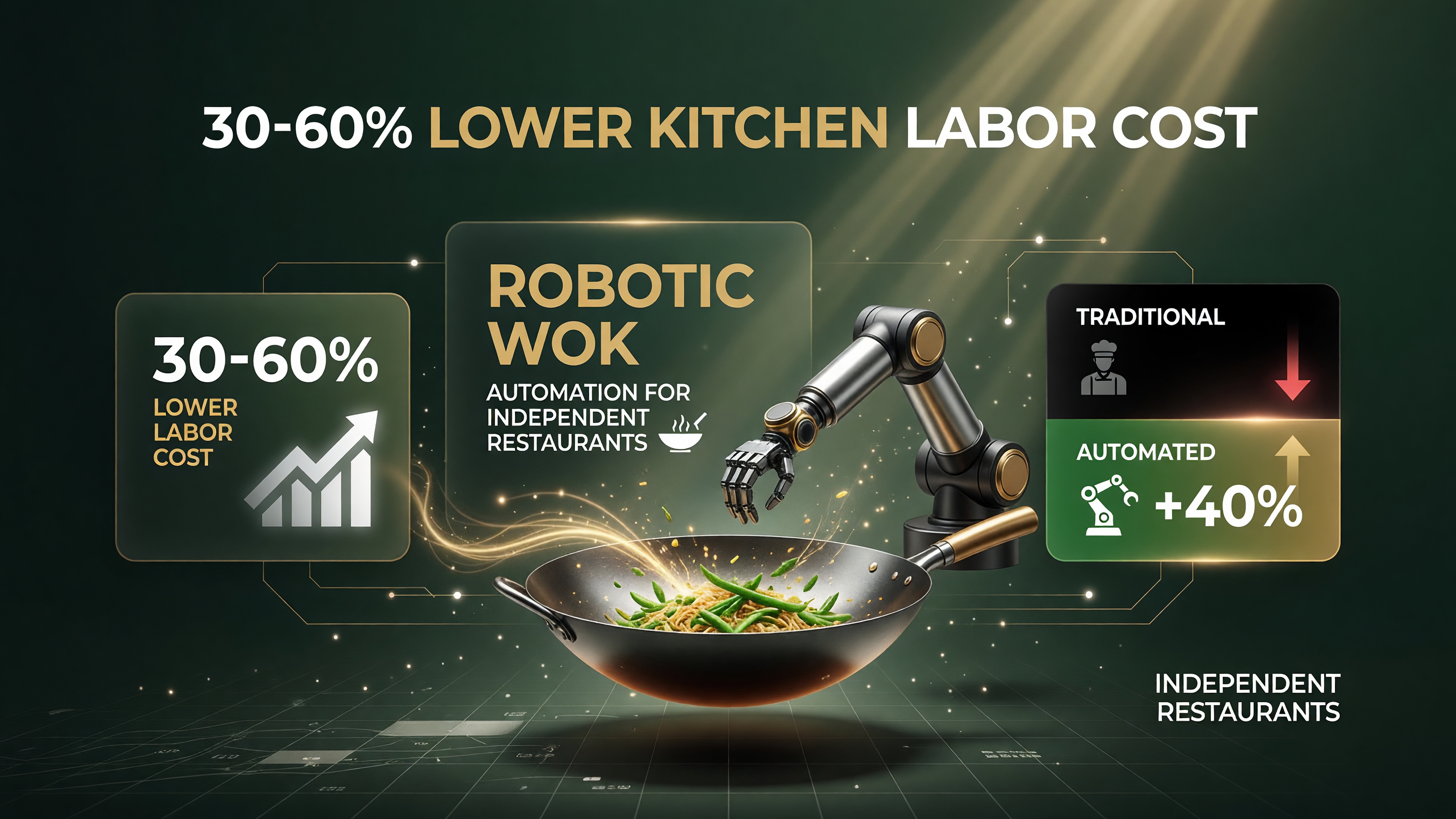
A Robby-class robotic wok uses infrared sensors and machine learning to control heat and seasoning — turning the hardest-to-staff station into a consistent, replicable output.
The Labor Math That Makes It Work
The financial case for a robotic wok comes down to a simple trade: upfront machine cost against recurring labor and waste savings. Deployment reports point to 30-60% cuts in total kitchen labor costs and roughly 10% less food and seasoning waste, driven by standardized output and reduced reliance on skilled, hard-to-hire staff.
The real-world proof is concrete. In Philadelphia, the concept InstaFoodz runs Robby robot woks, and owner Kenny Poon reports that the machine let him stop relying on a highly paid “main chef.” His staffing model shifted from hunting for skilled cooks to prioritizing availability, which made hiring dramatically easier and removed the wage premium and training burden that expert stir-fry cooks carry. The machine doesn’t replace the team — it replaces the single most expensive, least reliable role in the kitchen.
| Factor | Traditional Wok Line | Robotic Wok |
|---|---|---|
| Labor cost | Skilled cook at a wage premium | Machine + lower-skilled labor to prep |
| Consistency | Varies by cook, shift, and mood | Identical recipe output every time |
| Food waste | Portion drift, seasoning overage | Precise dispensing, ~10% less waste |
| Hiring | Hard to find skilled wok cooks | Easier hiring; availability over expertise |
| Payback | N/A — recurring labor cost | ~2-5 years, faster at higher local wages |
Payback is where the decision gets practical. Cost analyses put robotic wok payback at roughly 3 years when a location’s fully loaded labor cost sits near $18 per hour, and closer to 2 years in high-cost labor markets like California or New York where wages run near $22 per hour. A cooking robot typically offsets the equivalent of 1-2 human shifts per month. That math is far more accessible to an independent owner than the old assumption that kitchen robotics required chain-level capital and a six-figure budget.
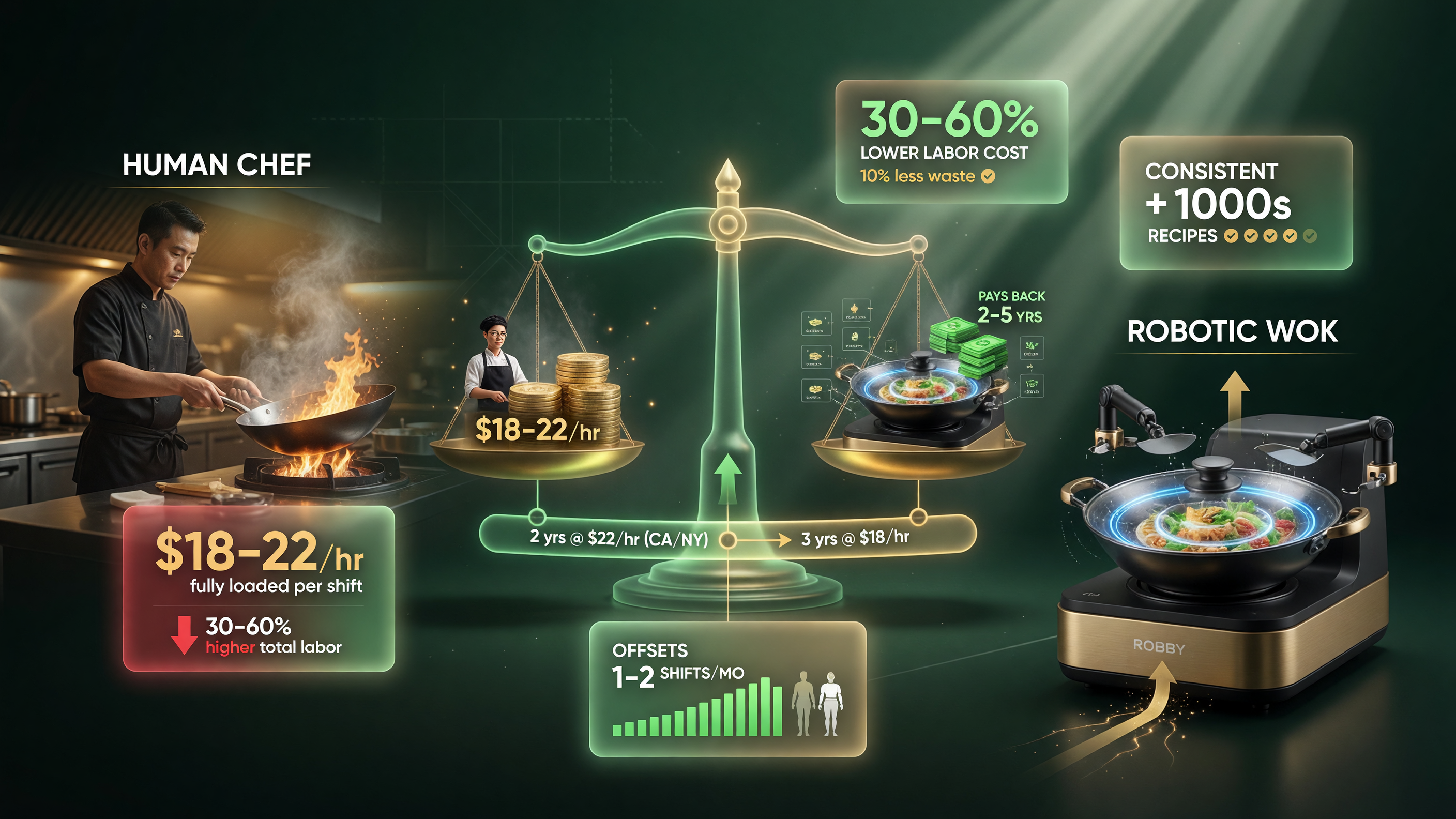
Deployment data points to 30-60% lower kitchen labor costs when a robotic wok replaces a skilled wok-chef station — the single biggest lever for independent operators.
Who’s Actually Running Them
This isn’t confined to Silicon Valley test kitchens. Real deployments are expanding across the country, especially in Asian fast-casual segments where wok cooking is central to the menu. Tigawok runs multiple Los Angeles locations using centralized prep combined with on-site robot woks. iWok has been planning expansion into Houston in 2026. NPR’s Planet Money even visited a Robby-equipped kitchen in March 2026 to check whether the machine can actually cook — and the conclusion was that it can, consistently, while cutting labor.
The pattern across all these deployments is the same: robotic woks fit high-volume, standardized menus best. If your kitchen serves a large number of the same dishes in a repeatable way — the model behind fast-casual and delivery-heavy concepts — the machine shines. If your menu is built on bespoke, chef-driven improvisation, a robotic wok is a poor fit, and you shouldn’t force it. The technology is not a universal hammer; it’s a precise tool for a specific kind of operation.
The Honest Limits for Independent Owners
It would be misleading to present robotic woks as a low-risk, no-brainer for every independent restaurant. There are real barriers, and knowing them up front is what separates a smart operator from someone who buys a half-million-dollar machine that sits idle behind the counter.
First, the initial investment is still significant, and full kitchen automation remains more common among chains and multi-unit operators than single independents. Second, integration matters — the machine has to fit your line, your prep workflow, and your delivery or dine-in rhythm, which takes planning, not just a purchase order. Third, a robotic wok complements rather than fully replaces staff. You still need people for prep, service, and oversight. The machine doesn’t run the restaurant; it quietly automates the one station where it pays off most.
The realistic read for an independent owner is selective adoption. You don’t have to automate your entire kitchen to capture the benefit. Target the single highest-volume, most standardized, most labor-intensive dish category on your menu — the one where a skilled cook is hardest to keep and consistency matters most — and run a robotic wok against exactly that. Measure the labor and waste savings over 90 days. If the numbers move for you, scale; if they don’t, the machine doesn’t earn its place.
What to Do This Quarter
If the robotic wok story resonates with your operation, here’s a disciplined path to evaluating it without gambling on a headline:
1. Find the Repeatable High-Labor Station
Open your P&L and your menu engineering. Identify the dish category that is high volume, standardized, and expensive to staff — usually wok-cooked items, fried rice, or stir-fry. If that category exists in meaningful volume, you have a candidate for automation.
2. Run the Payback Math on Your Local Wages
Use your actual fully loaded hourly cost, not a national average. The difference between $18 and $22 per hour is the difference between a 3-year and a 2-year payback. Model it with your real volume and your real labor line before you contact a single vendor.
3. Lease or Pilot First
Don’t buy a machine blind. Many robotics providers offer lease or pilot options. Run one robotic wok on your busiest station for 90 days, track labor hours and food cost before and after, and let your own numbers decide. The vendors are betting on the same math you are — make them prove it on your line.
The robotic wok is the clearest example yet of “invisible” kitchen automation: technology that changes your labor economics without changing the experience your guests see. It won’t replace your team, and it shouldn’t. But if you run a high-volume, standardized kitchen, it can quietly remove your single most expensive staffing problem — and that’s a competitive edge most of your neighbors haven’t adopted yet.
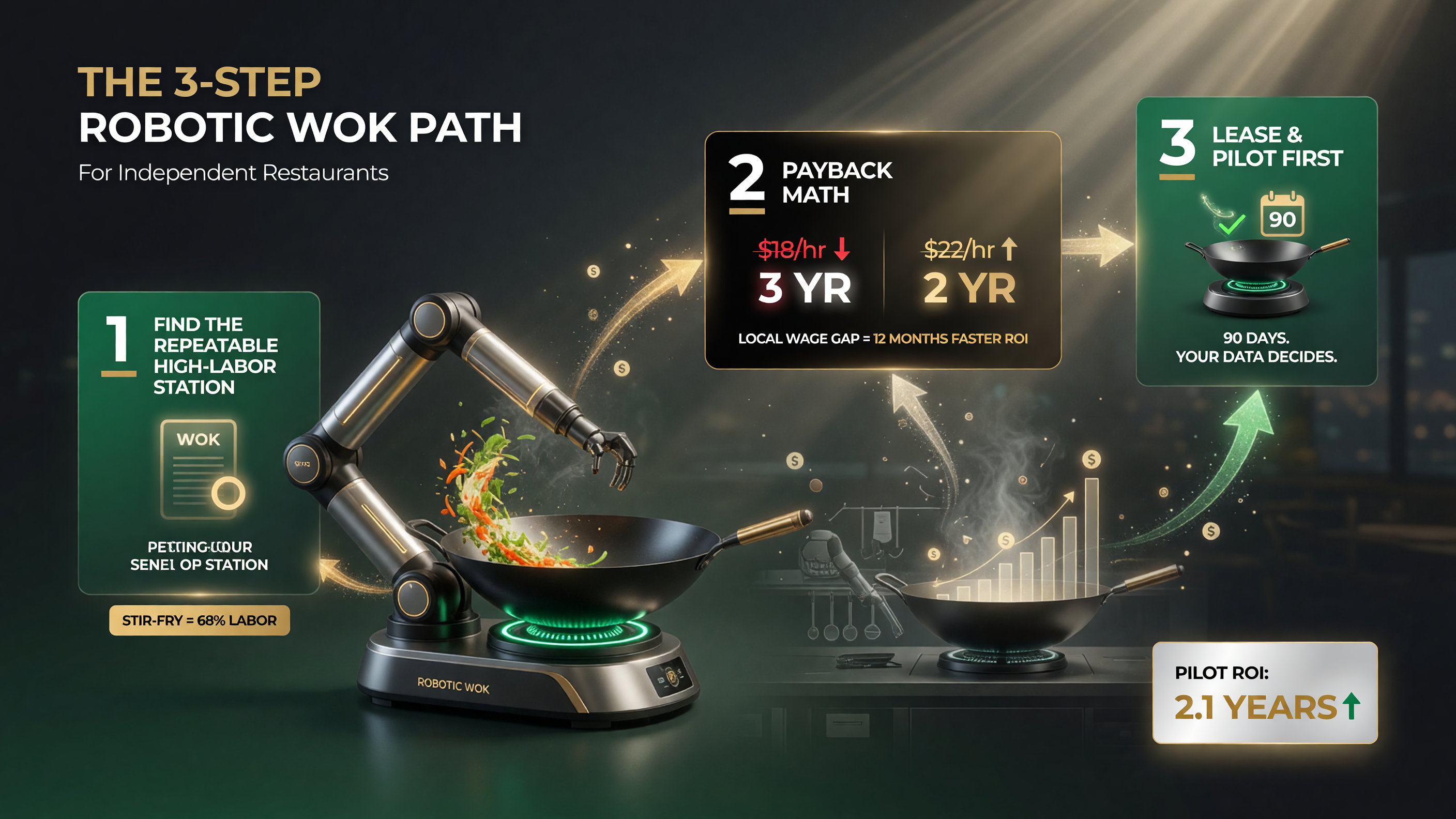
Start with one affordable piece: automate your single most expensive repeatable task, add the no-hardware AI layer, then let 90 days of your own kitchen data decide.
Frequently Asked Questions
What is a robotic wok and how does it work?
A robotic wok is a software-controlled cooking station that tosses ingredients over high heat using a spinning basket or rotating drum, dispenses precise sauce portions, and follows pre-programmed recipes. A human adds prepped ingredients and starts the cycle while the machine handles cooking, timing, and heat control.
How much can a robotic wok save on labor costs?
Deployment reports cite 30-60% cuts in total kitchen labor costs and roughly 10% less food and seasoning waste. In Philadelphia, InstaFoodz owner Kenny Poon used Next Robot’s Robby to eliminate the need for a dedicated main chef, making hiring easier and reducing wage premiums for skilled cooks.
How long does a robotic wok take to pay for itself?
Payback typically runs 2-5 years depending on local wages. It’s roughly 3 years at $18 per hour fully loaded labor cost, and about 2 years at $22 per hour in high-cost markets like California or New York. A cooking robot commonly offsets 1-2 human shifts per month.
Is a robotic wok right for an independent restaurant?
It fits high-volume, standardized menus best — like fast-casual and delivery-heavy concepts. If your menu is built on bespoke, chef-driven improvisation, it’s a poor fit. The smart approach is selective adoption targeting your single highest-volume, most labor-intensive dish category.
Does a robotic wok replace kitchen staff?
No. It complements staff rather than replacing them. You still need people for prep, service, and oversight. The machine automates the one station where labor is highest and consistency matters most — it doesn’t run the restaurant.

About Barak Schurr
Barak Schurr built and exited a major ticketing platform, ran global operations at Eventbrite, and now focuses on one question: which AI tools actually help independent restaurant owners run leaner and grow faster. He writes from the operator’s perspective — no vendor spin, no theory, just what’s real in 2026.
Email: [email protected]
More Resources for Restaurant Operators