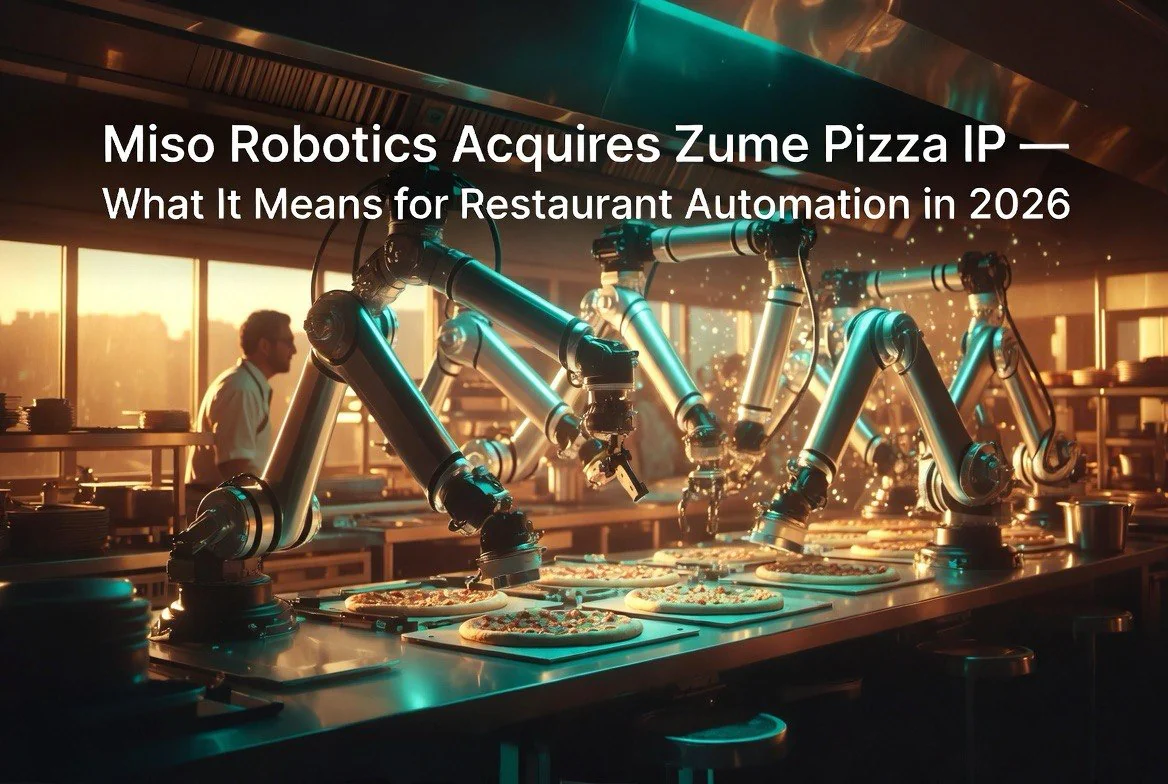
Miso Robotics Acquires Zume Pizza IP — What It Means for Restaurant Automation in 2026
⚡ Expert Summary: Miso Robotics — the company behind Flippy, the AI-powered fry station — has acquired the intellectual property assets of Zume Pizza, the once-hyped food tech startup that raised nearly $500 million and shut down in 2023. The acquisition gives Miso a substantial patent portfolio covering pizza-making robotics, packaging automation, and autonomous kitchen workflows. For US restaurant operators, this means Miso can now accelerate its move beyond fry stations into full kitchen automation.
The Deal: What Miso Robotics Bought and Why It Matters
Miso Robotics has been deploying Flippy — its AI-powered robotic fry station — since 2019. The robot uses computer vision and machine learning to monitor fry baskets, adjust cooking times, and alert human staff when baskets need to shake or pull. It’s a single-station solution that solves one of the highest-turnover positions in any US commercial kitchen.
But the company has always been clear that Flippy was step one, not the destination. The Zume acquisition gives Miso the patent firepower to build step two.
Miso Robotics announced in June 2026 that it had acquired Zume Pizza’s intellectual property assets, including patents, proprietary technology, and design rights.[1] Financial terms were not disclosed.
Zume was one of the most hyped food tech startups of the 2010s. Founded in 2015, it raised $445 million from SoftBank and others on the promise of fully automated pizza-making robots that could cook and deliver pizzas from trucks. The company burned through its funding, pivoted multiple times, and eventually shut down in 2023 when it ran out of capital.
But Zume’s technology was real. The company filed patents covering:
- Pizza assembly robotics: Automated dough pressing, sauce application, topping placement, and oven loading
- Packaging automation: Containers designed to vent steam during cooking to maintain crust quality
- Kitchen workflow software: Systems for coordinating robotic and human labour in commercial kitchens
- Autonomous preparation: Methods for machines to adjust cooking time based on real-time ingredient sensors
For Miso, these patents fill critical gaps. The company’s flagship product, Flippy, is a robotic fry station that handles one of the most dangerous and unpleasant jobs in a commercial kitchen: standing over a deep fryer. Flippy has been deployed in over 200 US locations, including chains like CaliBurger, White Castle, and quick-service stadium partners.
With Zume’s IP, Miso can now extend its automation capabilities beyond frying into the full back-of-house cooking line.
Why This Matters for US Independent Restaurant Operators
For the independent operator running a kitchen with 8-15 employees in cities like Austin, Denver, or Portland, the automation calculus is shifting every quarter.
The Miso-Zume acquisition matters most for operators who are watching automation cost curves. The restaurant industry in the United States is facing a structural labour shortage. According to the National Restaurant Association, 82% of restaurant operators said recruiting and retaining employees is their top challenge in 2026.[2]
Labour costs now represent 28-35% of revenue for the average independent restaurant. In major US metros like New York, Chicago, and Los Angeles, minimum wage increases scheduled for 2026-2027 will push back-of-house labour costs even higher.
Robotics that replace or augment kitchen labour — especially for the high-turnover positions like fry station, pizza station, and grill — are moving from “nice to have” to “survival tool” for operators who want to maintain margins.
Miso’s acquisition of Zume’s IP specifically unlocks pizza kitchen automation, which is one of the highest-margin categories in US restaurants. A pizza station requires consistent dough handling, sauce application, topping placement, and timing. These are repetitive, measurable tasks that robots handle better than humans. Zume’s patent portfolio covers exactly those workflows.
From Fry Station to the Full Kitchen: Miso’s Roadmap
Miso Robotics has stated clearly that Flippy was phase one. The Zume IP acquisition represents phase two. The question is what phase two looks like for the operator doing $1.5 million a year in revenue who can’t afford a full robotics overhaul.
Miso Robotics has been clear that Flippy was phase one. The Zume IP acquisition represents phase two.
The company’s CEO told Nation’s Restaurant News that the acquisition “accelerates our timeline to bring multi-station kitchen automation to the market by 18-24 months.”[3]
What that means in practical terms:
Near-term (2026-2027): Miso integrates Zume’s pizza-making patents into a new automated pizza station. Target customers: quick-service pizza chains, stadium food service operators, and university dining halls.
Medium-term (2027-2028): A modular kitchen automation platform where independent operators can choose which stations to automate — fry, pizza, grill, or prep. Stations share a common software and hardware backbone, reducing per-station cost.
Long-term (2028+): Full back-of-house automation where a single AI system coordinates multiple robotic stations alongside human workers, optimising throughput based on real-time order volume.
This roadmap is relevant for independent operators because it signals that the cost of entry-level kitchen automation is coming down. Miso’s strategy is not to sell a single expensive robot — it’s to sell a platform that operators can adopt progressively.
What Zume’s Failure Teaches Us About Restaurant Tech
Zume raised nearly half a billion dollars and failed. Miso Robotics bought its IP for an undisclosed sum — likely a fraction of what Zume spent developing it.
The lesson for US restaurant operators evaluating automation: technology viability and business viability are different things.
Zume had world-class robotics engineering. The company’s pizza assembly line worked. Its packaging was innovative. Its kitchen software was genuinely advanced. But Zume tried to become a restaurant chain that delivered pizza from automated trucks — an incredibly capital-intensive business model with thin margins.
Miso, by contrast, stuck with a B2B model: sell automation tools to existing restaurants. Lower margins per unit, but much higher total addressable market and lower capital requirements.
The Zume IP acquisition validates that approach. The technology worked. The business model didn’t. Miso gets the technology without the baggage.
Competitive Landscape: Miso vs Picnic vs Others
The kitchen robotics market in the United States has seen significant consolidation in 2026. Miso is now the clear leader in deployed units, but the competitive field tells a broader story about where the industry is headed.
Miso’s main competitor in kitchen robotics has been Picnic, which raised over $80 million for its pizza-making robot before shutting down in May 2026.[4] Picnic’s system automated sauce and topping application for pizza and could handle up to 100 pizzas per hour.
With Picnic’s closure and Miso’s acquisition of Zume’s IP, Miso now controls the dominant patent position in pizza-making robotics for US commercial kitchens.
Other players in the restaurant robotics space include:
- Bear Robotics: Server robots that bus tables and deliver food to tables (not kitchen automation)
- Kiwibot / Starship: Delivery robots (not kitchen)
- RoboEatz: Modular automated cooking stations (earlier stage)
- Moley Robotics: Full robotic kitchen arms (commercial price point still too high for most independent operators)
Miso’s position — having a deployed product (Flippy), a patent portfolio (Zume), and a path to modular kitchen automation — makes it the most credible player in US kitchen robotics as of mid-2026.
The National Restaurant Association Data Supports the Shift
The National Restaurant Association’s 2026 State of the Industry report found that 82% of operators cite recruiting and retention as their top challenge.[2] This isn’t a cyclical labour issue — it’s structural. The US restaurant workforce has shrunk by roughly 500,000 workers since 2020 and has not recovered to pre-pandemic levels, even as restaurant sales have grown.
For the operator looking at these numbers, the takeaway is not that robots are coming. It’s that labour is not coming back. The choice is between automation and permanently higher labour costs.
Miso’s Flippy has already demonstrated the model at scale. The Zume IP acquisition signals that the company believes the market is ready for the next step — automated pizza stations, then modular multi-station kitchens.
What Independent Operators Should Watch
For independent US restaurant operators, the Miso-Zume deal signals several actionable trends:
Watch for Miso’s pizza station pricing. Flippy costs approximately $3,000/month as a subscription service. If Miso can price a pizza station at a similar price point, it becomes viable for any independent doing $8,000+ a week in pizza sales.
Expect faster timeline on multi-station systems. Miso’s CEO said the acquisition advances the roadmap by 18-24 months. If that holds, modular kitchen automation will be available to smaller operators by 2028 instead of 2030.
Consider labour cost projections. With minimum wage increases locked in across most major US metros, the breakeven on kitchen robotics gets better every year. An operator who was on the fence about Flippy two years ago may find the economics make sense today.
Zume’s IP going to Miso means you won’t see a startup selling automated pizza stations for at least 2-3 years. The patent position makes it difficult for new entrants. Miso controls the pizza kitchen automation wedge.
The Bottom Line
Miso Robotics buying Zume Pizza’s intellectual property is significant because it consolidates kitchen automation patents into a company with a working business model, deployed hardware, and a clear roadmap. For the US independent operator, that means kitchen robotics are accelerating toward the practical, accessible, modular future the industry has been promised for years.
The race to automate the US restaurant kitchen is no longer about proving the technology works. It’s about affordability and deployment. Miso just moved the timeline on both.
Frequently Asked Questions
What did Miso Robotics acquire from Zume?
Miso acquired Zume Pizza’s intellectual property assets, including patents covering pizza-making robotics, packaging automation, kitchen workflow software, and autonomous food preparation systems. Financial terms were not disclosed.
Is Zume still in business?
No. Zume Pizza shut down in 2023 after raising nearly $500 million from SoftBank and others. The company’s IP assets were sold to Miso Robotics in June 2026.
Will this affect the cost of Flippy?
Miso has not announced any pricing changes for Flippy. The acquisition allows Miso to develop new products (starting with an automated pizza station) rather than changing pricing on existing ones.
How much does Miso’s kitchen automation cost?
Flippy, Miso’s flagship robotic fry station, costs approximately $3,000/month as a subscription, including maintenance and software updates. Pricing for future pizza station products has not been announced.
When will independent restaurants have access to full kitchen automation?
Miso’s CEO stated the Zume IP acquisition accelerates the roadmap by 18-24 months. Modular multi-station automation could be available to smaller operators by 2028.

About Barak Schurr
Barak Schurr built and exited a major ticketing platform, ran global operations at Eventbrite, and now focuses on one question: which AI tools actually help independent restaurant owners run leaner and grow faster. He writes from the operator’s perspective — no vendor spin, no theory, just what’s real in 2026.
Email: [email protected]
More on AI Restaurant Labor Management
This post is part of our comprehensive AI Restaurant Scheduling & Labor Management Guide. Check the full guide for AI scheduling tools, no-show prediction, automated hiring, and automation strategies for independent restaurants.
More AI Resources