SpotOn Launches Profit AI — Proactive Profit Recommendations for Independent Restaurants
Another restaurant technology company just made a move that tells you everything about where the industry is headed. SpotOn, one of the largest POS providers for independent restaurants, launched Profit AI in early June 2026 — a tool that does not just show you your numbers but tells you exactly what to do about them.
What Profit AI Actually Does
Most restaurant operators know their top-line revenue. Most know their approximate food cost. Far fewer know which specific menu items are dragging down margin, which shifts have the worst labor efficiency, or which suppliers have quietly raised prices on items that have been auto-ordered for six months.
Profit AI connects to SpotOn’s POS data and accounting integrations with QuickBooks Online, Restaurant365, and Xero to analyze what is happening across every cost center. Instead of a static dashboard, the AI generates specific, prioritized recommendations — “Your Thursday dinner labor cost exceeded the target by 14 percent for the last four weeks. Reducing one line cook shift on Thursdays saves $1,200 per month without impacting service times based on covers.” Not a vague “optimize your labor.” A specific number, a specific action, and a specific outcome.
The Breakfast Brothers, an independent multi-location restaurant in Texas that was among the first to test Profit AI, reported identifying $2,000 in monthly savings within the first 30 days. Butcher Paper BBQ, another early user, cut cost of goods sold by 9 percent using the AI’s inventory recommendations.
Why This Matters for Independent Operators
The restaurant industry has a long history of dashboards. Tools that show you charts, graphs, and reports but leave the hard work of interpretation to the operator. Profit AI represents a shift from “here is your data” to “here is what to do with your data.”
For an independent operator working 60-hour weeks, the difference is the difference between knowing you have a problem and knowing exactly how to fix it. A dashboard tells you your food cost is 34 percent. An experienced operator looks at that and starts hunting through invoices, recipe costs, and waste logs. Profit AI analyzes everything in the background, identifies that a specific protein cost went up 18 percent from a particular supplier, calculates that swapping to a comparable alternative saves 4.2 percent on that category, and presents the recommendation with projected impact.
The open beta testing period is designed for independent operators specifically. SpotOn is actively recruiting a diverse mix of restaurant types and revenue ranges to train the AI across more scenarios before general release. Operators in the beta get early access to the features that will eventually be standard.
Real Numbers: What Early Adopters Are Reporting
The case studies SpotOn has published alongside the Profit AI announcement provide specific numbers that independent operators can benchmark against.
Kalei Kitchenette, a single-location independent restaurant in the Pacific Northwest, reported saving $2,000 per month and lowering costs by 3 percent month-over-month after implementing Profit Assist, which feeds into Profit AI. The savings came from ingredient cost optimization and labor scheduling adjustments that the AI identified within the first two weeks of analysis.
Butcher Paper BBQ, a multi-location barbecue concept, reduced cost of goods sold by 9 percent across all locations. The key insight from the AI was that inconsistent portion sizing across different locations was driving food cost variance. The same recipe had different effective costs depending on which location was preparing it. Standardizing portions generated the bulk of the savings.
Talat Market, a fine-casual independent restaurant, used Profit Assist to identify P&L anomalies that manual review had missed for months. A supplier had gradually increased prices on six staple ingredients over three months, with each increase small enough to avoid notice in weekly reviews. The AI detected the cumulative 22 percent increase and recommended alternative sourcing.
These are not enterprise chains with dedicated finance teams. These are independent operations with the same constraints every single-location or small-group restaurant faces. The savings come from the AI spotting patterns that humans miss operating at the pace restaurants require. Across the three early adopters cited by SpotOn, the average monthly savings identified by Profit AI was $4,300 per location — against a tool cost that SpotOn has not yet announced but that industry analysts expect to be in the $49-99 per month range as an add-on to the existing SpotOn subscription.
How Profit AI Compares to Other Restaurant AI Tools
Profit AI is not the first AI tool for restaurant profitability, but its approach differs from the competition.
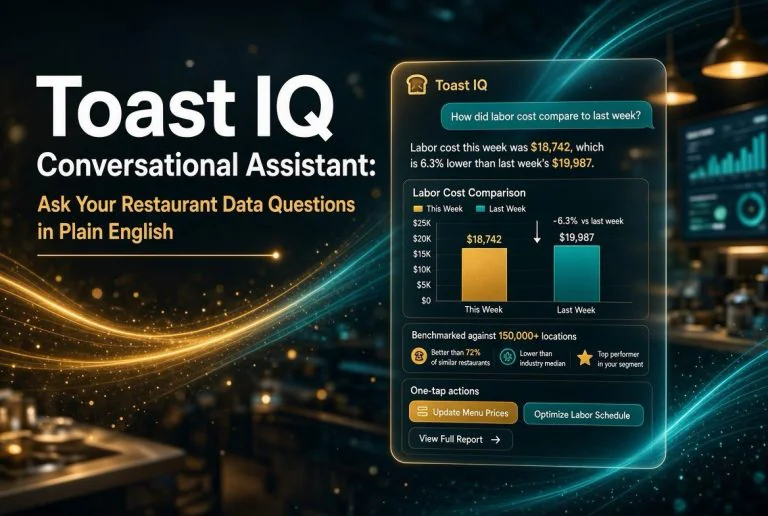
Toast IQ focuses on operational efficiency — answering questions about your data conversationally, predicting sales, and identifying trends. It is strong for day-to-day operations but does not generate specific profit recommendations automatically.
Restaurant365’s AI tools focus on back-office financial management — AP automation, invoice processing, and financial reporting. Its strength is in the accounting workflow, not operational profitability.
allO, which recently raised $14 million for its AI voice agents, is building an AI-native operating system that handles front-of-house operations like phone calls and reservations. Its roadmap includes back-office agents, but those are 12 to 18 months away.
SpotOn Profit AI sits in the middle — it pulls from both operational and financial data to make profit recommendations that cross the line between front-of-house and back-office. That positioning is strategically smart because the biggest profit leaks for independent restaurants often happen at the intersection of operations and finance.
The 2026 NRA Show featured panels where restaurant tech executives warned operators not to over-rely on AI tools and to be skeptical of vendors selling dashboards as AI. Profit AI appears to have absorbed that feedback — the tool is less about showing data and more about recommending actions. The shift from passive dashboards to active recommendations represents the most significant evolution in restaurant POS technology since the transition from on-premise terminals to cloud-based systems, and Profit AI is the first product to fully execute on that vision for the independent operator segment.
What Operators Should Do Before the Beta Ends
Profit AI is in open beta through at least Q3 2026, with general availability expected before year-end. For independent operators considering the tool, the window to get early access and influence the product is open now.
Applying for the beta is straightforward through the SpotOn dashboard. Operators accepted receive full access to Profit AI features, dedicated support for setup and interpretation, and the ability to suggest feature additions.
The practical recommendation is to start with data hygiene. Make sure your POS categories are accurate, your cost of goods sold entries are current, and your labor schedules reflect actual shifts rather than idealized coverage. The cleaner the data going in, the more specific and actionable the recommendations coming out.
Operators who take time to clean up their data before the beta also benefit from a more accurate baseline. Profit AI measures improvement against your starting point. A clean baseline means the recommendations and the measured impact are both more reliable.
The timeline matters. Operators who join the beta in June or July 2026 will have three to five months of AI-powered analysis before general availability pricing kicks in. That is enough time to identify significant savings, implement changes, and build the case for keeping the tool.
Implementation: What Independent Operators Should Know
Profit AI builds on SpotOn’s existing Profit Assist tool, which launched earlier in 2026 as an AI-powered P&L analysis system. Operators already using Profit Assist will find Profit AI adds the recommendation layer on top of the insights they already see.
The setup requires three things: an active SpotOn POS subscription, connection to your accounting software, and at least 90 days of transaction history for the AI to analyze. Operators with less than 90 days of data can still use the system but will receive more limited recommendations.
The recommendations come in the SpotOn dashboard grouped by category — food cost, labor, prime cost, and overhead. Each shows projected monthly savings, implementation difficulty, and a link to more detail.
The most practical approach is to start the open beta application and run the tool in observation mode for two weeks. The AI surfaces its recommendations but does not implement anything automatically.
What This Means for the Restaurant Tech Landscape
The launch of Profit AI signals that SpotOn is betting on proactive AI recommendations as a core differentiator. That reflects a broader shift in how restaurant technology companies position themselves in 2026.
Toast grew to 171,000 locations by building the deepest restaurant-specific POS platform, adding AI features like Toast IQ on top of an already strong foundation. Square competes on simplicity and price. SpotOn is competing on intelligence — using AI to deliver proactive insights the other platforms do not provide.
For independent operators, this competition is a good thing. Three major POS providers fighting for your business means better features, lower prices, and more attention to independent operators rather than enterprise chains. Profit AI would not exist if SpotOn did not need to differentiate from Toast.
The next 12 months will tell whether proactive AI recommendations become standard across all major POS platforms or remain a SpotOn differentiator. Either outcome benefits the operator. If every platform adds it, AI profit tools become table stakes. If only SpotOn has it, operators on that platform gain a measurable advantage.
Frequently Asked Questions
How do I choose the right AI tool for my restaurant?
Start by identifying your biggest operational pain point — labor scheduling, inventory waste, review management, or customer retention. Most AI platforms offer free trials, so test two or three tools against your specific workflow before committing.
Do small restaurants need AI tools?
Yes. Independent restaurants operate on thinner margins and have fewer staff than chains, which means AI tools deliver a higher relative ROI by automating tasks that would otherwise fall on an overworked owner or manager. Many tools start under 00 per month.
How long does it take to implement AI in a restaurant?
Most AI tools for restaurants can be set up in under an hour with no technical expertise required. Integration with existing POS and reservation systems typically takes an additional 30 minutes. Full adoption by staff usually happens within two weeks.
Is AI secure for restaurant customer data?
Reputable AI restaurant platforms comply with PCI DSS for payment data and SOC 2 for operational data. Always verify a tool’s security certifications before integrating with your POS or reservation system. Most major platforms publish their compliance documentation publicly.
Will AI tools replace restaurant managers?
No. AI handles data analysis, scheduling optimization, and routine customer responses — tasks that currently consume 30-40% of a manager’s time. This frees managers to focus on team development, food quality, and guest experience, which AI cannot replicate.
More AI Resources