Get the AI Restaurant Quick-Start Guide — Free
The 5 AI tools independent US restaurant owners are using right now to cut labor costs and answer every call.
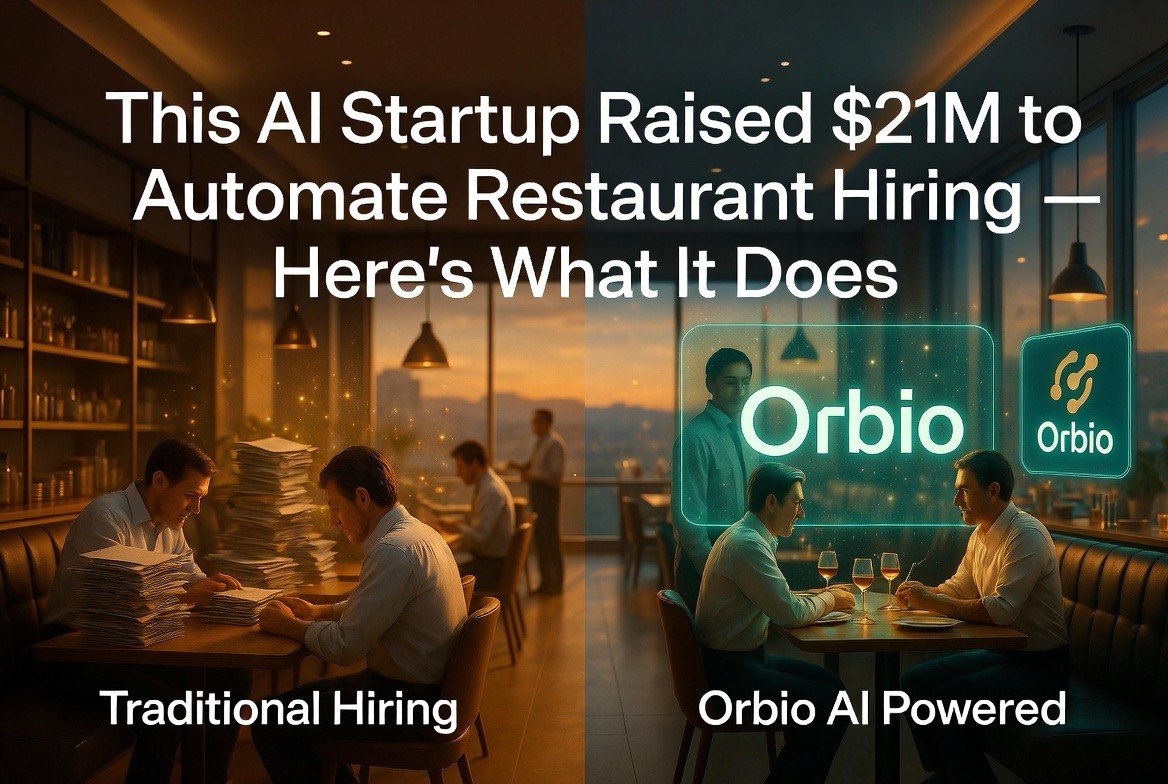
This AI Startup Raised $21M to Automate Restaurant Hiring — Here’s What It Does
⚡ Expert Summary: Orbio raised a $21M Series A to automate hiring and onboarding for frontline workers — the kind of employees every independent restaurant struggles to recruit and retain. The platform uses AI agents to screen candidates, schedule interviews, handle onboarding paperwork, and manage compliance. For restaurant owners losing $1,500-$3,000 per hourly hire to turnover, a tool that cuts hiring time by weeks is not a luxury — it’s an operational necessity.
Every restaurant owner knows the hiring cycle. Post a job. Get 50 applications from people who don’t show up to the interview. Hire someone who quits in two weeks. Repeat.
The math is brutal. The National Restaurant Association estimates the average independent operator loses $1,500 to $3,000 per hourly employee when you factor in recruiting costs, training time, lost productivity, and overtime coverage. With industry turnover running above 70% annually, a restaurant with 30 employees is spending $30,000-$60,000 a year just to keep its shifts covered.
Orbio is building a different system. The Barcelona-based startup, founded by ex-Amazon exec Sergi Bastardas alongside Nacho Travesí and Antonio Melé, just announced a $21 million Series A led by Dawn Capital. The platform uses AI agents to automate the entire frontline hiring workflow — from screening candidates to scheduling interviews to handling onboarding paperwork.
The restaurant industry has always had a hiring problem. What changed is that AI now has a solution that actually works on the floor — not a theoretical fix from a vendor who’s never run a busy Friday night service.
The average independent restaurant in the United States posts 8-12 job openings per year just to maintain a steady workforce. Each opening generates 30-80 applications. Of those, maybe 15-20 are qualified. Five to eight show up for an interview. One or two accept the job and actually start their first shift. Somewhere between 30 and 90 days later, you’re posting that same role again.
This is the cycle that Orbio’s founders experienced firsthand at Amazon, where Bastardas spent a decade managing frontline operations across fulfillment centers. The Amazon alumni understood something most hiring software vendors miss: frontline workers don’t apply to jobs the same way knowledge workers do. They apply on their phones, at night, between shifts, often from the parking lot of their current job. They don’t upload resumes. They don’t fill out multi-page application forms. They text, they call, they show up — and the system needs to meet them where they are.
For American restaurant owners who spend more time hiring than running their business, this matters.
What Orbio Actually Does
Orbio is not a job board. It’s not another applicant tracking system. It’s an AI agent platform that executes the hiring workflow — posting to multiple channels, screening applicants against your criteria, scheduling interviews, sending follow-ups, and managing the paperwork once you make a hire.
The founders built Orbio after watching frontline workers cycle through hiring systems designed for office roles. Restaurants, retail stores, and hospitality businesses hire differently than tech companies. They hire in volume. They hire fast. They hire people who often don’t have traditional resumes or work email addresses.
The Orbio platform targets three specific pain points:
- Screening at scale: AI agents review applications against your criteria — availability, experience, reliability signals — and rank candidates so you only interview people who are actually qualified and available for the shifts you need to fill.
- Interview scheduling automation: The system coordinates with candidates via SMS or WhatsApp (because frontline workers don’t always check email), finds mutual availability, and sends calendar invites. No more phone tag with 15 candidates for one line cook position.
- Onboarding and compliance: Once a candidate accepts, the platform handles I-9 verification, tax form collection, direct deposit setup, and policy acknowledgments. In the United States restaurant industry, where labor compliance varies by state and municipality, this alone can save hours per hire.
Why $21 Million for a Hiring Platform?
Because the frontline hiring market is enormous and underserved. There are roughly 5.6 million businesses in the United States with frontline workers — restaurants, retail stores, hotels, warehouses, healthcare facilities. Most of them are running hiring on spreadsheets, text messages, and the goodwill of a manager who stays late to process paperwork.
Dawn Capital, the lead investor, focuses on B2B software platforms that address structural labor market inefficiencies. Their thesis: AI agents that automate frontline hiring will become standard infrastructure, the way payroll processing became standard after ADP and Gusto proved the market.
The $21 million raise follows a seed round in early 2025, which means Orbio has been building and iterating for about 18 months. The Series A funding will go toward US market expansion — and if you’re an American restaurant owner, that’s the signal that matters. Orbio is coming to your market, and the investors backing it believe the demand is there.
How This Compares to What You’re Already Using
Most independent restaurants manage hiring through some combination of: posting on Indeed or Craigslist, collecting applications via email or paper forms, calling candidates to schedule interviews during off-peak hours, and processing I-9s and W-4s manually when someone finally shows up to work.
The typical cost per hire in this model is not just the 0 job posting fee. It’s the 8-12 hours of manager time spent screening, calling, scheduling, interviewing, and onboarding. At a manager’s effective hourly rate of 0-40, that’s 40-480 per hire in labor costs alone — before you account for the shifts you’re short-staffed during the hiring process.
Now multiply that across every hire you make in a year. For a restaurant with 30 employees and 70% annual turnover, you’re hiring 21 people. At 00 per hire in manager time, that’s ,300 a year just in internal labor costs — not counting job posting fees, overtime coverage for empty shifts, or the cost of a bad hire who costs you customers and team morale.
The National Restaurant Association’s 2026 report on labor costs found that independent operators spend an average of 22% of a manager’s time on recruiting and hiring activities. For a manager earning 5,000 a year, that’s over 2,000 in salary allocated to hiring. Most of that time goes to tasks an AI agent could handle: screening applications, scheduling interviews, sending follow-ups, processing paperwork.
Orbio’s approach replaces the manual workflow with AI agents that handle the repetitive parts. Your manager still interviews final candidates and makes the hiring decision. The AI handles everything before and after that decision — which is where 80% of the time goes.
The difference is not theoretical. Orbio’s European customers report an average of 60% reduction in time-to-hire and a 40% reduction in manager hours spent on recruitment admin. The company hasn’t released US-specific metrics yet, but the patterns are consistent across frontline industries.
Most independent restaurants manage hiring through some combination of: posting on Indeed or Craigslist, collecting applications via email or paper forms, calling candidates to schedule interviews during off-peak hours, and processing I-9s and W-4s manually when someone finally shows up to work.
The typical cost per hire in this model is not just the $50 job posting fee. It’s the 8-12 hours of manager time spent screening, calling, scheduling, interviewing, and onboarding. At a manager’s effective hourly rate of $30-40, that’s $240-480 per hire in labor costs alone — before you account for the shifts you’re short-staffed during the hiring process.
Orbio’s approach replaces the manual workflow with AI agents that handle the repetitive parts. Your manager still interviews final candidates and makes the hiring decision. The AI handles everything before and after that decision — which is where 80% of the time goes.
What This Means for Your Restaurant
Independent restaurant owners have been burned by tech too many times to get excited about another hiring platform. Every vendor promises to fix your turnover problem. None of them address the fundamental issue: hiring is slow, onboarding is paperwork-heavy, and managers would rather be on the floor than processing I-9s.
Orbio’s bet is that AI agents can collapse the hiring timeline — from 2-3 weeks to 3-5 days — by automating the low-value but high-time-cost parts of the process. If they’re right, the impact on independent operators is significant:
Consider a concrete example. Your line cook just gave notice. In the old system, you post the job, get 60 applications over the next week, spend 6 hours screening, schedule 10 phone screens (4 of which no-show), interview 5 candidates (2 no-show), make an offer, and start onboarding — a process that takes 18-21 days minimum. During those three weeks, the remaining cooks work overtime or you run with a shorter station, both of which hurt service quality and team morale.
With Orbio, the AI agents handle everything up to the final interview. Applications are screened automatically. Candidates who match your criteria receive an SMS interview invitation within hours, not days. Interview scheduling happens without phone tag. Paperwork is pre-filled and ready for digital signature. The timeline collapses to 5-7 days — and you’re short-staffed for one week instead of three.
- Fewer empty shifts: Faster hiring means shorter gaps between when someone quits and when their replacement starts. Every shift covered by a trained employee instead of overtime or a warm body is a better shift.
- Better candidate quality: AI screening filters out applicants who don’t actually match your requirements before they waste your interview time. The candidates you do meet are pre-verified against your criteria.
- Lower compliance risk: Automated I-9 and tax form processing reduces errors that can trigger fines or audits. For US restaurants, where the Department of Labor has stepped up enforcement in 2026, this is a real concern.
Independent restaurant owners have been burned by tech too many times to get excited about another hiring platform. Every vendor promises to fix your turnover problem. None of them address the fundamental issue: hiring is slow, onboarding is paperwork-heavy, and managers would rather be on the floor than processing I-9s.
Orbio’s bet is that AI agents can collapse the hiring timeline — from 2-3 weeks to 3-5 days — by automating the low-value but high-time-cost parts of the process. If they’re right, the impact on independent operators is significant:
- Fewer empty shifts: Faster hiring means shorter gaps between when someone quits and when their replacement starts. Every shift covered by a trained employee instead of overtime or a warm body is a better shift.
- Better candidate quality: AI screening filters out applicants who don’t actually match your requirements before they waste your interview time. The candidates you do meet are pre-verified against your criteria.
- Lower compliance risk: Automated I-9 and tax form processing reduces errors that can trigger fines or audits. For US restaurants, where the Department of Labor has stepped up enforcement in 2026, this is a real concern.
Frequently Asked Questions
How do I choose the right AI tool for my restaurant?
Start by identifying your biggest operational pain point — labor scheduling, inventory waste, review management, or customer retention. Most AI platforms offer free trials, so test two or three tools against your specific workflow before committing.
Do small restaurants need AI tools?
Yes. Independent restaurants operate on thinner margins and have fewer staff than chains, which means AI tools deliver a higher relative ROI by automating tasks that would otherwise fall on an overworked owner or manager. Many tools start under $100 per month.
How long does it take to implement AI in a restaurant?
Most AI tools for restaurants can be set up in under an hour with no technical expertise required. Integration with existing POS and reservation systems typically takes an additional 30 minutes. Full adoption by staff usually happens within two weeks.
Is AI secure for restaurant customer data?
Reputable AI restaurant platforms comply with PCI DSS for payment data and SOC 2 for operational data. Always verify a tool’s security certifications before integrating with your POS or reservation system. Most major platforms publish their compliance documentation publicly.
Will AI tools replace my restaurant staff?
No. AI handles data analysis, scheduling optimization, and routine customer responses — tasks that currently consume 30-40% of a manager’s time. This frees your team to focus on food quality, guest experience, and operational excellence, which AI cannot replicate.
More on AI Restaurant Labor Management
This post is part of our comprehensive AI Restaurant Scheduling & Labor Management Guide. Check the full guide for AI scheduling tools, no-show prediction, automated hiring, and automation strategies for independent restaurants.
More AI Resources