Get the AI Restaurant Quick-Start Guide — Free
The 5 AI tools independent US restaurant owners are using right now to cut labor costs and answer every call.
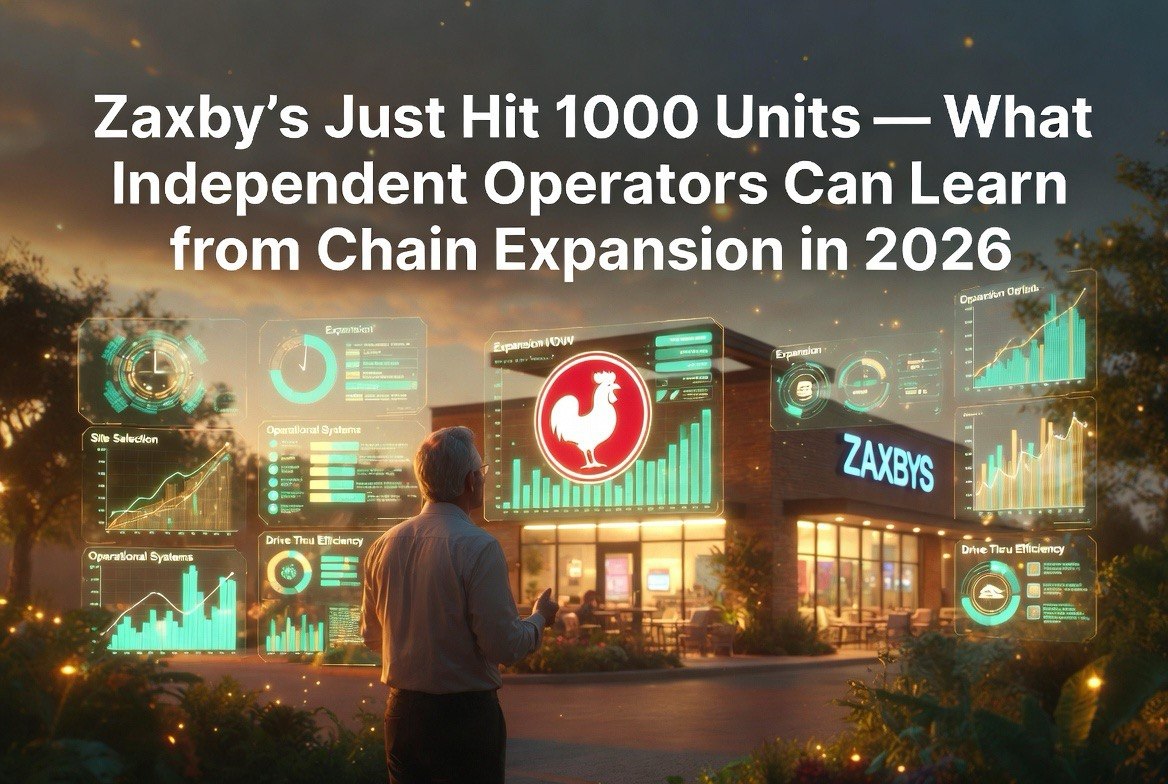
Zaxbys Just Hit 1,000 Units — What Independent Operators Can Learn from Chain Expansion in 2026
⚡ Expert Summary: Zaxbys passed 1,000 locations and hired Waffle House veteran Russell Holland as Chief Development Officer to fuel further growth. The chain’s success comes from a technology-first operations strategy — including AI-powered site selection, predictive labor scheduling, and automated kitchen systems. For independent operators, the lesson is not about how Zaxbys grew — it is about the AI-driven infrastructure that makes that growth profitable.
Zaxbys crossed 1,000 locations in June 2026, joining an exclusive club of chain restaurants that have scaled past that milestone. To sustain the growth, the chain hired Waffle House veteran Russell Holland as Chief Development Officer — a signal that the American fast-casual chain is not done expanding. For independent operators across the United States, Zaxbys’ growth strategy offers a blueprint for scaling using AI.
But the real story is not about unit count or executive hires. It is about the technology infrastructure underneath the growth — specifically, how Zaxbys uses AI to make expansion decisions that most independent operators still make by gut feeling.
Here is what Zaxbys does differently, and what independent operators can steal.
AI-Powered Site Selection Is the Real Growth Engine
When Zaxbys opens a new location, it is not based on a regional manager driving around and spotting empty retail space. The chain uses predictive analytics and AI-powered site selection models that process demographic data, traffic patterns, competitor density, and spending behavior to identify the optimal location for a new store.
This technology, developed by companies like PitchBook Location Intelligence and ESP Properties, has become standard among major chains. Zaxbys’ parent company, ZGL, runs these models before every new location decision. The result: higher first-year survival rates and faster path to profitability.
The models work by ingesting hundreds of variables. Median household income within a 3-mile radius, average traffic counts on the nearest major road, the presence of competing chicken concepts within 5 miles, the demographic shift of the neighborhood over the last 3 years, and even the average age of homes in the area — all processed through a machine learning model that scores each potential site on predicted revenue within a confidence interval.
For an independent operator opening a second or third location, the same tools are available at a fraction of what they cost five years ago. AI-driven site selection services cost $200-500 per analysis — cheap compared to the $300,000-500,000 cost of a failed restaurant launch.
Prado, a restaurant intelligence platform, offers AI-powered location scoring based on over 200 variables — traffic counts, income brackets, competitor saturation, and even social media sentiment in the target area. A single-location operator expanding to a second store can run the analysis in under an hour.
Zaxbys uses this to scale profitably. Independent operators can use the same technology to avoid the single biggest mistake in restaurant expansion: opening in a location that looks good but does not have the traffic or spending patterns to support the concept.
According to the National Restaurant Association’s 2026 State of the Industry report, 60% of new restaurants fail within the first year. The primary cause is not food quality, service, or concept — it is location. AI-powered site selection is the single most effective tool an operator can use to beat those odds.
When Zaxbys opens a new location, it is not based on a regional manager driving around and spotting empty retail space. The chain uses predictive analytics and AI-powered site selection models that process demographic data, traffic patterns, competitor density, and spending behavior to identify the optimal location for a new store.
This technology, developed by companies like PitchBook Location Intelligence and ESP Properties, has become standard among major chains. Zaxbys’ parent company, ZGL, runs these models before every new location decision. The result: higher first-year survival rates and faster path to profitability.
For an independent operator opening a second or third location, the same tools are available at a fraction of what they cost five years ago. AI-driven site selection services cost $200-500 per analysis — cheap compared to the $300,000-500,000 cost of a failed restaurant launch.
Prado, a restaurant intelligence platform, offers AI-powered location scoring based on over 200 variables — traffic counts, income brackets, competitor saturation, and even social media sentiment in the target area. A single-location operator expanding to a second store can run the analysis in under an hour.
Zaxbys uses this to scale. You can use it to survive.
Predictive Labor Scheduling: The Hidden Margin Killer
Labor is the single largest controllable cost in a restaurant. Zaxbys uses AI-driven predictive scheduling to forecast exactly how many staff it needs on any given shift based on historical sales data, weather patterns, local events, and seasonality.
The Intouch Insight 2025 Drive-Thru Study found that restaurants using AI-driven scheduling reduced labor costs by 8-12% while maintaining or improving service times. For a restaurant doing $15,000 in weekly sales, that is $12,000-18,000 in annual savings — enough to fund the entire technology stack for the restaurant and still have money left over.
Independent operators can access the same technology through platforms like 7shifts ($50-150/month), Push Operations, or Schedulefly. These tools analyze 12-24 months of historical data to predict traffic patterns, then generate optimized schedules that minimize overtime and overstaffing.
The difference between Zaxbys and an independent operator is not access to the technology — it is that Zaxbys has the data infrastructure to use it at scale. An independent with a single location can implement the same system in a weekend. The platforms integrate directly with Toast, Square, and Clover POS systems. The onboarding process takes about two hours.
The real benefit of AI scheduling goes beyond labor cost reduction. Better schedules mean happier employees. Happier employees mean lower turnover. Lower turnover means fewer training hours, fewer understaffed shifts, and better customer experience. The NRA’s 2026 turnover report found that restaurants using AI scheduling tools experienced 22% lower front-of-house turnover and 18% lower back-of-house turnover compared to operators scheduling manually.
For an independent operator running a single location, reducing turnover by 20% on a staff of 20 people means 4 fewer employees to recruit, interview, train, and onboard each year. The cost of replacing a single hourly employee is roughly $2,000 when you factor in recruiting, training, and lost productivity. Four fewer replacements saves $8,000 annually — far more than the cost of the software that enables it.
Labor is the single largest controllable cost in a restaurant. Zaxbys uses AI-driven predictive scheduling to forecast exactly how many staff it needs on any given shift based on historical sales data, weather patterns, local events, and seasonality.
The Intouch Insight 2025 Drive-Thru Study found that restaurants using AI-driven scheduling reduced labor costs by 8-12% while maintaining or improving service times. For a restaurant doing $15,000 in weekly sales, that is $12,000-18,000 in annual savings.
Independent operators can access the same technology through platforms like 7shifts ($50-150/month), Push Operations, or Schedulefly. These tools analyze 12-24 months of historical data to predict traffic patterns, then generate optimized schedules that minimize overtime and overstaffing.
The difference between Zaxbys and an independent operator is not access to the technology — it is that Zaxbys has the data infrastructure to use it at scale. An independent with a single location can implement the same system in a weekend.
Kitchen Automation: Where AI Actually Touches the Food
Zaxbys has invested in AI-powered kitchen systems that monitor cook times, alert managers to ticket delays, and optimize fryer usage during peak hours. These systems use computer vision to track which items are on the pass and predict when the next rush will hit based on real-time order data.
Miso Robotics and Kronos offer similar AI kitchen management platforms that work with any existing POS system. The core feature set: real-time ticket tracking that predicts when a 10-minute wait will become a 15-minute wait; automated temperature monitoring that flags food safety risks before they become violations; and cook-time optimization that adjusts frying schedules based on current order volume.
Beyond these mainstream tools, newer entrants like KitchAI and CookSys bring computer vision directly into the kitchen. A camera over the pass monitors every plate that leaves the kitchen, measures time from order to completion, and flags any item that exceeds the target cook time. The system learns which menu items take longest during peak hours and adjusts the kitchen workflow dynamically — moving slower-to-prepare items to earlier in the order sequence so the entire ticket comes out together.
The data these systems generate is equally valuable. Over a month of operation, the AI builds a heatmap of kitchen performance: which hours produce the longest wait times, which menu items are the most frequent bottlenecks, and which stations consistently fall behind during the rush. An operator can use this data to adjust staffing, change menu prep workflows, or redesign the line layout — all based on actual performance data rather than manager observation.
Toast’s 2025 Restaurant Technology Report found that 37% of full-service restaurants and 29% of quick-service restaurants now use some form of AI kitchen monitoring. The number is expected to exceed 50% across both segments by Q2 2027. The technology is no longer experimental — it is becoming table stakes for any restaurant that wants to compete on speed and consistency.
For a single independent location, the ROI math is straightforward. If AI kitchen monitoring reduces ticket times by 90 seconds per order and you serve 150 orders per lunch, you reclaim 3.75 hours of kitchen capacity. That is the difference between turning tables twice or three times during the lunch rush.
Why Chain AI Infrastructure Matters for Independents
There is a misconception that AI in restaurants is a chain game — that the technology requires enterprise budgets and IT teams. The reality is that the same AI systems Zaxbys uses are available to independents through SaaS platforms designed for single-location operators.
The gap is not technology access. It is awareness. Most independent operators do not know that AI-driven site selection, labor forecasting, kitchen monitoring, and menu optimization are available for under $1,000 per month combined. They continue making expansion decisions on hunches, scheduling by hand, and running kitchens without data.
Zaxbys hit 1,000 locations because the company built the operational infrastructure — including AI — to support profitable growth. The chain did not grow first and then add technology. The technology came first, and the growth followed.
Independent operators who reverse the sequence — adopt the technology, then grow — will find themselves in a stronger position than those who try to scale on intuition alone.
Frequently Asked Questions
How do I choose the right AI tool for my restaurant?
Start by identifying your biggest operational pain point — labor scheduling, inventory waste, review management, or customer retention. Most AI platforms offer free trials, so test two or three tools against your specific workflow before committing.
Do small restaurants need AI tools?
Yes. Independent restaurants operate on thinner margins and have fewer staff than chains, which means AI tools deliver a higher relative ROI by automating tasks that would otherwise fall on an overworked owner or manager. Many tools start under $100 per month.
How long does it take to implement AI in a restaurant?
Most AI tools for restaurants can be set up in under an hour with no technical expertise required. Integration with existing POS and reservation systems typically takes an additional 30 minutes. Full adoption by staff usually happens within two weeks.
Is AI secure for restaurant customer data?
Reputable AI restaurant platforms comply with PCI DSS for payment data and SOC 2 for operational data. Always verify a tool’s security certifications before integrating with your POS or reservation system. Most major platforms publish their compliance documentation publicly.
Will AI tools replace my restaurant staff?
No. AI handles data analysis, scheduling optimization, and routine customer responses — tasks that currently consume 30-40% of a manager’s time. This frees your team to focus on food quality, guest experience, and operational excellence, which AI cannot replicate.
More AI Resources