Get the AI Restaurant Quick-Start Guide — Free
The 5 AI tools independent US restaurant owners are using right now to cut labor costs and answer every call.
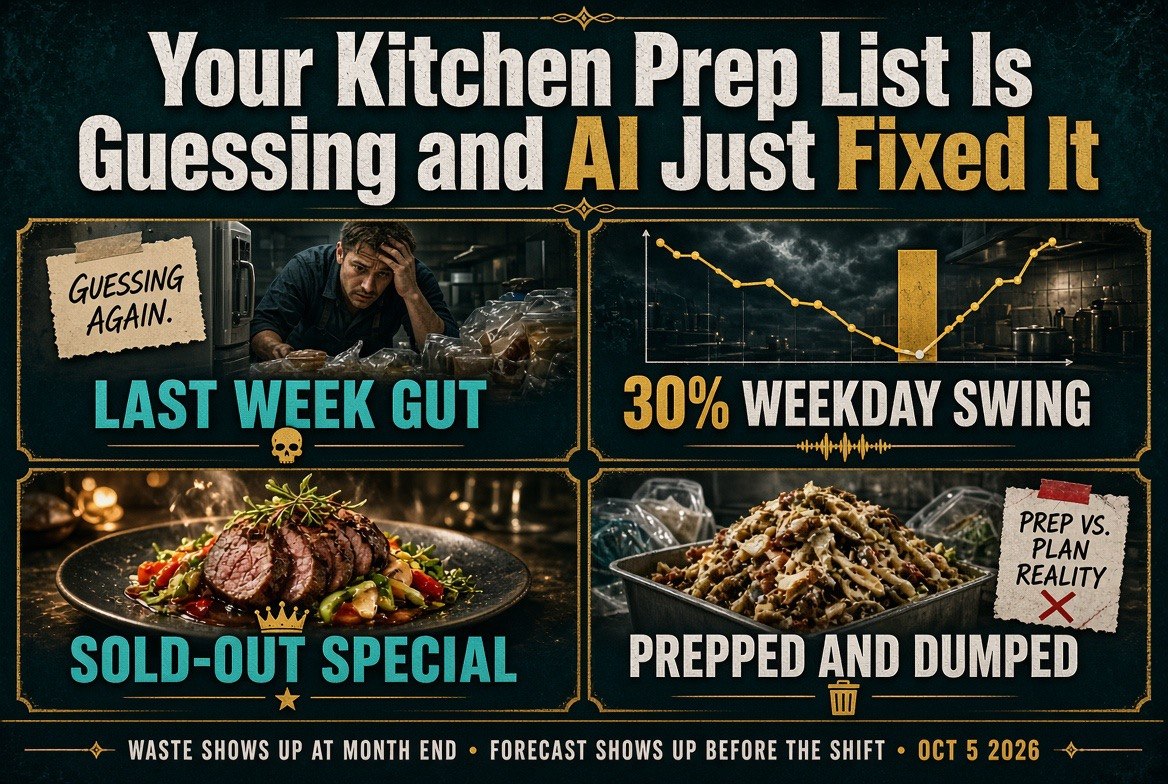
Your Kitchen Prep List Is Guessing and AI Just Fixed It
⚡ Expert Summary: Every independent kitchen runs prep off a number somebody guessed — last week’s count, a manager’s gut, or the same par sheet that has not changed since the last menu update. AI kitchen forecasting replaces the guess with a projection built from your actual sales history, weather, day of week, and local events. Done right, it cuts prep waste without adding a new system for your staff to learn.
Ask an independent restaurant owner how much prep they need for tomorrow and you will get one of three answers: the number from last week, the number their longest-serving cook says, or the number on a laminated sheet nobody has updated since the last price change. All three are guesses dressed as process.
That guess is expensive, and the cost hides in places that never show up as a line item. Over-prep becomes waste. Under-prep becomes a service failure at 8pm on a Friday. The kitchen absorbs both, and the owner sees neither clearly.
AI forecasting is the first tool in years that attacks this directly — not by adding another dashboard, but by replacing a guess with a projection built from data you already generate every single day.
Why the Prep List Keeps Guessing
A prep list is a decision about the future made with almost no information about the future. It is produced from memory, habit, and whatever the manager remembers about last Tuesday. That worked when the calendar was stable and menus rarely changed. It fails now for three reasons.
1. Demand moves faster than habit
Delivery mix, weather, local events, a competitor closing, a promo running on a third-party app — any one of those can swing a weekday by thirty percent. A par sheet built on an eight-week average cannot see it. A human cannot hold eight variables in their head while also running a shift.
2. The cost of being wrong is asymmetric and invisible
Over-prep shows up as dumpster weight and a quieter inventory variance at month end. Under-prep shows up as a guest who wanted the special and got an apology. Neither arrives with a dollar sign attached, so neither drives a fix.
3. The data already exists and nobody reads it
Your POS logs item-level sales by hour, by day, by channel. That is a forecast waiting to happen. It sits unused because pulling it into a spreadsheet and modelling it by hand is a job nobody has time for.
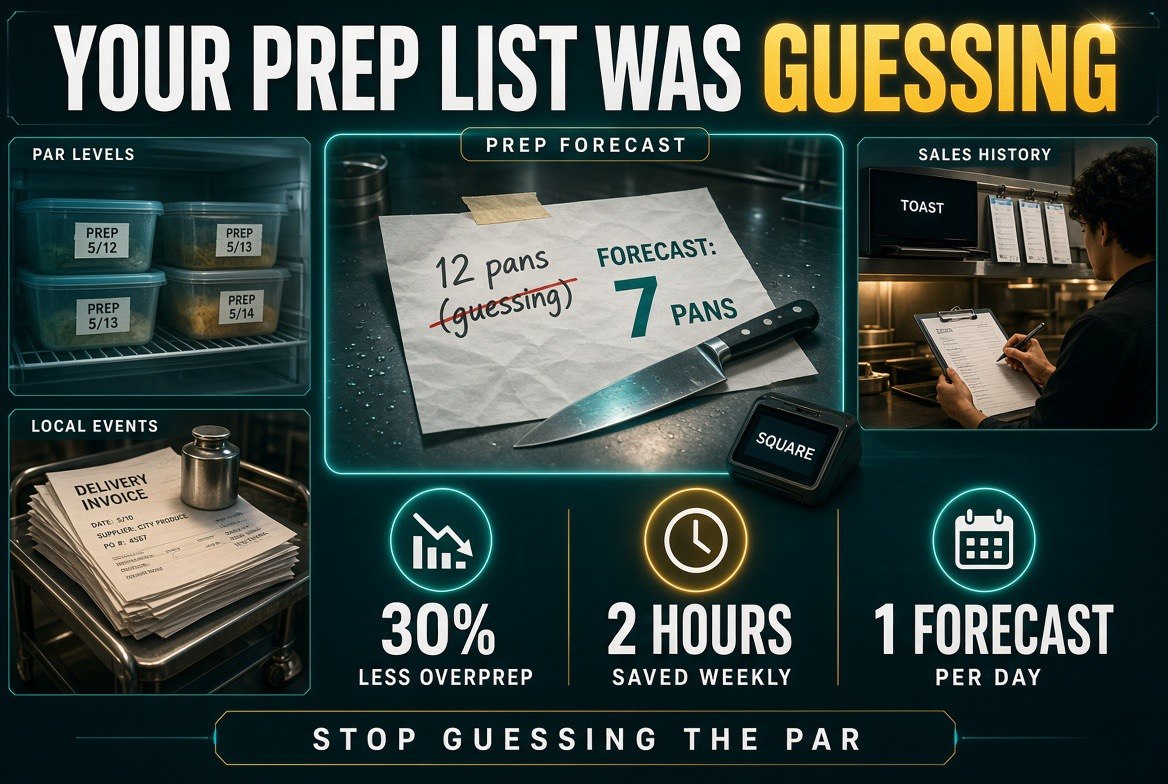
The whole shift in one sheet: the par level stops being memory and starts being a forecast built from sales history, weather and local events.
What AI Forecasting Actually Changes
The useful distinction is not “AI versus no AI.” It is guess-based prep versus projection-based prep. The table below is the comparison that matters for a working kitchen.
| Factor | Guess-Based Prep | AI-Forecast Prep |
|---|---|---|
| Where the number comes from | Last week’s count, habit, or a manager’s gut | Projection from real item-level sales history |
| What it accounts for | Whatever the manager remembers | Day of week, weather, events, channel mix, trends |
| Over-prep outcome | Waste you find out about at month end | Prepped to projected demand, not to habit |
| Under-prep outcome | Sold-out specials and apologies at peak | Buffer sized to the risk on that specific day |
| Who owns the decision | Whoever writes the list that morning | The forecast, with the chef free to override |
| Time cost | 30-60 minutes of manual counting and judgement | Minutes to review and adjust an auto-built list |
| What improves over time | Nothing — the sheet never learns | Accuracy compounds as more history accumulates |
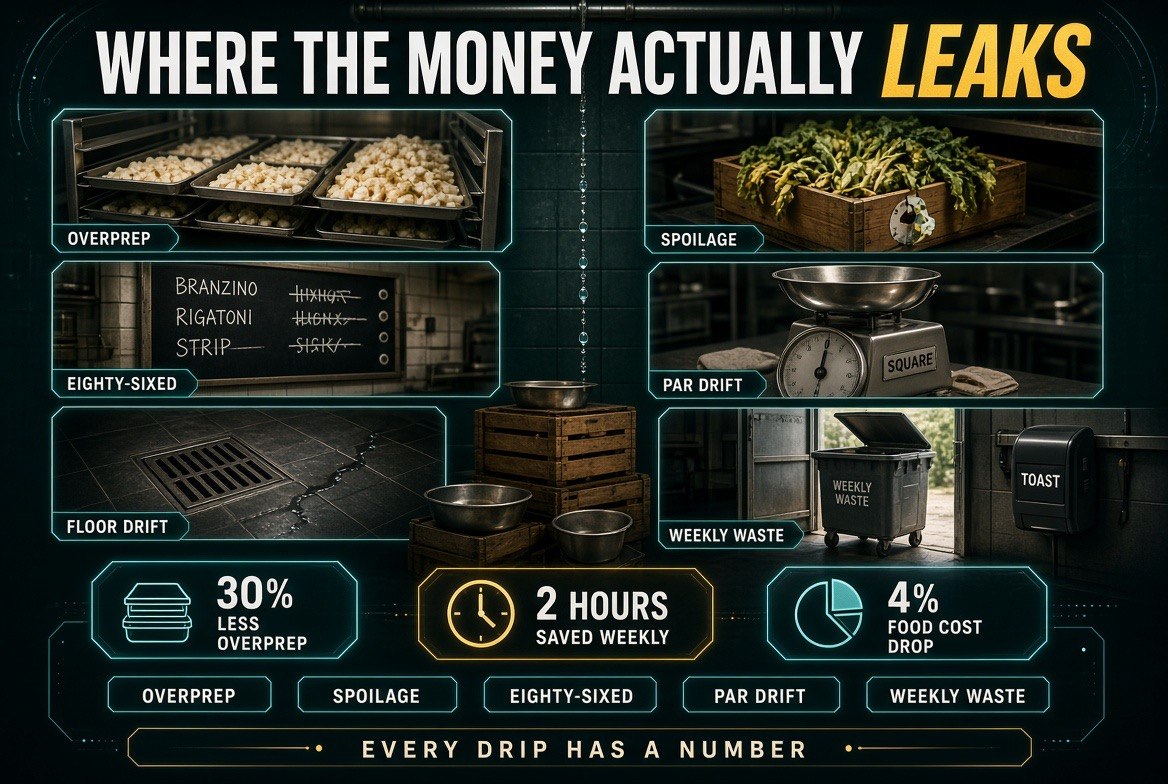
Every drip has a number: overprep, spoilage and eighty-sixed dishes are separate losses you can forecast, not one big vague food-cost problem.
The Numbers Behind Prep Waste
Food waste in full-service restaurants runs in the range of four to ten percent of food cost, and a meaningful share of that is over-prep rather than spoilage. On a location doing $1.2M a year, food cost around thirty percent, that band is roughly $14,000 to $36,000 of food walking out the back door annually — a large part of it ingredients that were prepped, held, and never sold.
Labour rides along with it. Over-prepping means hours spent cutting, portioning, and storing product that becomes waste, plus the storage and rotation labour that surrounds it. Under-prepping means the opposite cost: recovery cooking mid-shift, rush orders, and expedited deliveries at premium prices.
Forecasting does not eliminate either failure. It shrinks the gap between what you prep and what you sell, which is the only lever that moves both costs at once.
What to Look For Before You Buy Anything
The market for restaurant AI is crowded with tools that promise forecasting and deliver a dashboard. Four questions separate the real thing from the noise.
Does it read item-level sales, or just totals?
A forecast built on daily revenue totals is useless for prep. You need item-level history, because prep is ingredient-level. If the tool cannot tell you how many orders of a specific dish to expect, it cannot tell you how much to prep.
Does it write the prep list, or show you a chart?
The value is in the output, not the insight. A forecast that requires you to translate a graph into a prep sheet has moved the work, not removed it. Look for a tool that generates the list your kitchen already uses.
Does it respect how a kitchen actually works?
Chefs override forecasts, and they should. A tool that treats an override as an error instead of a correction will be ignored within a week. The good ones learn from what you change.
Can you verify its accuracy?
You should be able to see projected versus actual, in your own numbers, within weeks. If the vendor will not show you that comparison, the forecast is a black box, and a black box does not earn a kitchen’s trust.
How Forecasting Fits With What You Already Run
Forecasting is one job. It is not inventory counts, not invoice coding, and not vendor price tracking — and confusing the four is how operators end up paying for three tools that overlap. The table below separates them.
| Job To Be Done | What It Answers |
|---|---|
| Forecasting | How much of each item will we sell tomorrow? |
| Inventory counting | What do we physically have right now? |
| Invoice and cost tracking | What did we pay, and is the price drifting? |
| Prep automation | What should the kitchen make this morning, and how much? |
| Menu engineering | Which items make money and which ones only look popular? |
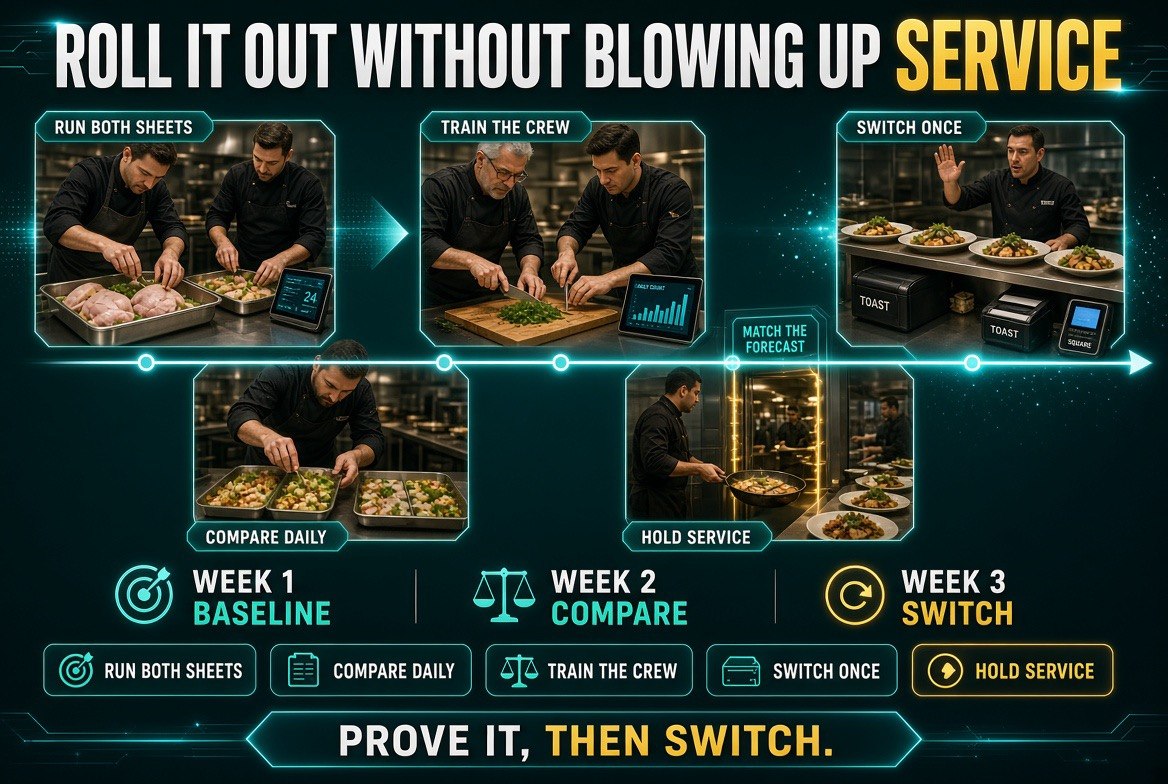
Run both sheets, compare daily, then switch — the forecast has to prove itself before it takes over the line.
How to Roll It Out Without Blowing Up Service
The failure mode of every kitchen system is the same: it asks staff to change how they work during a busy week, and it dies by Thursday. Forecasting avoids that if you introduce it in the right order.
Start by running it in parallel, not in place of anything. Let the forecast produce a prep list alongside the usual one, and compare for two weeks without changing a single thing in service. You are not saving money yet. You are checking whether the tool understands your restaurant.
Then pick one station, ideally the one with the most expensive over-prep, and switch it. Keep the rest manual. Measure waste at that station specifically. A win on one protein or one prep-heavy item is worth more than a broad rollout that nobody trusts.
Finally, let the chef override freely and review the overrides weekly. The gap between the forecast and the chef’s instinct is your most useful data source in the first month: it tells you whether the tool is missing something real, or whether the old habit was always wrong.
The Real Payoff Is Time, Not Just Waste
The waste reduction is the number you can put on a spreadsheet. The bigger effect is the hour a day that the manager stops spending counting, estimating, and arguing about par levels — an hour that goes back into the floor during service, or into the end of the shift instead of the middle of it.
Independent operators do not lose to chains because of bad food. They lose on systems: the chain has a forecast, a plan, and a variance report, and the independent has a laminated sheet. AI forecasting is the cheapest way to close that specific gap without hiring anyone.
If you want to see where that gap shows up first, our breakdown of the five money leaks AI will not find in your restaurant covers the areas that hide cost, and the rest of our coverage sits under restaurant technology.
Where the Forecast Data Comes From
The single question that decides whether forecasting works in your restaurant is where the numbers come from. Get this wrong and you have bought a chart. Get it right and the prep list starts writing itself.
Item-level sales history is the foundation: each dish, each day, each channel, for as far back as your POS will export. On top of that, the better tools layer context your old par sheet never had — day of week patterns, seasonal swings, local events, severe weather, and the delivery-versus-dine-in split, which matters enormously because a third-party order and a table order rarely pull the same prep.
What you should not accept is a forecast built on revenue totals. Revenue tells you the room was busy. It does not tell you the kitchen needed four more trays of one prep and two fewer of another, and prep is decided at the ingredient level. A tool that cannot speak in item counts cannot build a prep list.
There is also a data hygiene step most operators skip. If two menu items are really the same dish rung under different buttons, or if modifiers are not mapped to their ingredients, the forecast inherits that mess. An hour spent cleaning item mapping before rollout is worth more than a month of tuning afterwards.
Where the Money Actually Shows Up
Operators want to know which line of the P&L moves. Three do, and they move at different speeds.
Food cost moves first, because over-prepped product stops being made. That is the fastest visible change and the easiest to measure at a single station. Labour moves second: less time portioning and storing product nobody orders, plus fewer mid-shift scrambles when something runs out at peak. The third movement is the quietest and often the largest over a year — the manager hour that stops going into counting and estimating, and the consistency that comes from a kitchen working off the same plan instead of whoever wrote the list that morning.
Do not expect all three in week one. Expect food cost first on the station you switch, labour as the habit settles, and the time savings once the team trusts the list enough to stop double-checking it by hand.
Common Ways Forecasting Rollouts Fail
Most failures are not technical. They are organisational, and they repeat.
Switching everything at once
A full rollout means every station changes on the same morning, and the first busy night turns any small error into a story about how the computer got it wrong. Switch one station, keep the rest manual, and let the proof accumulate where the staff can see it.
Skipping the parallel run
Running the forecast silently alongside the existing list for two weeks costs nothing and catches item-mapping errors before they reach service. Skipping it is how a manageable setup problem becomes a service failure on a Saturday.
Treating chef overrides as input errors
When a chef adjusts the list because they know a private party is coming or a local game just got scheduled, that is information the model does not have. Good tools learn from overrides. Bad ones nag about them until the kitchen stops using the list entirely.
Never checking accuracy
You should be able to compare projected versus actual in your own numbers within a month. If nobody looks, nobody knows whether the forecast is improving or drifting, and the tool becomes another screen the staff ignores.
Frequently Asked Questions
What is AI kitchen forecasting?
It is software that projects how much of each menu item you will sell on a given day, using your own item-level sales history plus factors like day of week, weather, and local events. The output feeds a prep list instead of a guess.
Will AI forecasting actually reduce my food cost?
It reduces the gap between what you prep and what you sell, which trims over-prep waste and the labour attached to it. On a $1.2M location, over-prep commonly accounts for a meaningful slice of the four to ten percent food waste band.
Do I need a new POS to use forecasting?
Usually not. Most forecasting tools pull item-level sales from the POS you already run. The blocker is data access and clean item mapping, not the hardware.
Will my chefs accept a computer telling them what to prep?
They accept it when they can override it and when the forecast is right more often than habit. Run it in parallel for two weeks and let the comparison make the argument.
How long before I see results?
Accuracy improves as history accumulates, but operators typically see usable projections within the first few weeks and measurable waste reduction within the first month or two on the stations they switch.

About Barak Schurr
Barak Schurr built and exited a major ticketing platform, ran global operations at Eventbrite, and now focuses on one question: which AI tools actually help independent restaurant owners run leaner and grow faster. He writes from the operator’s perspective — no vendor spin, no theory, just what’s real in 2026.
Email: [email protected]
More AI Resources for Your Business