Get the AI Restaurant Quick-Start Guide — Free
The 5 AI tools independent US restaurant owners are using right now to cut labor costs and answer every call.
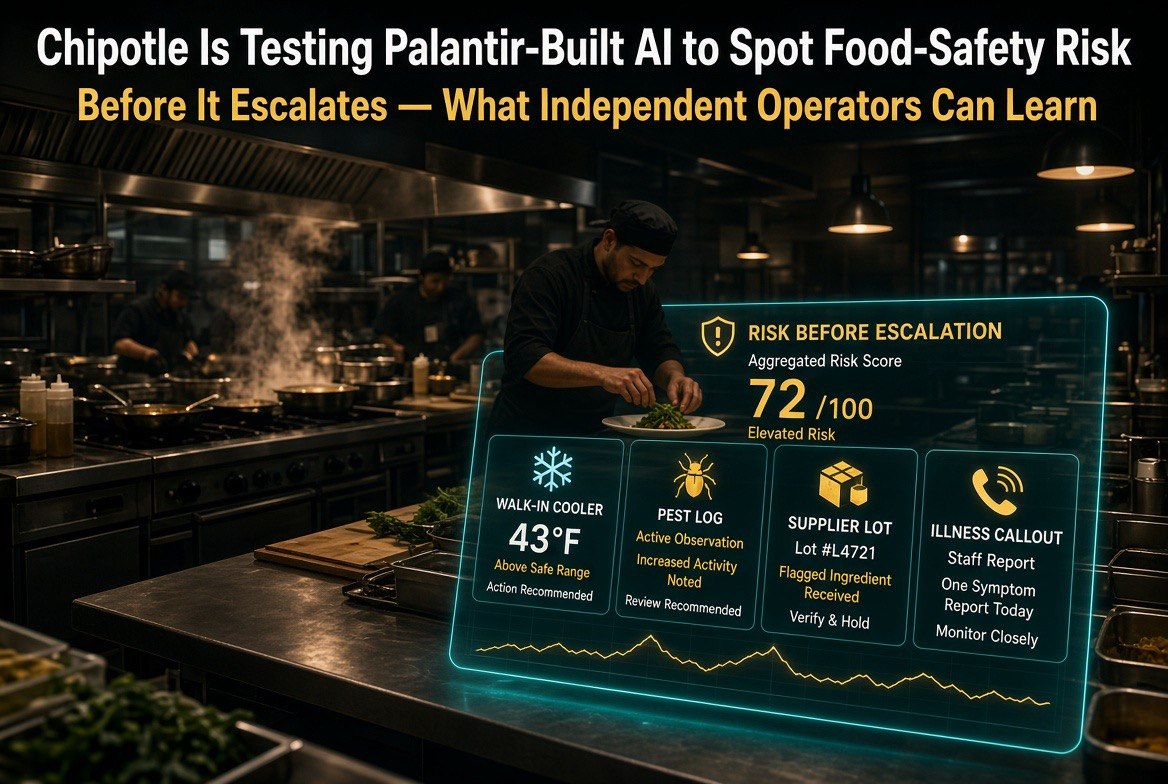
Chipotle Is Testing Palantir-Built AI to Spot Food-Safety Risk Before It Escalates — What Independent Operators Can Learn
⚡ Expert Summary: Chipotle has confirmed a pilot on Palantir Foundry — a data platform that pulls health-department inspection scores, pest incidents, supplier records, and employee illness reports into a single per-location risk view so problems get caught before an outbreak. It is not an AI that inspects your kitchen. It is a system that connects data you already collect but nobody reads together. That distinction is the entire opportunity for independent operators: you will never buy a Palantir contract, but the thing that made this work — joined-up data and a risk score per location — is something a single-location restaurant can build with tools already sitting in its POS and back office. Here is how the model translates, and what the $0 version looks like.
Every independent operator knows the feeling. Your Tuesday health inspection is a snapshot of one morning. Your food-safety reality is the other 364 days.
That gap is why the Chipotle story is worth fifteen minutes of your time even if you run one location and will never sign an enterprise data contract.
Chipotle has confirmed it is piloting a technology platform built on Palantir Foundry designed to surface food-safety risks before they escalate into incidents. The core idea is not a smart thermometer or a camera watching your line cooks. It is a data-integration play: the platform pulls in signals that already exist in separate systems — health department inspection results, pest-control reports, supplier and lot records, employee illness callouts — and combines them into a per-location view that flags patterns no individual report would reveal.
Palantir’s Foundry is an enterprise data platform known for connecting systems that were never designed to talk to each other. It is the same class of tool that gets used in defense and logistics contexts, applied here to the decidedly unglamorous problem of figuring out which store is drifting toward a food-safety failure before a customer gets sick.
Context matters for why this is on a restaurant chain’s roadmap at all. The FDA tracked the jalapeño-linked Salmonella outbreak that sickened hundreds of people across dozens of states, with a substantial share requiring hospitalization. For a chain with thousands of locations, a single contaminated ingredient reaching stores means a recall, a news cycle, and a measurable sales hit. Predictive risk detection is an insurance policy on a very large number.
Independent operators do not carry that exposure at that scale. But you carry the same structure of risk — many small signals, spread across paper logs, a POS, a pest guy’s invoice, and a text thread, with nobody joining them up.
What “Predictive Food-Safety” Actually Means (And What It Doesn’t)
Vendor language gets loose here, so let’s be precise about what this category is.
What it is: a risk-scoring layer. You feed it operational data. It builds a baseline for what normal looks like at that location, then flags deviations. A walk-in cooler running slightly warm for three days. A spike in a specific complaint keyword in online reviews. Two employee illness callouts in one week. Pest activity logged in the dry storage area. Each one is ignorable alone. Together they form a pattern.
What it isn’t: a replacement for your food-safety manager, a lab test, or a legal shield. No platform knows whether your tomatoes are contaminated. What it can do is tell you where to look first, which is the difference between finding a problem on a Tuesday morning and finding it on a Friday night at full capacity.
That reframing matters because it kills the excuse. You don’t need Palantir. You need the behavior Palantir was hired to enable: making the signals visible in one place, on a schedule, with someone responsible for reading them.
| Capability | Chipotle + Palantir Approach | Independent Operator Version |
|---|---|---|
| Data collection | Automated feeds from POS, suppliers, inspection portals, pest vendors | One shared digital log — temperature checks, deliveries, incidents — filled by staff on a phone |
| Risk detection | Model flags deviations from each location’s baseline | Weekly 15-minute review of the log against thresholds you set yourself |
| Accountability | Central food-safety team owns follow-up per flagged store | Named shift lead per location owns the corrective action, written down with a date |
| Cost | Enterprise data platform contract | Spreadsheet plus a phone-based form — near zero |
| Time to value | Multi-month integration and pilot | This week — start logging tomorrow |
Read that table honestly and the lesson is uncomfortable in a useful way. The enterprise version automates steps two and three. The independent version requires you to do them by hand. What the enterprise version does not do is remove the need for someone to look at the data and act — which is the part most single-location operators already struggle with, and the part no contract fixes.
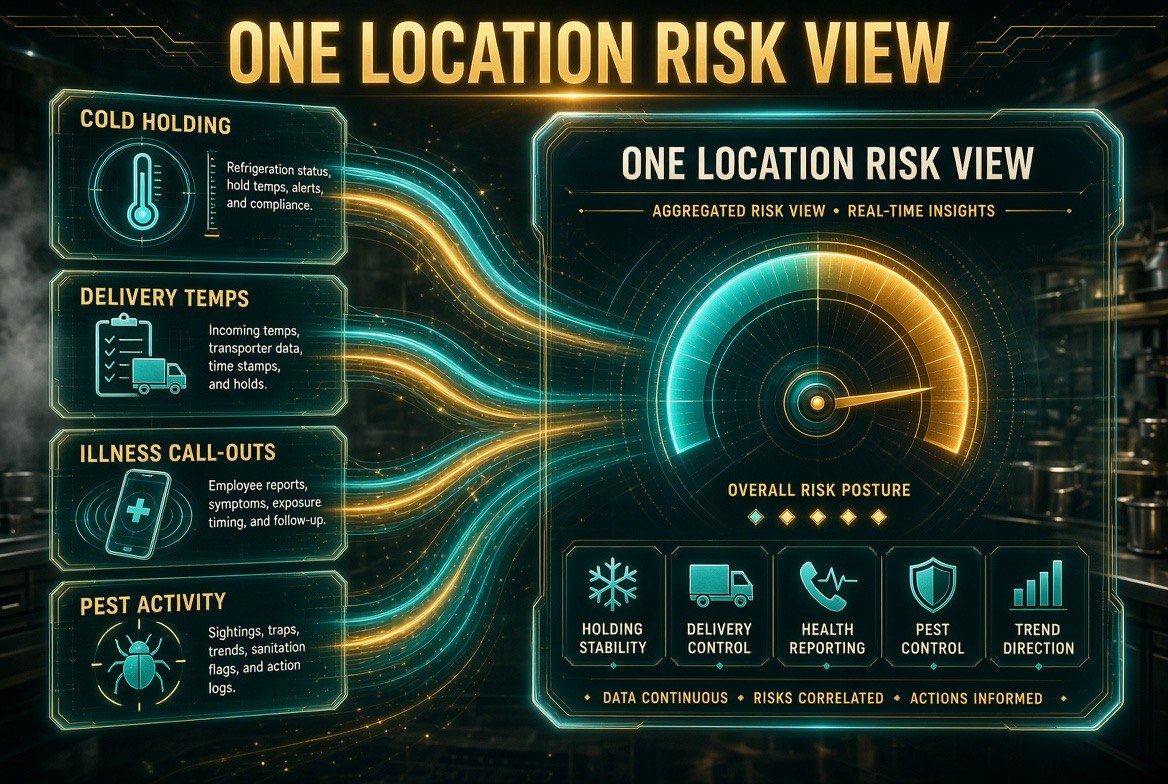
Four separate logs — cold holding, delivery temps, illness call-outs, and pest activity — joined into one per-location risk view. This is the honest core of what Chipotle is testing: not an AI that sniffs out contamination, but one that surfaces a location before the problem escalates.
The Affordability Question: What Can You Actually Buy
Let’s separate the categories of tooling by what they solve, because “AI food safety” is sold as one thing and is really four.
1. Traceability and recall management. Trustwell and similar vendors handle supplier documentation, lot tracking, and recall execution. This matters most if you have multiple suppliers and a menu with long ingredient chains. If your restaurant lives off a single broadline distributor, your exposure is smaller and your distributor’s recall process covers much of it.
2. Temperature and equipment monitoring. Wireless sensors in coolers, freezers, and hot-holding units that alert you by text when something drifts out of range. This is the highest-ROI category for most independents, because it prevents the most common and most expensive failure — losing a full cooler of product overnight, or worse, serving from it. Sensor kits are inexpensive and install in an afternoon.
3. Digital logging. Replacing the clipboard. Any phone-based form tool gets you there. The value isn’t the software; it’s that the data becomes searchable, timestamped, and reviewable instead of a stack of damp paper nobody reads.
4. The Palantir-style integration layer. Joining all of the above into one risk view. This is the category that is genuinely out of reach for a single-location restaurant — and the one you don’t actually need, because at one location you are the integration layer. You know your kitchen. What you lack is the record.
That last point is the honest answer to “can I copy Chipotle?” You can’t buy their platform. You can absolutely copy their data discipline, and at one location the data discipline is 90% of the value.
The 5-Step Version You Can Run Starting Tomorrow
This is the translation of the Chipotle model into a format that fits a single-location P&L.
Step 1: Pick five signals, not fifty. Cooler and freezer temps. Delivery temperatures on arrival. Pest sightings or activity. Employee illness callouts. Guest complaint keywords. Those five cover the overwhelming majority of food-safety escalations in a restaurant your size. Writing down fifty data points guarantees you’ll stop by week two.
Step 2: Make logging take under twenty seconds. If a temperature check requires finding a pen, you have already lost. A phone form with big buttons and a timestamp gets filled out. Paper gets skipped on a busy Friday.
Step 3: Set thresholds before you need them. Write down what counts as a deviation: a cooler above 41°F, two illness callouts in seven days, any pest activity within ten feet of food storage, a complaint mentioning illness. Deciding this while you’re calm is what makes the system work when you’re slammed.
Step 4: Review weekly, for fifteen minutes, on the calendar. Sunday morning, coffee, log open. Look for patterns, not one-offs. The whole value of the Palantir approach is pattern detection over time — and at one location, a human doing a weekly read achieves most of it.
Step 5: Write down every corrective action with a name and a date. This is the step that saves you during an inspection, an insurance claim, or a customer dispute. “We noticed the walk-in was drifting on the 14th, we called refrigeration on the 15th, service completed the 16th” is a document that demonstrates a functioning system. Absence of documentation reads as absence of system, regardless of how good your actual practices are.
None of those five steps requires AI. Add sensors and a form tool and you’ve got automation on top of a process that already works — which is the correct order of operations. Automating a process that doesn’t exist just produces faster chaos.
| Signal to Track | Where It Lives Today | Threshold to Flag |
|---|---|---|
| Cold-holding temperature | Paper clipboard, checked irregularly | Above 41°F at any check |
| Delivery arrival temps | Receiver’s memory | Any out-of-range load accepted |
| Employee illness callouts | Text messages to the GM | Two or more in seven days |
| Pest activity | Pest vendor’s monthly report | Any activity near food or dry storage |
| Guest complaint language | Reviews, DMs, and comment cards | Any mention of illness or food quality |
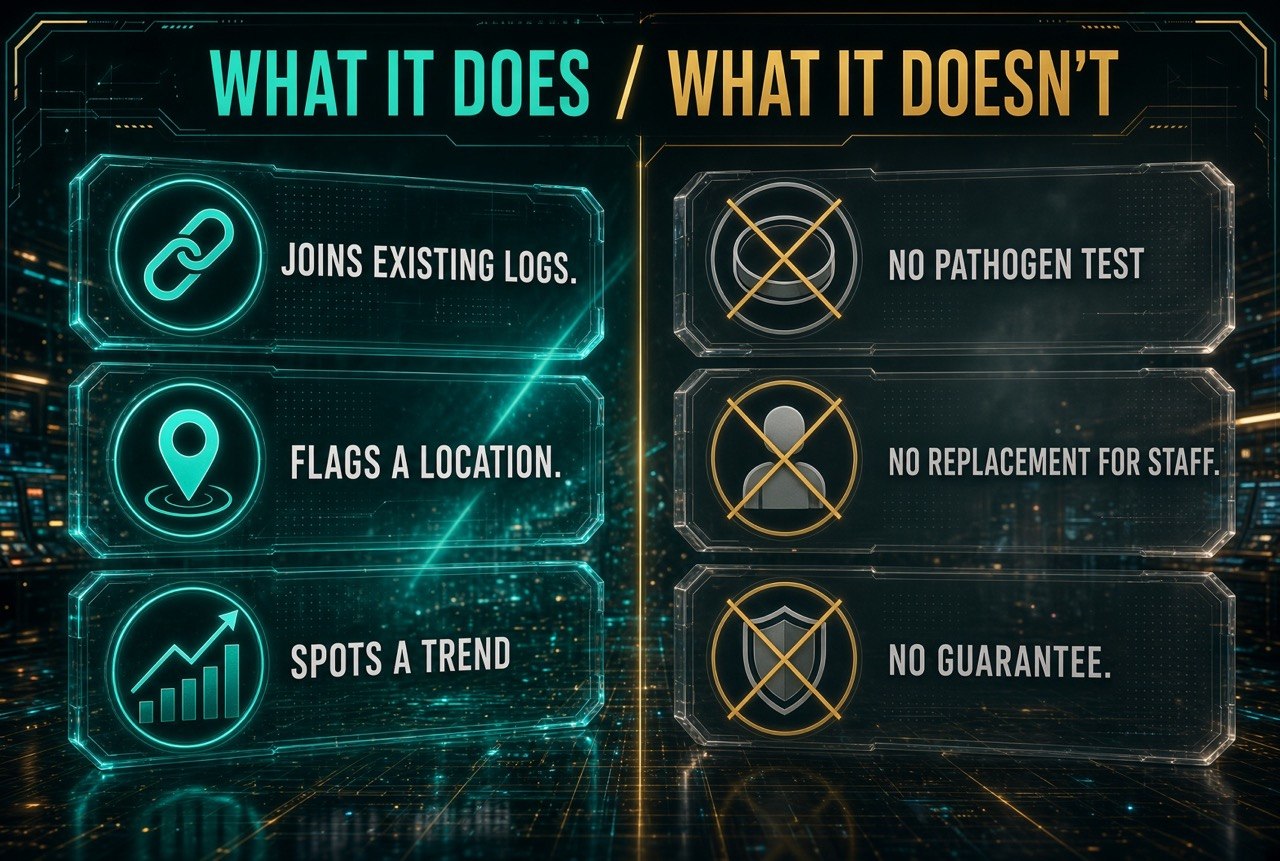
What this class of tool does — join logs, flag a location, spot a trend — and what it does not. It is a risk surfacing layer, not a pathogen test and not a replacement for your staff.
Why This Matters More Right Now Than It Did Two Years Ago
Three forces are pushing food-safety documentation from nice-to-have to table stakes for independents.
Supply chains remain volatile. Ingredient sourcing has shifted repeatedly, and every new supplier is a new lot-tracking obligation. The jalapeño outbreak showed how fast a single ingredient can create a multi-state problem. Even a restaurant far from that supply chain got questions from regulars.
Insurance and franchising both reward documentation. Carriers increasingly ask about food-safety procedures at renewal. Landlords and franchisors ask for it in lease and agreement negotiations. A documented system is worth real money in those conversations regardless of whether anything ever goes wrong.
Online reviews are a food-safety signal whether you treat them that way or not. A pattern of vague complaints about a specific dish or about feeling unwell after eating at your restaurant is exactly the kind of weak signal a risk-scoring system would surface. Your customers are already generating that data. Almost no independent operator reads it as an operations input instead of a reputation problem.
That last one is the cheapest win in this entire post. Set a weekly ten-minute pass through your reviews specifically looking for operational patterns — not ratings, not sentiment, but repeated mentions of the same dish, the same symptom, the same time of day. It costs nothing and it is genuinely the same signal class Palantir is being paid to detect.
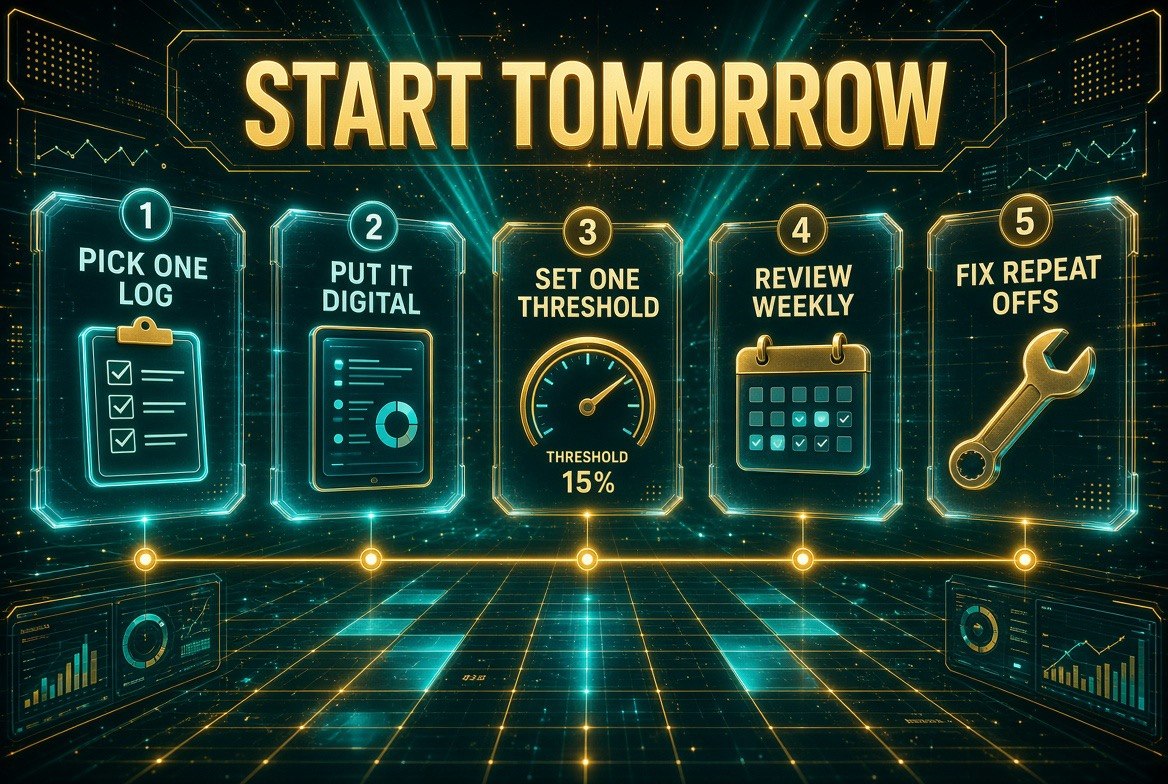
The five-step version you can run starting tomorrow. You do not need a vendor, a contract, or a data team — you need one log, one threshold, and a weekly review you actually keep.
The Bottom Line
Chipotle is buying an integration layer to solve a problem created by scale — thousands of locations generating signals faster than a central team can read them. You don’t have that problem. You have the smaller, more tractable version: the signals exist, nobody joins them up, and the record disappears.
Copy the discipline, skip the contract. Five signals, twenty-second logging, pre-set thresholds, a fifteen-minute weekly review, and a written corrective action with a name and a date. If that process runs clean for ninety days, then talk about sensors and automation — in that order, on top of a working process.
The chains will get predictive food safety whether independents do or not. The independents who treat documentation as an operating tool rather than an inspection chore will be the ones who come through the next supply-chain shock with their reputation intact.
Frequently Asked Questions
Does Chipotle’s food-safety platform use AI to detect contaminated food?
No. The pilot is built on Palantir Foundry, a data-integration platform that combines operational signals — inspection results, pest reports, supplier data, and illness reports — into a per-location risk view. It surfaces patterns and flags deviations; it does not test food or detect pathogens directly.
Can an independent restaurant afford this kind of food-safety technology?
The enterprise integration layer is out of reach for a single-location restaurant, but the underlying behavior is not. A phone-based logging form, a set of written thresholds, and a weekly fifteen-minute review deliver most of the value at near-zero cost. Temperature sensors are the highest-ROI paid upgrade for most independents.
What does Palantir Foundry actually do?
Foundry is an enterprise data platform designed to connect systems that were never built to share information, then make that combined data usable for analysis and decision-making. In this case it joins food-safety signals that normally live in separate systems into one view per location.
What is the single most valuable food-safety habit for a small restaurant?
Documenting corrective actions with a name and a date. Anyone can claim they run a safe kitchen. A written record showing that you detected a deviation, acted on it, and confirmed resolution demonstrates a functioning system — which is what inspectors, insurers, and lawyers actually evaluate.
Do I need AI at all to improve food safety?
No, and adding AI to a process that doesn’t exist makes things worse, not better. Build the manual process first — five signals, fast logging, weekly review, written corrective actions. Add sensors and automation once the process is running consistently, so you’re automating something that already works.
How do temperature sensors compare to manual checks?
Manual checks are a snapshot taken by a person who may be busy or rushed, and they produce a paper record that is rarely reviewed. Wireless sensors monitor continuously and alert by text when something drifts out of range, which prevents the most expensive common failure: losing an entire cooler of product overnight or serving from it.

About Barak Schurr
Barak Schurr built and exited a major ticketing platform, ran global operations at Eventbrite, and now focuses on one question: which AI tools actually help independent restaurant owners run leaner and grow faster. He writes from the operator’s perspective — no vendor spin, no theory, just what’s real in 2026.
Email: [email protected]
More Restaurant AI Resources