Get the AI Restaurant Quick-Start Guide — Free
The 5 AI tools independent US restaurant owners are using right now to cut labor costs and answer every call.
Presto Brings Voice AI to Drive-Thru Ordering: What Independent Restaurants Should Know
⚡ Expert Summary
Presto’s drive-thru voice AI now plugs directly into one of the largest restaurant point-of-sale platforms in the country, meaning orders captured by an AI voice can land in the kitchen without a human touching a screen. Presto’s own published metrics claim 95% of orders handled with no staff intervention, an 88% upsell offer rate, and roughly 6% monthly incremental revenue. Here’s what that actually means for an independent operator deciding whether to test voice AI this year.
Drive-thru voice AI has spent three years being a headline and about eighteen months being a real product. The gap between those two things has usually been integration — the AI can hear the order, but getting it into the kitchen and onto the check still involves a human, a screen, and a translation step that defeats the point.
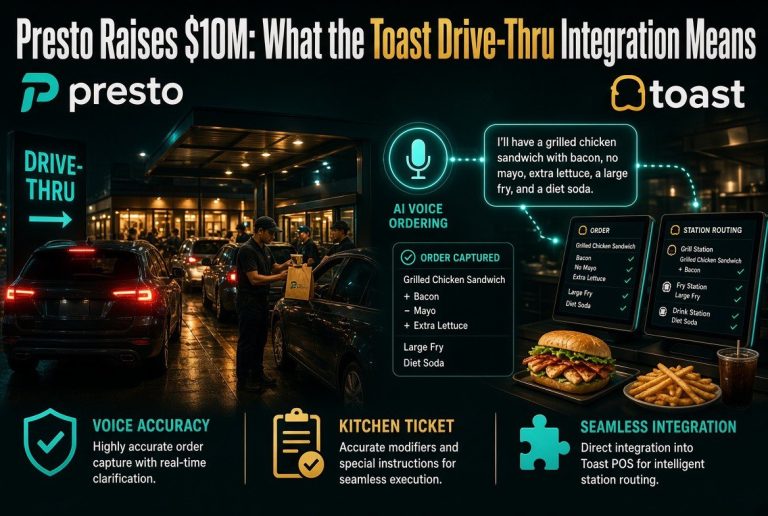
That gap is what this month’s Presto announcement targets. Presto, a voice AI company focused on restaurant drive-thrus, has joined a major restaurant platform’s partner ecosystem, with the stated goal of scaling drive-thru voice automation across that platform’s restaurant base. For independent operators, the interesting part isn’t the partnership logo. It’s that voice AI ordering is moving from a standalone bolt-on product toward something that lives inside the systems restaurants already run.
What Actually Changed
Presto has been selling voice AI for drive-thru lanes for years. What’s new is placement: the integration puts Presto inside a partner ecosystem that already includes more than 200 technology partners, which means restaurants running on that platform can adopt voice AI without rebuilding their ordering stack.
The mechanical improvement matters more than the marketing language. When an AI voice agent takes an order in the drive-thru lane, the order is now captured through the voice flow and passed directly into the kitchen — the same path a manually keyed order would take. There’s no re-entry step, and no staff member re-typing what the AI heard.
That re-entry step was the quiet killer of first-generation drive-thru AI. An AI that takes an order but requires a human to verify and retype it doesn’t reduce labor; it adds a dependency. Removing that step is the difference between a demo and a deployment.
Justin Graham, Vice President and General Manager of Enterprise Products at the platform company, framed the partnership around bringing voice AI to more restaurants. Krishna Gupta of Presto positioned it similarly — expanding voice AI’s reach by making it available where restaurants already operate.
The Numbers Presto Is Publishing
Presto has put specific performance claims on the record as part of this announcement. These are the company’s own published figures, and they should be read as vendor-reported rather than independently audited:
| Presto Metric | Published Figure | What It Means in Practice |
|---|---|---|
| Orders with no staff intervention | 95% | The AI completes the order without a human stepping in — the core labor claim |
| Upsell offer rate | 88% | The system consistently offers add-ons — something human crews skip on a rush |
| Monthly incremental revenue | ~6% | The revenue lift attributed to consistent upselling at the speaker |
| Partner ecosystem size | 200+ partners | Distribution reach — restaurants already on the platform can adopt without a full replatform |
The 95% no-intervention figure is the one to focus on, because it’s the claim that either holds up in your lane or doesn’t. An AI that handles 95% of orders means roughly one in twenty still needs a human. On a 200-car day, that’s about ten interventions — manageable. On a badly configured system with an unusual menu, that ratio can invert fast.
The 88% upsell offer rate is arguably the more interesting number. Human crews upsell inconsistently — they skip it during a rush, they forget during shift change, and they read the car rather than the script. A voice agent offers the upsell on 88% of orders because it has no reason not to. That consistency, not the labor saving, is often where the return actually comes from.
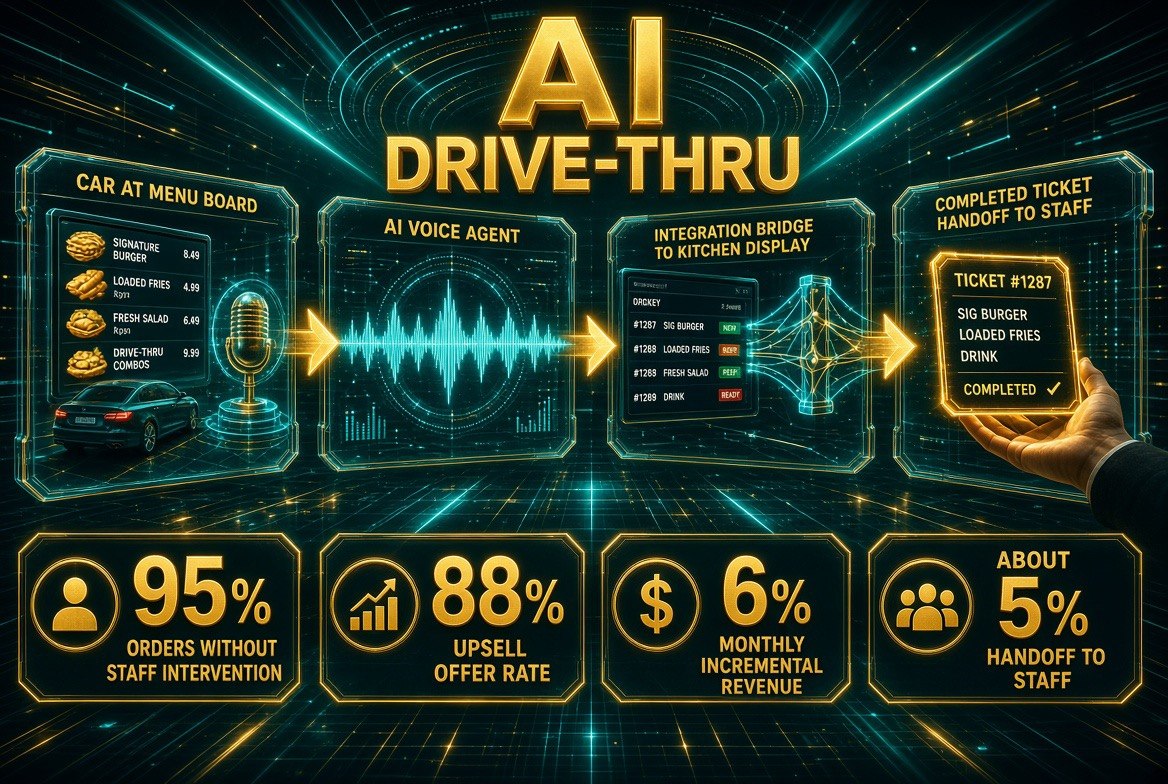
The full drive-thru path: menu board, AI voice agent, order routed into the kitchen display, ticket handed to staff. The vendor’s published figures are 95% of orders without staff intervention, an 88% upsell offer rate, and about 5% handed off to a human.
AI Voice vs. Human Crew in the Drive-Thru Lane
The real decision isn’t voice AI versus no technology. It’s voice AI versus the staffing model you’re running now.
| Factor | AI Voice Ordering | Human Headset Crew |
|---|---|---|
| Consistency at peak | Identical on order #1 and order #300 | Degrades with fatigue, rushes, shift changes |
| Upsell discipline | Offers on ~88% of orders per vendor data | Highly variable, often skipped under pressure |
| Handling menu exceptions | Weakest area — unusual requests need escalation | Strong — a person improvises and moves on |
| Accent and dialect | Improving, but still a known failure mode | Generally more forgiving in practice |
| Cost structure | Fixed monthly or per-order, scales without hiring | Hourly, with turnover and training costs on top |
| Covers callouts and no-shows | Yes — no lane goes unstaffed | No — a callout can close a lane |
Read across that table and the strategic case is clear: AI voice wins on consistency and coverage; humans win on ambiguity. The restaurants getting value from voice AI in 2026 aren’t removing people from the drive-thru entirely. They’re using AI to guarantee the lane always has a taker, then moving their strongest people to the window, where the human judgment actually generates tips and repeat visits.
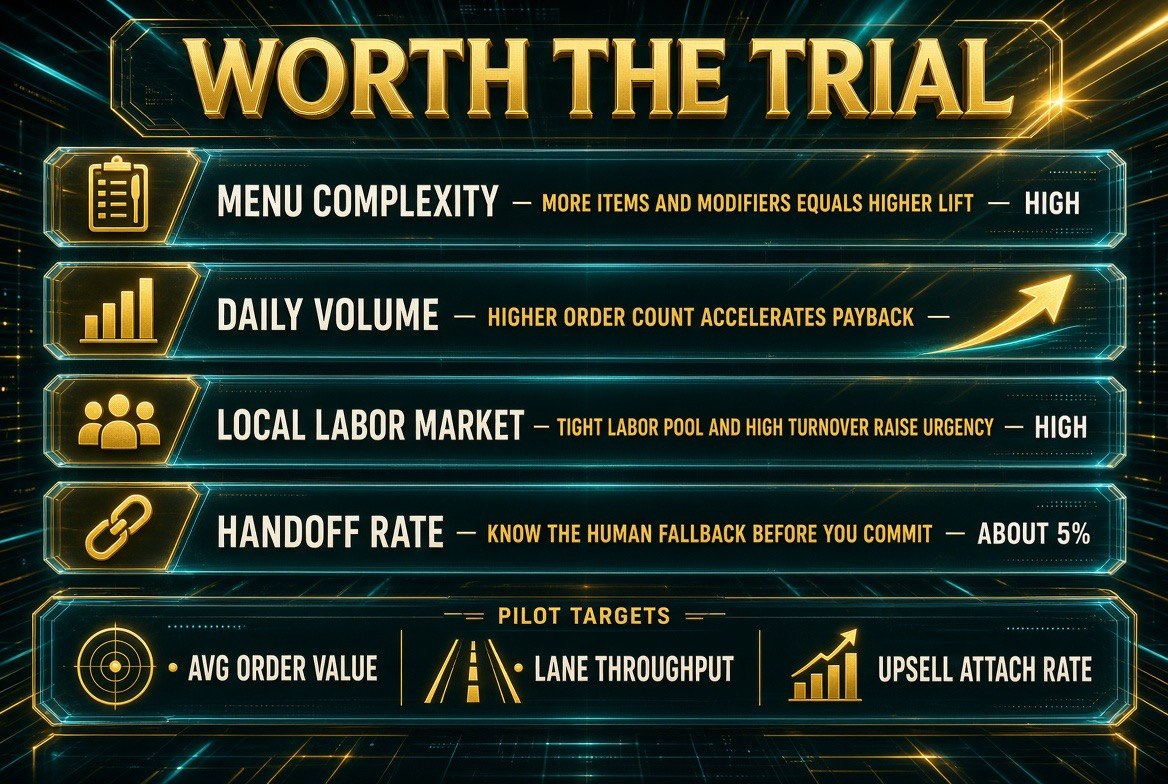
Four factors decide whether a voice AI trial is worth your time: menu complexity, daily volume, local labor market, and the handoff rate — with average order value, lane throughput, and upsell attach rate as the pilot targets.
What This Means for an Independent Operator
Franchise chains have been the loudest adopters, partly because they can absorb a failed pilot across hundreds of locations and partly because standardized menus are the easiest case for speech recognition. Independent restaurants have the opposite profile: tighter margins, so a win matters more, and more menu variation, so the AI has a harder job.
That means the calculus for you is different. A few things to weigh honestly:
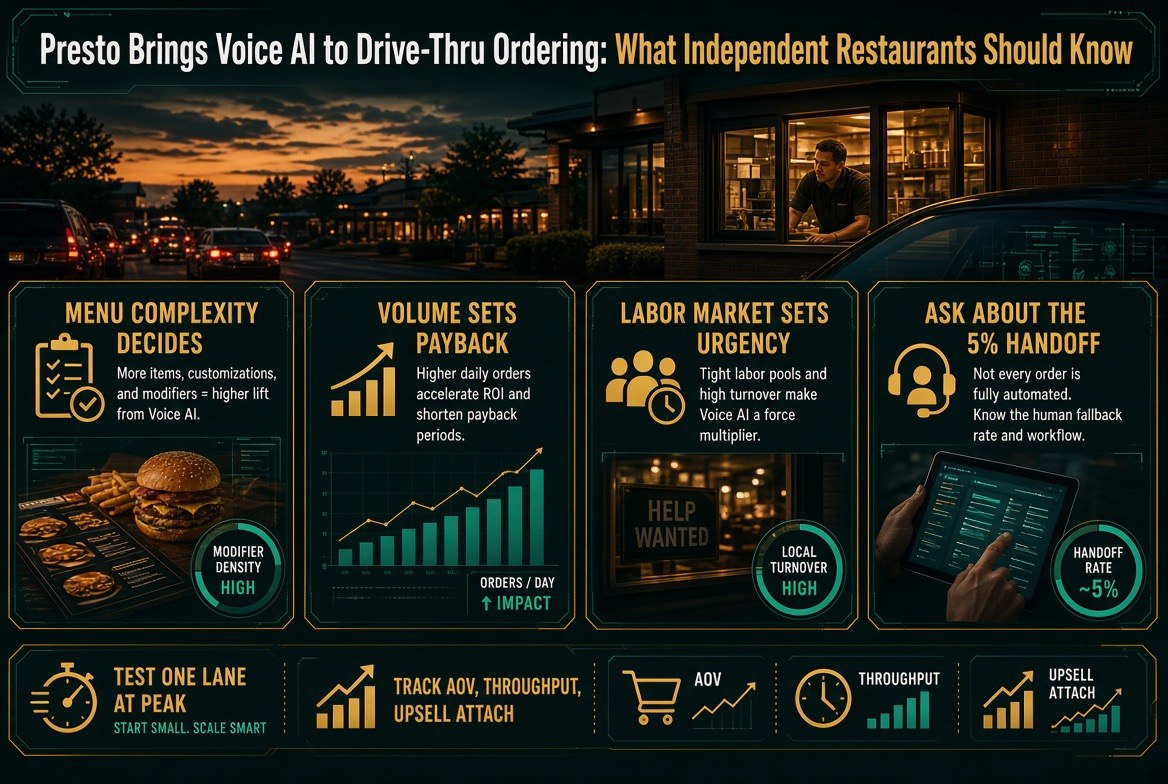
- Your menu complexity is the deciding variable. A focused menu with stable item names is where voice AI performs. Heavy daily specials, frequent substitutions, and verbal-only modifiers are where it struggles.
- Your drive-thru volume sets the payback. Voice AI needs enough order volume to justify the subscription. If you run a single lane with modest traffic, the labor saving may be smaller than the upsell consistency gain.
- Your labor market sets the urgency. If you’re chronically short on reliable headset staff, the coverage argument is strong even before the upsell argument.
- Your existing stack sets the effort. The reason this integration matters is that it removes the replatforming work. If adopting voice AI meant replacing your POS, the answer for most independents would be no.
There’s also the question every operator should ask before signing: what happens on the 5% of orders the AI can’t finish? Get a straight answer on that before you commit. The failure path — does it escalate to a person mid-order, does it hand off cleanly, does the customer have to repeat themselves — is the single biggest driver of whether drive-thru voice AI feels like an improvement or an irritation.
Practical pilot design matters here, because most disappointing AI deployments fail on setup rather than on the technology. Run the test on one lane during your highest-volume daypart rather than across the whole week. That’s where the labor pressure is real and where an AI that handles orders without intervention proves its worth fastest. It also gives you the cleanest comparison against your current numbers.
Before you start, write down three baseline figures: average order value, average lane throughput per hour, and upsell attach rate. Without those, you have no way to tell whether the AI is actually performing or whether you’re just remembering the good hours. After four weeks, compare against those baselines — not against the vendor’s published percentages, which came from someone else’s menu, someone else’s customers, and someone else’s staff.
One more thing worth watching during a pilot: how your regulars react. Drive-thru is a habitual behavior, and repeat customers notice when the voice on the speaker changes. Some will find it faster and cleaner. Others will miss the person they used to talk to. Watching that split during a controlled test is far cheaper than discovering it after a full rollout.
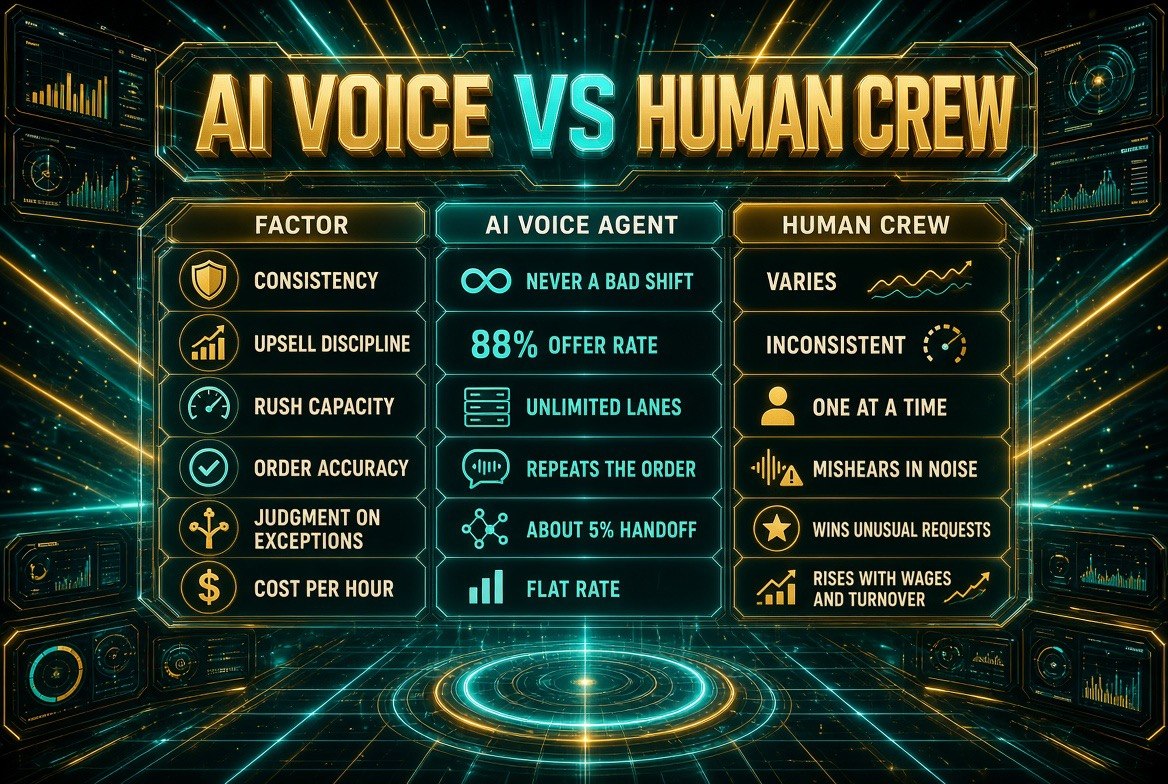
The honest split: the voice agent wins on consistency, upsell discipline, rush capacity, and cost per hour. Humans still win on judgment for unusual requests — which is exactly why about 5% of orders get handed off.
The Direction of Travel
Three years ago, drive-thru voice AI was a demonstration. Two years ago it was a pilot. The pattern of this integration — voice AI being absorbed into the ordering platforms restaurants already run rather than sold as a separate system — is what the technology maturing actually looks like.
It also tells you where the pricing goes. When voice AI is a partner integration rather than a standalone product, it competes on the same shelf as everything else in your ordering stack. That’s usually good news for operators and pressure on vendors.
The practical takeaway is not that you should deploy voice AI at your drive-thru this quarter. It’s that the barrier just dropped for anyone who was waiting for it to work inside their existing systems. If your drive-thru labor is fragile, your menu is simple, and your volume is real, this is now a testable decision rather than a theoretical one.
Frequently Asked Questions
What did Presto announce?
Presto, a voice AI company focused on restaurant drive-thru automation, joined a major restaurant technology platform’s partner ecosystem to expand voice AI for drive-thru ordering. The integration allows orders captured through the AI voice flow to be passed directly into the kitchen without staff re-entry.
What numbers has Presto published?
Presto has published a 95% rate of orders completed with no staff intervention, an 88% upsell offer rate, and roughly 6% monthly incremental revenue. These are vendor-reported figures published by the company, not independently audited results.
Can small independent restaurants use drive-thru voice AI?
Yes, and the integration model makes it more practical by removing the need to replace your existing ordering platform. The main constraints for independents are menu complexity — voice AI performs best with stable, clearly named items — and sufficient drive-thru volume to justify the cost.
Will voice AI replace my drive-thru staff?
Unlikely in full. The pattern that works is AI covering the order-taking lane so it’s never unstaffed, with your strongest people moved to the window where human interaction drives tips and repeat business. AI handles consistency; people handle exceptions.
What’s the biggest risk with drive-thru voice AI?
Handling exceptions. Accents, unusual requests, and menu items with complex modifications remain the weak points. Before signing, ask specifically what happens when the AI can’t complete an order and how cleanly it escalates to a person.
How do I know if voice AI is worth testing at my restaurant?
Three signals point to yes: your drive-thru volume is consistent enough to justify the subscription, your menu is simple enough for reliable speech recognition, and your labor situation is fragile enough that consistent lane coverage has value beyond the raw hours saved.

About Barak Schurr
Barak Schurr built and exited a major ticketing platform, ran global operations at Eventbrite, and now focuses on one question: which AI tools actually help independent restaurant owners run leaner and grow faster. He writes from the operator’s perspective — no vendor spin, no theory, just what’s real in 2026.
Email: [email protected]
More Resources for Restaurant Operators