Xianglu Robotics Debuts CookingMuse, an AI Cooking Foundation Model That “Understands” Cooking, Not Just Repeats It
⚡ Expert Summary: At the 2026 World Robot Conference, Xianglu Robotics unveiled three new products built around a single idea: AI should enter real kitchens and solve real problems, not just demonstrate tricks. The centerpiece is CookingMuse (Chuqi), described as the world’s first multimodal cooking AI foundation model trained on real kitchen data — a “cooking brain” that moves AI from recognizing a dish to understanding what is actually happening to it. It powers the 3K Vision Cooking Robot, which uses visual perception to see changes inside the wok in real time and judge what to do next, and the RoboCook, which pairs a humanoid robot with cooking units to handle everything from picking ingredients to serving a finished meal. The message for restaurant operators: cooking robotics is shifting from fixed-program automation toward adaptive intelligence.
What Xianglu Announced
Xianglu Robotics presented three new products at the 2026 World Robot Conference (WRC): the multimodal cooking AI foundation CookingMuse (Chuqi), the 3K Vision Cooking Robot, and the RoboCook. Together, the company says, they represent the technological path by which AI enters real kitchens and solves real problems — pushing robots from “demonstrating capabilities” toward “creating real value.”
Each product plays a distinct role in Xianglu’s roadmap: cooking AI, intelligent robots, and embodied intelligence. But they are not separate gadgets. They are three layers of one system designed to work together.
CookingMuse: The Cooking Brain
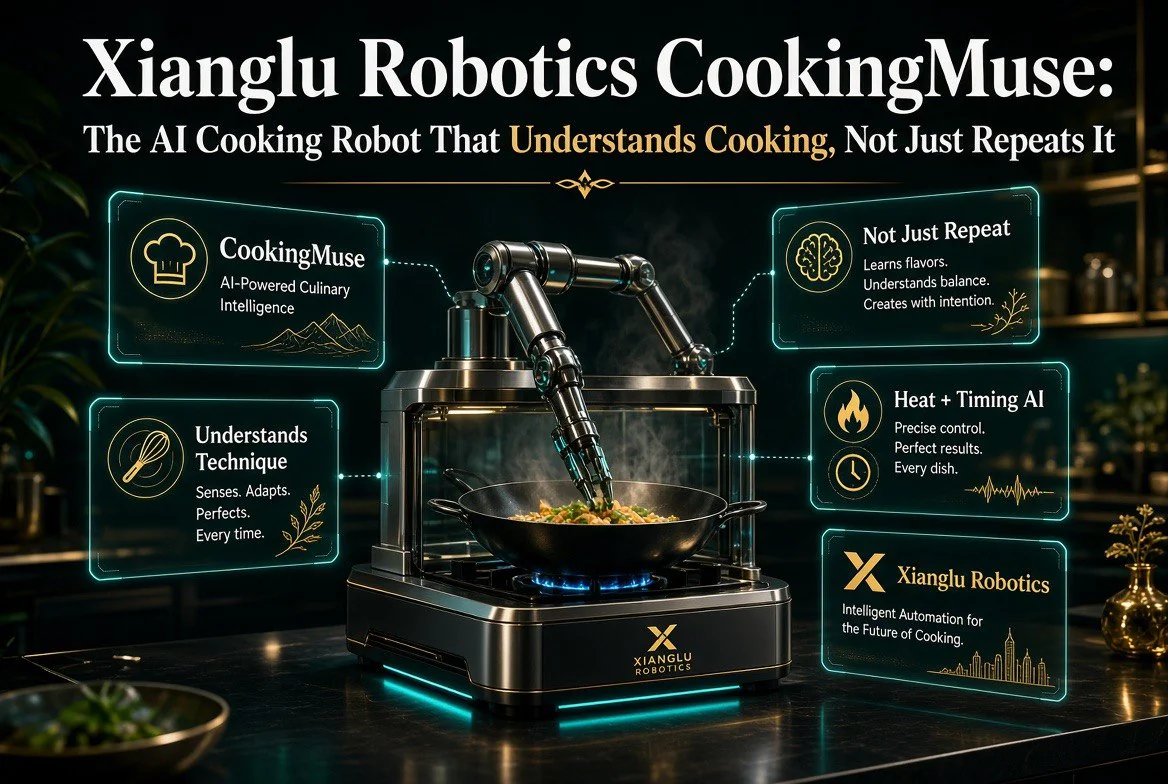
CookingMuse is the foundation of the lineup. Xianglu calls it the world’s first multimodal cooking AI foundation model trained on real kitchen data. The name matters because “foundation model” is a meaningful claim: this is not a robot that follows a hard-coded recipe routine, but a general AI system built to understand cooking the way a skilled cook does.
According to Xianglu, CookingMuse fuses vision, cooking-process data, and intelligent decision-making. The result is that an AI cooking robot no longer merely completes actions according to preset programs — it begins to understand what is happening to a dish and, on that basis, judges what should be done next. The company describes this as a capability leap from “automation” to “intelligence.”
The distinction is central. In the past, cooking robots relied on fixed timing, fixed heat levels, fixed ingredient loading, and fixed procedures to complete a dish. But real kitchens are not standard laboratories. The freshness, moisture content, size, and temperature of ingredients — and the state inside the wok — are constantly changing. Xianglu’s argument is that the truly scarce ability of a great chef is not repeating motions but continuously observing, judging, and adjusting amid change. CookingMuse is designed to give robots that adaptive judgment.
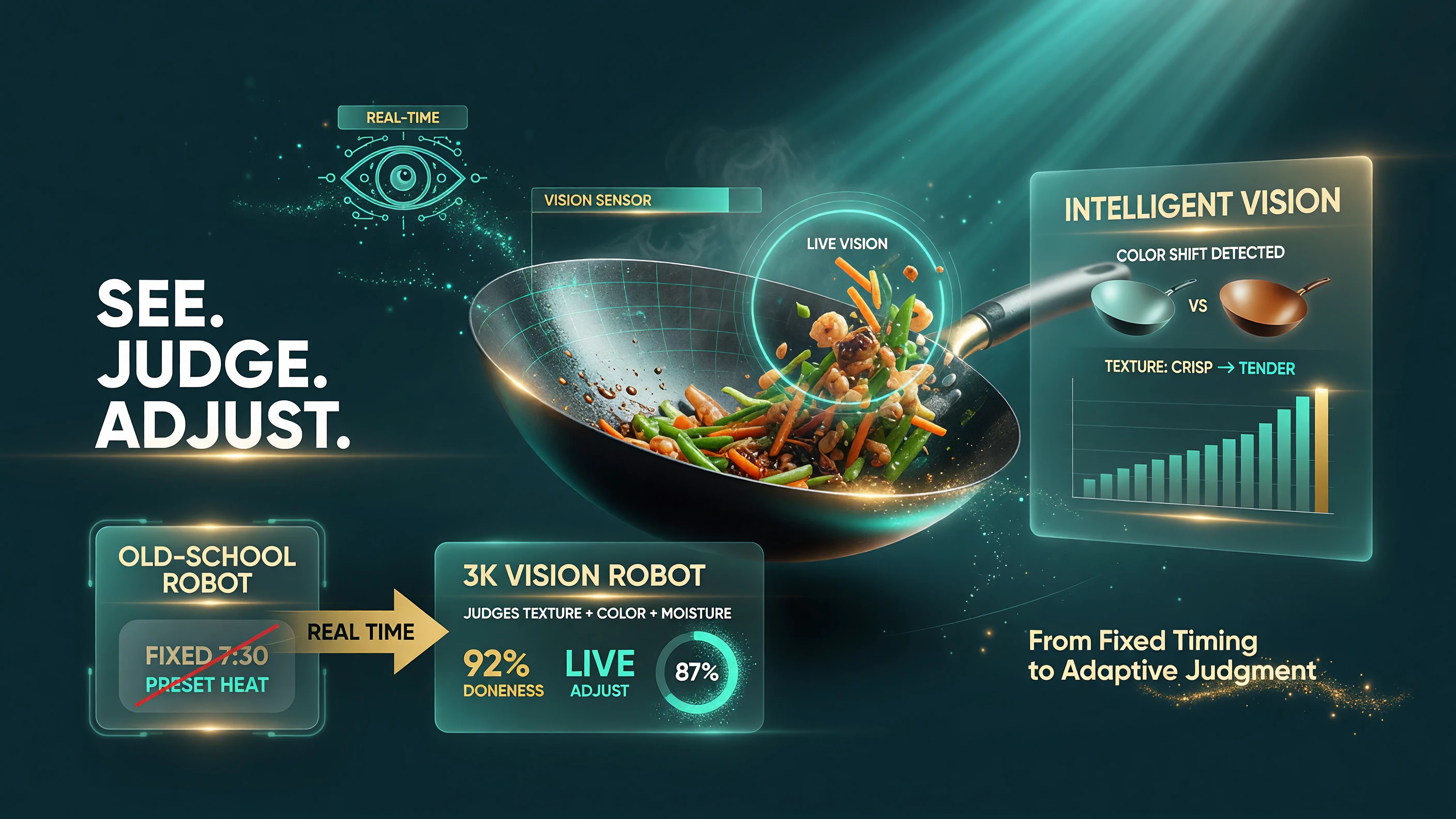
The 3K Vision Cooking Robot watches the wok: its vision sensor reads color shift and texture, so it can judge doneness and adjust live instead of following a fixed preset.
The 3K Vision Cooking Robot: Seeing and Judging
The 3K Vision Cooking Robot is the product that puts CookingMuse’s intelligence to work. Equipped with the cooking brain, it captures changes inside the wok in real time through visual perception. Xianglu says this allows the robot, for the first time, to both “see” the food and, on that basis, to “judge” what to do next.
| Capability | Old-School Cooking Robot | 3K Vision Cooking Robot |
|---|---|---|
| Method | Fixed timing, heat, ingredient loading, preset procedures | Visual perception + adaptive judgment in real time |
| What it sees | Essentially nothing — follows a scripted routine | Changes inside the wok moment to moment |
| Handles variability | Poor — ingredient size, moisture, temperature throw it off | Adjusts based on what it observes in the pan |
| Underlying AI | Fixed recipes / programmatic logic | CookingMuse foundation model trained on real kitchen data |
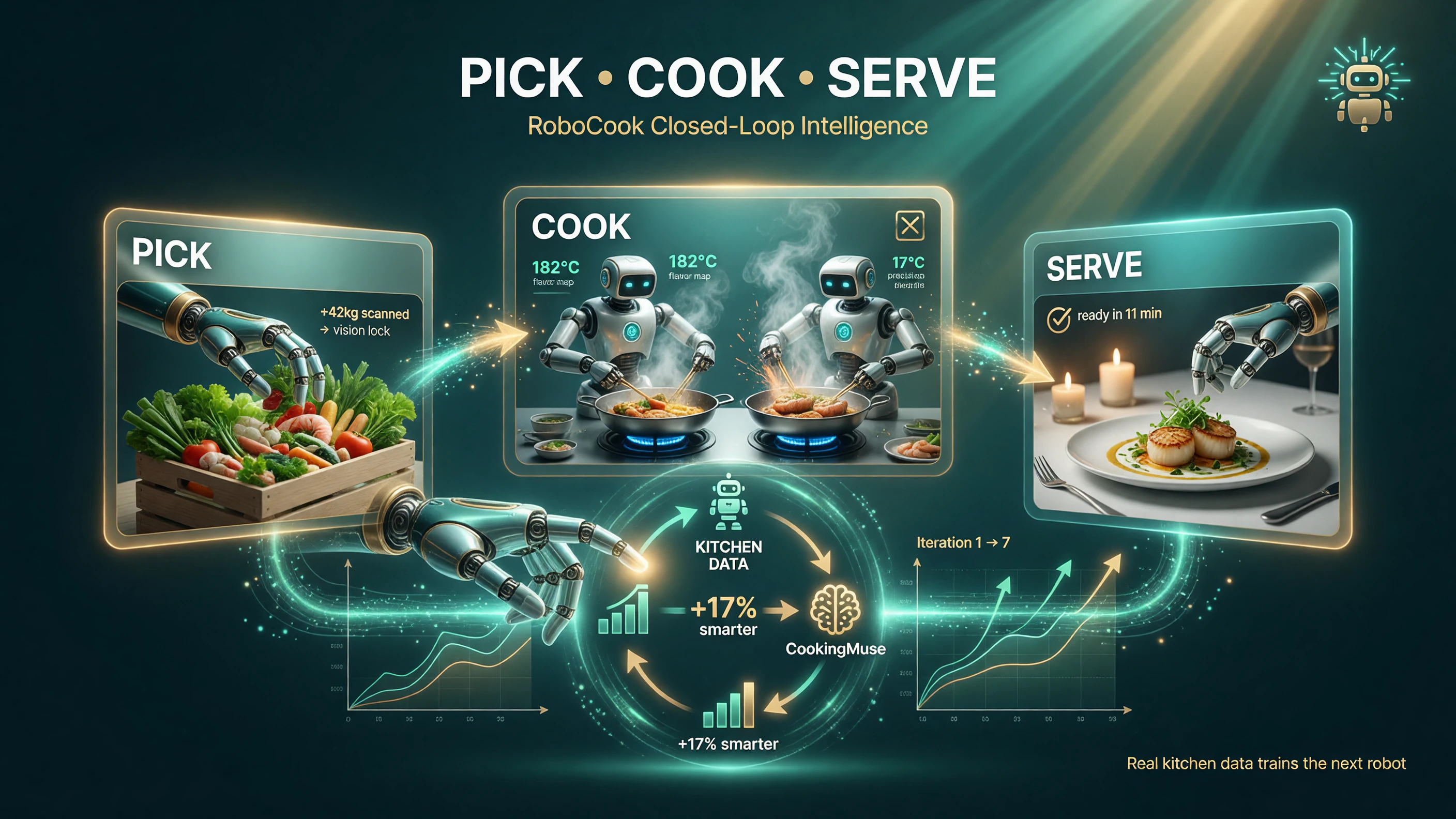
RoboCook closes the loop from raw ingredient to plated dish — and every real meal feeds back into CookingMuse, so the system gets sharper with each iteration instead of staying fixed.
The RoboCook: From Ingredient to Table
The third product, RoboCook, expands the scope from a single cooking station to the full service chain. It pairs a humanoid robot with dedicated cooking robots to complete the entire sequence: picking and placing ingredients, cooking, and serving. The aim is to let AI not only understand cooking but enter the real world and deliver a complete meal — not just produce one dish in isolation.
This matters for future deployment because a kitchen is a sequence of coordinated actions, not a single wok. RoboCook represents Xianglu’s attempt to connect the cooking brain to physical movement across the whole workflow, closing the loop from raw ingredient to plated dish.
The Closed Loop: Robot, Data, Model, Robot
Xianglu frames the entire system around what it calls a continuously evolving closed loop: “robot — data — model — robot.” The idea is that each robot deployment generates real kitchen data, which trains and improves the CookingMuse model, which in turn makes the next generation of robots smarter. Over time, the system gets better at handling the variability of real cooking because it keeps learning from real kitchens rather than from idealized lab conditions.
That data flywheel is what separates a foundation model approach from a fixed automation approach. A traditional cooking robot ships with a program and does not improve. CookingMuse is built to get sharper with every real meal it helps prepare.
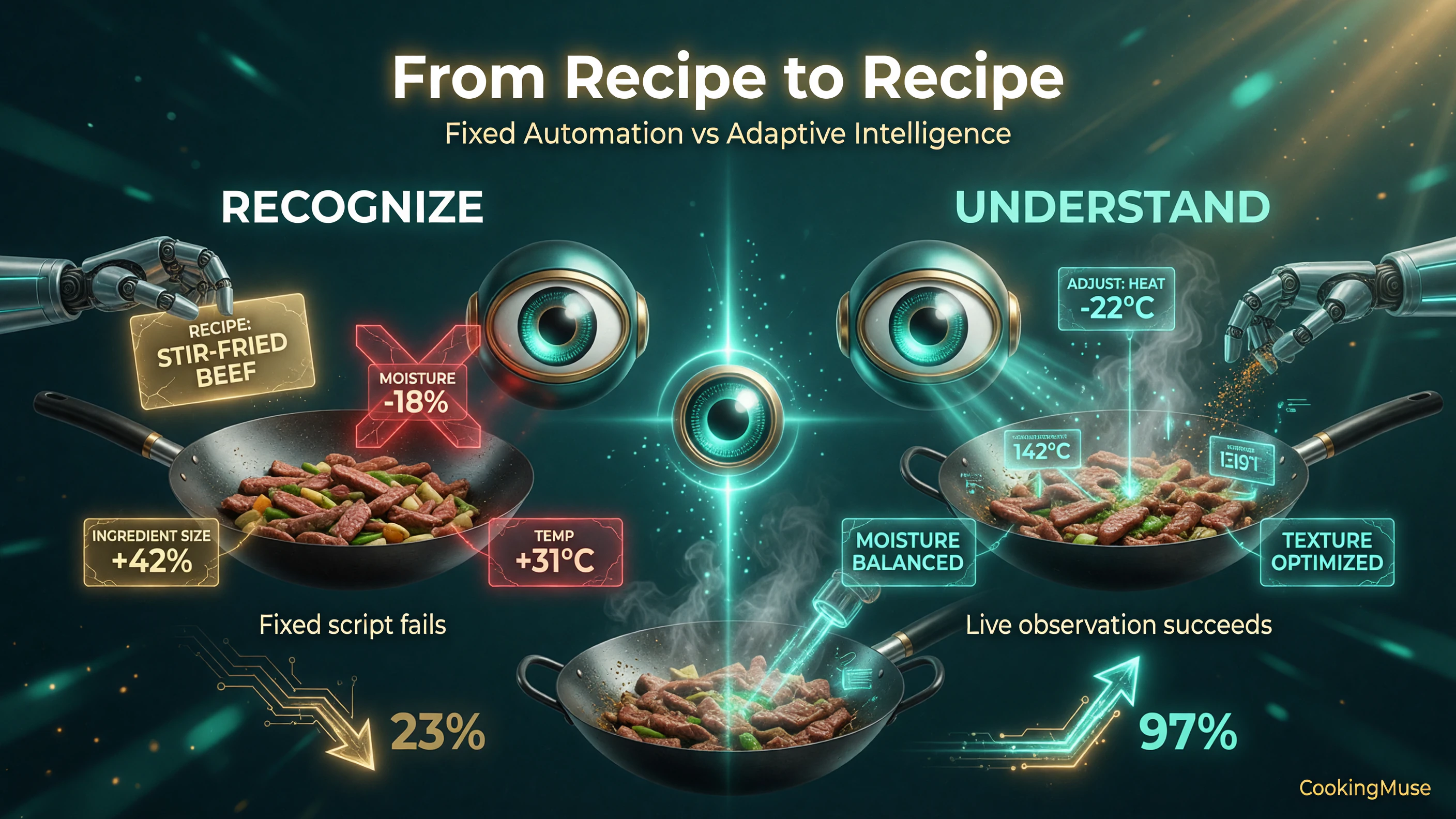
CookingMuse’s core claim: a robot that merely recognizes a dish follows fixed timing and falls apart as ingredient conditions shift, while one that understands cooking watches the pan and adapts.
From “Recognizing” to “Understanding” Cooking
The most important idea in Xianglu’s announcement is a subtle but consequential distinction: moving AI from “recognizing cooking” to “understanding cooking.” Recognizing a dish means the system can identify what something is — that a pan holds a stir-fry or a braise. Understanding cooking means the system grasps the current state of that dish and why it is in that state, so it can decide what to do next. That is a fundamentally different level of capability, and it is the core claim behind CookingMuse.
This distinction matters because it addresses the real reason cooking robots have struggled to leave the demo stage. A robot that recognizes a recipe step and executes fixed timing can make a dish look right in a controlled test. But kitchens are chaotic. The tomatoes that arrived today are riper and softer than yesterday’s batch. The walk-in runs a degree warmer in the afternoon. The wok heats differently after hours of use. A recognizing robot has no way to react to any of that; an understanding robot can see the change, judge what it means, and adjust.
That is exactly the gap Xianglu is targeting. The company’s thesis is that the scarce skill in a great kitchen is not repeating a motion but continuously observing and adapting. By building CookingMuse around that idea, Xianglu is trying to give machines the judgment layer that has historically been the domain of an experienced cook — and that is what makes the announcement more than just another robot reveal.
The Advantage of Training on Real Kitchen Data
CookingMuse’s second major claim is that it is trained on real kitchen data rather than idealized or simulated conditions. That distinction is easy to gloss over, but it is central to why the approach could actually work where earlier systems fell short.
Simulated or lab-trained cooking models learn from clean, controlled examples: perfect ingredient placement, consistent temperatures, no unexpected variables. A model trained that way can appear impressive in a test kitchen and then fail in a working restaurant, because the real world does not match its training distribution. Xianglu’s approach is the opposite: by training on real kitchen data, the model learns the messiness it will actually encounter — varying ingredient quality, different pan states, the natural noise of a busy line.
This is the same reason modern foundation models in other fields perform better than earlier rule-based systems: they are trained on the full range of real-world variation rather than a curated subset. If Xianglu has genuinely built a large, real-kitchen dataset and trained a multimodal model on it, that is a meaningful technical moat. It is also directly relevant to operators, because a robot trained on real kitchens is far more likely to survive contact with an actual line than one trained in a lab.
Why This Matters for Restaurant Operators
For independent restaurant owners and operators, the significance of Xianglu’s announcement is not the novelty of a robot flipping food. Robots have been doing that for years. The meaningful shift is the move from scripted automation to adaptive intelligence — a robot that can handle the messiness of real ingredients the way a line cook does.
If that capabilty matures, it changes the labor math in a kitchen. The hardest roles to staff are the ones that require judgment: knowing when a sauce is right, when to pull something off the heat, how to adjust for a batch of produce that came in a little different. CookingMuse’s whole premise is to give machines that judgment so they can take on more of the cooking work autonomously while human staff handle the parts that still need a person.
What This Means for the Menu and the Line
If CookingMuse-class systems reach commercial maturity, they have direct implications for how a menu and a kitchen line are run. The most obvious application is high-volume, repeatable dishes where consistency matters — the same plat on the same portion, pulled at the same doneness, every shift. A robot with adaptive judgment can hold that consistency without tiring, which has real value for a busy kitchen.
But there is also a more interesting implication: a robot that understands cooking can be retrained for new dishes far more easily than a robot that must be reprogrammed line by line. Because CookingMuse is a foundation model, operators would ideally teach it a new dish through data and examples rather than rewriting procedures. That changes the economics of automation — instead of a dedicated machine locked to one product, a single adaptable system could handle a rotating menu.
For an independent restaurant, that flexibility is the difference between automation that only works for a chain with one signature item and automation that could realistically fit a varied, changing menu. It is a speculative future, and Xianglu has not yet proven commercial deployment at that level, but it is the direction the company’s technology points toward.
Questions an Operator Should Ask
| Question | Why It Matters |
|---|---|
| What menus can it cook reliably? | A foundation model trained on real kitchen data is only useful if it covers the dishes your kitchen actually serves. |
| How does it handle quality controls and food safety? | Adaptive cooking is promising, but operators need documented consistency and safety standards before trusting it with paying customers. |
| What is the real cost per meal? | Hardware, maintenance, and the data pipeline all add up — is the labor savings real after accounting for the system? |
| Is it deployable today or a concept? | Announcements at conferences like WRC are often early-stage — confirm commercial availability before planning around it. |
Limitations and Caveats
- Early-stage capability claims — CookingMuse is presented at a conference launch, and the distance between a foundation-model demonstration and a dependable commercial kitchen system is significant.
- Real-world validation pending — the 3K Vision robot’s adaptive judgment needs proven track records in busy, high-volume kitchens before operators can rely on it.
- Deployment is not turnkey — integration into an existing kitchen, training on a specific menu, and staff workflows remain open questions.
The Bottom Line
Xianglu Robotics’ CookingMuse represents an important conceptual milestone in cooking robots: the shift from machines that repeat fixed procedures to machines that understand and adapt to real cooking. For operators, the takeaway is not to buy today, but to watch closely. The “robot — data — model — robot” loop is a credible path to robots that genuinely help in the kitchen, and the company’s real-kitchen-data approach addresses the core weakness of earlier cooking robots. When — and if — this capability reaches commercial deployment at a price that makes sense for a working kitchen, it could genuinely change the labor equation. Until then, treat it as a meaningful signal of where kitchen robotics is headed.
Frequently Asked Questions
What is CookingMuse?
CookingMuse (Chuqi) is a multimodal cooking AI foundation model from Xianglu Robotics, described as the world’s first such model trained on real kitchen data. It is designed to help robots understand and judge cooking rather than just repeat fixed programs.
What is the 3K Vision Cooking Robot?
It is a cooking robot equipped with the CookingMuse brain that uses visual perception to see changes inside the wok in real time and judge what to do next, enabling adaptive rather than scripted cooking.
What is RoboCook?
RoboCook pairs a humanoid robot with dedicated cooking robots to complete the full chain — picking and placing ingredients, cooking, and serving — letting AI deliver a complete meal.
How is this different from earlier cooking robots?
Earlier robots relied on fixed timing, heat, and procedures. CookingMuse-based robots observe what is happening to the dish and adjust, moving from automation to adaptive intelligence.
Is this available for restaurants now?
These products were launched at the 2026 World Robot Conference and are early-stage. Operators should confirm commercial availability and reliability before planning around them.

About Barak Schurr
Barak Schurr built and exited a major ticketing platform, ran global operations at Eventbrite, and now focuses on one question: which AI tools actually help independent restaurant owners run leaner and grow faster. He writes from the operator’s perspective — no vendor spin, no theory, just what’s real in 2026.
Email: [email protected]
More Restaurant AI Resources