Get the AI Restaurant Quick-Start Guide — Free
The 5 AI tools independent US restaurant owners are using right now to cut labor costs and answer every call.
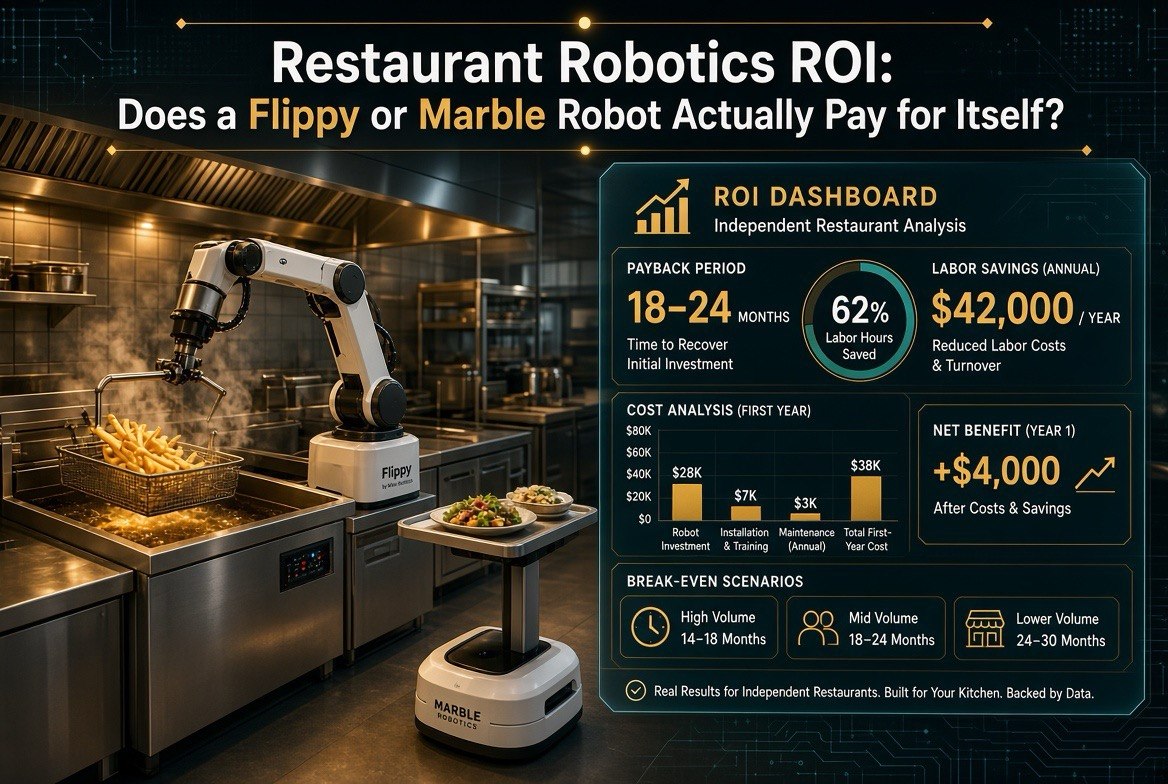
Restaurant Robotics ROI: Does a Flippy or Marble Robot Actually Pay for Itself?
⚡ Expert Summary: Restaurant robotics are no longer a novelty, but the decision to buy is a financial one, not a tech one. A robotic fry station like Flippy, a serving robot like Marble, or a robotic wok each has a different payback period depending on labor cost, throughput, and install price. This guide gives the real ROI math so an independent operator knows whether the robots pay for themselves — and in how many months.
A fry cook in the United States can cost an operator $16 to $20 an hour before benefits, payroll taxes, and overtime. Over a year, one full-time equivalent position on a fry station can run $40,000 to $50,000 in loaded cost. That is the number every robotics pitch leads with. But the honest question is not “does the robot replace a person,” it is “does the robot replace the specific labor hours I actually have, at a throughput my kitchen can sustain, and pay back its purchase price before it needs service or replacement?”
Restaurant robotics took a major step forward in late 2025 and 2026. Serious capital went into the space, and the hardware matured from demo units to commercially deployed systems in franchise kitchens and independent venues. Companies like Miso Robotics (Flippy), Marble (serving robots), and a wave of robotic wok and fry concepts in the Asian quick-service segment all claim labor savings. This guide walks through the real margin math each type of robot delivers, so you can decide which — if any — belongs in your kitchen.
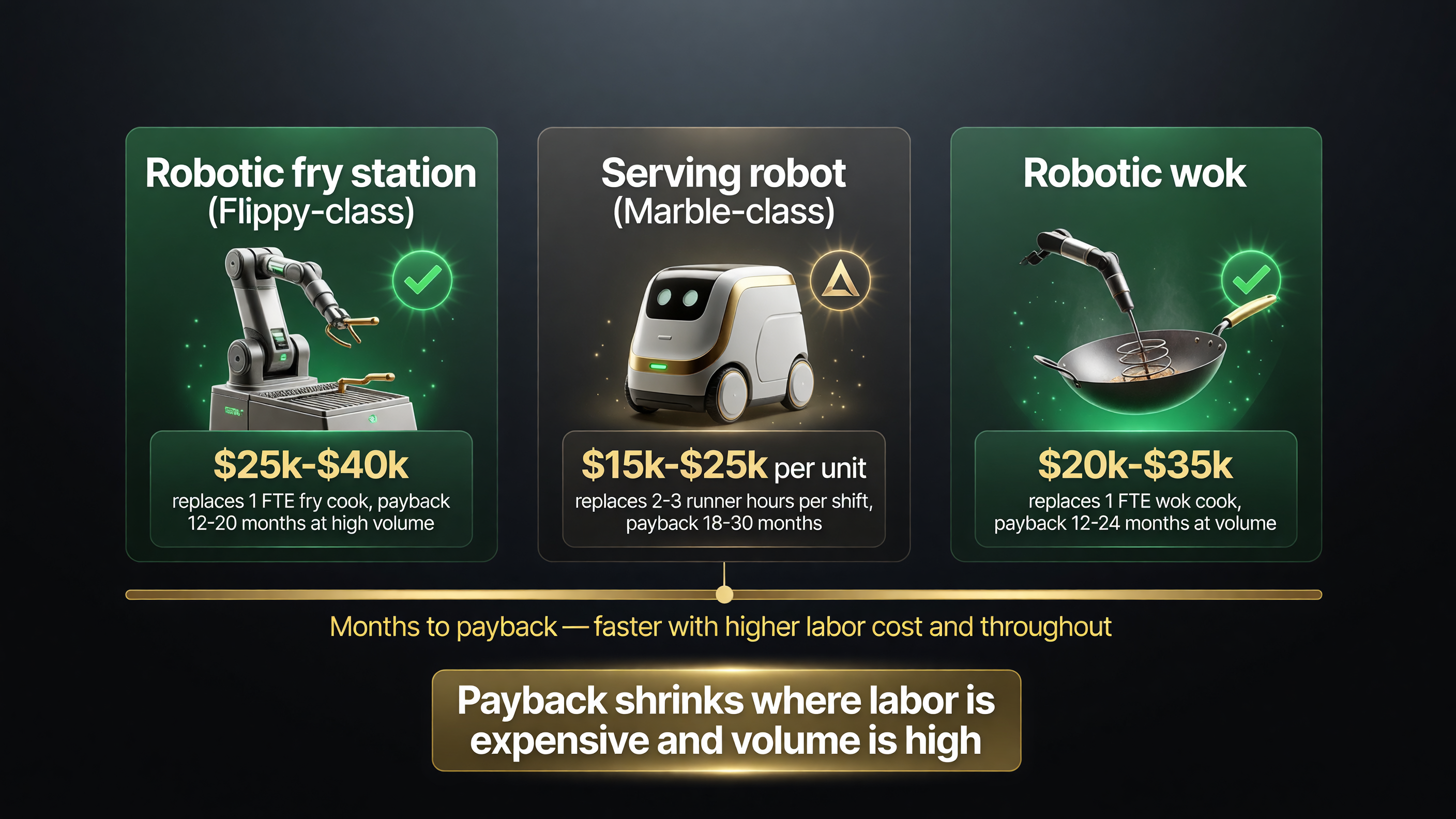
Caption: Realistic payback windows by robot type. Flippy-class fry stations run 5k-0k with 12-20 month payback at volume; Marble serving robots run 5k-5k per unit with 18-30 month payback; robotic woks run 0k-5k with 12-24 month payback. Payback shrinks where labor is expensive and throughput is high.
How to Read a Robotics ROI Calculation
Every robot ROI pitch comes down to three variables: how much labor it replaces, how much the hardware costs, and how many orders it can actually handle in your kitchen. Get these three right and the payback math is simple. Get the throughput assumption wrong and the robot becomes an expensive shelf ornament.
The classic formula is: (loaded labor cost per hour × hours replaced per day × 365) − (installation + subscription + maintenance per year) ÷ (purchase price) = months to payback. Most vendors assume near-total replacement of a full shift and near-maximum throughput every day. Real kitchens run at partial capacity, so build in a 70-80% utilization factor before you trust a vendor’s numbers.
Also budget for the non-obvious costs: installation and kitchen reconfiguration, staff training that takes hours out of your busiest shifts, ongoing maintenance contracts, and software subscriptions that some vendors bill monthly. A robot with a low sticker price can carry a heavy total cost of ownership when subscriptions stack up.
| Robot Type | Typical Price | Labor Replaced | Realistic Payback |
|---|---|---|---|
| Robotic fry station (Flippy-class) | $25k-$40k | 1 FTE fry cook | 12-20 months at high volume |
| Serving robot (Marble-class) | $15k-$25k per unit | 2-3 runner hours/shift | 18-30 months |
| Robotic wok | $20k-$35k | 1 FTE wok cook | 12-24 months at volume |
The payback ranges show why volume is the whole game. A robot pays back fastest where throughput is highest and labor cost is highest. A high-volume franchise location in a major US city pays back a fry robot faster than a low-traffic independent location in a smaller market, even when the hardware price is identical.
The Fry Station Robot: Flippy and Its Class
Flippy, built by Miso Robotics, is a robotic arm that runs a fry station. It picks baskets, drops them into the fryer, monitors cook time, shakes the basket, and plates the order. The pitch is that a fry station is the highest-turnover, most repetitive job in a kitchen and the hardest to staff, so replacing it has outsized value.
The realistic math for a Flippy-class robot: loaded fry-cook labor at roughly $45,000 per year, hardware and install in the $25,000 to $40,000 range, plus a monthly software and service fee typically in the low hundreds. At a location that runs the fry station 10 to 12 hours a day, the labor replaced is close to a full FTE, and the system can pay back in roughly 12 to 20 months.
The caveats are real. The robot needs stations it can physically reach, which often means kitchen reconfiguration. It needs a steady baseline of fry orders to stay busy; a location that only does a few hundred dollars of fry business a day will not get the utilization. And it still needs a person to load product and handle fryer maintenance, so the savings are a full position only if those tasks were separate from the fry cook’s job to begin with.
The Serving Robot: Marble and Its Class
Marble builds delivery robots, but in the restaurant robotics context the relevant product class is the on-premise serving robot — the rolling units that carry food from the pass to tables or from the kitchen to the drive-through window. These are cheaper per unit than prep robots, which is why many operators try them first.
The realistic math: a serving robot in the $15,000 to $25,000 range replaces two to three runner-hours per shift, not a full position. Runners make less than cooks, and a robot still needs a human to load it and mind it in traffic. The payback stretches to 18 to 30 months because the labor replaced is cheaper and partial.
Serving robots earn their keep differently: they reduce steps in the back of house, cut plate-drop frequency, and let existing staff focus on guest service. Those are real benefits, but they show up as efficiency gains rather than a clean headcount removal. For the ROI math, count them as labor-hours saved, not as a full position eliminated.
The Robotic Wok
Robotic woks and automated wok stations are the fastest-growing segment in the Asian quick-service space, and they solve a different problem. A skilled wok cook is expensive, hard to find, and hard to keep. A robotic wok standardizes stir-fry output and can run multiple dishes with consistent timing.
The realistic math mirrors the fry station: $20,000 to $35,000 for the unit, replacement of roughly one FTE wok cook, and a 12 to 24 month payback at consistent volume. The twist is that the robotic wok also improves consistency and reduces the training burden of a skilled position, which adds value beyond raw labor cost.
For an operator deciding between a fry robot and a wok robot, the wok usually pays back faster in kitchens where stir-fry volume is high and the skilled-cook shortage is acute. The fry robot pays back better in high-throughput fry-heavy concepts like burgers and chicken tenders.
The Real Decision Framework for Independent Operators
Before you buy any robot, run this five-step check:
- Identify the specific labor hours you want to replace and what they actually cost loaded, not just the hourly wage.
- Measure your real throughput on that station or task for 2-4 weeks. Vendors assume peak; you live in averages.
- Price total cost of ownership: install, reconfiguration, training, subscription, and maintenance — not just the sticker.
- Compute payback at 75% of claimed utilization and decide if that month count is acceptable for your business.
- Run a 30-60 day pilot if the vendor offers one, before committing to a purchase.
This keeps your downside small. A robot that pays back in 14 months at peak but 26 months at real-world utilization may not clear your hurdle. The sequence protects you from the volume-based assumptions that make vendor ROI sheets look better than your kitchen will deliver. For a wider look at how AI and automation are reshaping independent kitchen economics, browse the AI for Restaurants guide hub.
When Robotics Actually Make Financial Sense
Robotics make the most sense when three conditions line up: labor cost is high, the task is repetitive and high-volume, and the skill is scarce. In a restaurant operating area where fry cooks or wok cooks are hard to hire and cost $18+ an hour loaded, a prep or cook robot can be a genuine ROI win. In a location where throughput is modest and labor is cheaper, the same robot is a slow payback.
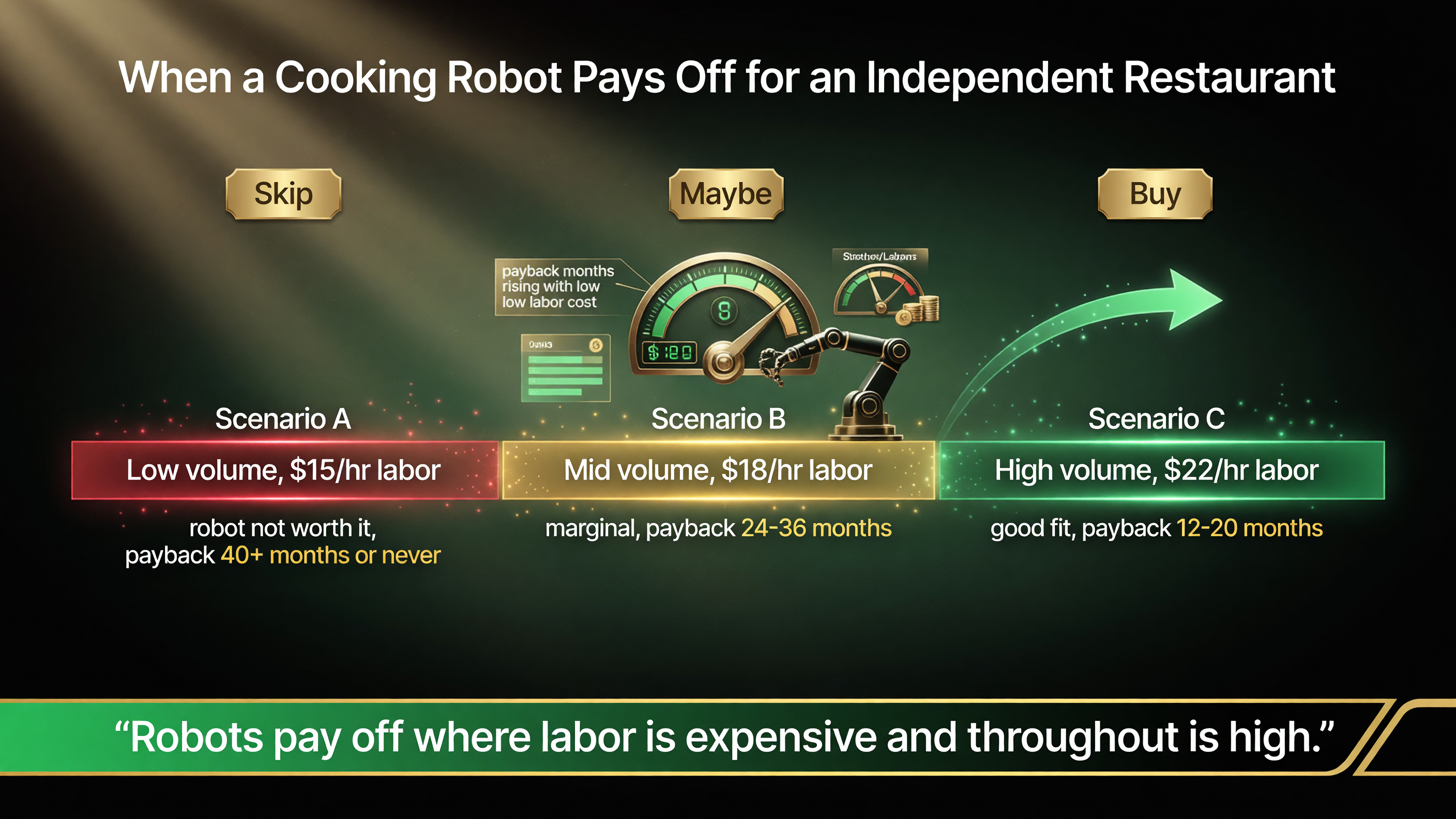
Capacity: Whether a cooking robot pays off comes down to labor cost and throughput. Low volume with $15/hr labor means a 40+ month payback or never (skip); $18/hr mid volume is marginal at 24-36 months (maybe); high volume with $22/hr labor is a genuine fit at 12-20 months (buy). Robots pay off where labor is expensive and throughput is high.
The bigger trend in 2026 is that robotics vendors have shifted from selling hardware to selling labor-as-a-service — subscription models where the robot is bundled with service, software, and support for a monthly fee. That changes the math from a capital purchase you depreciate to an operating expense you can tune. For an independent operator with limited capital, the subscription path de-risks the decision because you can scale the robot up or down with your volume.
Whether you buy or subscribe, the decision rule is the same: the robot has to replace labor hours at a cost you can measure, at a volume your kitchen can sustain, and pay back within a period you can tolerate. Run the numbers at realistic utilization, not the vendor’s peak, and you will rarely make a bad robotics decision.
The Bottom Line
Restaurant robotics are real, they are improving, and they can be a strong ROI for the right kitchen — but they are not a universal win. A Flippy-class fry robot or a robotic wok can pay back in 12 to 24 months when labor is expensive, volume is high, and the skilled position is hard to fill. A serving robot like Marble pays back more slowly because it replaces cheaper runner hours. The deciding factor is always the same: run the per-ticket and per-hour math at real utilization, price the total cost of ownership, and pilot before you buy. Do that and the robots will tell you honestly whether they belong in your kitchen.
FAQ
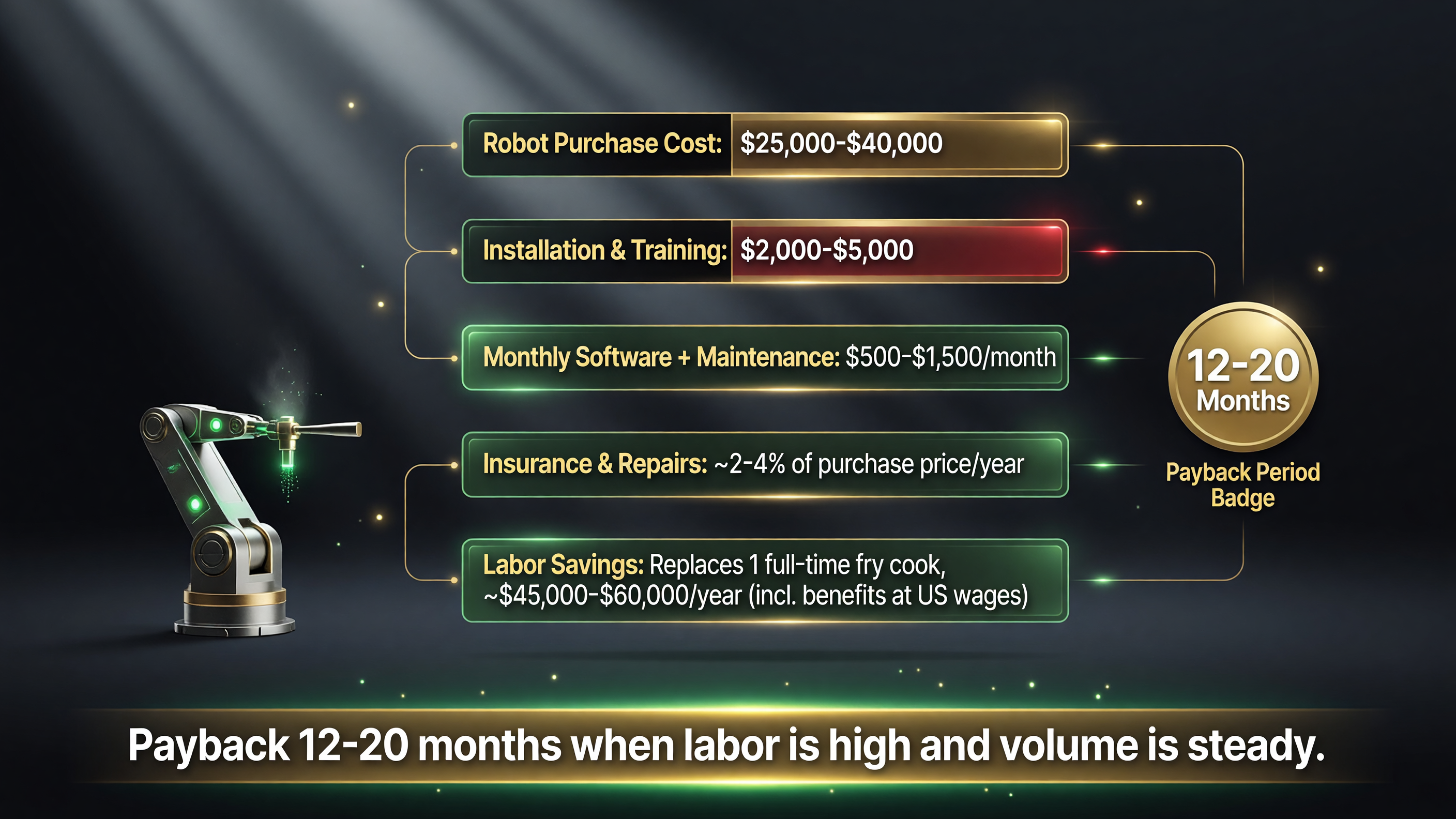
Caption: The full cost picture. Purchase runs 5k-0k, installation and training k-k, software and maintenance 00-,500 a month, insurance and repairs 2-4% of price a year. Against one replaced fry cook (~5k-0k a year), payback lands at 12-20 months when labor is high and volume is steady.
How long does it take for a restaurant robot to pay for itself?
A Flippy-class fry robot or a robotic wok typically pays back in 12 to 24 months at high volume, while a serving robot like Marble usually stretches to 18 to 30 months because it replaces cheaper runner hours. Your actual payback depends on labor cost, throughput, and total cost of ownership.
What is the most realistic ROI calculation for restaurant robotics?
Take loaded labor cost per hour times hours replaced per day times 365, subtract yearly installation, subscription, and maintenance, then divide by the purchase price to get months to payback. Run the number at 75% of the vendor’s claimed utilization, not peak, to avoid overestimating savings.
Is a Flippy fry robot worth it?
Flippy-class fry robots can be worth it in high-volume, fry-heavy kitchens where a loaded fry cook costs $40,000 to $50,000 a year. Expect a 12 to 20 month payback at high throughput, but budget for installation, reconfiguration, and a monthly software or service fee.
Do restaurant robots actually replace employees?
Prep and cook robots can replace close to one full-time position on a repetitive station, while serving robots typically replace only two to three runner hours per shift. Most robots still need a person to load, monitor, and maintain them, so savings are partial rather than total headcount removal.
Can an independent restaurant afford a robot?
Yes, especially through subscription or labor-as-a-service models that turn the hardware cost into a monthly operating expense. The payback only works if your kitchen has the throughput and labor cost to feed the robot, so run the math at real utilization before buying.

About Barak Schurr
Barak Schurr built and exited a major ticketing platform, ran global operations at Eventbrite, and now focuses on one question: which AI tools actually help independent restaurant owners run leaner and grow faster. He writes from the operator’s perspective — no vendor spin, no theory, just what’s real in 2026.
Email: [email protected]
More Resources for Restaurant Operators