Get the AI Restaurant Quick-Start Guide — Free
The 5 AI tools independent US restaurant owners are using right now to cut labor costs and answer every call.
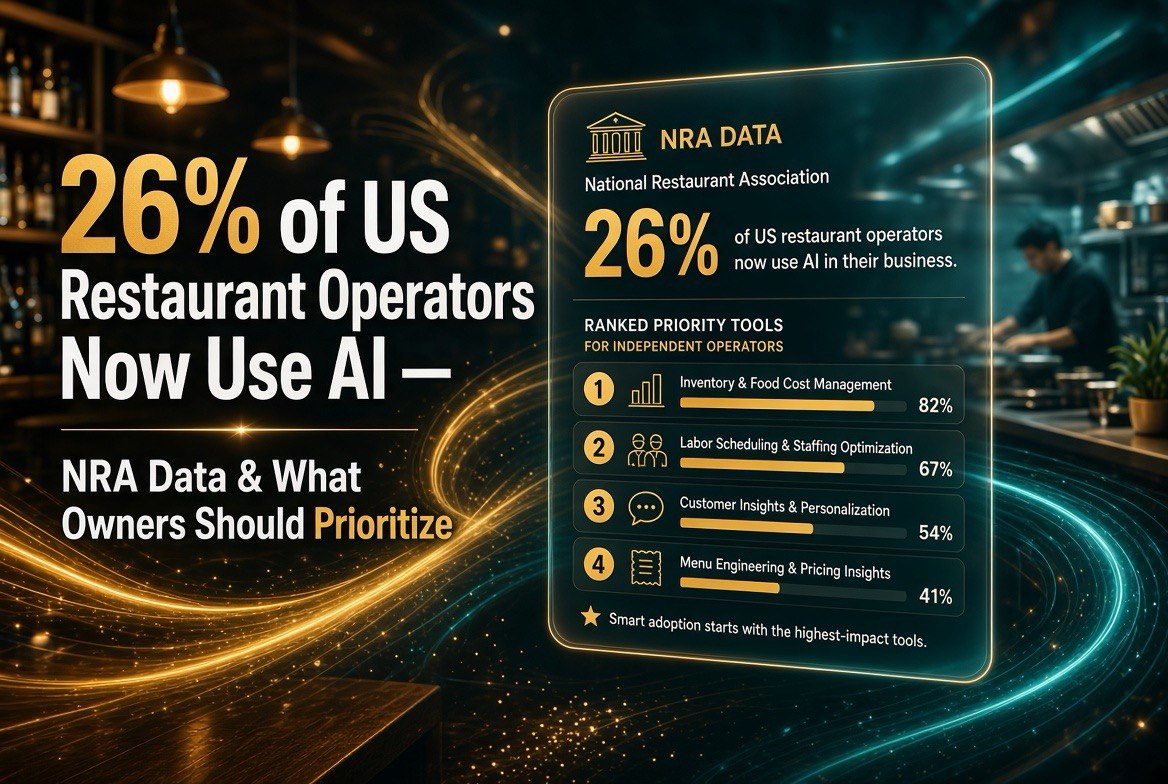
26% of US Restaurant Operators Now Use AI — NRA Data & What Owners Should Prioritize
\n\n
Here is the number that should reframe how you think about your competition: 26% of US restaurant operators now use AI tools at their restaurants. That figure comes from the National Restaurant Association’s State of the Restaurant Industry 2026 report, and it means one in four operators is no longer treating AI as a buzzword. They are using it on the job, today.
\n\n
For independent owners still on the fence, the question is no longer should I use AI? It is where do I start so I am not the one left behind? The good news is the NRA data also tells you exactly where other operators are finding value first — and it is probably not where you expect.
\n\n
\n\n
What the 26% Actually Means
\n\n
The NRA’s State of the Restaurant Industry 2026 report, released in February 2026, surveys a broad, representative slice of operators — not just tech-forward chains. That is why its number reads lower than some vendor studies. When a survey is run by the people selling the software, adoption always looks higher. The NRA’s figure is the honest, sector-wide baseline: about one in four operators is actively using AI right now, not merely piloting or planning it.
\n\n
What matters for you is not the exact percentage — it is the direction. A quarter of your peers have moved past the hype and are using AI for real work. Within a couple of years that number will climb toward the majority. The operators who figure out the high-value uses now will have the processes and the cost advantages before the rest of the market catches up.
\n\n
\n
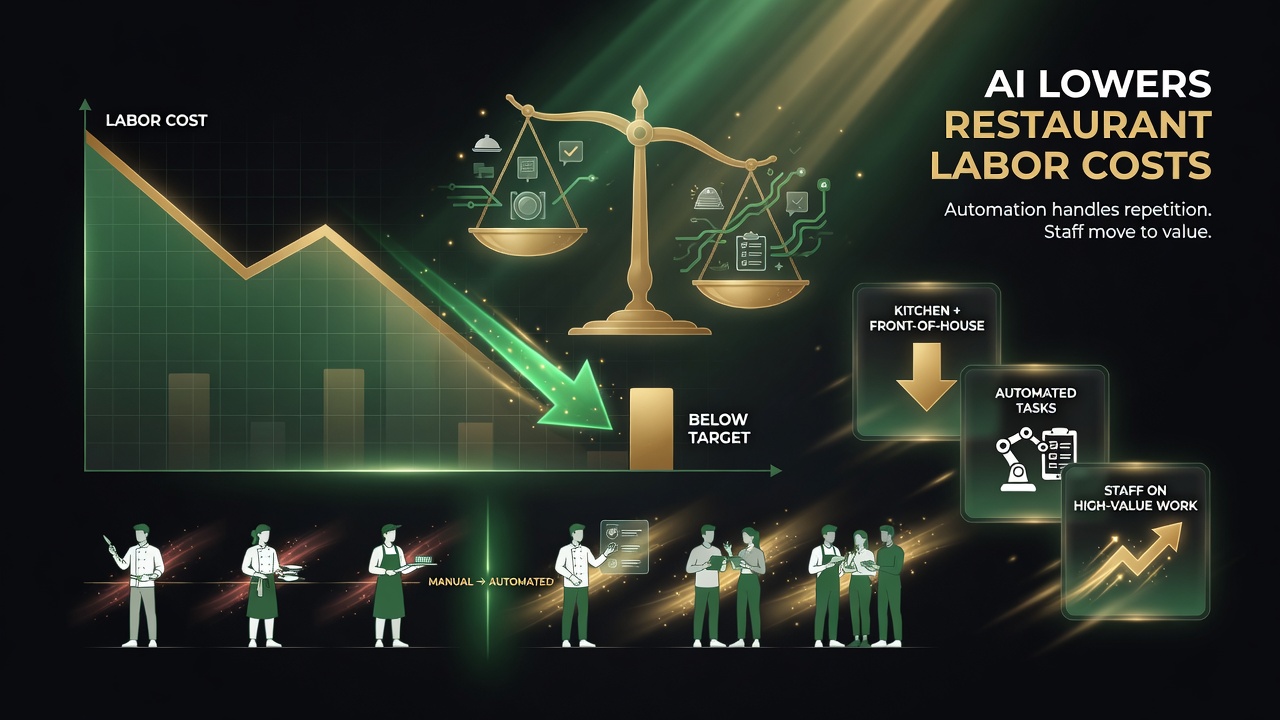
AI pulls labor costs below target: automation absorbs repetitive work so fewer hours go to manual tasks, freeing staff for higher-value roles.
\n
The Leading Use: Marketing, Not Robots
\n\n
Here is the surprise in the data. When most owners picture restaurant AI, they picture drive-thru voice ordering or kitchen robots. But the NRA report shows the top practical use today is far more accessible: marketing assistance — 19% of full-service operators and 15% of limited-service operators use AI for marketing.
\n\n
That makes sense when you think about it. Menu descriptions, social posts, email campaigns, response to reviews — these are repetitive, time-consuming, and perfect for AI. They do not require new hardware, they do not disrupt the kitchen, and they deliver visible output in minutes. Marketing is the low-risk on-ramp most operators can adopt this week.
\n\n
Administrative tasks run a close second. The pattern across the NRA data is consistent: AI is earning its keep in the back office and the marketing side before it ever touches the food line.
\n\n
What Owners Should Prioritize — In Order
\n\n
If you are an independent operator looking at a budget and a to-do list both stretched thin, you cannot do everything. Here is the priority order the NRA data and real adoption patterns support:
\n\n
- \n
- Marketing and guest communication first. Lowest friction, fastest visible results, uses tools you likely already pay for. Emails, social, menu copy, review responses.
- Back-office automation second. Food costing, inventory, scheduling, reporting. This is where the quiet money is — it does not generate a flashy demo, but it protects margin.
- Guest-facing AI last. Voice ordering, AI phone agents, kiosks. Higher cost, more disruption, and you should wait until the operational basics are stabilized.
\n
\n
\n
\n\n
That is the opposite of the instinct to chase the most impressive technology. The operators getting real ROI are the ones starting with the boring, repetitive work and scaling from there.
\n\n
\n
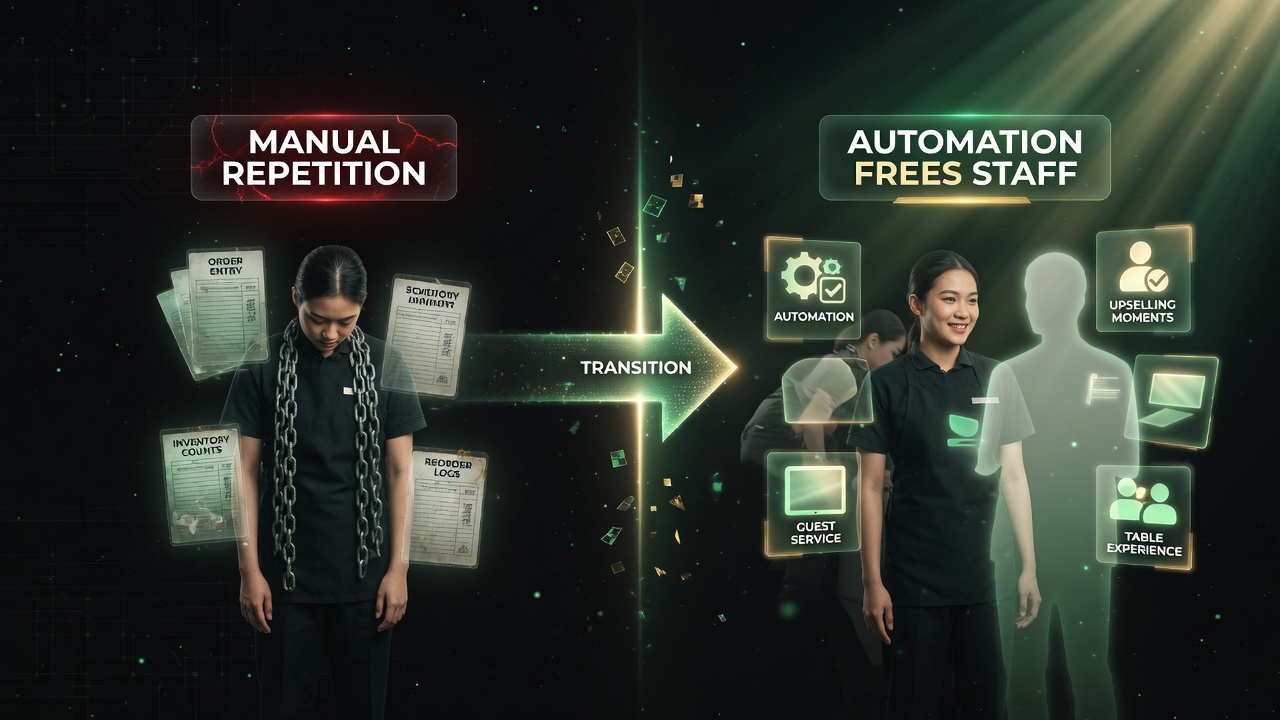
When routine order entry, inventory and scheduling move to automation, staff shift from manual repetition to guest service and upselling.
\n
The Adoption Gap Between Haves and Have-Nots
\n\n
The NRA picture gets sharper when you look at who is adopting and who is not. Larger and multi-unit operators are moving faster, pulling further ahead on labor efficiency and food-cost control. Independent single-unit owners are the slowest to adopt — not because the tools do not work for them, but because they wear every hat and have no time to research, let alone implement, anything new.
\n\n
That gap is exactly why the data matters. The competitive pressure is not coming from the companies already using AI; it is coming from the fact that they are compounding efficiency while you are still deciding where to begin. Here is the comparison, straight:
\n\n
| Factor | Early AI Adopters | Still Deciding |
|---|---|---|
| Marketing output | Campaigns and posts generated in minutes | Drafts eaten up by manual writing time |
| Food cost control | AI costing and inventory tools watching margins | Manual spreadsheets, updated rarely |
| Labor efficiency | Automated scheduling and admin relief | Owner and managers buried in repetitive tasks |
| Time to results | Compounding weekly | Still waiting for the right moment |
\n
\n\n
The gap is not about a single dramatic invention. It is the compounding effect of small efficiencies applied every week by the quarter of operators who have already started.
\n\n
And it is worth being blunt about what that compounding does to a menu and a P&L. The operator who saves ten hours a week on admin can spend that time on the floor, on the pass, or improving the guest experience that keeps regulars returning. The operator who keeps doing everything by hand is spending those same ten hours typing emails and entering inventory numbers by midnight. Year after year, that is the difference between a business that reinvests in itself and one that is just surviving week to week.
\n\n
\n\n
How Much Time Does a Typical Operator Spend on AI-Ready Tasks?
\n\n
To make the decision concrete, it helps to see where the hours actually go. Most of the repetitive load an AI tool can carry falls into a few buckets, and each one maps to a specific, affordable tool:
\n\n
| Task | Typical Weekly Load | AI Replacement |
|---|---|---|
| Social posts and menus | 2–4 hours | AI drafts from your notes in minutes |
| Email campaigns | 1–3 hours | AI writes and segments the list |
| Review responses | 1–2 hours | AI drafts on-brand replies |
| Food costing and inventory | 3–5 hours | AI costing tools track margins live |
| Staff scheduling | 2–3 hours | AI optimizes shifts against labor cost |
\n
\n\n
Add that up and the repetitive load runs 9 to 17 hours a week — essentially a full second shift of admin work per week that AI can largely carry. That is the real ROI story behind the 26% adoption figure.
\n\n
Start Small, but Start Now
\n\n
The single best move an independent operator can make this quarter is not to buy a big-ticket AI system. It is to pick one repetitive task and offload it this week. Start with something you already touch daily — writing a marketing email, responding to a review, costing a menu item — and use a free or low-cost AI tool to do a first draft, then review and refine it.
\n\n
The goal is not perfection on day one. It is building the habit and the confidence to expand. The owners who are part of that 26% did not transform overnight; they started with one useful task and kept going. You are never going to feel ready, and waiting only widens the gap between your operation and the one down the street that has already started.
\n\n
Set a tiny, concrete goal to make it stick: this week, use AI to write one marketing email and one week’s worth of social posts, then run your regulars’ special that you have been meaning to promote. Next week, cost your five best-selling menu items and see which ones are actually carrying their weight. Small, finished tasks beat grand plans that stall, and each one gives you a real example of the tool working for your specific operation.
\n\n
\n
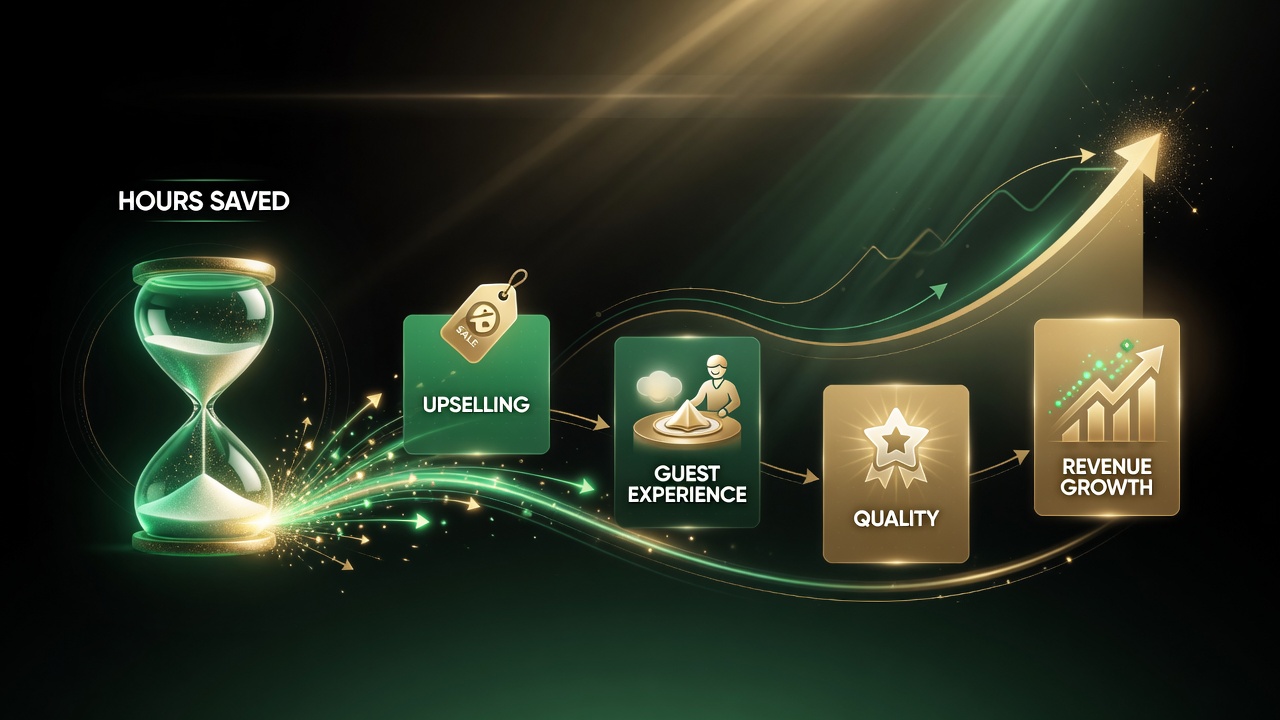
Saved labor hours flow back into upselling, guest experience and quality, turning cost savings into revenue growth.
\n
The Bottom Line
\n\n
The NRA’s 26% figure is the clearest signal yet that AI in restaurants has crossed from experiment to normal practice. It is not about robots replacing cooks and it is not a distant future — it is one in four operators using AI for marketing, admin, and efficiency right now. The gap between early adopters and everyone else is already compounding.
\n\n
Start with the boring work. Marketing and back-office tasks give you the fastest, safest wins, and they build the foundation for whatever comes next. By the time the next NRA report comes out and the number is 40% or 50%, you want to be on the right side of the statistic, not a line item in it.
\n\n
\n\n
Frequently Asked Questions
\n\n
What is the current rate of AI adoption in US restaurants?
\n
According to the National Restaurant Association’s State of the Restaurant Industry 2026 report, 26% of US restaurant operators report actively using AI tools at their restaurants. This is a broad, representative benchmark of active use, not planned or piloted adoption.
\n\n
What do restaurants use AI for most?
\n
Marketing is the leading use. The NRA 2026 report finds 19% of full-service and 15% of limited-service operators use AI for marketing assistance, followed by administrative tasks. Guest-facing applications like voice ordering see lower adoption.
\n\n
Is 26% adoption high or low?
\n
It is a strong baseline for a sector that is often slow to adopt technology. Some vendor-run surveys report higher figures because they include planned adoption or focus on digital-first operators, but the NRA figure reflects broad, active use across the industry.
\n\n
Should independent owners start with the most advanced AI?
\n
No. The data supports starting with marketing and back-office tasks first — they are low-risk, fast to implement, and deliver visible results. Guest-facing AI like voice ordering and kiosks should wait until operational basics are stabilized.
\n\n
How much time can AI save a restaurant operator?
\n
Typical repetitive tasks — social posts, emails, review responses, food costing, scheduling — add up to roughly 9 to 17 hours a week. AI can carry much of that load, which is the core value behind adoption.
\n\n
Where can I check the full NRA report?
\n
The State of the Restaurant Industry 2026 report is published by the National Restaurant Association and available through restaurant.org. Coverage of the AI adoption figures appeared in Restaurant Dive and other restaurant industry trade outlets in early 2026.
\n\n\n\n\n
 \n
\n
About Barak Schurr
\n
Barak Schurr built and exited a major ticketing platform, ran global operations at Eventbrite, and now focuses on one question: which AI tools actually help independent restaurant owners run leaner and grow faster. He writes from the operator’s perspective — no vendor spin, no theory, just what’s real in 2026.
Email: [email protected]
\n
\n
\n\n\n
More Restaurant Tech Resources
\n
 \n
\n\n
 \n
\n\n
\n