SpotOn Profit AI — The First POS Tool That Tells You Where You Are Losing Money
⚡ Expert Summary: SpotOn launched Profit AI — a tool that uses POS data to proactively identify profit-boosting opportunities for independent restaurants. It analyzes pricing, menu mix, labor allocation, and vendor costs to surface specific, actionable recommendations. For operators running on tight margins, this shifts restaurant analytics from passive reporting to active profit optimization.
Most restaurant owners have a gut sense of where their margins are leaking. The problem is that by the time you confirm it with spreadsheet analysis, another week of profit has already slipped through.
SpotOn, the POS company that has been steadily expanding its restaurant technology stack, just launched SpotOn Profit AI — a tool that does not just show you reports. It tells you exactly where you are losing money and what to do about it.
See more restaurant AI tools and strategies for independent operators.
What SpotOn Profit AI Actually Does
Traditional POS reporting is retrospective. You run a sales report. You look at labor vs. revenue. You compare this month to last month. If something is wrong, you dig through numbers until you find the problem.
Profit AI flips that model. It actively scans your POS data — sales, menu mix, labor hours, vendor invoices, comps and voids — and surfaces specific, prioritized recommendations. The system is built on three layers of analysis:
Margin leak detection. Profit AI identifies menu items where the gap between theoretical and actual food cost exceeds a threshold, then flags whether the issue is portion control, vendor pricing, recipe drift, or theft. Instead of a vague “food cost is high” warning, you get: “Your grilled chicken entree is running 4% above target cost. Vendor pricing on chicken breast has not changed. Recommend checking portion weights on the evening shift.”
Pricing optimization. The tool analyzes price elasticity across your menu — which items can sustain a price increase without driving customers away, and which items are already priced above what your local market will bear. It cross-references this against competitor pricing data where available.
Labor allocation recommendations. Based on historical sales data by day part and season, Profit AI recommends optimal staffing levels for each shift. It does not just tell you to cut labor — it shows you where overstaffing is costing you money and where understaffing is costing you sales.
The key difference from existing tools: Profit AI makes recommendations, not reports. It tells a busy owner what to do on Tuesday morning, not where to look for problems.
The Operating Context That Makes This Valuable
Independent restaurant margins in the US have been under sustained pressure since 2023. Food costs have stabilized but remain elevated relative to pre-2020 levels. Labor costs have become the single largest expense line at 28-35% of revenue in most markets. Debt service from pandemic-era loans continues to weigh on cash flow.
In that environment, a percentage point of margin is meaningful. A restaurant doing $800,000 in annual revenue that improves its net margin from 5% to 6% generates an additional $8,000 in profit — roughly the equivalent of a month’s rent for many operators. Profit AI’s value proposition is that it can find those percentage points across multiple dimensions simultaneously: food cost, labor allocation, pricing strategy, and vendor management.
Restaurant operators often focus on one or two metrics — food cost percentage and labor as a percentage of sales — because those are the metrics they can track manually. But real profitability is determined by the interaction of multiple variables. A menu item might look profitable on food cost alone, but if it takes longer to prepare (driving up labor per cover) and generates more waste (driving up effective cost), its true margin is lower than reported. Traditional POS systems cannot surface these compound inefficiencies because they do not cross-reference metrics. Profit AI connects them.
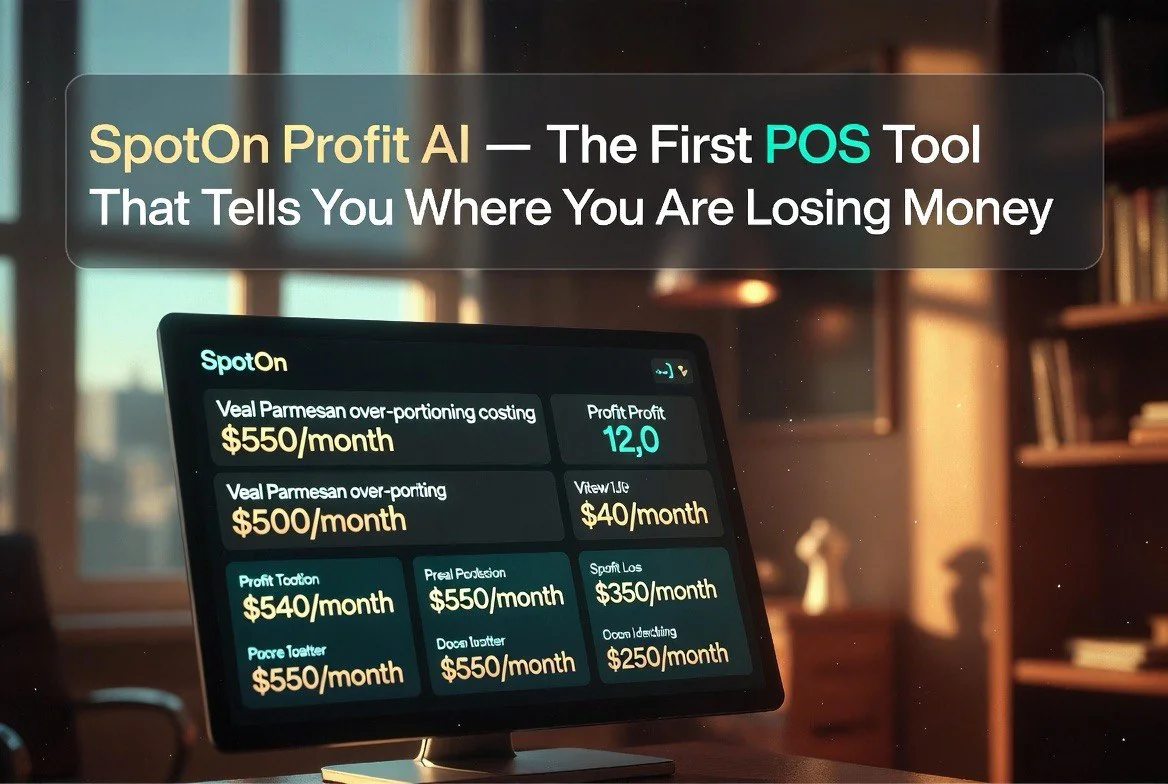
Consider a concrete example. A Midwest independent Italian restaurant running on SpotOn POS received a Profit AI notification that their veal parmesan entree had a theoretical food cost of 28% but an actual cost of 35%. The system flagged portion weight variance between the lunch and dinner shifts as the likely cause. The owner investigated and found that the dinner cook was consistently over-portioning by 1.5 ounces. Fixing that one variance recovered approximately $550 per month in food cost — a 0.8% improvement in overall restaurant margin from a single notification.
The tool is also notable for what it does not do. It does not claim to solve restaurant profitability through some broad AI abstraction. It focuses on operational levers that restaurant owners already understand — food cost percentage, labor dollars per cover, average check size — and makes them actionable. This grounded approach is more likely to drive real adoption among independent operators than flashier AI solutions that abstract too far away from the day-to-day realities of restaurant management.
The pricing angle is unconfirmed but worth watching. SpotOn has not published exact pricing for Profit AI as a standalone add-on. Industry speculation places it at $50-150 per location per month based on comparative POS analytics tools. At that price point, the tool pays for itself if it surfaces even one actionable profit improvement per quarter. For an $800,000 revenue restaurant, that is roughly a 0.1-0.2% margin impact needed to break even — a low bar for a system that continuously scans multiple margin dimensions.
How It Compares to Other Restaurant AI Tools
SpotOn Profit AI enters a market that already has several established players in restaurant analytics. Toast offers AI-powered operational intelligence through its platform. Crunchtime has AI forecasting and inventory tools that provide recommendations. SevenRooms offers data-driven insights for reservations and customer engagement.
What sets Profit AI apart is its proactive recommendation model. Most restaurant analytics tools require the operator to log in, navigate dashboards, and interpret data. Profit AI pushes recommendations to the operator — via the POS dashboard, email, or mobile notifications — with specific action items.
For a multi-unit operator managing 3-5 locations, this distinction matters. A regional manager does not have time to log into five separate analytics dashboards every morning. A single feed of prioritized profit recommendations across all locations changes how that manager spends their time: less data review, more execution.
The Real Question: Will Restaurant Owners Trust It?
The biggest barrier to adoption for AI-powered operational tools in restaurants is trust. Owners and managers have been burned by technology that promised simplicity and delivered complexity. A tool that tells you to change your pricing, adjust your labor schedule, or audit your food cost is making recommendations that directly affect your bottom line. Getting it wrong can cost real money.
SpotOn is positioning Profit AI as a decision support tool, not an autonomous system. The AI surfaces recommendations, but the operator makes the final call. This is the right framing for the current maturity of restaurant AI. Operators who test the tool, find that its recommendations make sense, and see real P&L improvement will expand their usage. Those who get burned by a bad recommendation will not.
The early adoption pattern is likely to mirror AI adoption across the industry broadly. According to recent data, 71% of restaurant operators now report using some form of AI. The majority of that usage is in targeted, operational applications — not wholesale automation. Profit AI fits squarely in that adoption pattern: a practical, bounded tool that does one thing well.
The broader trend matters here. AI tools for restaurants are maturing from novelty status to operational necessity. Crunchtime’s AI now forecasts demand with up to 99% accuracy. SevenRooms Voice AI handles reservation calls autonomously. Nuxa.ai positions itself as an “AI operating system” unifying marketing, reviews, and operations data. These tools are not replacing restaurant owners — they are giving owners information that previously required a team of analysts to produce. Profit AI’s contribution to this ecosystem is its focus on the bottom line, not customer experience or marketing. For owners who already track their numbers closely, that distinction makes it the most immediately practical AI tool a restaurant can adopt today.
Frequently Asked Questions
Does SpotOn Profit AI require a specific POS system?
Yes. Profit AI is built on SpotOn’s POS platform. It is available to current SpotOn customers as an add-on feature. Pricing is based on the number of locations and the feature set selected.
Can Profit AI make autonomous pricing changes?
No. Profit AI surfaces recommendations. All pricing and operational changes must be implemented manually by the restaurant owner or manager. This is a deliberate design choice to maintain operator control.
How is Profit AI different from Toast’s analytics?
Both tools analyze POS data, but Profit AI emphasizes proactive, specific recommendations pushed to the operator rather than dashboard-based reporting. It identifies precise issues like specific menu items with cost variances rather than aggregate food cost percentages.
What data does Profit AI need to work effectively?
Profit AI requires at least 90 days of continuous POS data to establish baselines and generate meaningful recommendations. More data improves accuracy. It analyzes sales, labor, inventory, and vendor cost data.
Is Profit AI available for multi-location operators?
Yes. SpotOn supports multi-location setups with centralized recommendations and per-store granularity. Multi-unit operators are a primary target market for the tool.

About Barak Schurr
Barak Schurr built and exited a major ticketing platform, ran global operations at Eventbrite, and now focuses on one question: which AI tools actually help independent restaurant owners run leaner and grow faster. He writes from the operator’s perspective — no vendor spin, no theory, just what’s real in 2026.
Email: [email protected]
More AI Resources