Bojangles Goes All-AI Drive-Thru, Presto Raises $10M — Voice AI for Restaurants Just Got Real
⚡ Expert Summary: Two July 2026 stories mark a tipping point for restaurant voice AI: Bojangles became the first major chain to deploy fully AI drive-thru ordering, and drive-thru AI company Presto raised $10 million in new funding. For independent operators, the question is no longer whether voice AI works — it’s when your POS vendor will offer it and what it will cost.
If you’ve been watching restaurant AI from the sidelines, July 2026 delivered two stories that should move you from “watching” to “planning.”
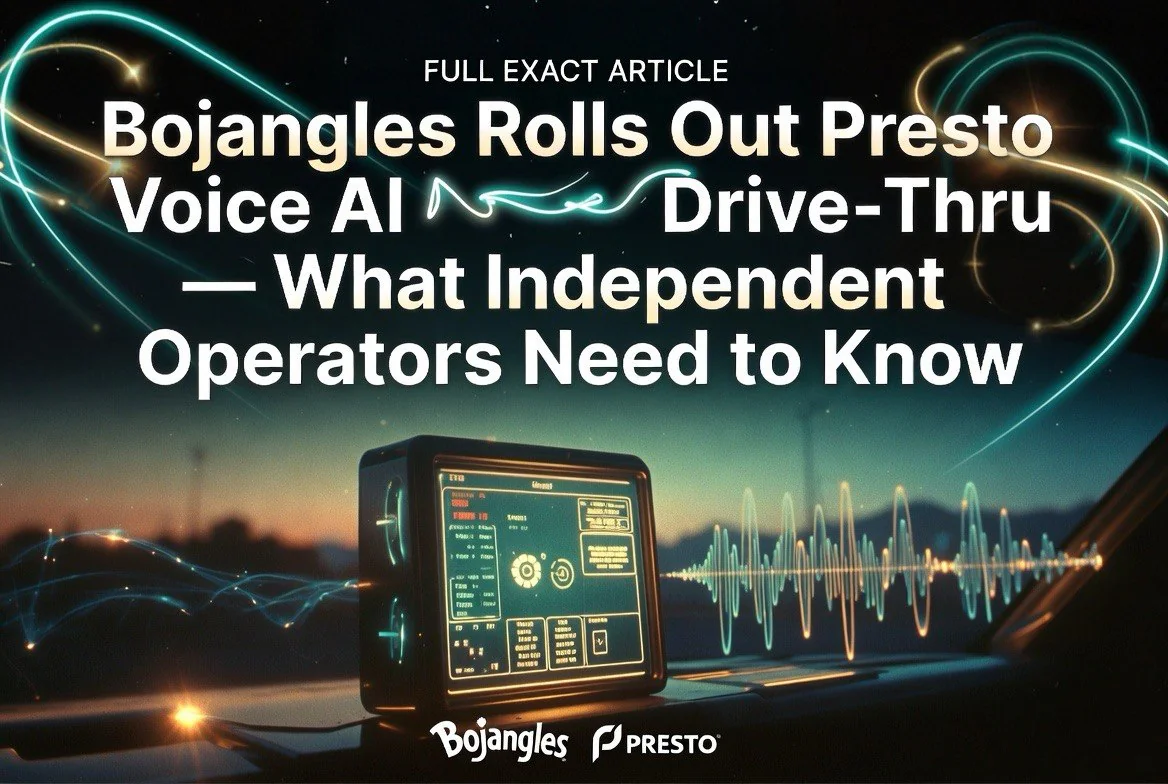
Bojangles became the first major fast-food chain to deploy an all-AI drive-thru ordering system, fully removing human order-takers from the drive-thru lane.
Presto, a leading drive-thru voice AI company, raised $10 million in new funding this month, signaling that investors see the restaurant voice AI market as real, growing, and ready for scale.
Together, these two announcements mark the moment when AI restaurant ordering crossed from pilot programs into production infrastructure.
Bojangles: The First Fully AI Drive-Thru
Bojangles’ move is significant not because of technical novelty — AI can take an order — but because of what it signals about operational confidence. A major chain chose to remove human order-takers from the drive-thru entirely.
That doesn’t mean removing all staff. It means the person who used to stand at the drive-thru window taking orders is now doing something else inside the restaurant: preparing food, cleaning, restocking, or managing customer flow during peak hours.
For independent operators, the math is compelling. The average drive-thru lane costs a restaurant $30,000 to $50,000 per year in order-taker labor at a single location. AI doesn’t eliminate that cost entirely — there’s still a subscription fee and maintenance — but even a 50% reduction in drive-thru labor costs is meaningful for a single-unit operator.
Bojangles is betting that the AI reliability has crossed the threshold where the cost savings outweigh the risk of an AI mishearing an order. Early industry data suggests they’re right. Drive-thru AI systems have improved significantly in accuracy over the past 18 months, with error rates dropping from 15-20% in early 2025 to below 5% in controlled deployments by mid-2026.
Presto’s $10M Raise: What It Means
Presto’s $10 million funding round is notable for what it’s not — it’s not a massive Series C or a headline-grabbing unicorn valuation. It’s a measured, strategic investment in a company that has been quietly deploying voice AI across hundreds of drive-thru locations.
Presto’s technology is already in use at chains like Dairy Queen, which expanded its voice AI drive-thru tests in partnership with Presto in early 2026. The company focuses specifically on drive-thru voice ordering — a narrow, well-defined problem that AI can solve more reliably than the broader “restaurant AI” category.
The $10 million figure tells you investors believe the drive-thru AI market has room to grow. The total addressable market includes roughly 200,000 drive-thru lanes across the United States, and the penetration rate for AI ordering was still under 5% entering 2026. A 10x expansion over the next 3-5 years is plausible, and Presto is positioning to capture a significant share.
For context, Nation’s Restaurant News reported in July 2026 that Bojangles’ all-AI deployment, Presto’s funding, and NCR Voyix’s new AI suite all landed within days of each other. The restaurant technology sector is no longer wondering whether voice AI works. It’s scaling it.
How Voice AI Drive-Thru Actually Works
If you haven’t experienced an AI drive-thru, here’s what’s happening under the hood:
- Wake word detection — The system activates when a vehicle pulls up to the menu board, just like a human would say “Welcome, what can I get started for you?”
- Speech-to-text conversion — The customer’s spoken order is transcribed in real time, even with background noise from the car engine, children, or nearby traffic.
- Intent parsing — The AI identifies what was ordered, including modifiers, quantities, and menu aliases (“numbah one with sweet tea” translates to a specific combo meal with a specific drink).
- Upselling — Most systems are programmed to suggest add-ons or upgrades at natural points in the conversation, just as a trained human order-taker would.
- Order display — The order appears on a screen for customer confirmation before it’s sent to the kitchen.
- Human escalation — If the AI can’t understand the order after two attempts, it flags a human staff member to take over, preventing frustration.
The “human escalation” path is key. No current system claims 100% accuracy. But AI doesn’t need to be perfect — it just needs to handle 80-90% of orders without human intervention to generate real labor savings.
What This Means for Independent Operators
If you don’t have a drive-thru — and most independent restaurants don’t — you might think this story doesn’t apply to you. Here’s why it does:
Voice AI for phone orders is the same technology. The speech recognition, intent parsing, and order management systems that power drive-thru AI are the same ones that can handle phone orders. Your phone is your drive-thru. And phone orders create the same staffing pressure: someone has to stop what they’re doing to answer it, often during the busiest part of service.
Papa Johns just deployed a voice AI ordering agent across phone, app, and web using Google Gemini (covered in our previous post). The technology that’s driving through Bojangles’ drive-thru lanes is the same technology that can answer your restaurant phone during the Friday night rush.
Vendors serving independents are watching this closely. Toast, Square, and SpotOn all saw the same July 2026 headlines you just read. They know their independent restaurant customers will want AI ordering capabilities. Many are already building or partnering on voice AI features for their 2027 roadmaps.
The cost will come down. Presto’s $10M raise and Bojangles’ national deployment create a competitive market for voice AI. More deployments mean more training data, better accuracy, and lower per-location costs. The technology that costs a chain $2,000-5,000 per location per month today will cost an independent operator $200-500 per month within two years — or be bundled into existing POS subscriptions.
Three Things to Do Right Now
You don’t need to deploy voice AI tomorrow. But these three steps will put you in position when the technology reaches your price point:
-
Clean up your menu data. Voice AI is only as good as the menu database it reads from. If your POS has inactive items, inconsistent modifier names, or duplicate entries, your AI ordering will generate errors. Run a menu audit now while the cost of fixing it is low.
-
Document your most common phone orders. What do customers actually say when they call? “Let me get two of the usual” or “I need a gluten-free option” or “Can I get the lunch special but with the salad instead of fries”? The more predictable your order patterns, the better AI can handle them.
-
Ask your POS vendor about AI roadmap. Send an email today. “I read about Bojangles and Presto’s voice AI. What are your plans for voice ordering features for independent operators?” The vendors who hear this question from customers are the ones who prioritize shipping the feature.
The Bottom Line
July 2026 was the month voice AI for restaurants stopped being theoretical. Bojangles went all-in on AI drive-thru. Presto raised capital to scale. Papa Johns deployed a Gemini-powered ordering agent. McDonald’s rolled out operational AI tools across thousands of locations.
For independent operators, the window to understand this technology — and prepare for it — is open now. You don’t need to buy anything today. But you should know what’s coming, because the independent restaurants that understand voice AI before their competitors do will be the ones that benefit first from lower labor costs, fewer order errors, and better customer experiences.
Why Independent Operators Should Watch the Drive-Thru AI Market
You might wonder why we’re covering drive-thru AI on a site for independent restaurant owners, most of whom don’t have drive-thrus. Here’s the reason: the drive-thru AI market is where the technology gets battle-tested at scale. The improvements in accuracy, the reductions in cost, and the operational lessons learned in 200,000 drive-thru lanes across America will flow directly into the voice AI products available to non-drive-thru restaurants.
Think of it like cloud computing. AWS was built for startups and scaling internet businesses. But the infrastructure it created — cheap storage, on-demand compute, managed databases — eventually powered every industry. Drive-thru AI is the AWS of restaurant voice AI. The investment, the training data, and the competition will produce a technology platform that every restaurant can use, regardless of format.
Independent operators who understand the technology trajectory now — who learn the terminology, understand the accuracy benchmarks, and know which questions to ask vendors — will be the ones who deploy effectively when the price drops. The operators who wait until voice AI appears on their POS dashboard without understanding how it works will either overpay or underuse it.
The Bigger Trend: AI Is Going Operational, Not Just Transactional
The Bojangles and Presto stories are about AI handling the transaction — taking an order, processing a payment, moving a ticket to the kitchen. But the July 2026 restaurant AI news also includes a shift toward operational AI that runs deeper than the order-taking surface.
McDonald’s is using AI-driven accuracy scales that weigh bags of food before handoff and alert staff if the weight doesn’t match the expected order. That’s not a customer-facing AI. It’s behind-the-scenes operational quality control. Similarly, McDonald’s “Ready on Arrival” program uses geofencing to time food production to customer arrival, reducing hold times and waste. Both are AI applications that don’t talk to customers but directly affect operational costs and customer satisfaction.
NCR Voyix’s new AI suite includes loyalty tools that use AI to personalize offers and promotions based on purchase history and visit patterns — again, back-end AI that increases revenue per customer without the operator doing anything differently.
The pattern is clear: AI in restaurants is no longer about flashy chatbots or robot servers. It’s about layering intelligence underneath every operational touchpoint — ordering, cooking, quality checking, loyalty, and scheduling. The front-facing AI (voice ordering) gets the headlines, but the back-end AI (inventory prediction, labor optimization, dynamic pricing) is where the real margin improvement lives for independent operators.
Frequently Asked Questions
Which chain was the first to deploy fully AI drive-thru ordering?
How much did Presto raise in July 2026?
How accurate is AI drive-thru ordering?
Can independent restaurants without drive-thrus benefit from voice AI?
How much does AI drive-thru ordering cost?

About Barak Schurr
Barak Schurr built and exited a major ticketing platform, ran global operations at Eventbrite, and now focuses on one question: which AI tools actually help independent restaurant owners run leaner and grow faster. He writes from the operator’s perspective — no vendor spin, no theory, just what’s real in 2026.
Email: [email protected]
More AI Resources