Amazon Handed Your Prime Customers to Uber Eats. Uber Won’t Say What It Charges You for Them.
⚡ Expert Summary: Amazon now routes US Prime members’ food delivery through Uber Eats, and $0 delivery is permanent on qualifying orders with a $25 minimum measured on subtotal before taxes and fees. Every Prime tier qualifies, plus one adult on an Amazon Family plan. What nobody will tell you is the number that decides whether this is a customer channel or a cost channel: Uber has not said whether a restaurant pays the standard Plus rate, the Uber One rate, or something new on an order that originated on Amazon — and Uber’s spokesperson declined to discuss commercial terms with Bloomberg, including whether Uber pays Amazon a referral fee. Neither company will say who funds the waived delivery fee. That silence is the whole deal for an independent operator, because it means the commission on your next order is a term you cannot read, negotiate, or plan a margin against.
The press release reads like a win for everybody. Amazon gets a food benefit for Prime. Uber gets the biggest customer funnel in American e-commerce pointed at its delivery network. The customer gets free delivery. Three winners on one page, which is usually the signal that somebody off the page is paying.
Restaurant owners are the obvious candidates, and not because anybody said so. They are candidates because the delivery business has worked this way since the beginning: the platform builds demand, the restaurant absorbs the discount, and the rate card is written in a document the restaurant never sees.
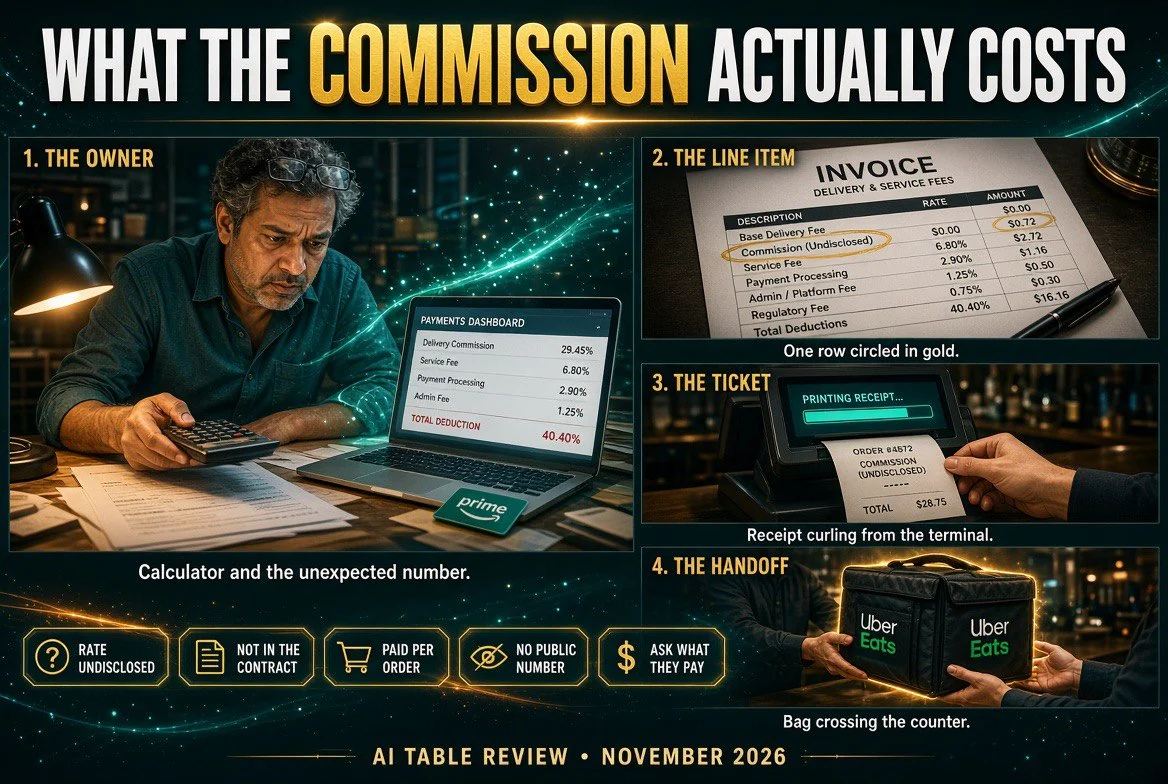
Here is the specific problem with this launch. In a normal third-party deal, an operator can look up what a Plus or a One order costs them and run the math against a known ticket size. On an Amazon-originated order, that math has a hole in it. The order is real, the customer is real, the delivery fee is waived, and the rate the restaurant pays on that order has not been disclosed by the company collecting it.
What Is Actually Confirmed on This Deal
Strip out the mystery and the mechanics are clear, which is what makes the silence so conspicuous. It is not a vague partnership announcement. It has terms, tiers, dates, and a permanent promise.
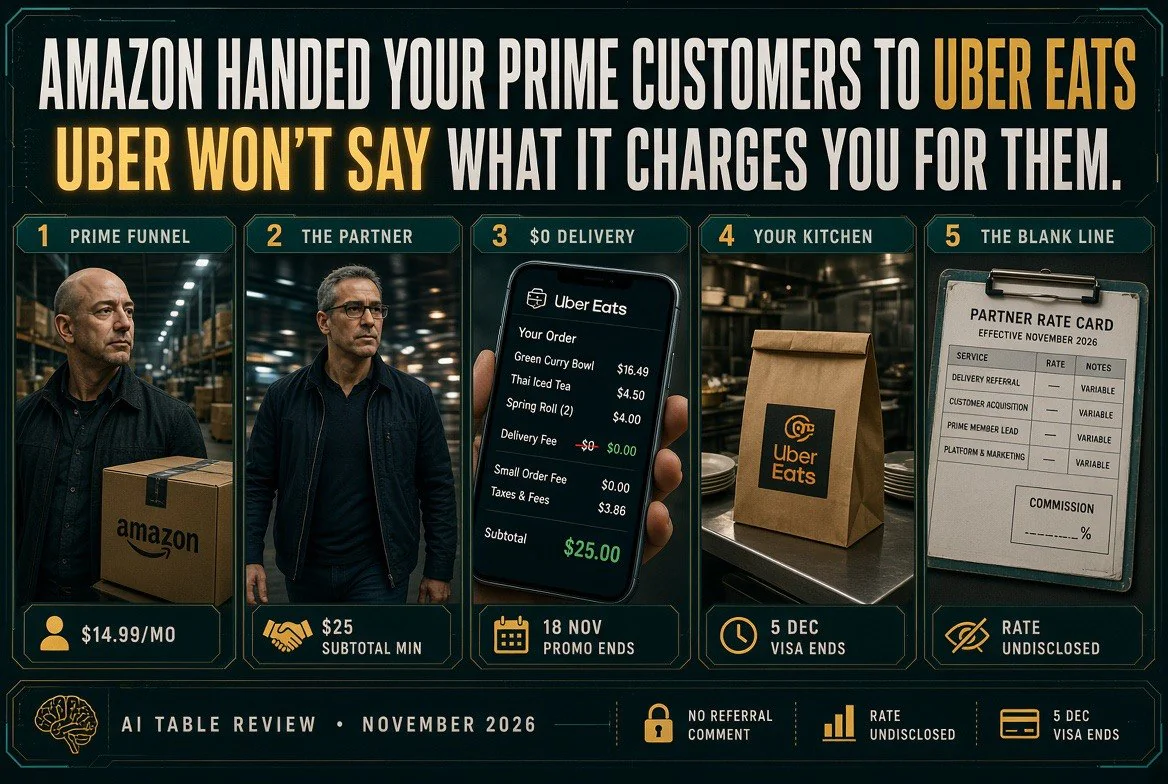
All US Prime tiers qualify. The standard plan at $14.99 a month or $139 a year, the Young Adults tier at half price, and Prime Access for qualifying members. One adult on an Amazon Family plan can also use it. That is a very wide funnel, and it is worth being precise about the size of it: this is not a test in three cities, it is the entire American Prime base.
The $0 delivery fee is permanent, subject to change at any time. That distinction matters because two other benefits on this deal are promotional and die on dates. The $20-off promotion ends 18 November 2026 at 11:59 PM PST. The 5% back on the Prime Visa ends 5 December 2026. Only the delivery fee waiver is described as a standing benefit.
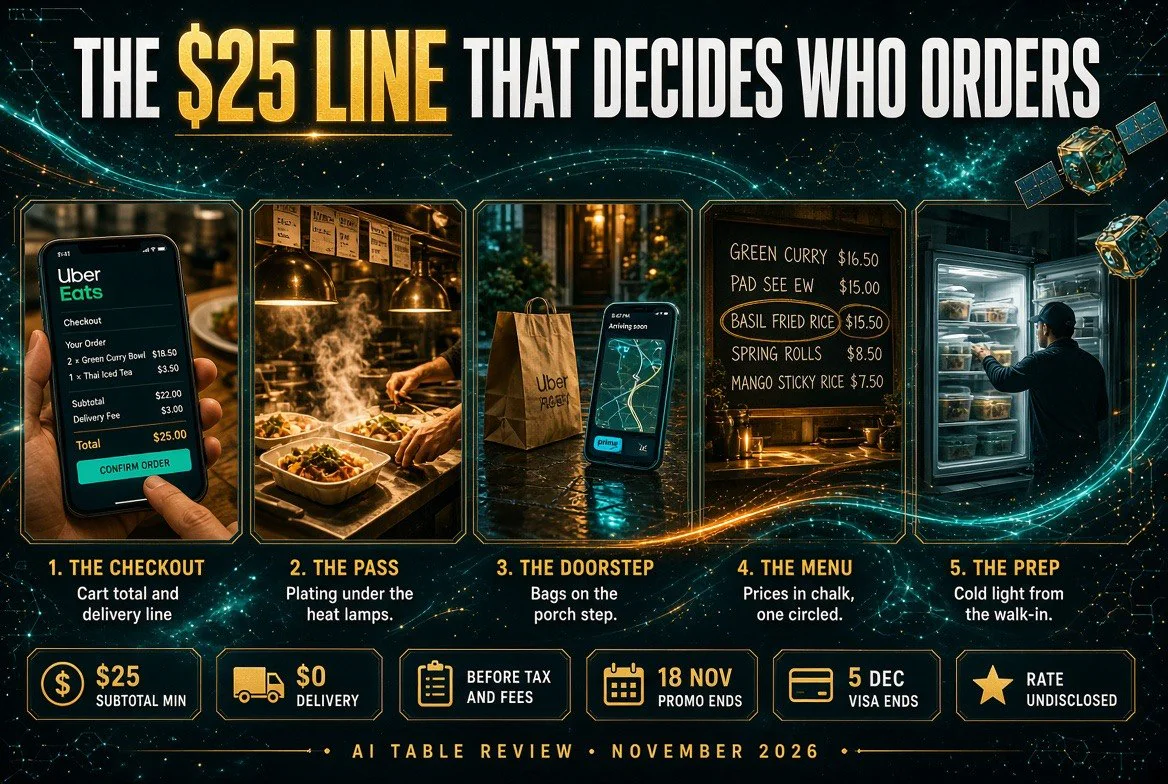
The $25 minimum is subtotal, before taxes and fees, measured on the food itself. For an operator, that is the single most useful number in the announcement, because it is a menu-engineering constraint disguised as a customer perk.
| Term | What It Says | What It Means for Your Restaurant |
|---|---|---|
| Eligible customers | All US Prime tiers: $14.99/mo or $139/yr, Young Adults at half price, Prime Access, plus one adult on Amazon Family | The entire American Prime base, not a pilot market |
| $0 delivery fee | Permanent, subject to change at any time | A standing discount, not a launch gimmick |
| $25 minimum | Subtotal before taxes and fees | Menu baskets below $25 get filtered out of the funnel |
| $20-off promotion | Ends 18 November 2026, 11:59 PM PST | Promotional, expires in nine days |
| 5% back on Prime Visa | Ends 5 December 2026 | Promotional, expires in under four weeks |
| What the $0 fee covers | The delivery fee only | Service fees, taxes and tips still land on the customer |
| Restaurant commission on Amazon orders | Not disclosed by either company | The number your margin depends on |
Notice the asymmetry in that table. Six of seven rows are precise enough to build a spreadsheet from. The seventh — the one that determines whether this channel is profitable — is blank, and it is blank on purpose.
The Fee Nobody Will Explain
The $20-off promotion ending on 18 November is a spend decision by somebody. The 5% back on the Prime Visa is a subsidy paid by somebody. The permanent $0 delivery fee on qualifying orders is a cost carried by somebody, in perpetuity, across the biggest Prime base in the country.
Those are three different parties potentially, and none of them has been named. Bloomberg’s reporting is explicit on this point: an Uber spokesperson declined to discuss the commercial terms, including whether Uber pays Amazon a referral fee. That is not a reporter failing to get an answer. That is a company choosing not to give one, on the record, to the most direct question in the story.
Uber already has published rates for restaurants. Plus sits at roughly 25 percent of the order value in the standard tier, and Uber One orders run around 30 percent. A restaurant can look those numbers up. What no restaurant can look up is which of them, if either, applies when the customer arrived through Prime, or whether a new rate exists for that channel that has not been published anywhere.
If the restaurant pays a Plus rate on a Prime order, the delivery fee waiver is a customer acquisition cost funded by Uber or Amazon, and the operator’s economics are unchanged from any other Plus order. If the restaurant pays more, the $0 delivery fee is being funded out of the operator’s commission, and the headline “free delivery” is a discount taken from the kitchen.
Those two scenarios look identical on the customer’s receipt and completely different on the restaurant’s P&L. Nobody in a position to settle the question has answered it.
| Scenario | Standard Plus Order | Amazon-Originated Order |
|---|---|---|
| Published commission rate | Roughly 25 percent on Plus | Not disclosed, not published |
| Who pays the delivery fee | The customer | Waived; payer unnamed |
| Who owns the customer relationship | Uber Eats account | The checkout began inside Amazon |
| Who eats the discount | Nobody; there is no discount | Unknown, and this is the only question that matters |
| Can you renegotiate it | Rate is on a published card you already accepted | Not a rate you have seen, let alone agreed to |
| What you can verify before ordering | Everything | Almost nothing |
There is a version of the argument that says this is normal. Platform partnerships launch with negotiated rates that are not public all the time, and restaurants frequently do not know the exact cost of a given order until the payout statement arrives. That is true, and it is also why the right response is not a boycott but an invoice audit.
Why Amazon Won This Round
The strategic picture is worse for the delivery platforms than it is for restaurants, and it is worth understanding because it explains the silence.
For years the assumed endgame was that Amazon would enter food delivery directly, build its own courier network, and undercut everybody. Instead Amazon did something cheaper and more damaging: it sold its customer list to an existing network and let them handle the operational headache. Amazon gets a Prime benefit without buying a single scooter. Uber gets demand it did not have to pay to acquire. The cost of that arrangement lands somewhere between the two, and both have a reason to keep that arrangement private.
The losers in that structure are the platforms that now face a competitor with an e-commerce account relationship instead of a delivery app relationship. Domestic restaurant operators are the ones who will find out what the arrangement costs them, one payout statement at a time.
For an independent operator in the United States, the practical consequence is a shift in where your delivery business comes from, and how little visibility you have into it. A Prime funnel does not care what your ticket size is. The $25 subtotal minimum is the only filter it applies, which means the customer who is worth serving — the one building a basket above $25 — is the one this channel is built for.
What the Grubhub Divorce Tells You
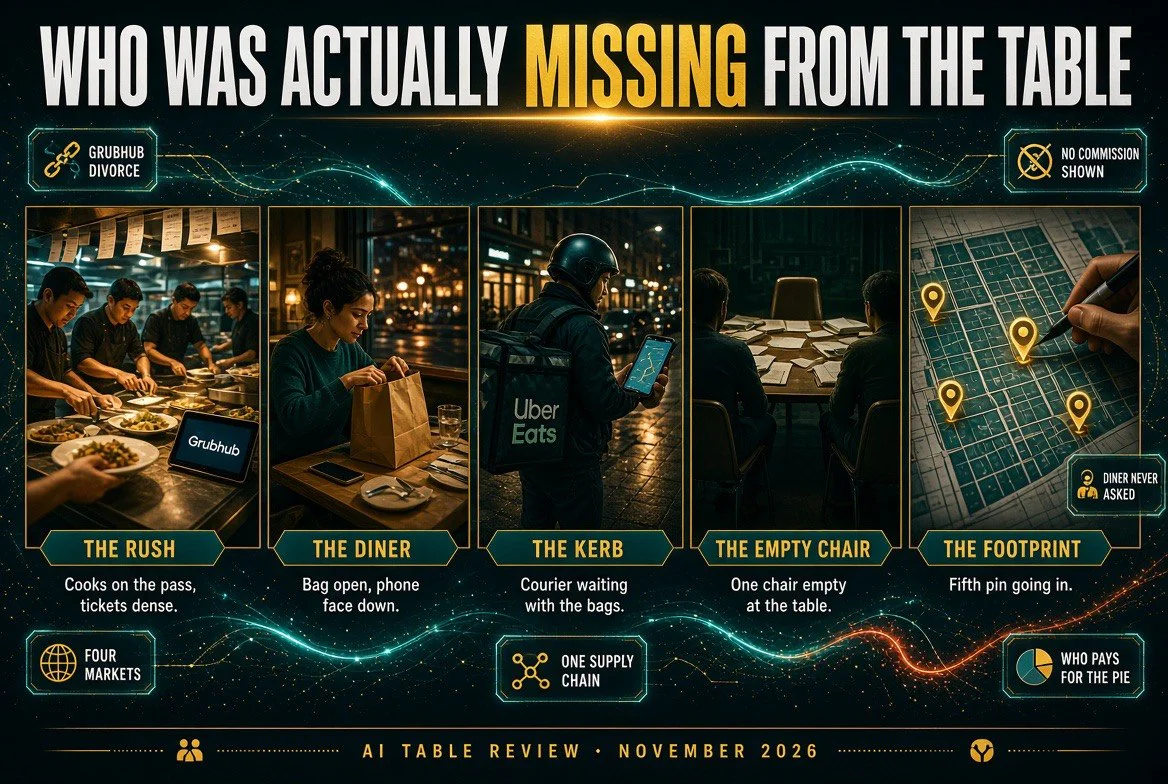
The termination of Amazon’s Grubhub partnership is the part of this story that got one line in most coverage, and it is the part that tells an operator the most about how these deals are built.
Amazon had a stake, an arrangement, and a relationship with Grubhub. That ended at the same time Uber Eats became the Prime delivery partner. Whatever the stated reasons, the practical read is that Amazon treats delivery partnerships as a slot to be filled by whichever network offers the best terms at that moment. That is rational for Amazon. It is also a warning for anyone building a business plan on the assumption that a partnership announced this November will still exist in three years.
When a partnership can be terminated, the terms attached to it can be renegotiated, and the party with the least visibility into those terms has the least warning when they change. Restaurants sit at that position in this structure by default. The only way out of it is to know your numbers well enough to spot a change in the first payout statement after it happens, rather than in a quarterly review three months later.
There is a second lesson in the Grubhub change, and it is about customer stickiness. A Prime member who learned to order through one network now orders through another, and their behaviour barely changes because the interface and the benefit came from Amazon, not from the delivery company. That is precisely the risk an operator carries when the customer relationship lives above them in the stack. The restaurant brand is interchangeable in a way the Prime benefit is not.
What to Do About It This Week
You cannot negotiate a rate that has not been disclosed, but you can find out what one costs you, and you can do it before the channel reaches scale in your market.
First, watch the payout statements for the next two weeks and separate Amazon-originated orders from everything else. The distinction is normally visible as an order source or channel field. If it is not visible in your reporting, that is itself an answer about what you were told.
Second, model the $25 minimum against your own menu. If your average basket sits near or below that line, this channel will systematically move your mix toward larger orders, and you should decide in advance which items you want carrying that weight. If your average is already well above $25, you are exactly the operator this deal was designed to find, and your exposure to the unknown rate is proportionally larger.
Third, and this is the one most operators skip: ask your account manager in writing what commission applies to Amazon-originated orders. Not what the standard rate is. Not what the Plus card says. The specific rate on that channel. A written answer protects you. A verbal assurance that it is “the usual” does not, and if the answer is that the rate is not yet determined, that is worth knowing while you still have room to adjust your own pricing on that channel.
Fourth, remember the clock. The $20-off promotion ends 18 November 2026 at 11:59 PM PST, nine days from now. The 5% Prime Visa back ends 5 December 2026. Both of those are demand spikes with a shelf life, and the orders they drive will arrive with the same undisclosed commission attached. A promotion ending is not a reason to celebrate larger volume unless you know what the volume costs you.
The Quiet Part: The Customer Is Now Amazon’s
Everything above is arithmetic. Here is the part that does not show up on a payout statement.
When a customer orders through Uber Eats, the relationship — the app, the address book, the reorder button, the notification that brings them back a second time — belongs to Uber Eats. When that same customer orders through a checkout that began on Amazon, the relationship sits between two of the largest consumer companies in the United States, and the restaurant’s name is a row in a catalogue.
That is not a new problem in delivery, but this deal accelerates it in a specific way. Uber Eats built its position on being the place people go when they want to order food. Amazon just became a place people go when they want to order food, using somebody else’s courier network, without operating a single kitchen or scooter. Restaurant brands that were already fighting for recognition inside one marketplace now have to be recognisable inside two, and the second one has no loyalty programme for restaurants.
For an operator, that argues for something independent of this deal: keep a direct ordering channel that you own, price it honestly, and make it the cheapest place for your regulars to buy from you. Every dollar of business that arrives through a checkout you do not control is a dollar where somebody else decides what your food is worth.
None of this means refuse the order. Take the business. Serve it well. But read the statement, and treat an undisclosed commission rate as a risk you are carrying rather than a detail you will sort out later. In a business with margins measured in single-digit percentages and labour costs running between 28 and 35 percent of revenue, a few points of delivery commission on the wrong channel is not a rounding error. It is the difference between a good month and a bad one.
The Numbers Most Coverage Left Out
Two figures deserve more attention than the headline gave them, because they describe the shape of the demand rather than the existence of the deal.
The first is the spread between the $14.99 monthly price and the $139 annual price, which works out to roughly $3.42 a month for anyone paying yearly, a 23 percent discount for committing. That matters to a restaurant only indirectly, but it matters a lot: annual subscribers are the least price-sensitive cohort in the funnel, and they are also the ones whose delivery fee is already sunk. They order more often, and they order without thinking about the fee line, which is exactly the customer behaviour that drives frequency. If the channel works, it will work hardest on the annual cohort.
The second is the $25 subtotal minimum, which is high for lunch and low for dinner. An operator serving a lunch crowd with a $14 average ticket will see almost no volume from this channel, because the basket has to nearly double to qualify. An operator serving family dinner with a $40 average will clear the bar without changing anything. Same deal, opposite outcomes, and neither the press release nor the terms page explains that to you.
That is the entire practical case for modelling the minimum against your own menu before you get excited about a new demand source. The channel is not biased toward good restaurants or bad ones. It is biased toward large baskets, because it has to be. The delivery fee has to be paid by somebody, and the $25 line is the mechanism that makes the math work at the volume Amazon is pointing at Uber.
What This Means for the AI Systems You Already Run
There is a second-order effect here that nobody has written about, and it lands on operators who have already put AI into their order flow.
If you run AI voice ordering, an AI phone agent, or an automated upsell engine, every one of those systems was tuned against a specific basket profile: your own average ticket, your own item mix, your own threshold for when a suggestion makes sense. A new channel with a hard $25 subtotal floor is a new optimization target, and the systems will not know it exists unless you tell them.
Concretely, an upsell model that nudges a $19 basket toward $23 is doing good work on your own site and useless work on an Amazon-originated order, because $23 still fails the minimum. An agent trained on your weekday lunch mix will push the wrong items at a dinner basket that only exists on this channel. None of that is a failure of the AI. It is a failure to hand the system the constraint.
The fix is cheap. Give whatever ordering tool you use the channel as an input, and give it the $25 floor as a rule. Systems that can see the threshold will build toward it; systems that cannot will keep optimizing for a target that does not apply. Most operators will skip this step because it feels like a small detail, and then wonder why the new channel converts worse than their own site.
The blunt version of the whole story: three companies announced a deal that benefits them, two of them declined to explain the commercial terms, and the third party absorbing the outcome is the one that found out from a press release. That is not an accusation, it is a description of what has been published. Uber was asked. Uber declined. The number exists. It just has not been told to the people whose margins depend on it.
Frequently Asked Questions
What exactly changed between Amazon, Uber Eats and Prime?
US Prime members can now order food delivery through Uber Eats from inside Amazon, with a permanent $0 delivery fee on qualifying orders. All Prime tiers qualify — the standard plan at $14.99 a month or $139 a year, Young Adults at half price, and Prime Access — plus one adult on an Amazon Family plan. The concurrent news was the termination of Amazon’s Grubhub partnership.
What is the $25 minimum based on?
The minimum is $25 measured on subtotal, before taxes and fees. It applies to the food itself, not the total the customer pays, which means the service fee, taxes and tip sit outside the threshold. For an operator, that makes it a menu-basket constraint rather than a customer discount.
What commission do restaurants pay on an Amazon-originated order?
Neither company has disclosed it. Uber has published standard rates of roughly 25 percent for Plus and around 30 percent for Uber One orders, but has not said which applies to orders that originate through Prime, or whether a separate rate exists. Uber’s spokesperson declined to discuss commercial terms with Bloomberg, including whether Uber pays Amazon a referral fee.
Who pays for the waived delivery fee?
That has not been disclosed either. The waiver could be funded by Uber as a customer acquisition cost, by Amazon as a Prime benefit, or by the restaurant through a higher commission on that channel. The customer’s receipt looks identical in all three cases, and only one of them costs the operator money.
Which parts of this deal are temporary?
Two of the three benefits are promotional. The $20-off promotion ends 18 November 2026 at 11:59 PM PST, and the 5 percent back on the Prime Visa ends 5 December 2026. The $0 delivery fee is described as permanent, subject to change at any time. Only the delivery fee waiver is a standing term.
What should an independent restaurant owner do right now?
Separate Amazon-originated orders on your payout statements, model the $25 subtotal minimum against your average basket, and ask your account manager in writing what commission applies to that specific channel. Watch the promotion end dates so a demand spike does not arrive with an unknown cost attached, and keep a direct ordering channel you control so not all of your delivery business depends on a checkout somebody else owns.

About Barak Schurr
Barak Schurr built and exited a major ticketing platform, ran global operations at Eventbrite, and now focuses on one question: which AI tools actually help independent restaurant owners run leaner and grow faster. He writes from the operator’s perspective — no vendor spin, no theory, just what’s real in 2026.
Email: [email protected]
More Resources for Restaurant Operators