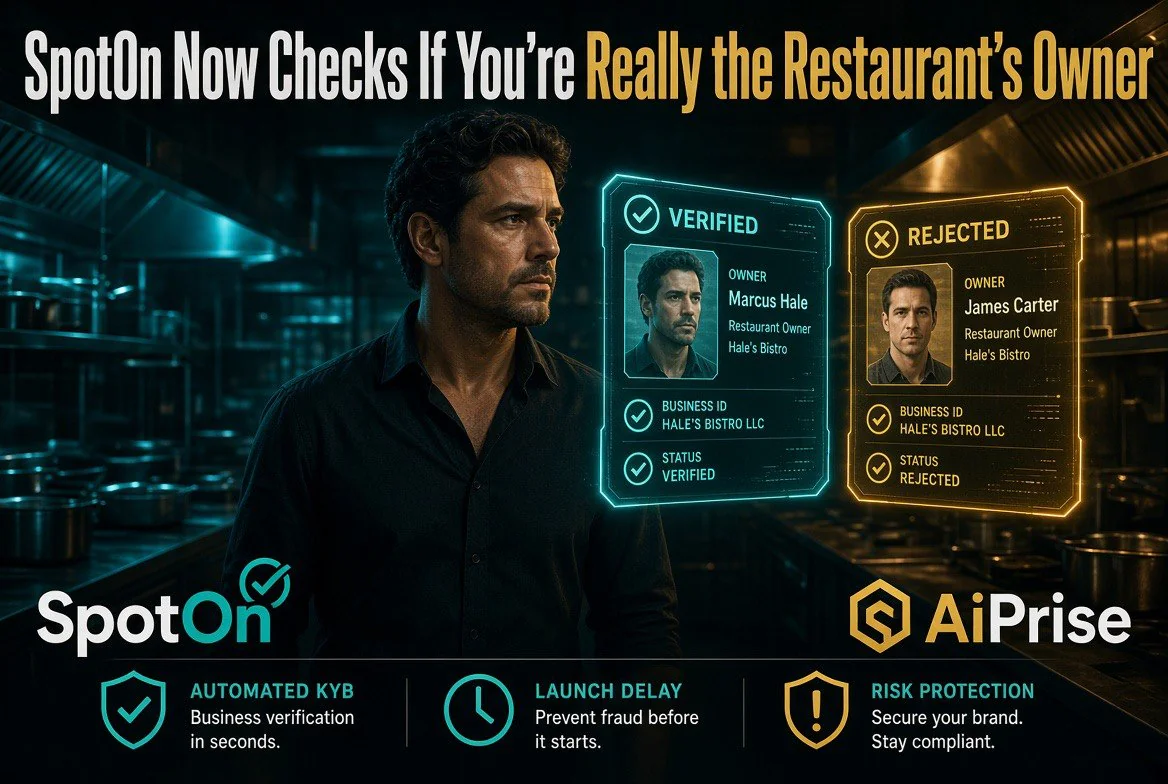
SpotOn Now Checks If You’re Really the Restaurant’s Owner
⚡ Expert Summary: SpotOn has brought in identity-verification firm AiPrise to confirm who actually stands behind every restaurant joining its platform — cross-referencing owners against government registries and international watchlists in one workflow. This is Know Your Business compliance arriving at the POS layer, and it changes your launch timeline: mismatched legal names, undocumented 25% owners, and virtual office addresses now fail automated checks before a single card is swiped. If you are opening a location in the next six months, your paperwork is now part of your critical path.
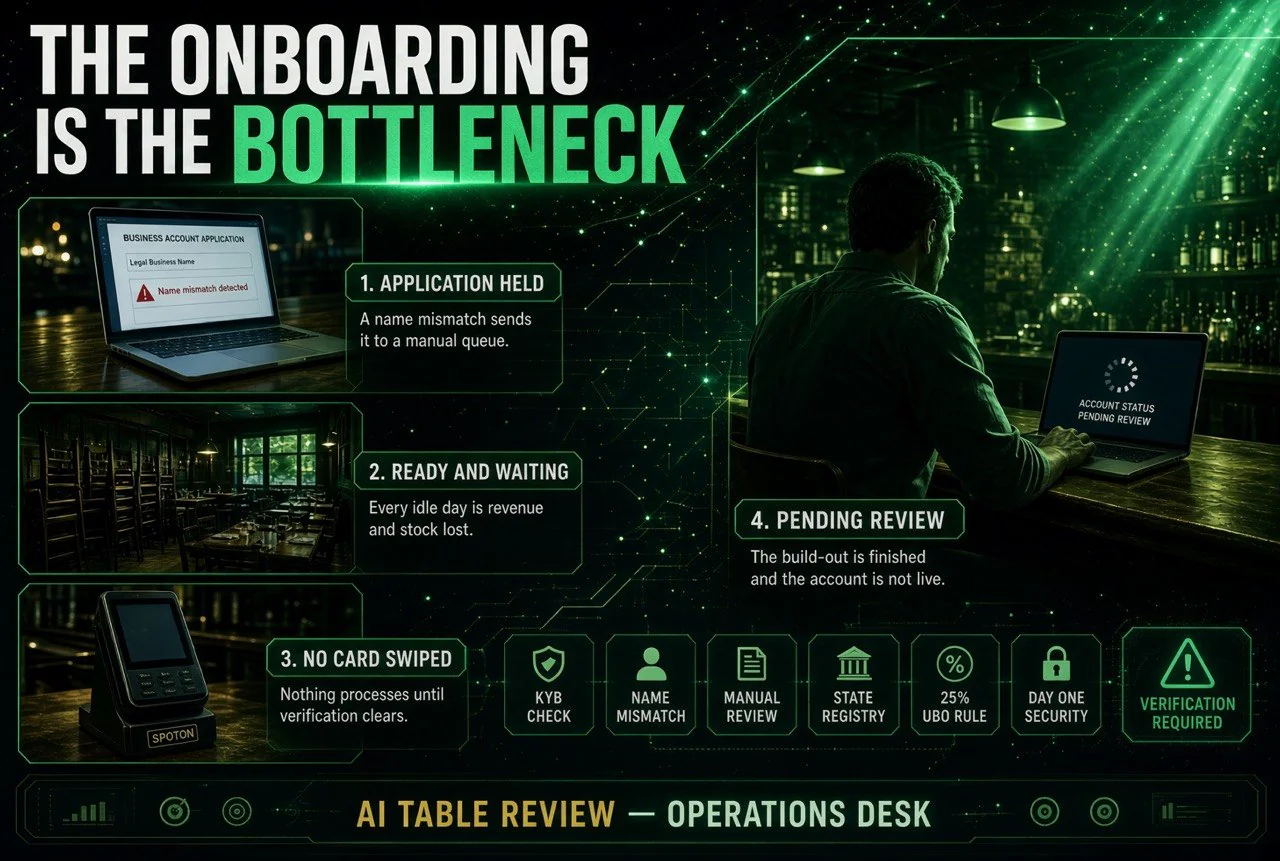
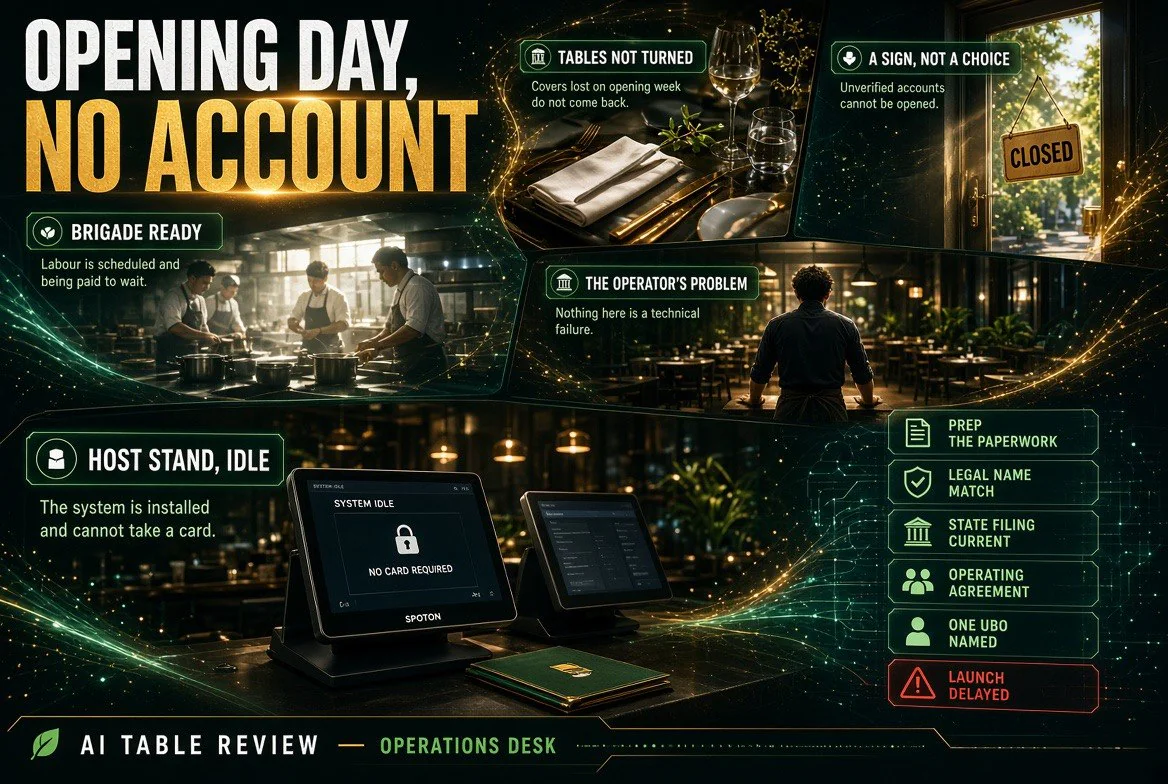
The build-out is finished. The equipment is installed. The staff is trained, the walk-in is stocked, and the grand opening is on the calendar with a photographer booked. And then the payment processor’s onboarding portal returns a message that reads like a tax form had a child with a detective novel: verification pending, manual review required.
For a growing number of US restaurant operators, that message is the real bottleneck of 2026 — not permits, not labor, not food cost. It is merchant onboarding, and the mechanics behind it just got more automated and less forgiving.
The trigger is the partnership between SpotOn, the US restaurant software and payments provider, and AiPrise, an identity orchestration platform that runs Know Your Business verification across government registries and watchlists worldwide. SpotOn’s chief compliance officer, Lisa Lechner, framed it as resolving the core tension of the category: “Our restaurant partners want to be up and running fast, and we need to be certain who we’re working with to keep their accounts secure from day one. AiPrise lets us do both without adding friction to onboarding.”
Read past the vendor language and there is a harder message for anyone signing a POS contract this year. The verification layer that used to happen after you went live — if it happened at all — now sits in front of your first transaction. And it is not a human being reading your articles of organization. It is an algorithm comparing strings.
Why a POS Company Cares Who Owns Your Restaurant
Most operators think of their POS vendor as a software company. Legally, it is closer to a financial institution.
When SpotOn or any competitor takes card payments on your behalf, it becomes part of the payments chain, and the payments chain carries legal obligations around anti-money laundering, sanctions screening and merchant fraud. If a merchant account is used to move dirty money — a shell restaurant with real terminals and fake covers — the processor absorbs the regulatory consequence, not just the restaurant. Fines, lost banking relationships, and in serious cases criminal exposure sit with the company that let the merchant on.
That produces a genuinely two-sided operational squeeze, and it is worth understanding because your onboarding experience is the direct product of it.
| Pressure | What it pushes toward | What you feel on your side |
|---|---|---|
| Merchant speed | Approving accounts in hours so a new location can trade immediately | Every day without terminals is revenue, inventory and goodwill lost |
| Regulatory liability | Screening every principal before the account goes live | A mismatch in your filings becomes a multi-week review queue |
| Fraud exposure | Preventing synthetic and shell merchants from processing | Legitimate structures that look odd on paper get flagged as suspect |
| Competitive pressure | Making verification invisible so it does not cost deals | Automation replaces the human who would have asked a clarifying question |
Historically, a processor handled this with compliance staff. A person opened your PDF packet, squinted at your articles of organization, cross-checked a name in a database, and moved on. Slow, inconsistent, and expensive — which is exactly why the approvals sometimes took a week and sometimes took an hour depending on who was at the desk.
The automated replacement removes the variability. It also removes the human who might have noticed that “Mama’s Kitchen LLC” and “Mama’s Kitchen Cafe” are obviously the same restaurant run by the same woman. The algorithm sees two different strings. Two different strings is a mismatch. A mismatch is a review queue.
KYB vs KYC: The Distinction That Decides Your Application
Most operators have heard “KYC” and assume it applies to them personally. The screen that will actually stop your restaurant is a different check, and knowing which is which tells you what to fix.
| Check | Subject | Evidence required | Fails when |
|---|---|---|---|
| KYB — Know Your Business | The legal entity | State registration, EIN, good standing, registered address | Entity inactive, name mismatch, unfiled state reports |
| KYC — Know Your Customer | The individual human | Government photo ID, address, date of birth | Expired ID, unreadable scan, name does not match records |
| UBO — Ultimate Beneficial Owner | Anyone owning 25% or more | Ownership breakdown plus ID for each principal | Ownership undisclosed, layered holding structure |
| Watchlist screening | Every unmasked principal | Name, DOB, nationality against AML, sanctions and PEP lists | A near-match flag, even a common-name collision |
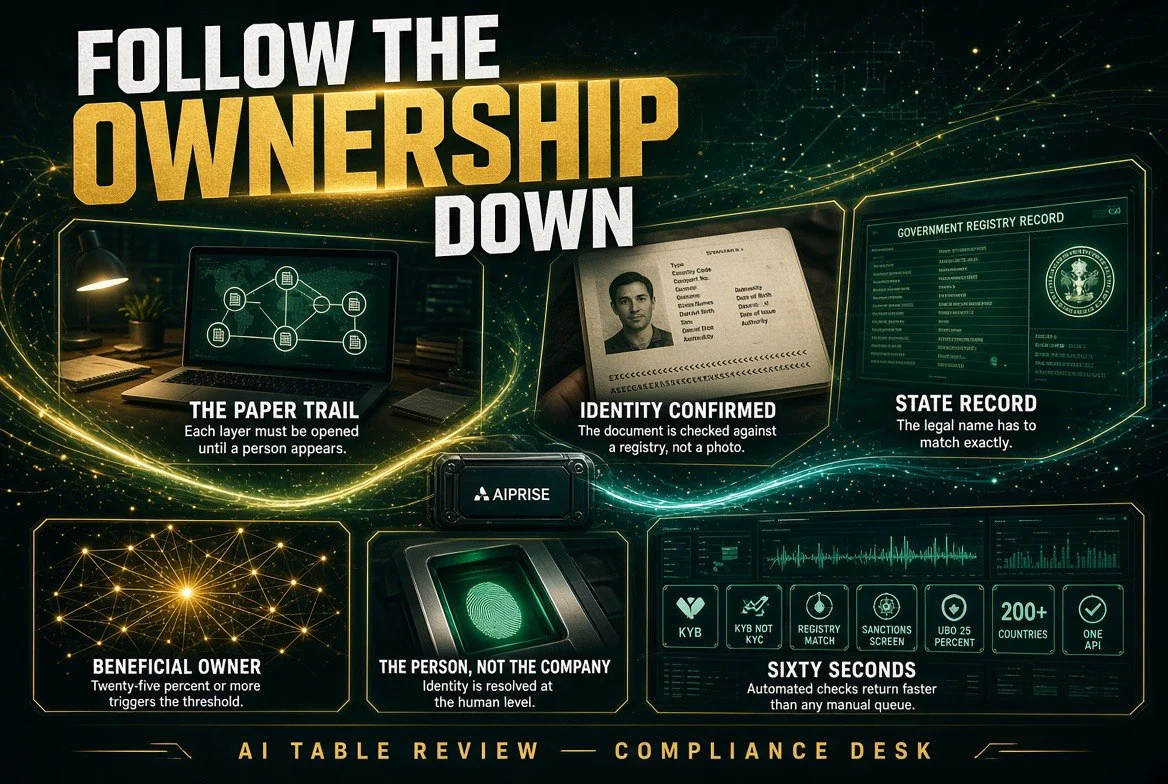
The uncomfortable one for multi-partner restaurants is the UBO check. You cannot hide behind an LLC anymore. If your restaurant is held by a management company, which is held by a family trust, which is held by three siblings, the system walks that chain until it reaches physical people and requires identity documentation for each one above the 25% threshold.
That is a paperwork problem you can solve in an afternoon or a delay you can discover on opening week. Operators who have been through it usually describe it the same way: it was not the check that hurt, it was discovering the structure they had been operating under for years was never properly documented anywhere.
What the System Actually Checks, Step by Step
Once your application is submitted, it does not sit in a queue waiting for a person. It enters an orchestration workflow that runs several checks in a single pass. Understanding the sequence tells you which failure you are likely to hit first.
1. The registry sweep. The system queries corporate registries to confirm your entity exists, is active and in good standing, and that the legal name and registered address on file match what you submitted. AiPrise states coverage of one API spanning 200+ countries and 500+ registries. For a single US location this is a fast lookup against your secretary of state’s database. For a group with an out-of-state holding entity, it is several lookups that all have to agree.
2. The ownership graph. Layers of corporate structure are mapped automatically until the system reaches beneficial owners. Where the entity owns another entity, the graph resolves down to individuals. This is where an informally structured restaurant group — common in independents, where a founding partner holds equity on a handshake — produces a documentation gap rather than a fraud flag, but the practical outcome for your timeline is the same.
3. Watchlist and sanctions screening. Each identified individual is screened against anti-money-laundering databases, international sanctions lists, and politically exposed persons registries. Modern systems use AI agents to handle document reading and entity resolution — AiPrise markets specialized agents for AML, documents and website review. This is where false positives live: a common surname, a partial date-of-birth match, an address that appears on a list for an unrelated person.
4. Risk scoring and disposition. Every signal consolidates into a score. Low risk clears. High risk is held for review or declined. And the signals that push a score up are not always about you — they are about patterns. A registered address that matches a virtual office. A business address that resolves to a residential block. A filing date that is two weeks before an application. Each of those is individually innocent and collectively suspicious to a scoring model.
The Part That Changed for Operators
The structural shift here is not really about AiPrise or SpotOn specifically. It is that payments companies have moved from reactive fraud management to preventative gatekeeping, and they are doing it at the front door.
The old model approved merchants quickly and dealt with problems after the fact, absorbing fraud losses as a cost of growth. That model is over across the industry. Regulatory scrutiny of payments has tightened, banking partners have become less tolerant of merchant portfolios with unexplained fraud rates, and the economics of eating losses no longer work at scale. Screening before activation is cheaper than remediation after.
The consequence for an operator is one sentence long: your onboarding paperwork is now part of your opening critical path, and it is evaluated by software that rewards exactness and punishes ambiguity.
There is a fair counter-argument, and it deserves airing. Automated KYB is, on balance, better for legitimate small operators than the old system was. The old system was slow, inconsistent and depended on human judgment that varied by whoever picked up the file. There is no serious evidence that manual review was more accurate — it was just more forgiving of sloppiness, and equally capable of arbitrary rejection. A system that resolves a clean application in minutes is genuinely better than one that takes five days because someone was on holiday.
The catch is that a clean application is now defined by machine standards, not human ones.
The Prep Checklist Nobody Gives You
Treat your compliance dossier with the same seriousness as your health permit. Everything below should be verified and in hand before you begin a POS application, not assembled during one.
1. Match your legal name exactly, everywhere. The entity name on your application must match your IRS EIN confirmation letter (Form CP 575) and your state articles of organization, character for character. “Mama’s Kitchen LLC” on the registry and “Mama’s Kitchen Cafe” on the application is a mismatch. It costs you a review cycle for a reason that a human would have laughed off.
2. Document every owner above 25%. A written ownership breakdown for any principal at or above the threshold, plus clean, unexpired, color scans of government photo ID for each. Expired IDs are one of the most common and most avoidable failures.
3. Prove a real physical footprint. A commercial lease or utility bill tied directly to the restaurant location. Virtual offices, residential addresses used as a primary business address, and mail-drop boxes are the exact patterns shell-merchant detection is built to catch. If your registered agent address differs from your operating location, expect the question and answer it preemptively in your packet.
4. Confirm you are in good standing before you apply. Log into your secretary of state’s business search and confirm status is Active. Delinquent franchise taxes and unfiled annual reports fail the registry check instantly, and that failure looks identical to a fraud flag from the processor’s side.
5. Get the bank letter early. A bank reference letter or voided check in the exact legal entity name — not the owner’s personal account — is a standard request and one that stalls many applications because it takes a branch visit.
6. Resolve name collisions before they resolve you. If a principal has a common name, prepare to supply date of birth and government ID in the first submission rather than waiting to be asked. The delay is in the back-and-forth, not in the screening.
What This Means for the Independent Operator
There is a real asymmetry here, and it is worth naming plainly.
Chains have compliance departments. They have an entity structure designed by lawyers, documented ownership, standing corporate counsel and a standard packet they resubmit every time they open a location. When a chain applies for merchant processing at a new store, the paperwork is a formality because someone built the machine for it years ago.
An independent opening a second or third location is assembling that packet from a drawer. The articles of organization are in a folder from the original filing. Two of the three partners are on the operating agreement; the third put in money and is not. The lease is under the landlord’s holding company name. None of that is fraud. All of it is going to generate flags.
The honest strategic read is that documentation discipline has quietly become a growth constraint for independent restaurant groups. It is not as visible as labor or food cost, but it hits at the exact moment you can least afford a delay: the week you are trying to open a second door.
The operators who get through cleanly are not the ones with the simplest structures. They are the ones who can produce a consistent, exact, documented version of their structure on demand. That is a solvable problem, and it is cheaper to solve on a Tuesday afternoon in November than on the morning of a soft opening.
The Wider Pattern
Zoom out and the SpotOn-AiPrise arrangement is one instance of something happening across restaurant technology: the compliance and verification layers are being automated and pushed to the front of every relationship, because the alternative — cleaning up after a bad actor — has become too expensive.
The same direction of travel shows up in labor verification, in alcohol-delivery checks, in age-gating and in food-safety documentation. Software is increasingly asked to establish that a thing is true before it allows the transaction, rather than trusting and auditing later. Vendors are engineering the friction out of their own side and, unavoidably, putting it into the operator’s paperwork instead.
None of that makes these systems villains. A processor that does not screen merchants is a processor that will eventually transfer money for someone who should never have had an account. The screening is not the problem.
The problem is that the standard of proof is now exactness, and most independent restaurants were built on a foundation of reasonable approximations. Getting the paperwork to machine standard is the work — and it is work you can do in advance, in an afternoon, before it ever delays an opening.
Frequently Asked Questions
What is KYB and how is it different from KYC? KYB — Know Your Business — verifies the legal entity itself: that the company exists, is active, and matches the registration on file. KYC — Know Your Customer — verifies the individual humans behind it using government photo ID. Payment processors typically run both, plus screening of beneficial owners against watchlists.
Why did SpotOn bring in AiPrise? SpotOn needed to confirm who controls each restaurant joining its platform without slowing down onboarding for legitimate operators. AiPrise combines identity verification against government records and international watchlist screening in a single workflow, allowing both checks to complete in one pass rather than a fragmented manual process.
What counts as an ultimate beneficial owner? In most US compliance frameworks, anyone owning 25% or more of the legal entity. Layered ownership — a restaurant owned by a holding company owned by a partnership — does not conceal the principals; the verification system maps the chain down to individuals who meet the threshold.
What are the most common reasons a restaurant application fails verification? Legal name mismatches between the application and state registration, entities not in good standing due to unfiled reports or delinquent franchise tax, expired or poorly scanned photo IDs, undisclosed ownership stakes, and the use of virtual office or mail-drop addresses as a primary business location.
Does using a holding company or LLC delay onboarding? Not inherently, provided the structure is documented before you apply. Delays come from undocumented structure — ownership that exists in practice but not on paper — not from complexity itself. An accurate ownership chart submitted upfront resolves most of it.
Will watchlist screening flag a common name? It can. Screening returns near-matches as well as exact ones, and a common surname with a partial date-of-birth match can generate a flag that requires manual resolution. Submitting date of birth and ID with the initial application usually shortens that process.

About Barak Schurr
Barak Schurr built and exited a major ticketing platform, ran global operations at Eventbrite, and now focuses on one question: which AI tools actually help independent restaurant owners run leaner and grow faster. He writes from the operator’s perspective — no vendor spin, no theory, just what’s real in 2026.
Email: [email protected]
More Resources for Restaurant Operators