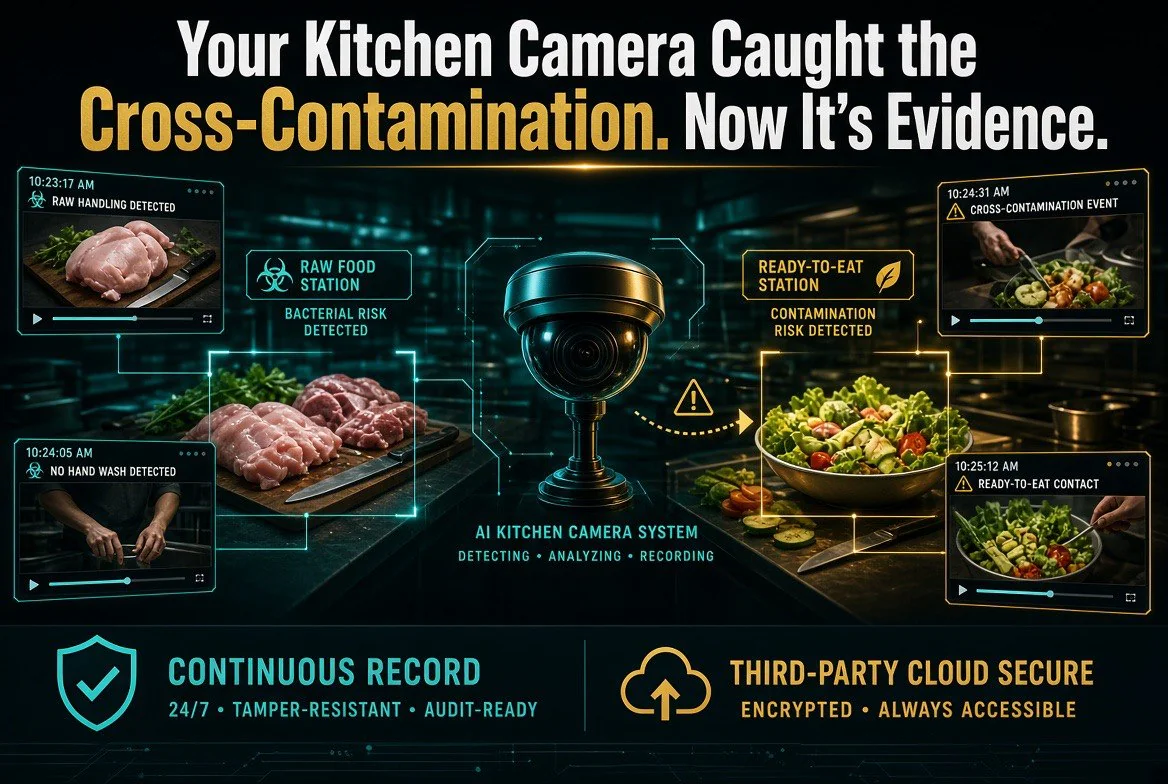
Your Kitchen Camera Caught the Cross-Contamination. Now It’s Evidence.
⚡ Expert Summary: AI computer vision systems are moving into commercial kitchens and processing lines to flag cross-contamination, slicing defects and hygiene risks in real time — a genuinely different product category from the waste-reduction and drive-thru cameras most operators have seen. The safety case is real. The problem is what the camera does the rest of the time: it records your kitchen continuously, it uploads to someone else’s cloud, and that footage becomes evidence the moment there is an illness claim, an inspection dispute or a labour complaint. Buy the camera for the contamination alerts. Understand that you are also buying a permanent, third-party-hosted record of every mistake your kitchen makes.
There is a version of the AI kitchen camera pitch that everyone has heard by now. It watches what you throw away and tells you to order less. Or it counts cars in the drive-thru. Useful, measurable, and safe to talk about at a trade show.
The version shipping this quarter is different, and it is arriving with much less fanfare. Cameras mounted on the line, trained to spot cross-contamination as it happens, to check slicing precision on a protein, to flag quality defects too small for a human eye to catch at rush-hour speed — and to do it before the plate reaches a cook. The systems are being deployed into processing lines and commercial kitchens right now, and the capability goes well past the temperature checks that food-safety tech has meant for the last decade.
That is a real advance. It is also the moment the camera in your kitchen stops being an inventory tool and becomes a record of everything your business does wrong.
What These Systems Actually Do Now
Older kitchen vision tech answered narrow questions. Is the fryer oil the right colour. Did someone wash their hands before returning to the line. Did the bin fill past the threshold. Each of those is a discrete check against a discrete rule.
The new generation is trying to answer continuous ones. Is there contact between raw and ready-to-eat product on this station right now. Is this cut consistent enough to plate. Is there a defect in this batch that a line cook working a Friday night would never see. The software is not checking a box on a clipboard — it is watching a process and judging it in motion.
That shift matters because it changes what the system is for. A waste camera produces a recommendation. A contamination camera produces an assertion: at this moment, on this line, this condition existed. Assertions are evidence. Recommendations are not.
| System Type | What It Observes | What It Produces | Legal Exposure If Something Goes Wrong |
|---|---|---|---|
| Waste-reduction camera | Volume and type of discarded product | Ordering recommendation | Low — nothing asserted about safety |
| Drive-thru vision | Vehicle presence, order timing | Throughput metrics | Low — commercial data only |
| Temperature and handwash logging | Discrete rule checks at intervals | Compliance log | Moderate — a gap in the log is itself a finding |
| Cross-contamination and defect vision | Continuous food-safety conditions on the line | Real-time alerts plus a retained audiovisual record | High — stored proof of conditions at a specific timestamp |
The bottom row is the one to think about before you sign. Everything above it observes something commercial. That one observes something a plaintiff’s lawyer would love to have.
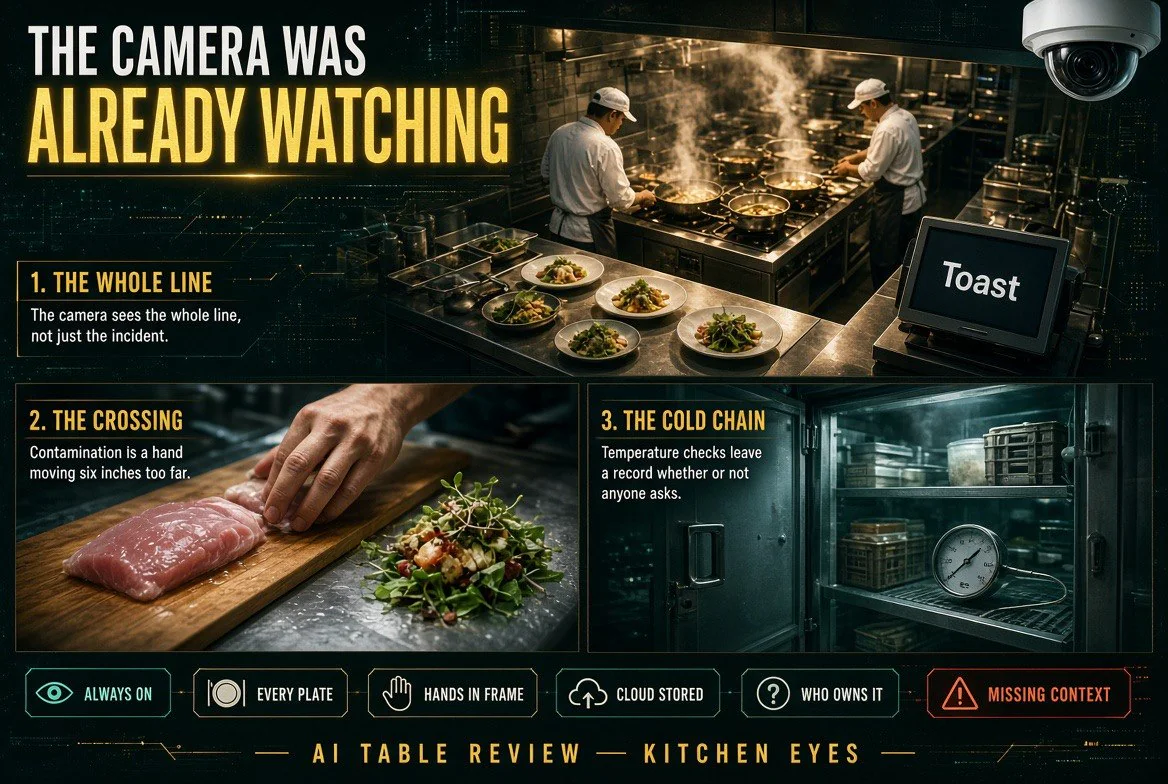
The Evidence Problem Nobody Puts in the Brochure
Here is how the sales conversation goes. The system caught 340 contamination events this month. It flagged a protein batch before it hit the line. Three near-misses you would never have known about. That is a compelling pitch, and the numbers are usually real.
Here is the question that is not in the deck. What happens to that footage after thirty days, and who can demand it.
Two scenarios, both ordinary.
The illness claim. A guest gets sick. The claim comes in. Discovery follows, and your kitchen footage becomes a data source. Now consider what the system already told you. It flagged a cross-contamination event on the relevant date and it was corrected within four minutes. That detail is your best defence — and only if the record is intact and complete. If the system flagged ten events that week and your team cleared every alert without acting, you have just produced a machine-generated log of your own negligence, timestamped, in high resolution.
The inspection dispute. An inspector records a violation. You believe it was fixed within the hour. Now ask whether you can prove when. If the camera recorded the correction, you win. If the system only retains alerts and not the resolution, you have a log that shows a problem and no record of the fix — which is worse than having no log at all.
Both of these outcomes are determined by contract terms and retention settings that nobody reads, decided at purchase, and discovered at the worst possible moment. The camera is neutral. The configuration is a legal decision.
Where the Footage Actually Lives
Most of these systems are sold as a subscription with cloud processing, because that is how the vendor makes a margin and how the model gets better. Your kitchen footage — continuous, timestamped, geolocated, audio-capable — sits on infrastructure you do not own and cannot audit.
That raises three questions no operator asks in the demo.
Who else can see it. Read the data-processing terms. Does the vendor reserve the right to use your footage to improve its models? Many do. That means your line, your staff, your recipes and your failures are training data for a system that will later be sold to your competitor down the street.
Where it is stored. Cross-border storage affects which data-protection rules apply and how fast you can be compelled to hand something over. A vendor hosting in a jurisdiction you did not consider is a problem you inherit.
What happens if you leave. Ask what the export looks like on cancellation. If the answer is “we don’t provide a bulk export,” you have spent two years building evidence you cannot take with you — and the record disappears the day you switch vendors. That cuts both ways: it removes your defence as well as your exposure.
None of this is exotic. It is the same set of questions a business should ask about any camera system, and almost no independent restaurant asks them because the purchase decision is being made by an operator thinking about food safety, not data governance.
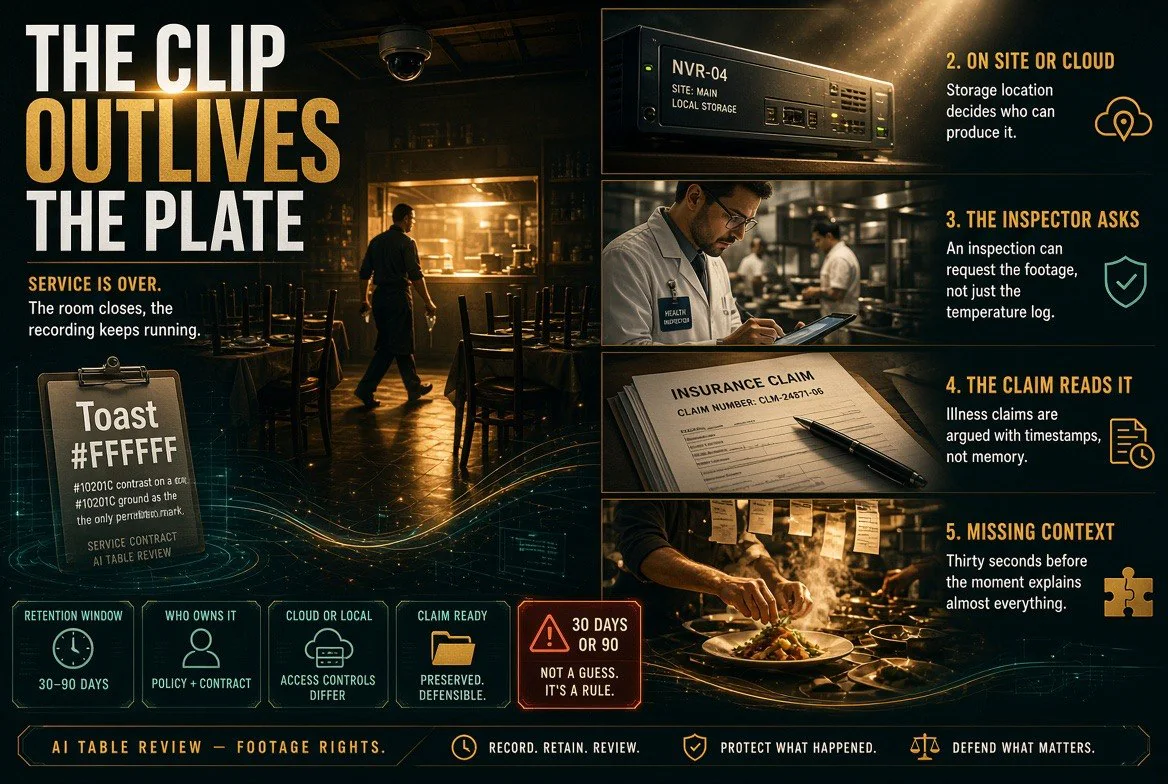
Why Independents Get the Worst Version of This Deal
The chains building these deployments have lawyers in the room at purchase. They negotiate retention windows, indemnities, model-training exclusions and audit rights. They have a data-protection officer who reads the terms before the equipment lands.
An independent operator gets the standard click-through and a monthly invoice.
The asymmetry is not in the technology — the same software is often on offer to both. It is in the contract review. The chain’s version of this system is configured to protect the chain. Yours is configured to the vendor’s defaults, which were chosen to make the product work well and the pricing attractive, not to protect you in a courtroom.
There is a second asymmetry, and it is worse. A chain with twelve hundred locations has a legal department that can absorb a document-production request. A four-unit operator facing a foodborne illness claim has to produce the same categories of evidence with no in-house counsel, on a deadline, while running service. The system that was supposed to protect you becomes the thing that buries you in discovery.
Scale buys you the ability to survive your own records. Independents buy the records and hope.
The Honest Counter-Argument
Everything above could be read as an argument against buying the camera. It is not, and the counter-argument deserves its full weight.
Foodborne illness kills people. Cross-contamination is the single most common mechanism by which it happens in commercial kitchens, and it happens overwhelmingly because a human under pressure made a mistake that no one saw. A system that catches that in real time prevents harm that would otherwise have occurred. Weighing the risk of a future lawsuit against the risk of a customer in a hospital is not a close call, and any operator who treats it as one has their priorities inverted.
There is also a defensive asymmetry that cuts in the operator’s favour. Right now, if a guest claims illness, you have almost nothing — a temperature log with gaps, a manager’s memory, and a supplier’s paperwork. A complete, machine-generated record of conditions on the line is the strongest evidence an operator has ever been able to hold. Most foodborne illness claims are not valid. A system that can show conditions were correct on the date in question closes those claims quickly. That is a real and underrated benefit.
And the vendor-retention objection is solvable. Configure retention to match your actual obligations. Negotiate the model-training exclusion — most vendors will grant it on request, because they know the request is coming from anyone with counsel. Ask for a bulk export clause and get it in writing before you sign.
The technology is not the problem. The defaults are.
What to Do Before You Buy One
This is a five-question checklist, and it should be answered before a purchase order exists rather than after an incident.
| Question | Acceptable Answer | Walk Away If |
|---|---|---|
| How long is footage retained, and can I change it? | You choose the window, in writing; 30–90 days typical | Only a fixed term, or “forever” with no deletion option |
| Is my footage used to train the vendor’s models? | Explicit opt-out in the contract, no default sharing | Silence in the terms, or “anonymised” with no definition |
| Can I export everything if I leave? | Bulk export in a standard format, stated in the contract | Export on request, unspecified format or fee |
| Are alerts and their resolutions both logged? | Full audit trail: alert, action, timestamp, user | Alerts only — a log that shows problems and not fixes |
| Who is the processor, and under which jurisdiction? | Named entity, named jurisdiction, named sub-processors | “Our cloud partner” with no named entity |
There is a sixth question that is not in the table because it is not a vendor question. It is yours.
Does your team actually clear the alerts? A camera that flags 340 contamination events a month and gets ignored is not a safety system. It is a record of a safety system you bought and did not operate. That distinction will not survive contact with a lawyer, and it will not survive contact with an inspector either. If you cannot staff the response, the camera is doing more harm than good — because it is documenting the gap.
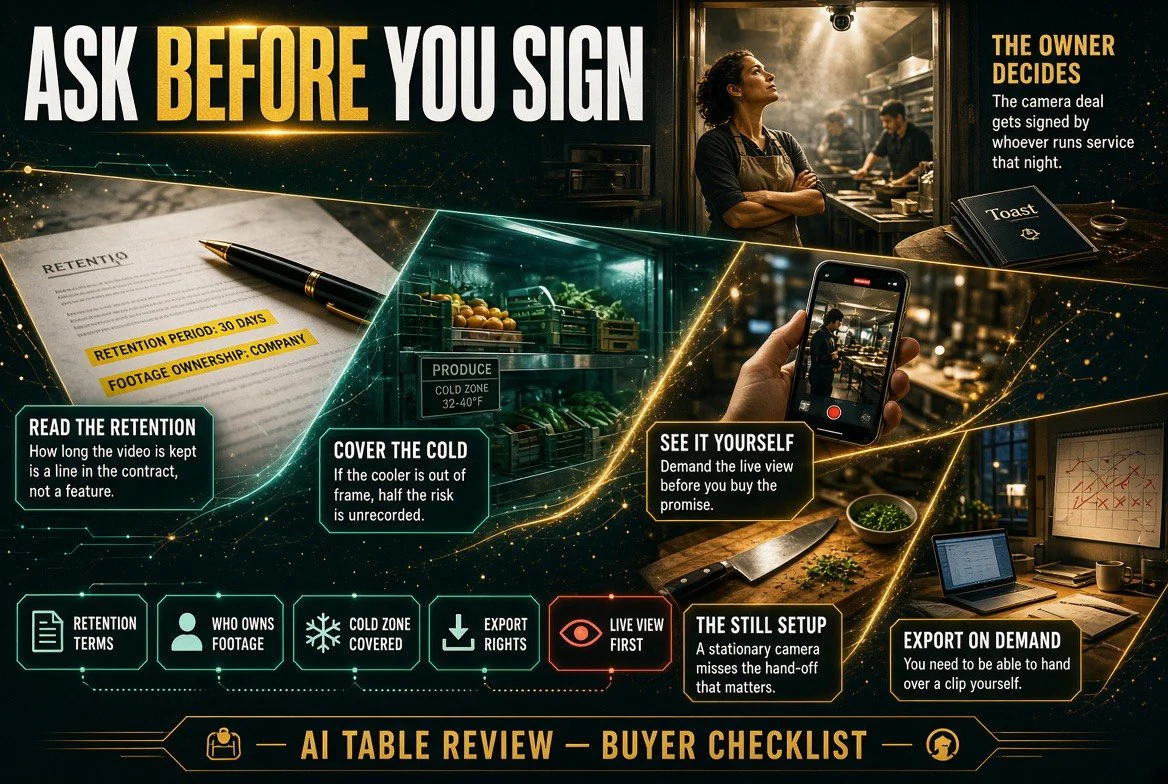
Where This Goes Next
The trajectory is clear enough. Vision systems will get cheaper, more accurate and more common, and within a few years a camera on the line will be as unremarkable as a POS terminal. Insurance carriers will notice, and some already are — a documented safety record is an underwriting input, and a verifiable one is worth money.
Regulators will notice more slowly, but they will notice. The moment an inspection regime accepts machine-generated records as evidence of compliance, the operator without them will be the one with something to explain.
Which leaves you two honest positions. You can buy the camera and treat it as a safety tool and a legal exposure at the same time, configured deliberately, with the terms negotiated and the alerts staffed. Or you can wait, keep your current logs, and accept that your record of what happens in your kitchen on a Friday night is a manager’s memory and a clipboard.
What you cannot do is buy the system, accept the vendor’s defaults, and assume it is only watching for contamination. It is watching everything. The only question left is who owns what it saw.
Frequently Asked Questions
What is AI computer vision in a commercial kitchen actually used for? Three broad categories. Waste and inventory cameras observe how much product is discarded. Operational cameras cover drive-thru throughput and order timing. The newest category monitors food-safety conditions in real time — cross-contamination between raw and ready-to-eat product, slicing precision, and quality defects too small to catch at speed. That third category is the one with legal implications, because it continuously records safety-relevant conditions rather than producing commercial metrics.
Is the footage discoverable in a lawsuit? Assume yes. Any record you hold that relates to the conditions in your kitchen on a given date is a plausible target in a foodborne illness claim or an inspection dispute. The relevant variable is not whether it can be requested, but whether the record helps you or hurts you when it is produced. A complete record of correct conditions and prompt corrections is a defence. A log of unresolved alerts is the opposite.
Can the AI vendor use my kitchen footage to train its models? Depending on the contract, yes. Many subscription agreements reserve the right to use customer data to improve the product, often described as anonymous or aggregated. If that matters to you — and it should, because your recipes, staffing patterns and failure modes are commercially sensitive — ask for an explicit exclusion in writing. Most vendors will grant it when asked before signing and much less often after.
Does a food-safety camera reduce my insurance premium? Not automatically, and not yet across the board. Some carriers are beginning to treat documented, verifiable safety records as an underwriting input. The practical move is to ask your carrier directly whether a machine-generated safety log affects your rate before you buy the system, so the purchase decision includes the insurance conversation rather than discovering it later.
What is the biggest mistake operators make with these systems? Buying them and then not staffing the response. A camera that generates 340 alerts a month which nobody action is not a safety improvement — it is a machine-generated record that you knew about the problems and did nothing. Configure the retention, negotiate the terms, and then make sure someone actually owns the queue during service.
Should a small independent operator buy one now? Only if you can answer the five contract questions in the checklist and staff the alert response. The technology is genuinely valuable and the safety case is real. But the deal available to an independent today is usually the vendor’s default configuration, and the default configuration protects the vendor. Read the terms, negotiate the exclusions, and treat the retention window as a legal decision rather than a settings screen.

About Barak Schurr
Barak Schurr built and exited a major ticketing platform, ran global operations at Eventbrite, and now focuses on one question: which AI tools actually help independent restaurant owners run leaner and grow faster. He writes from the operator’s perspective — no vendor spin, no theory, just what’s real in 2026.
Email: [email protected]
More Resources for Restaurant Operators