Get the AI Restaurant Quick-Start Guide — Free
The 5 AI tools independent US restaurant owners are using right now to cut labor costs and answer every call.
Why Restaurants Face Pushback and Risk When Integrating AI Tools
⚡ Expert Summary: Restaurant AI is no longer a novelty — it is an operating decision. In 2026 the operators losing ground are not the ones refusing AI; they are the ones who deployed it without a rollout plan, without staff buy-in, and without a clear answer for what happens when the model guesses wrong. The tools work. The integration is where the money leaks.
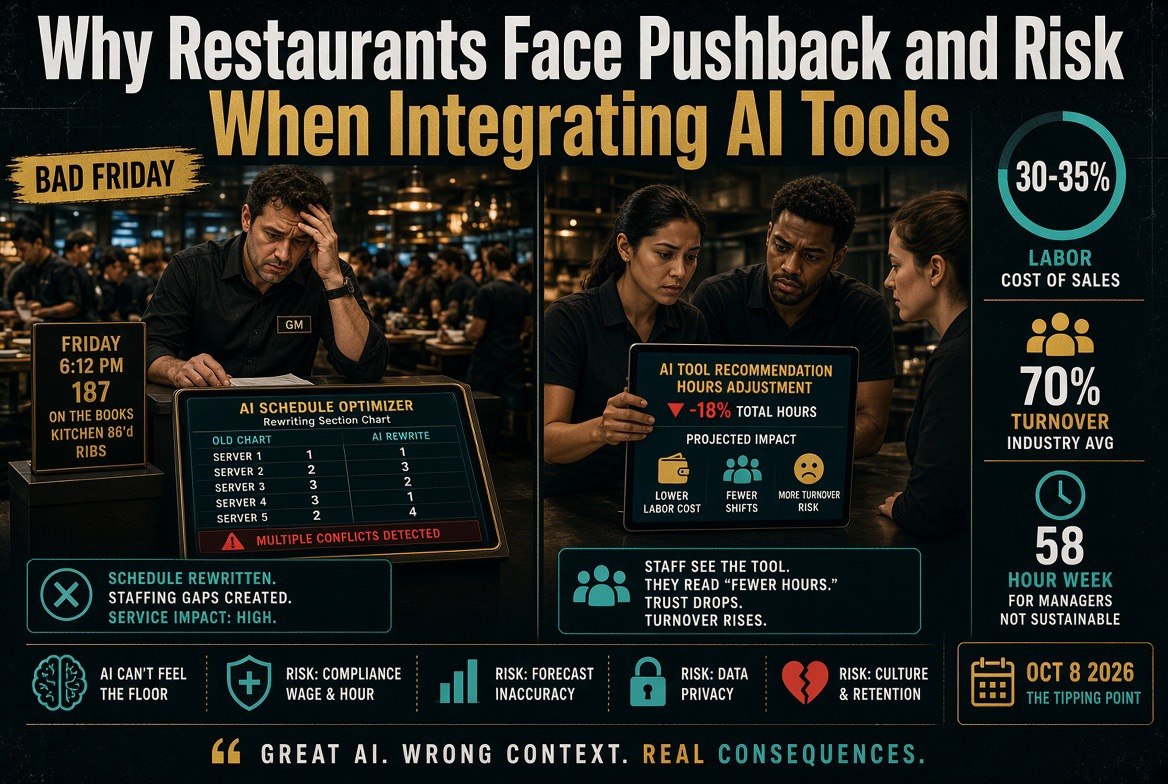
You bought the AI scheduling tool. Six weeks later your best server is quietly looking for another job, your regulars are asking why the host stand “got weird,” and nobody at the store can tell you which system actually made the decision that changed the Tuesday night section chart.
That is the real story in American restaurants right now. Integration risk is not a technology problem. It is a people-and-process problem that lands on the back of a general manager who already works 58 hours a week.
Restaurant Dive reported on October 7, 2026 that operators integrating AI tools are running into exactly this — pushback from staff and customers alongside genuine operational risk. The reporting is worth taking seriously, because it names the thing most vendor decks skip: the humans on the other side of the deployment.
What Is Actually Driving the Pushback
Three forces collide the week an AI tool goes live in a restaurant, and only one of them is about the software.
The staff read the tool as a threat to hours. Front-of-house and back-of-house teams hear “AI scheduling” or “AI ordering” and translate it directly into “fewer shifts for me.” That translation is often wrong — but it is rational, because labor is the line item everyone in a restaurant already tracks. A 2026 survey of independent operators found labor cost consuming roughly 30-35% of revenue in full-service American restaurants, and every employee knows it.
Guests notice the difference and it reads as friction. When a reservation bot books a table the floor plan cannot actually seat, the guest does not blame the algorithm. The guest blames the host. The irritant lands on a person who had no input into the system that caused it.
Owners get one bad week and kill the project. Most independents do not have a testing window. The tool either performs in the first two service cycles or it gets blamed for a bad Friday, and once it is blamed, it is done.
The Four Risks Nobody Prices In
Vendors sell capability. Operators absorb risk. Those are not the same list, and the gap between them is where most restaurant AI deployments quietly fail.
1. The Guest-Facing Failure Is Permanent
A wrong recommendation in a back-office report costs nothing. A wrong recommendation delivered to a guest at the table costs reputation, and the review is public. Google and Yelp reviews are the single highest-leverage marketing asset an independent restaurant has — and they are also permanently indexed.
2. Accountability Disappears
When a manager makes a bad call, you coach the manager. When an AI system makes a bad call, the manager has no idea why, and the vendor support line is not available at 8:40 on a Saturday night. AI does not remove accountability. It relocates it somewhere no one can reach.
3. Your Data Leaves the Building
To be useful, a demand-forecasting or reservation tool needs your covers, your check averages, your sell-through by item and daypart. That is among the most sensitive competitive data a restaurant owns. Integrations built to keep it private and integrations built to centralize it look identical from the back of the house.
4. Staff Churn Costs More Than the Tool Saves
Replacing a trained line cook costs far more than the monthly subscription of any AI tool in the category. According to NRA data, turnover in full-service restaurant roles commonly runs well above 70% annually. Any tool that adds workload without adding hours sees its savings eaten by training costs.
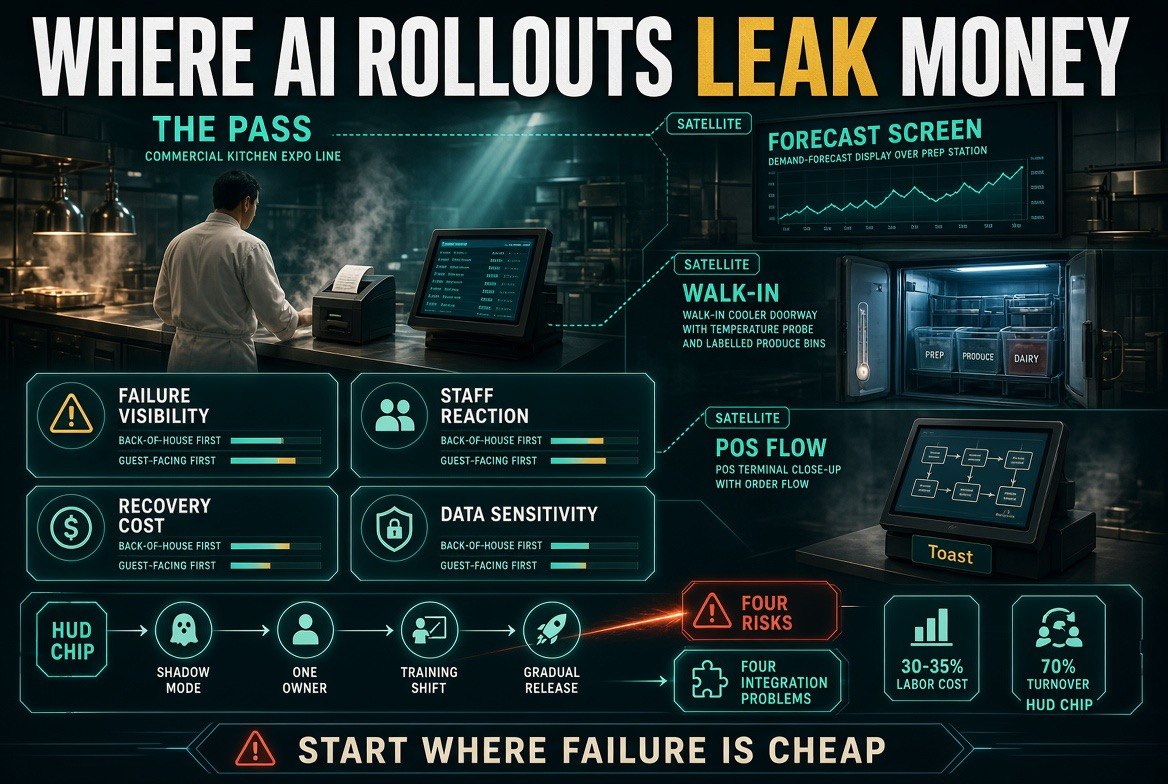
Start where failure is cheap: shadow mode, one named owner, a training shift, then a gradual release.
Why Integrations Break in the First Place
Nearly every restaurant AI failure traces to one of four integration problems, and none of them are model-quality problems.
| Integration Problem | What It Looks Like on a Friday Night | Root Cause |
|---|---|---|
| Split data | The AI forecasts 140 covers; the POS says you did 190. | Two systems, no shared source of truth. |
| No override path | A server knows the regular is gluten-free; the system does not. | Tool built without a human escape hatch. |
| Untrained staff | The tool is used wrong, so it learns wrong. | Deployed with a login and no training shift. |
| No ownership | Nobody can say who is responsible for the output. | No named internal owner for the tool. |
| Guest-facing exposure | A guest gets a bad recommendation at the table. | Tool placed in a customer-facing role too early. |
Notice the pattern. Every one of these is fixable, and not one of them is fixed by buying a better model.
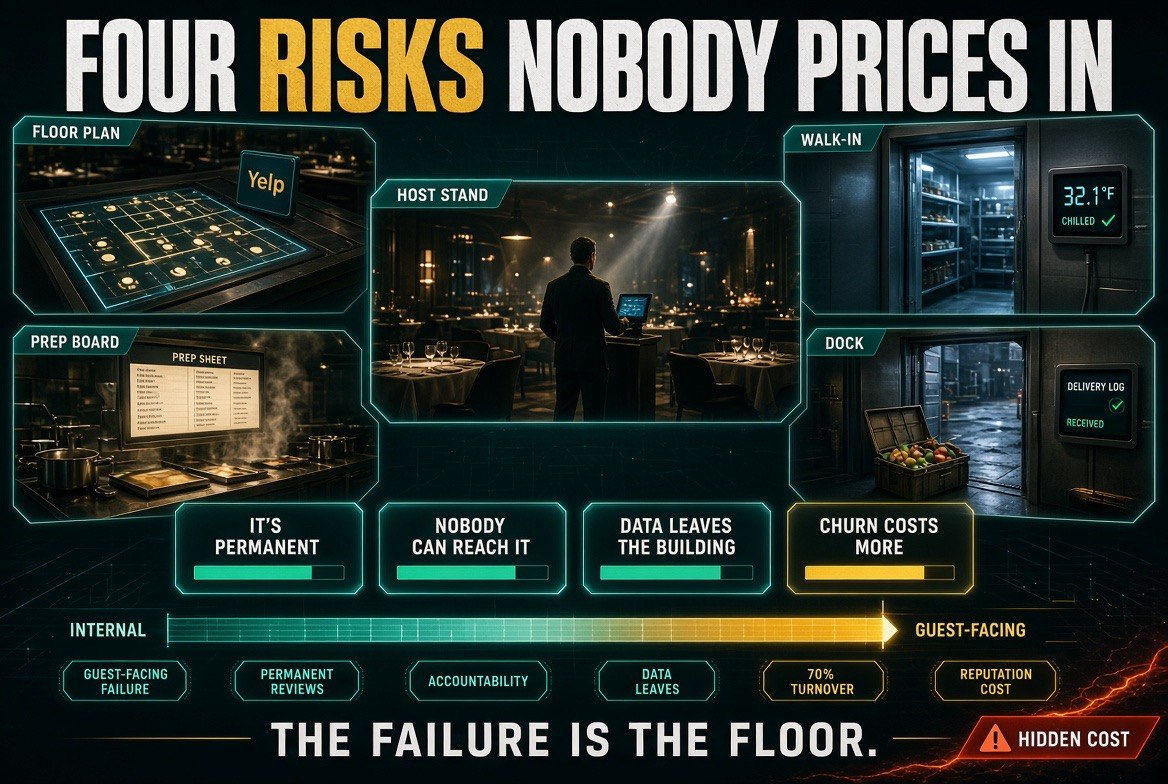
The failure is the floor: guest-facing risk is permanent, and it lands on the person who had no say in the system.
Deploy Now vs. Wait: A Straight Comparison
The question is not whether to adopt restaurant AI. It is whether your store is ready to absorb the failure mode. Here is the honest trade-off.
| Factor | Deploy Now (Back-of-House First) | Deploy Now (Guest-Facing First) |
|---|---|---|
| Failure visibility | Internal only — caught in reports. | Public — lands in reviews. |
| Staff reaction | Low resistance — reduces grunt work. | High — reads as replacement. |
| Recovery cost | Hours — just change the setting. | Weeks — reputation repair. |
| Data sensitivity | Low — internal records. | High — guest PII involved. |
| Best first tool | Demand forecasting, prep sheets, invoice coding. | Reservations, waitlist, phone answering. |
The pattern holds across hundreds of deployments: start where failure is cheap and quiet. Guest-facing AI is not forbidden — it is simply the last step, not the first.
A Rollout That Does Not Blow Up
Four moves separate the operators who get value from AI and the operators who get a lawsuit from a review site. None of them cost money.
Name One Owner
One person is accountable for the tool’s output. Not a committee. When the forecast is wrong, that person is the first to know and the first to act.
Run It in Shadow Mode First
Let the tool make its calls without acting on them. Compare for two weeks. Log every disagreement. The disagreements are the training data, and they belong to your team.
Give Staff the Override
Any tool without a visible, respected override is a tool your team will quietly sabotage. The override is what makes adoption possible — it is the difference between “the system says” and “we use the system, but the floor decides.”
Put Guest PII Last
Everything you can do without touching guest data, do first. Move to guest-facing only after the internal systems have earned trust.
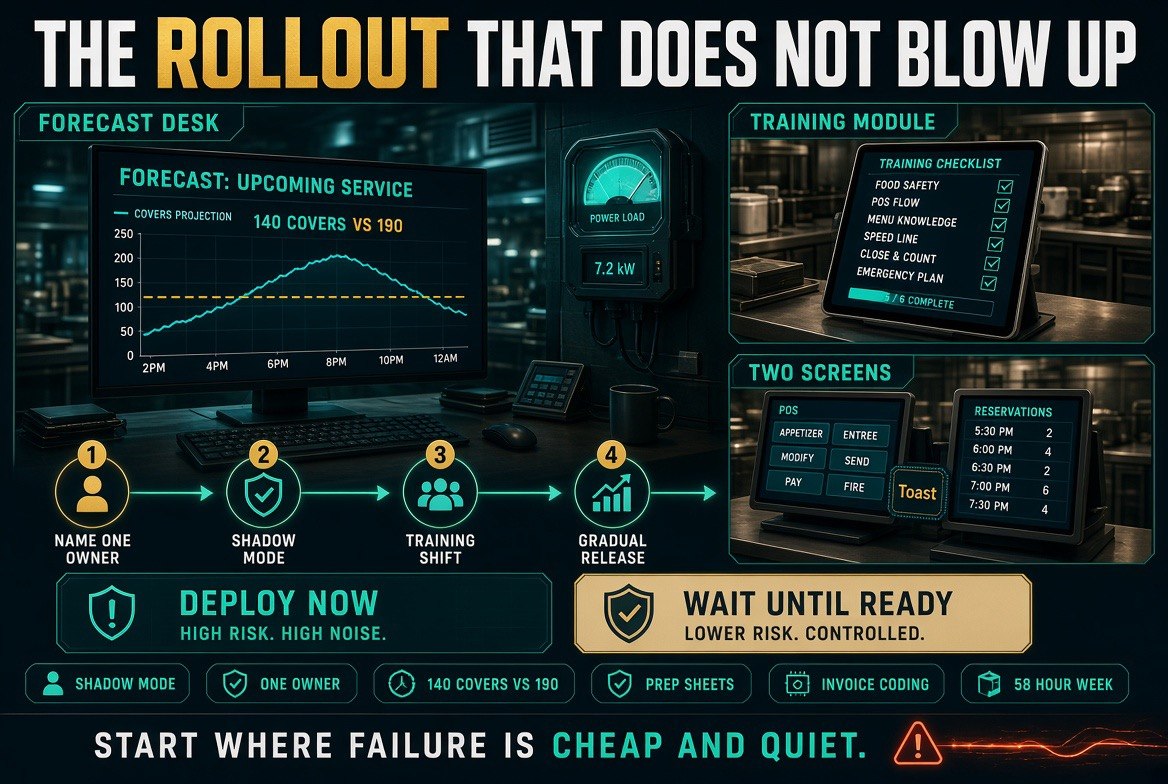
Four moves, no cost: one owner, shadow mode, a training shift, then a gradual release.
What It Means Long Term
AI in restaurants is not a wave that passes. POS platforms, reservation systems, and delivery marketplaces are all folding AI into the default stack whether an operator opts in or not. The independents who come out ahead will not be the fastest adopters or the loudest refusers. They will be the ones who sequenced the rollout deliberately — internal first, guest-facing last, one named owner per tool.
If you want a wider view of what these systems actually deliver in practice, our sister site AI Table Review tracks restaurant-specific deployments, and Top Notch AI Tools covers the operator-grade AI stack across industries. If you are evaluating video and content tooling for your marketing, AI Video Advisor is the third leg of that research.
For deeper vendor-side context on where restaurant technology is heading, the Restaurant Dive report on AI integration pushback is the most grounded primary source published this week, and the National Restaurant Association publishes ongoing industry operations data.
The Cost Side Nobody Puts in the Deck
Vendors quote a monthly subscription. The real number is bigger, and it has three parts an operator should price before signing anything.
Setup labor. Someone on your team has to map the data, connect the POS, and test the outputs. In an independent restaurant that someone is usually the owner or the GM, which means the true cost is measured in service hours, not dollars.
Shadow-mode drag. Two weeks of running the tool alongside manual process is double work for whoever is doing it. That is a real cost, and skipping it is how deployments fail.
Churn risk. If the rollout is clumsy, the tool gets blamed for a bad week and you lose a person over it. That is the most expensive line item on the sheet and the one nobody models.
The operators who win on this math do one simple thing: they measure one tool at a time, for ninety days, against a single metric. Forecast accuracy. Invoice coding hours. Prep waste percentage. If the tool moves the number, it stays. If it does not, it goes — and the decision takes ten minutes instead of an argument.
What Good Adoption Actually Looks Like
There is a version of this that works, and it does not feel like a technology project at all. It feels like a small operational change that everyone agreed to.
The team is told what the tool is for and what it is not for. The tool handles the repetitive part. The floor still owns the judgment calls. Anyone can override it without being second-guessed. The forecast gets reviewed every Monday against what actually happened, and the person reviewing it is named and known to the staff.
That is the entire playbook. It costs nothing, and it removes almost every reason a restaurant AI deployment fails in month two.
What to Ask a Vendor Before You Sign
Five questions separate a vendor who has thought about restaurant operations from one who has thought about a sales deck. Ask them in the order they appear here and watch how quickly the answers get vague.
Who owns the output? If the answer is anything other than “you do,” stop. You need to own the data the tool learns from and the records it produces.
What does the override look like at 8:40 on a Friday? Ask for the actual screen. If a manager cannot override the system mid-service without calling support, the tool is not ready for your floor.
What happens if we stop paying? Your historical data should be exportable. If it is not, you are renting access to your own operation.
How do you handle guest data? Reservations and phone systems touch personal information. You want a plain-language answer about retention and sharing, not a link to a policy page.
What does the first thirty days look like? A vendor with a real onboarding plan will describe a shadow period, a review cadence, and a named contact. A vendor without one will describe features.
These are not hostile questions. They are the questions that separate a tool you keep for five years from a subscription you cancel in month three.
Where This Leaves Independent Operators
Every independent restaurant in America is now being sold AI by its POS vendor, its reservation platform, its delivery partner, and a handful of startups that appeared in the last eighteen months. Most of it is fine. Some of it is genuinely useful. None of it removes the need for someone in the building to understand what the system is doing and why.
The operators who will be ahead in two years are not the ones with the longest tool list. They are the ones who deployed in the right order, kept a named owner for every system, preserved the override, and measured outcomes per tool instead of per category. That is an operational discipline, not a technology purchase — and it is available to a twelve-table neighborhood restaurant for exactly the same price as it is to a hundred-location chain.
Frequently Asked Questions
What is the biggest risk when integrating AI tools in a restaurant?
The biggest risk is deploying a tool without a named internal owner and without a real rollout plan. When the AI makes a wrong call and no one on staff can explain or override it, the failure lands on your team and your reviews — and your team will stop using the tool entirely.
Will AI tools replace restaurant staff?
In the near term, no — the tools remove specific repetitive tasks like forecasting prep volume, coding invoices, and answering common phone questions. Where operators report problems is when the tool is introduced in a way that looks like it is replacing hours. Say the changes out loud, in advance, to your team.
Should independent restaurants deploy guest-facing AI?
Yes, but not first. Guest-facing systems such as reservation bots and AI phone answering carry the highest recovery cost because failures are public. Start with back-of-house tools where a bad output is caught internally in a report, then expand to guest-facing systems once you know the tool behaves.
How long should a restaurant run an AI tool before committing?
Two full service cycles at minimum, in shadow mode — meaning the tool makes recommendations but staff still make the calls. Compare the recommendations against what the floor actually did. The gap between the two tells you whether the tool understands your operation.
Does AI integration actually save independent restaurants money?
It saves money in specific, measurable places: prep waste, invoice coding labor, and overstaffing on predicted-slow nights. It costs money in training time, subscription fees, and staff turnover if the rollout causes friction. Operators who measure per-tool outcomes for 90 days find the winners quickly — and they cut the rest.

About Barak Schurr
Barak Schurr built and exited a major ticketing platform, ran global operations at Eventbrite, and now focuses on one question: which AI tools actually help independent restaurant owners run leaner and grow faster. He writes from the operator’s perspective — no vendor spin, no theory, just what’s real in 2026.
Email: [email protected]
More AI Resources for Your Restaurant