Get the AI Restaurant Quick-Start Guide — Free
The 5 AI tools independent US restaurant owners are using right now to cut labor costs and answer every call.
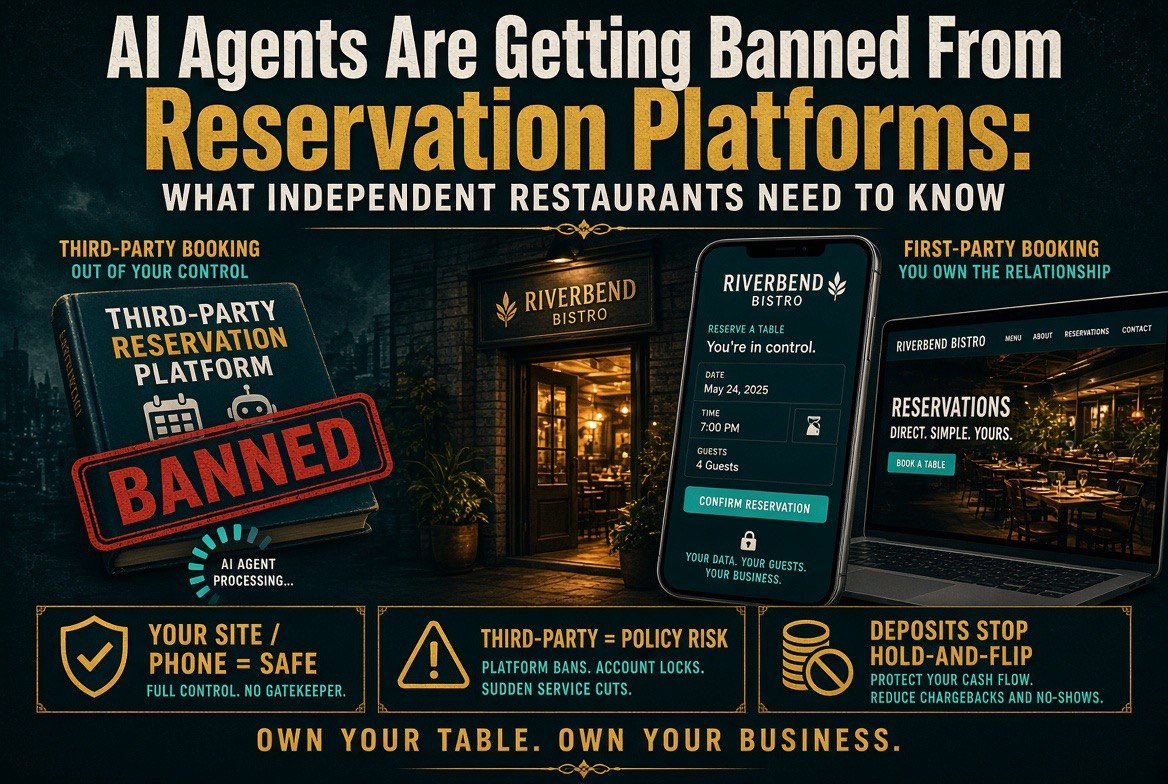
AI Agents Are Getting Banned From Reservation Platforms: What Independent Restaurants Need to Know
⚡ Expert Summary: Reservation platforms have started deactivating accounts that use third-party AI agents to book tables. Resy banned at least two high-profile users this month, then reinstated them. For independent operators the practical question is not whether the agents are fair — it is whether your own booking flow still works when a chunk of demand arrives through channels your platform refuses to serve.
Two weeks ago, a venture capital principal woke up to an email from Resy telling him his account had been deactivated. He had used an AI agent to try to book a table at a New York hot spot. He was not alone, and the resulting fight has now put every restaurant that takes reservations in the middle of a policy argument it never asked for.
What Actually Happened
Per Restaurant Business and CNN, the details are specific enough to matter.
JC Bahr-de Stefano, a principal at a venture capital firm, instructed an AI assistant built by a company called Instinct to book a table at 4 Charles, a New York City restaurant. The agent did not politely check once. According to Bahr-de Stefano, it made “roughly 200 API requests per hour, around the clock,” including a burst of 200 to 375 requests around 9 a.m. each day when 4 Charles opened its reservation book.
Resy deactivated the account for violating its terms of service. The platform does not permit unapproved third-party bots or agents to access its system. A separate X user, Brian Distelburger — an American Express Platinum cardholder of 20+ years and, in his words, a Resy member since launch — was deactivated for the same reason after building his own agent to scan for openings. Both accounts were eventually reinstated. Bahr-de Stefano said he is done with the approach: “First time = last time.”
Resy’s own statement was unambiguous: it “does not currently permit unapproved third-party bots or agents to independently access or interact with the Resy platform,” adding that bots introduce risk and give some diners an unfair advantage over others. The company declined to say how many accounts it has deactivated.
Resy founder Ben Leventhal framed the scale of the problem in a single post: “10,000 vibe coders have written Resy sniper bots.” That is the sentence independent operators should pay attention to, and we will come back to why.
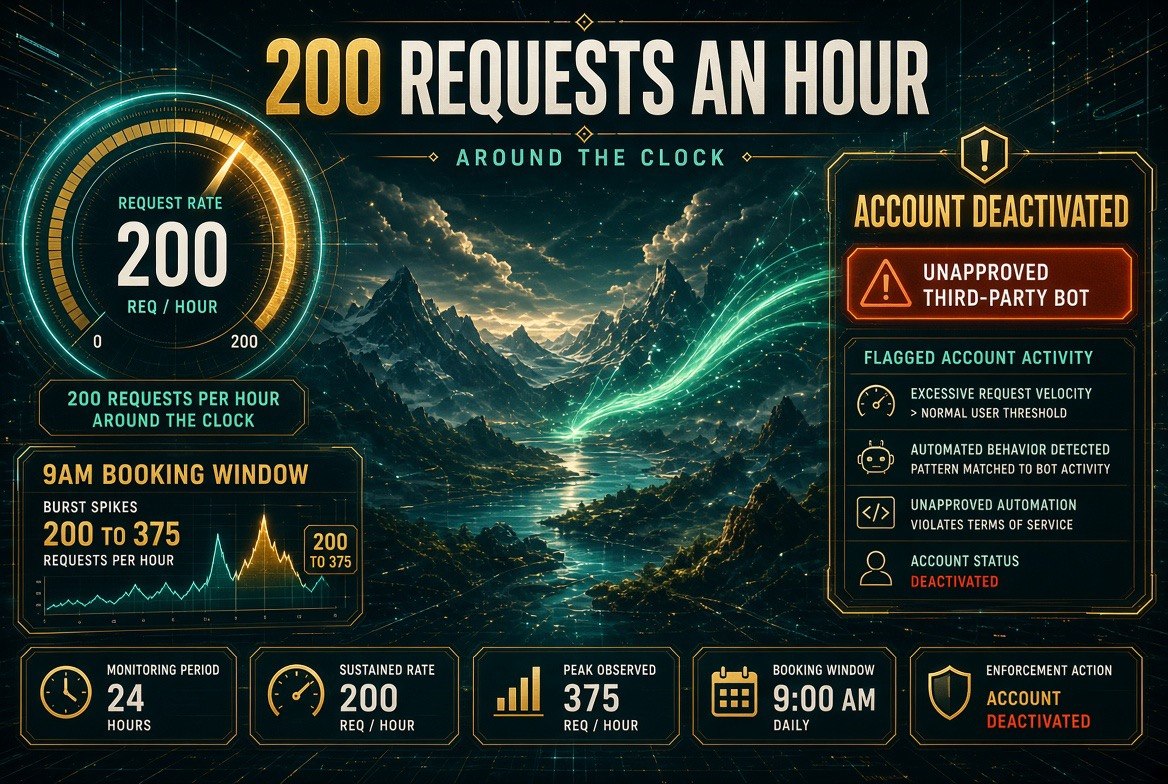
What the banned agent actually generated: a sustained 200 requests per hour around the clock, with 200 to 375-request bursts during the 9am booking window, until the platform deactivated the account.
Why This Is a Restaurant Problem, Not Just a Diner Problem
It is easy to read this story as a tech-ethics spat between a reservations platform and the people who use it. That framing misses where the cost lands.
Start with the requests. An agent firing 200 API requests per hour, around the clock, is not a diner tapping refresh. It is load. Multiply one motivated agent by the thousand-plus that Leventhal says exist, concentrated on the same handful of high-demand restaurants at the same moment — the instant a book opens or a cancellation drops — and you are describing a denial-of-service pattern that no booking platform designed for human-paced traffic was sized for.
When that load slows the platform, the restaurant experiences it as lost bookings. Not angry bots — lost customers. A guest who tried to book at 9:01 a.m. and got a spinner does not call the restaurant to explain. They book somewhere else.
Then there is the inventory question, which is worse. An agent that grabs a table is not necessarily the person who eats. Tables secured by automation can be held, resold, or abandoned. New York banned the secondary market for reservations in late 2024; New Jersey followed this spring. Those laws exist because the arbitrage is real. When an AI agent takes a 7:30 table that a real guest would have taken, the restaurant collects the same cover revenue but loses the guest relationship — and possibly the second visit.
Finally, there is the reason the two deactivated accounts belonged to a venture capitalist and a founder. AI booking agents are currently an early-adopter product. The people using them are exactly the high-spend, high-frequency, high-visibility guests that independent restaurants build their businesses on. Banning them is not the same as banning anonymous scalpers. It is closer to banning your best customers for using a tool, and the platforms have not yet worked out how to draw that line.
What Resy’s Ban Does and Does Not Cover
Operators need precision here, because “bots are banned” is not the rule.
Platform-sanctioned integrations are untouched. Resy, OpenTable and Tock all connect to approved partner software — waitlist tools, CRM platforms, Google’s reservation surfaces, hotel concierge systems. None of that is affected by this enforcement wave.
What is banned is unapproved third-party access: an agent that logs in or hits the API as if it were the diner, at machine speed, without the platform’s blessing. The Instinct agent crossed that line by design. So did the custom sniper bots built by individual users.
The gray zone is where this gets genuinely hard for an operator to navigate. A guest who asks ChatGPT to find them a table is not running a bot. A guest using an agent to monitor for cancellations is. Both look the same at your host stand, and neither is something you can screen for.
Where Your Own Booking Stack Fits
This is the part that should prompt an actual look at your systems rather than an opinion about fairness.
If a meaningful share of your demand is arriving through third-party booking channels, you are now dependent on how those channels enforce their own bot policies. That is a dependency you did not choose and cannot influence. The two things you control are your first-party booking path and how much of your inventory you hand to intermediaries.
That is the same structural calculation that runs through our breakdown of how to cut third-party delivery commission with AI: the commission is the visible cost, and the lost customer relationship is the real one.
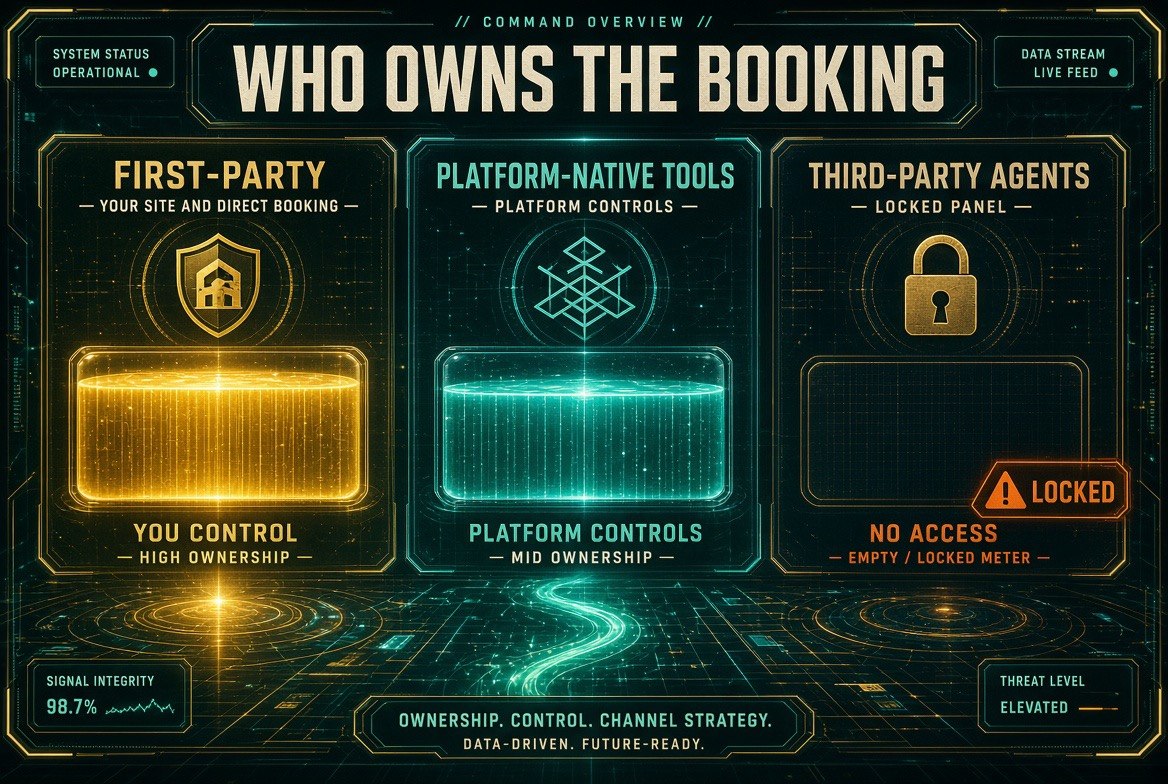
The three reservation channels ranked by who actually holds the data: first-party direct booking you control, platform-native tools the platform controls, and third-party agents left locked out.
Reservation Channels Compared: Which Ones You Actually Control
Not all booking paths carry the same exposure to this problem. This is the practical comparison for an independent operator deciding where to push guests.
| Channel | Exposure to agent traffic | Who owns the guest data | What a ban means for you |
|---|---|---|---|
| Your own site or phone | Low — human-paced by default | You | Nothing breaks. This is your floor. |
| Resy / OpenTable / Tock | High on hot tables — sniper agents target them | Shared, favors the platform | Some high-value guests get locked out of your book |
| Google / Maps booking | Moderate — high volume, mixed quality | Google, relayed to you | Unchanged — sanctioned partner integration |
| DM, text and social requests | Low, but unmanaged | You, if you capture it | No ban risk, but no-shows spike without deposits |
The pattern is consistent: the more exclusive your tables, the more agent pressure your third-party channels absorb, and the more of your best guests’ booking attempts depend on a policy you do not set.
Before you decide what to change, get the measurement right. This is the set of numbers that tells you whether agent traffic is actually touching your revenue — four figures, each one pullable from your POS or reservation platform reporting.
| Metric | Healthy range | Warning sign |
|---|---|---|
| Third-party booking share | Under 40% of covers | Your platform can filter out a large slice of demand without you knowing |
| First-party booking share | Above 50% of covers | You rent your customer list instead of owning it |
| Same-day cancellation rate | Under 10% of bookings | Tables are being held speculatively rather than committed to |
| Prime-time fill from direct bookings | Roughly half or better | Automated traffic is colonizing your highest-margin slots |
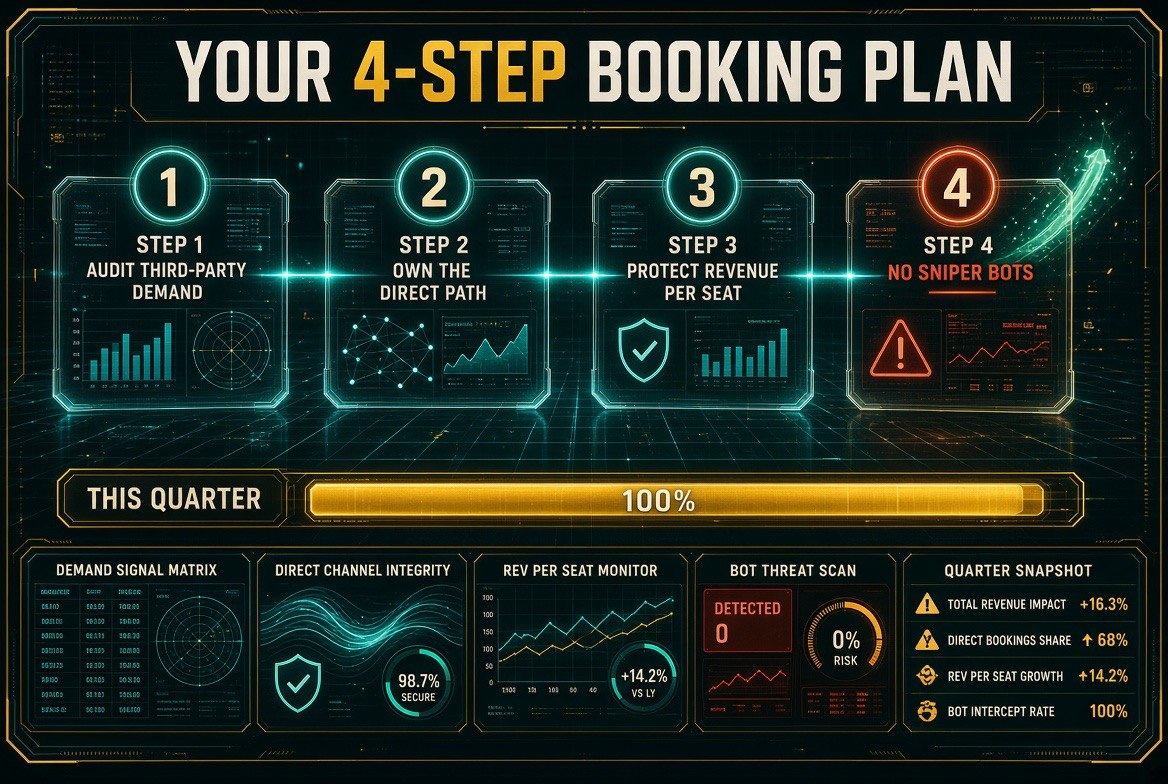
The four moves that actually hold your booking demand this quarter: audit third-party reliance, own the direct path, protect revenue per seat, and stay off the sniper-bot approach that got accounts deactivated.
What Independent Operators Should Do This Quarter
Four moves, in the order that matters.
1. Find out how much of your demand is third-party
Pull three months of booking source data. If a third of your covers come through platforms you do not control, you have a concentration risk independent of the AI question. You cannot fix what you have not measured, and most independent operators have never separated first-party from third-party cover counts.
2. Push guests to a path you own
Every booking that arrives on your own site or phone line is a booking no platform policy can take away. Direct booking prompts — on your confirmation emails, your receipts, your social bios — are the cheapest insurance available, and they cost nothing to add. Our guide to picking an AI reservation system for restaurants in 2026 walks through what to look for so the system you choose keeps that data first-party.
3. Protect revenue per seat, not just seat count
If automated bookings are eating your prime-time inventory, a deposit or prepaid model changes the economics — an agent that has to commit a card at booking is a different proposition than one that holds a table for free. That is the mechanism behind the approach in our Tock review: how prepaid seats kill no-shows, and it works whether the guest is human or a script.
4. Do not build your own sniper bot
If you operate multiple locations and have a coder on staff, the temptation to scrape your own platform for demand signals is real. Do not. Platforms are actively hunting for exactly that traffic pattern, and losing your account means losing your reservation book. Ask your platform for an approved reporting integration instead.
The Bigger Shift: Booking Is Becoming a Machine-to-Machine Channel
The specifics of the Resy story will be stale within a month. The direction will not.
Reservation demand is migrating from humans tapping phones to software acting on human instructions. That is the same shift that already happened in airline seats, hotel rooms and concert tickets, and it produced the same sequence every time: automated access, an arms race, then platform enforcement and official APIs. Restaurants are entering that sequence late and without much leverage.
That leaves operators with a clear choice about which side of the handshake they want to be on. You can be the restaurant whose only access point is a platform that bans the agents, absorbing whatever share of demand gets filtered out. Or you can be the restaurant that is reachable through your own booking path, in the channel the agent can actually complete a transaction in, with a deposit attached so the booking is real.
The second option is not complicated, and it does not require new technology. It requires deciding that your reservation flow is infrastructure you own.
One more thing worth watching: what platforms do about agents that are good for restaurants. A bot that fills Tuesday-night seats at a neighborhood spot is not the same threat as a bot that snipes Saturday prime time at 4 Charles. Expect approved-agent programs within the year, and expect the restaurants that already own their guest data to get the better terms.
Frequently Asked Questions
Why did Resy ban people for using AI agents to book tables?
Resy’s terms of service prohibit unapproved third-party bots or agents from accessing the platform. The platform says bots introduce risk and give some diners an unfair advantage, and it deactivated at least two accounts for using AI agents before reinstating them.
Does this affect my restaurant’s reservation system?
Not directly. Approved partner integrations like waitlist tools, CRM platforms and Google booking are unaffected. The ban targets unapproved automated access, not your own booking setup.
Can AI still book reservations for restaurants?
Yes, through sanctioned channels. What is banned is unapproved agents hitting the platform directly at machine speed. Restaurants that offer a first-party booking path or an approved integration stay reachable.
How much traffic did the banned AI agent generate?
According to the user involved, the Instinct agent made roughly 200 API requests per hour around the clock, with bursts of 200 to 375 requests around 9 a.m. when the restaurant’s reservation book opened.
Should restaurants add deposits to stop automated bookings?
A deposit or prepaid model changes the economics of any booking, automated or not, because it requires a real commitment at the time of reservation. It also reduces no-shows from human guests, which is the larger revenue problem for most independents.
Will reservation platforms create official AI agent programs?
Likely, and probably within the year. Platforms cannot ban automation entirely without ceding demand to competitors, so approved-agent access with defined limits is the logical endpoint. Restaurants with their own guest data will negotiate better terms.

About Barak Schurr
Barak Schurr built and exited a major ticketing platform, ran global operations at Eventbrite, and now focuses on one question: which AI tools actually help independent restaurant owners run leaner and grow faster. He writes from the operator’s perspective — no vendor spin, no theory, just what’s real in 2026.
Email: [email protected]
More Resources for Restaurant Operators