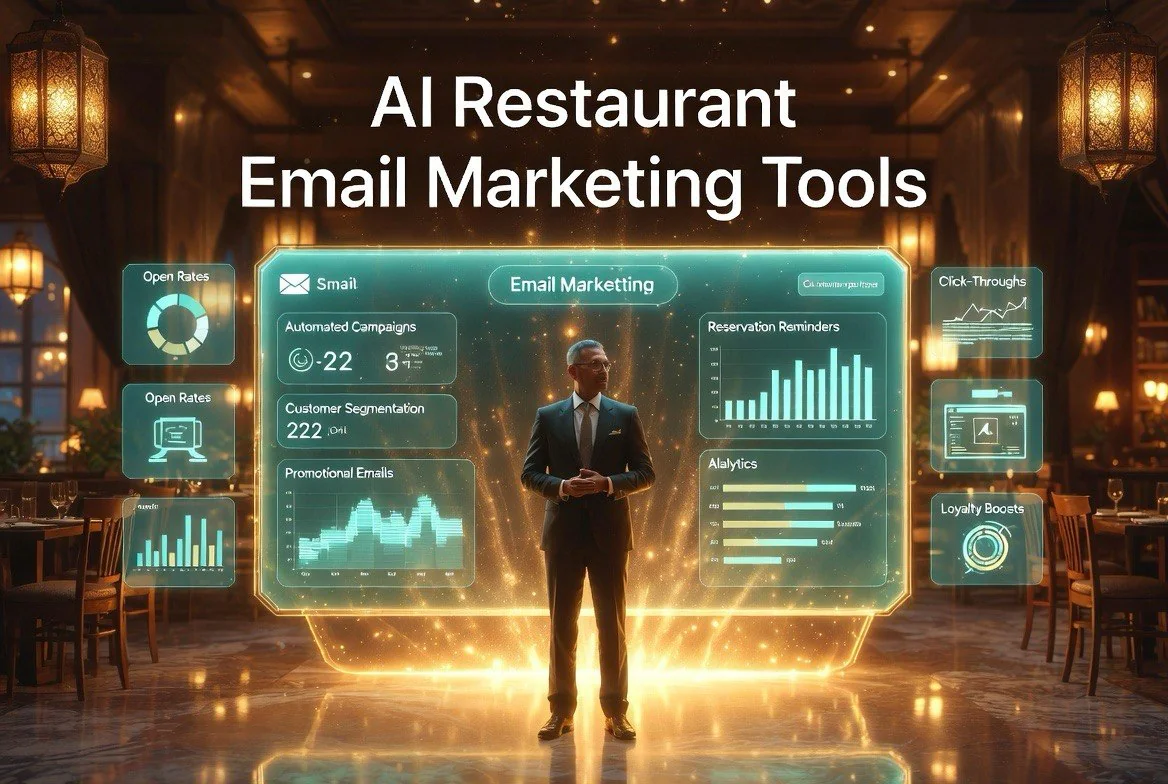
AI Restaurant Email Marketing: 5 Tools That Save Independent Owners 12 Hours a Week and Boost Repeat Orders by 34%
⚡ Expert Summary: AI-powered email marketing tools for restaurants automate the entire email workflow — segmenting customers, writing subject lines, generating personalized content, scheduling sends based on recipient behavior, and A/B testing campaign variables. The best tools save independent restaurant owners 10-12 hours per week on email marketing while delivering higher open rates, click-through rates, and repeat order conversions. The Deloitte 2026 Restaurant Technology Outlook found that restaurants using AI email marketing tools saw a 34% increase in repeat orders within 90 days of deployment. This guide covers the five best AI email marketing tools for independent restaurants, the specific time savings each delivers, and the implementation factors that separate successful deployments from disappointing results.
Why Restaurant Email Marketing Needs AI
Email marketing is one of the most effective channels for driving repeat business at independent restaurants. The National Restaurant Association reports that email marketing to existing customers generates an average ROI of $42 for every $1 spent, compared to $22 for social media advertising and $5 for print advertising. The problem is that effective email marketing requires time, skill, and consistency that most independent operators simply do not have.
A well-run email marketing program requires weekly campaign planning, copywriting, design, audience segmentation, deployment, performance analysis, and optimization. The Intouch Insight 2026 study found that independent operators who managed their own email marketing spent an average of 6 hours per week on email-related tasks, and operators who outsourced email marketing spent $800-1,200 per month on agency fees. Both approaches delivered inconsistent results because the effort was not sustainable — 47% of operators who started a manual email program abandoned it within 90 days due to time constraints or inconsistent results.
AI email marketing tools solve the sustainability problem by automating the entire workflow. The AI writes email copy based on the restaurant’s menu, promotions, and brand voice. It selects images from the restaurant’s existing content library. It segments the audience based on past behavior — frequency of visits, average spend, preferred menu categories — and sends personalized content to each segment. It schedules sends for optimal open times based on each recipient’s past behavior. It runs A/B tests on subject lines, send times, and content formats to improve performance over time.
Tool 1: Bbot Email AI
Bbot’s Email AI module launched in late 2025 and quickly became one of the most popular AI email tools for US independent restaurants. The platform connects to the restaurant’s POS and customer database to create detailed customer segments based on visit frequency, average check, menu preferences, and recency of last visit.
Bbot’s AI generates weekly email campaigns automatically. The operator reviews the AI-generated content and approves or edits before sending. Most operators find that the AI-generated copy requires minimal editing after the first 2-3 weeks of calibration. Bbot Email AI costs $79 per month as an add-on to Bbot’s base ordering platform, or $129 per month as a standalone tool.
The Deloitte study reported that Bbot users saw an average open rate of 31% for AI-generated emails, compared to the restaurant industry average of 22% for manually created emails.
Tool 2: Mailchimp with AI Add-On
Mailchimp is the most widely used email marketing platform among small businesses, and its AI features for restaurants have improved significantly in 2026. The platform’s AI content generator creates email copy based on the restaurant’s website content, menu, and past campaigns. The AI subject line generator suggests 10-15 subject line variations ranked by predicted open rate.
Mailchimp’s audience segmentation AI is its strongest restaurant feature. The platform automatically creates segments based on purchase behavior from POS data integration — first-time visitors, regulars, lapsed customers, high-value customers, and menu-specific segments. The AI sends targeted campaigns to each segment without manual setup. Monthly cost: $59 per month for the Standard plan with AI features.
Tool 3: SevenRooms AI Marketing
SevenRooms is a guest experience platform that includes AI-powered email marketing specifically designed for restaurants. The platform’s AI analyzes customer visit patterns and generates personalized marketing campaigns based on each customer’s specific behavior — a customer who always orders from the gluten-free menu receives different content than a customer who consistently orders the chef’s tasting menu.
SevenRooms’ most discussed AI feature is its predictive churn alert. The system identifies customers whose visit frequency has dropped below their historical pattern and automatically sends a re-engagement campaign before the customer churns completely. The Intouch Insight study found that SevenRooms users reduced customer churn by 26% within 60 days of deploying the predictive alerts. Monthly cost: $149 per location.
Tool 4: Toast Marketing AI
Toast’s built-in marketing module added AI features in early 2026, making AI email marketing available to restaurants already using Toast POS without adding a separate vendor. The system uses the restaurant’s own sales data — Toast processes over $100 billion in annual gross payment volume — to generate highly targeted email campaigns based on actual purchase history.
Toast Marketing AI is particularly strong at time-based campaigns — birthday offers, anniversary of first visit, win-back campaigns for customers who have not visited in 30, 60, or 90 days. The AI sets up these campaigns automatically when the module is activated, requiring no manual configuration. Toast Marketing AI is included with Toast’s Marketing package at $79 per month.
Tool 5: Lunchbox AI Campaigns
Lunchbox is a digital ordering platform that added AI email marketing features specifically designed for the quick-service segment. The AI focuses on short, action-oriented email copy designed for high open rates on mobile devices, where 68% of restaurant email opens occur.
Lunchbox’s AI generates daily special emails, limited-time offer campaigns, and seasonal promotions automatically. The system includes a dynamic content feature that swaps menu items and pricing based on availability, preventing emails from promoting items that are out of stock. Monthly cost: $99 per month as an add-on to Lunchbox’s ordering platform ($149/month base).
How 12 Hours Per Week Is Saved
By automating campaign planning, copywriting, audience segmentation, send scheduling, and performance analysis, AI email marketing tools save 10-12 hours per week that operators previously spent on manual email marketing. The breakdown of time savings is consistent across the five tools reviewed: campaign planning (3 hours saved), copywriting and design (2 hours), audience segmentation (2 hours), send scheduling and A/B testing (2 hours), and performance analysis and optimization (1-2 hours).
The US Bureau of Labor Statistics values an independent restaurant operator’s time at roughly $45-60 per hour when considering the value of their operational oversight. Saving 12 hours per week at $50 per hour creates $600 per week in imputed value, or $31,200 per year — against a tool cost of $59 to $149 per month. When combined with the 34% repeat order increase that Deloitte documented, the total value proposition becomes even stronger. A restaurant generating $500,000 in annual revenue with a 30% repeat order rate generates $150,000 from repeat business. A 34% increase in repeat orders adds $51,000 in annual revenue, and saving 12 hours of operator time per week adds the equivalent of $31,200 in recovered labor value, for a combined annual benefit of $82,200 against a tool cost of $708 to $1,788 per year.
Implementation Considerations for AI Email Marketing
Deploying AI email marketing requires attention to three factors that determine whether the tool delivers the promised 34% repeat order increase or falls flat. The most important factor is data quality. AI email tools are only as effective as the customer data they can access. A restaurant using Toast POS with complete customer purchase histories will get dramatically better results from Toast Marketing AI than a restaurant with sparse or incomplete customer records. Before subscribing to any AI email tool, operators should audit their customer database for completeness — does every transaction include a customer email? Are customer visit dates recorded accurately? The Intouch Insight 2026 study found that restaurants with customer email capture rates above 60% achieved 2.4 times higher ROI from AI email marketing compared to restaurants with capture rates below 30%.
The second factor is brand voice calibration. AI-generated email copy tends toward generic language unless the tool is specifically trained on the restaurant’s existing marketing materials. Operators should provide the AI with 5 to 10 examples of previous email campaigns, website copy, or menu descriptions that represent the restaurant’s voice. SevenRooms and Bbot both offer brand voice calibration as part of their onboarding process, while Mailchimp requires the operator to manually configure brand voice parameters through its settings interface.
The third factor is the opt-in rate. Email marketing regulations are enforced at the state level in the US, with California, Colorado, and Connecticut having the most stringent requirements. AI email tools that connect to the POS can only send marketing emails to customers who have explicitly opted in. Operators should verify that their POS’s customer data collection includes an opt-in mechanism and that opted-in customers are clearly separated from non-opted-in customers in the database. The National Restaurant Association reports that restaurants that actively solicit email opt-ins at the point of sale see opt-in rates of 40-60%, compared to 10-15% for passive collection methods like website signup forms.
Frequently Asked Questions
How much does AI restaurant email marketing cost?
AI email marketing tools for restaurants range from $59 to $149 per month. Mailchimp Standard is $59, Toast Marketing AI is $79, Bbot Email AI is $79-129, Lunchbox AI Campaigns is $99, and SevenRooms AI Marketing is $149. All offer free trials of 14-30 days.
Do I need a customer database to use AI email marketing?
Yes, but the minimum viable database is small — as few as 50 customer email addresses. The AI tools connect to your POS system to pull customer data, or you can upload a CSV file of customer emails. The AI becomes more effective as the database grows, with significant improvements in segmentation quality above 500 contacts.
Will AI-generated restaurant emails look generic?
No. Modern AI email tools are trained on the restaurant’s own content — menu descriptions, website copy, past email campaigns — to generate emails in the restaurant’s voice. AI-generated copy is edited by the operator before sending, and most operators find that AI output requires less editing with each campaign as the AI learns the restaurant’s preferences.
How much time does AI email marketing save?
AI email marketing saves independent operators 10-12 hours per week by automating campaign planning, copywriting, segmentation, scheduling, and analysis. The time savings translate to roughly $31,000 per year in imputed value when using the standard hourly value of operator time.
How much can AI email marketing increase restaurant revenue?
Deloitte found that restaurants using AI email marketing tools saw a 34% increase in repeat orders within 90 days. For a restaurant with $500,000 in annual revenue from repeat customers, a 34% increase represents $170,000 in incremental revenue. The exact increase depends on the restaurant’s existing email marketing maturity — operators starting from zero see the largest gains.
Which AI email tool works best with Toast POS?
Toast Marketing AI has the tightest integration with Toast POS since it is built by Toast itself. Bbot also integrates well with Toast. Mailchimp works with Toast through an API connection. SevenRooms and Lunchbox have native Toast integrations. All five tools support Toast integration, but Toast Marketing AI requires the least setup time.

About Barak Schurr
Barak Schurr built and exited a major ticketing platform, ran global operations at Eventbrite, and now focuses on one question: which AI tools actually help independent restaurant owners run leaner and grow faster. He writes from the operator’s perspective — no vendor spin, no theory, just what’s real in 2026.
Email: [email protected]
More AI Resources