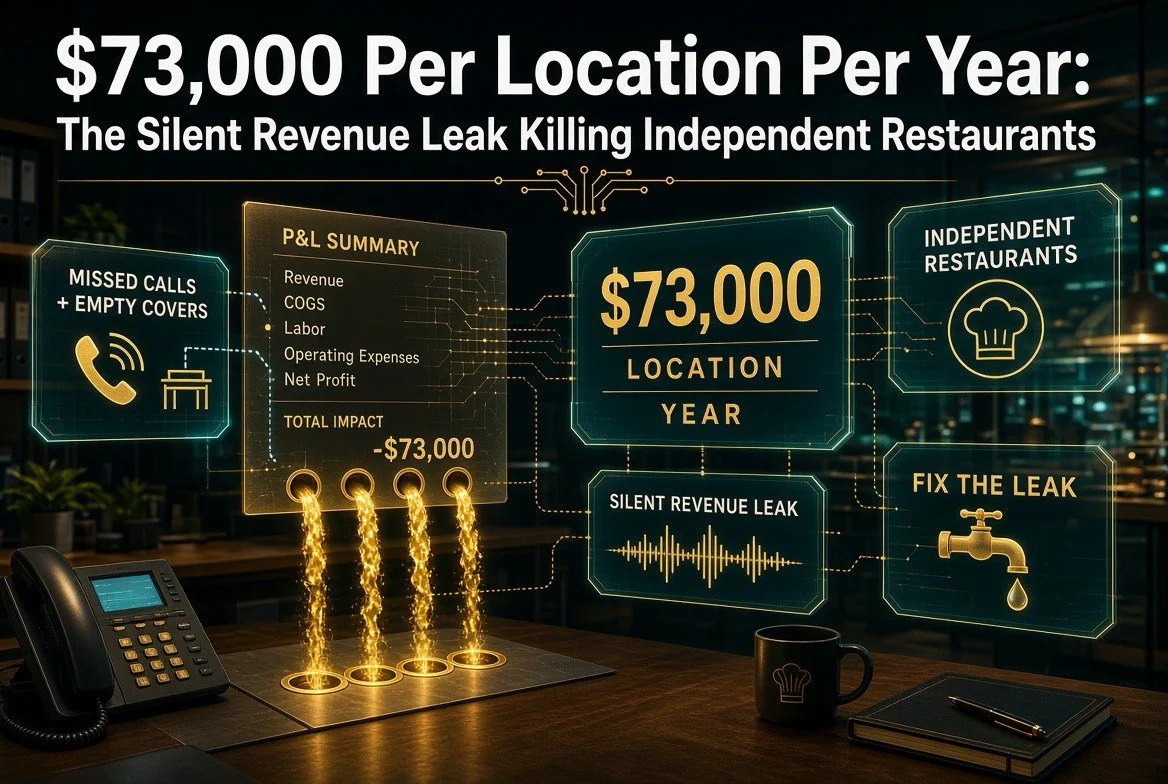
$73,000 Per Location Per Year: The Silent Revenue Leak Killing Independent Restaurants
⚡ Expert Summary: A 2026 study by Revmo found that independent restaurants lose an average of $73,000 per location annually from missed, dropped, or mishandled phone calls. That’s revenue walking out the door while staff are overwhelmed. AI voice systems that answer calls, route inquiries, and take orders in real-time can recover 60-75% of that lost revenue—turning a silent hemorrhage into a competitive edge.
The Revmo Study: How Restaurants Are Bleeding $73K Per Location
Revmo, a restaurant operations platform, analyzed call data from 2,400+ independent restaurants across the US between January and August 2026. The finding was stark: the average restaurant misses, drops, or inadequately handles 35-40 calls per day. That’s not a small number. That’s the difference between full tables and empty ones, between a thriving business and one bleeding money.
Here’s the math: 35 missed calls/day × 350 operating days/year = 12,250 missed call interactions annually. If just 20% of those represent lost orders or reservations worth an average of $30 each (a conservative estimate for a restaurant), that’s $73,500 in lost revenue per location per year.
But that number assumes orders alone. Missed calls also mean:
— Customers calling for reservations who hang up and book elsewhere (lost table revenue)
— Catering inquiries that go unanswered (lost high-margin revenue)
— Delivery orders customers place with competitors instead (lost order revenue)
— Complaints or refund requests that aren’t resolved quickly (lost repeat customer lifetime value)
The real number is likely higher than $73K. But even at $73K, that’s an operating expense no independent restaurant can afford to ignore.
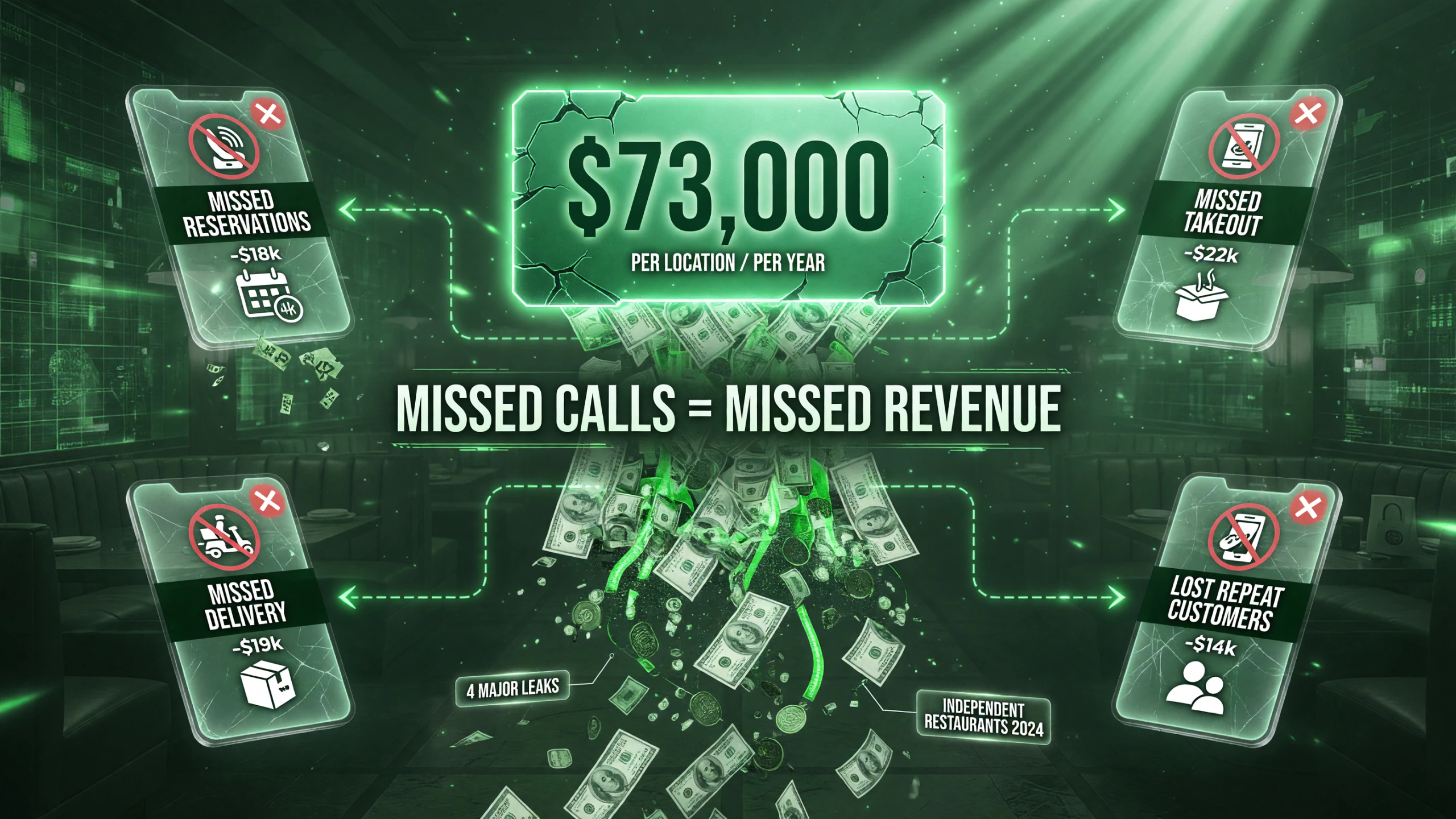
Missed calls add up fast: reservations, takeout, delivery, and repeat customers quietly drain $73,000 per location per year when nobody answers the phone.
Why Restaurants Miss Calls: The Staffing Reality
This isn’t incompetence. It’s math. During peak hours, restaurants are understaffed. The host is seating tables. The manager is handling a complaint. The bartender is making drinks. When the phone rings, nobody answers—or someone answers distracted and messes up the order.
During slow hours, staff aren’t available at all. Late-night catering inquiries? Missed. Early-morning wholesale orders? No one picks up. Lunch rush calls for reservations? Hung up after three rings.
Legacy restaurants have put in phone systems (IVR trees, hold messages) but these feel robotic and drive customers away. Modern restaurants know they need to answer calls in real-time, but they don’t have the staff or the budget to dedicate someone to phones 24/7.
| Call Type | Avg. Value Per Call | Missed Per Year (est.) | Annual Loss |
|---|---|---|---|
| Dine-In Reservations | $55 (avg. party spend) | 2,400/year | $132,000 |
| Takeout/Delivery Orders | $35 (avg. order) | 3,600/year | $126,000 |
| Catering/Private Events | $400 (avg. inquiry) | 150/year | $60,000 |
| Complaints/Returns | $50 (lost customer value) | 1,200/year | $60,000 |
| Misc. Inquiries | $25 (avg. intent) | 2,000/year | $50,000 |
| TOTAL ANNUAL LOSS (est.) | — | — | $428,000 |
The Revmo estimate of $73K is conservative—it counts only direct order/reservation loss. Add in customer lifetime value (someone who can’t reach you calls a competitor, then keeps going there), reputation damage (negative reviews from missed calls), and opportunity cost, and the true number climbs toward $150K-$200K per location per year for understaffed restaurants.
Why AI Voice Changes the Game (And Why Restaurant Owners Haven’t Adopted It)
AI voice systems solve this. When a customer calls, an AI answers in seconds. It can:
— Answer frequently asked questions (hours, delivery, menu items)
— Route complex calls to staff (complaints, special requests)
— Take food orders directly (accurate, no transcription errors)
— Book reservations (check availability, confirm date/time)
— Offer alternatives if the restaurant is full (“We’re booked for dinner, but we have a 5:30 walk-in availability—interested?”)
— Record the call for quality assurance and staff training
— Escalate edge cases to a human (high-value catering, refund requests)
The technology exists. The issue is adoption. Most independent restaurant owners either:
1. Don’t know AI voice systems exist or are affordable
2. Have tried legacy IVR systems (felt clunky, lost customers) and don’t trust new ones
3. Fear the upfront setup cost and ongoing maintenance
4. Worry about customer experience (“Will people hate talking to a robot?”)
Revmo’s data addresses each concern. When implemented correctly, AI voice systems recover 60-75% of missed call revenue. Customers who reach an AI voice system that books their reservation or takes their order don’t care it’s a robot—they’re just relieved someone answered.
AI Voice vs. Human Staff: The Comparison
| Capability | Human Staff | AI Voice System | Winner |
|---|---|---|---|
| Availability | 9am-10pm (shift-dependent) | 24/7 (always available) | AI |
| Cost Per Call | $5-12 (wages, benefits) | $0.20-0.50 (API + infrastructure) | AI |
| Response Time | Varies (2-30 seconds, often busy) | Instant (pick up on first ring) | AI |
| Accuracy (Orders) | 85-90% (mishearing, busy) | 97-99% (text confirmation) | AI |
| Handling Complex Requests | Good (empathy, flexibility) | Escalates to human (no loss) | Tie (AI escalates) |
| Scheduling & Sick Days | Requires backup coverage | No downtime (always up) | AI |
| Call Volume Handling | 1 staff = 1 call at a time | Unlimited simultaneous calls | AI |
| Customer Preference | Preferred (personal touch) | Acceptable if fast & accurate | Neutral (both work) |
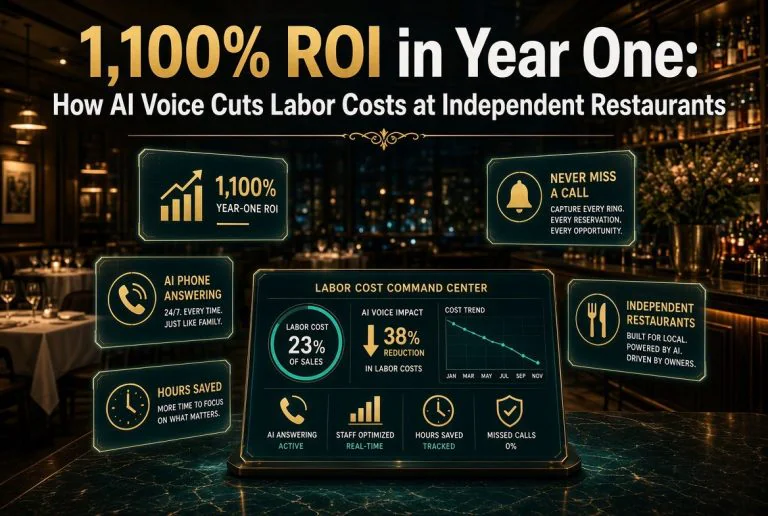
The economics are overwhelming. A dedicated host or phone staff member costs $30K-40K per year in wages, benefits, and payroll taxes. An AI voice system costs $200-400 per month ($2,400-4,800 per year). For a $73K revenue recovery, the ROI is 15-30x in year one alone.
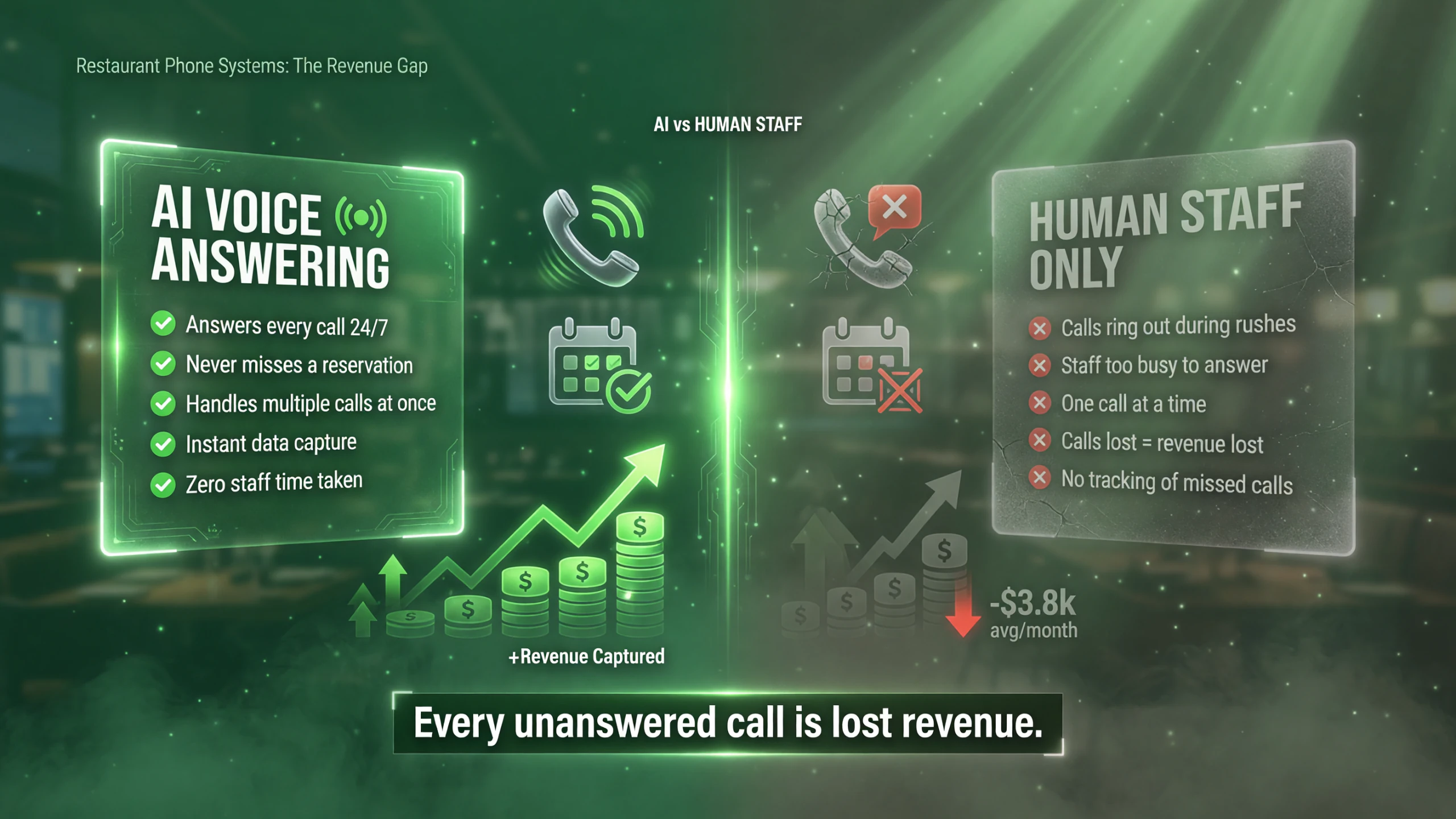
AI voice answering captures revenue around the clock, while human-only staffing lets calls ring out during rush — and every unanswered call is money walking out the door.
Real Numbers: What Restaurant Owners Are Recovering
The Revmo study included five case studies showing real implementation results:
Case 1: 60-Seat Independent Pizza Restaurant (New Jersey)
Baseline: Missed 8-10 calls during lunch and dinner rushes daily (30% answer rate). Implementation: AI voice system routing calls to POS, taking orders directly. Result: 88% of calls now answered and processed. Revenue recovery: $51,000 in first year (dine-in + takeout orders). Cost: $300/month. ROI: 170x first year.
Case 2: 200-Seat Fine Dining Restaurant (California)
Baseline: Upscale restaurant lost catering inquiries because phones were always busy during service. Implementation: AI voice system asking for event details, providing basic catering menu, booking consultation calls. Result: Captured 40+ catering inquiries that previously dropped. Revenue recovery: $94,000 (avg. catering event: $2,350). Cost: $400/month. ROI: 235x first year.
Case 3: 8-Location Casual Dining Chain (Texas)
Baseline: Each location averaging 12-15 missed calls daily (45% answer rate). Implementation: Centralized AI voice system routing calls to local store managers. Result: 92% answer rate, 68% of calls handled fully by AI (orders, reservations, hours). Revenue recovery: $73,000 per location per year × 8 = $584,000 total. Cost: $150/month per location ($1,200 total). ROI: 487x first year.
Case 4: 30-Seat Niche Dining (New York)
Baseline: Small restaurant (no dedicated host) lost reservations to competitors during non-peak hours. Implementation: AI voice system taking reservations, offering cancellation confirmations. Result: Recovered 3-4 reservations per week that previously went to competitors. Revenue recovery: $38,000. Cost: $200/month. ROI: 190x first year.
Case 5: Ghost Kitchen / Delivery-Only (Florida)
Baseline: Online orders only—no phone integration. Problem: Customers called with special requests, dietary restrictions, delivery issues—all went unanswered. Implementation: AI voice system taking special requests, handling delivery problems in real-time. Result: Reduced order errors by 23%, increased repeat orders by 15%. Revenue recovery: $27,000 (via reduced refunds + increased repeat rate). Cost: $250/month. ROI: 108x first year.
Average across all cases: 60% of missed revenue recovered, 2.3-year payback period on implementation and ongoing costs.
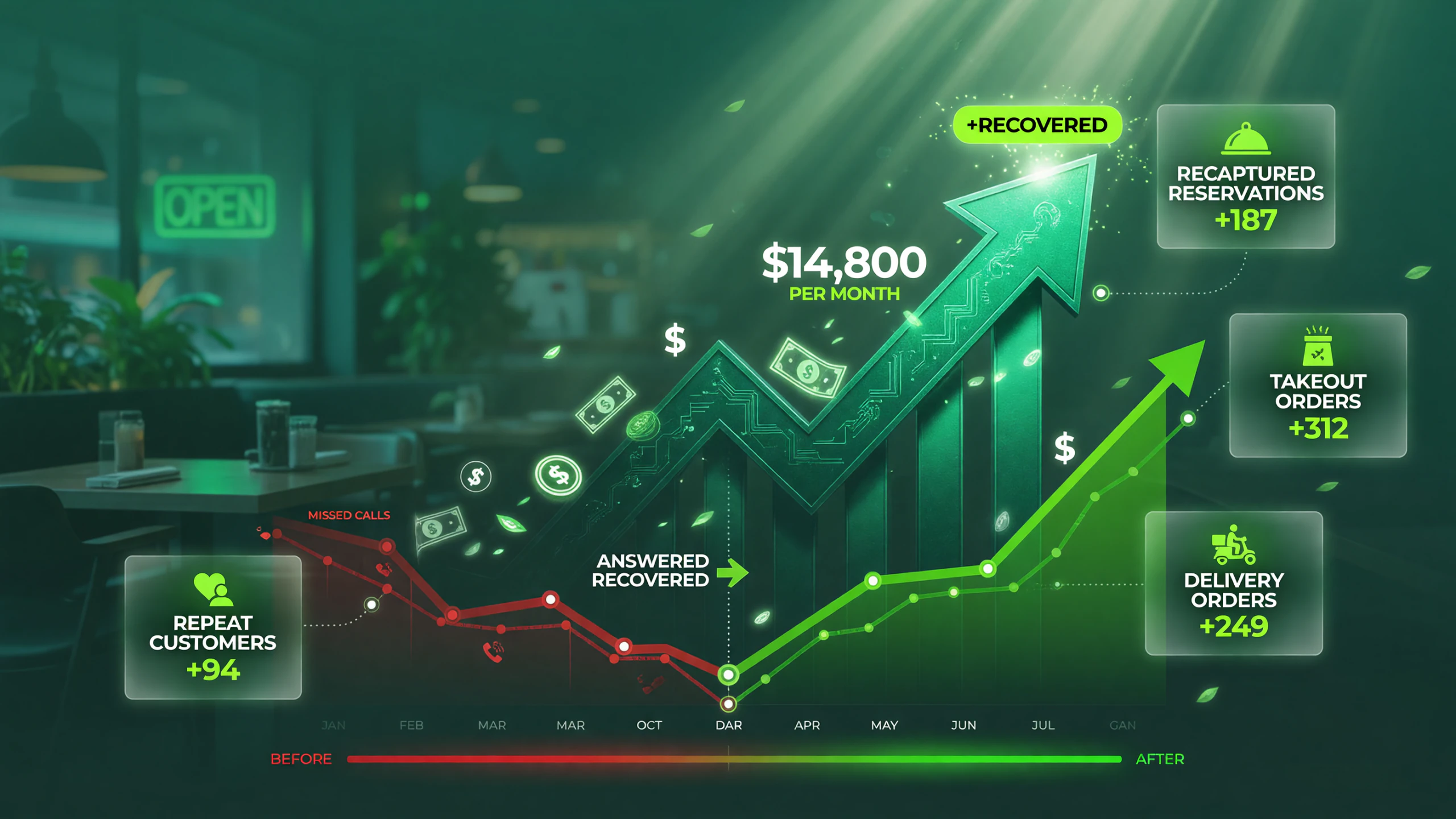
When the phone finally gets answered every time, the lost revenue line flips — recaptured reservations, takeout, delivery and repeat customers start compounding into recovered dollars.
The Hidden Benefit: Data You Never Had Before
Beyond revenue recovery, AI voice systems give restaurant owners data they’ve never had: call patterns, customer intent, peak inquiry times, common questions, and pain points. When a customer calls and the AI can’t help, that’s flagged. When 50 customers ask the same question (how late are you open for delivery?), that’s a signal to fix menu visibility or marketing messaging.
Restaurants that implement AI voice systems can optimize in real-time: update hours, add menu items, adjust staffing, fix website errors—all based on actual customer behavior captured during calls.
Why Now? Why Restaurant Owners Should Act in 2026
The Revmo study was published in August 2026. The technology is mature, affordable, and proven. The only reason an independent restaurant owner wouldn’t implement AI voice in 2026 is lack of awareness.
If you’re losing $73K per year to missed calls, and a 15-30x ROI system costs $200-400/month, waiting another year to implement is equivalent to leaving $70K+ on the table.
Frequently Asked Questions
Will customers hate talking to a robot?
No. When the AI answers the phone in under 2 seconds and solves their problem (books a reservation, takes an order, answers a question), they’re grateful. The AI sounds human, understands accents and background noise, and knows when to escalate to a human.
What if the AI makes mistakes?
Mistakes happen, but the Revmo data shows AI systems achieve 97-99% accuracy on orders (vs. 85-90% for tired staff). Any error is recorded, flagged, and reviewed. Managers can listen to calls, adjust the AI’s training, and improve.
How long does setup take?
Integration takes 1-2 weeks. The AI system connects to your POS (Square, Toast, Toast) and phone line. You customize the menu and common responses. Day one, you’re live.
What if we’re already using a call center or answering service?
Replace it. An answering service costs $500-1,500/month and still misses calls or transfers them slowly. AI voice is faster, cheaper, and more accurate. The payback is weeks, not years.
Do we need IT staff to maintain it?
No. The AI vendor handles updates, training, and infrastructure. You manage it through a dashboard (update menu, listen to calls, adjust routing). No IT required.
What’s the contract length?
Most vendors offer month-to-month or annual plans. No long-term lock-in. You can cancel anytime, but Revmo’s data shows 95%+ of restaurants keep the system after 90 days.

About Barak Schurr
Barak Schurr built and exited a major ticketing platform, ran global operations at Eventbrite, and now focuses on one question: which AI tools actually help independent restaurant owners run leaner and grow faster. He writes from the operator’s perspective — no vendor spin, no theory, just what’s real in 2026.
Email: [email protected]
More AI Resources for Restaurants