Get the AI Restaurant Quick-Start Guide — Free
The 5 AI tools independent US restaurant owners are using right now to cut labor costs and answer every call.
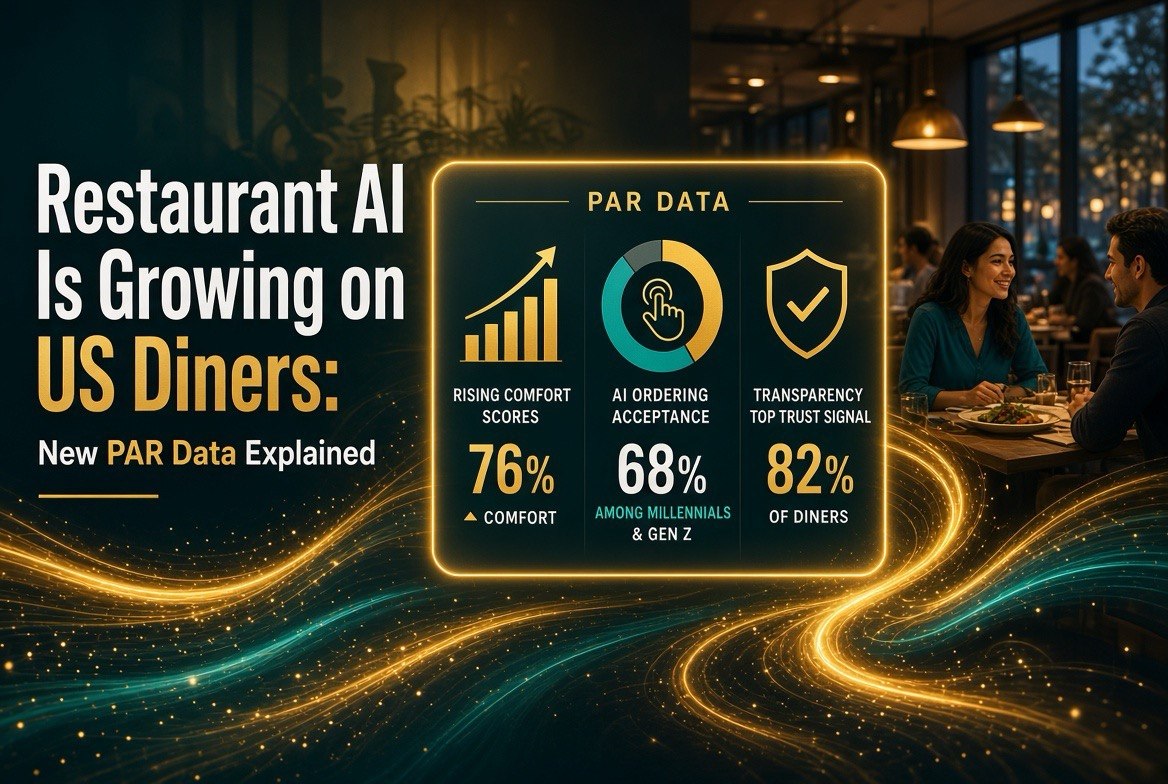
Restaurant AI Is Growing on US Diners: New PAR Data Explained
Quick answer: US diners are warming to restaurant AI — on their own terms. A new PAR Technology survey of 1,000 US consumers (June 2026) shows average discomfort with AI in restaurants dropped to 27%, from 41% a year earlier who said they would avoid an AI-heavy restaurant. Nearly 3 in 4 diners are now open to restaurant AI in some form. The catch: they want transparency, control, and access to a human. Diners are most comfortable with AI doing operational work behind the scenes (48%), and a striking 62% would order through an AI chatbot if the conditions were right. For restaurant owners, the message is clear — use AI to improve service and show your hand; diners punish AI that hides or replaces staff.
The story of restaurant AI over the past two years had a simple shape: guests were skeptical, sometimes hostile, and many said they would walk out the door before letting a machine near their order. That story is changing. Across the United States, diners are not just tolerating AI in restaurants — a growing share now expect it, want it, and will use it to place orders. The shift is measured, not anecdotal, and it comes from one of the industry’s biggest restaurant-technology providers.
PAR Technology released its 2026 Industry Report, titled “AI on the Diner’s Terms,” on August 18, 2026. The report is based on an online survey of 1,000 US adult consumers fielded in June 2026 by Dynata on behalf of PAR, with year-over-year comparisons to PAR’s 2025 survey of 1,000 US consumers. The headline is a reset in consumer sentiment: restaurant AI is no longer a thing diners reject out of hand — it is a thing they are willing to accept, provided the restaurant uses it honestly and keeps humans in the picture.
The Headline Shift: Discomfort With Restaurant AI Is Falling Fast
The single most important number in the report is the drop in consumer discomfort. In PAR’s 2025 survey, 41% of diners said they would choose an AI-free restaurant. In 2026, average discomfort with restaurant AI fell to 27%. That is a 14-point swing in a single year — a meaningful change in how Americans feel about machines in their dining experience.
Even more telling: nearly 3 in 4 diners (74%) are now open to restaurant AI in some form. That does not mean they want a fully automated restaurant. It means they are no longer uniformly against AI — they are open to it where it clearly helps them or the restaurant, and they expect to keep some control over how it is used.
Where Diners Are Comfortable: Operational AI Leads
Digging into the numbers, comfort is not uniform across use cases. Diners are most accepting of AI that works behind the scenes — the operational AI that helps the restaurant run better without changing the guest experience in an intrusive way:
- 48% of consumers are comfortable with AI handling operational decisions — for example, adjusting labor based on demand or optimizing the menu via inventory data.
- Comfort rises to 51% for AI applications that improve service consistency and shorten wait times.
In plain terms: guests want you to use AI to schedule the right number of staff, keep the kitchen stocked, and get their food out faster. They are far less comfortable with AI doing visible, interpersonal work — the moments where a human touch still matters most.
Personalization Trust Is Rising
Diners are also warming to AI-powered personalization. Trust in AI for suggesting personalized offers based on dining history rose from 33% in 2025 to an average of 45% in 2026. That is a notable gain in trust for a capability — loyalty-driven, data-informed offers — that historically made guests nervous about how their data was being used.
The Big One: Ordering Through AI Is Now a Real Option
Perhaps the most operationally significant finding is around large language models (LLMs) as an ordering channel. A full 62% of US consumers say they would order through an LLM — an AI chatbot or voice assistant — given the right offer or conditions. That number climbs sharply among the demographics restaurants most want to attract and retain:
- 74% of parents would order through an LLM
- 73% of Millennials would order through an LLM
- 70% of Gen Z would order through an LLM
This is not a hypothetical interest from tech enthusiasts. Major shares of mainstream restaurant customers — the parents and young adults who drive traffic — say they would place an order through an AI assistant. For independents, that signals where guest ordering behavior is heading.
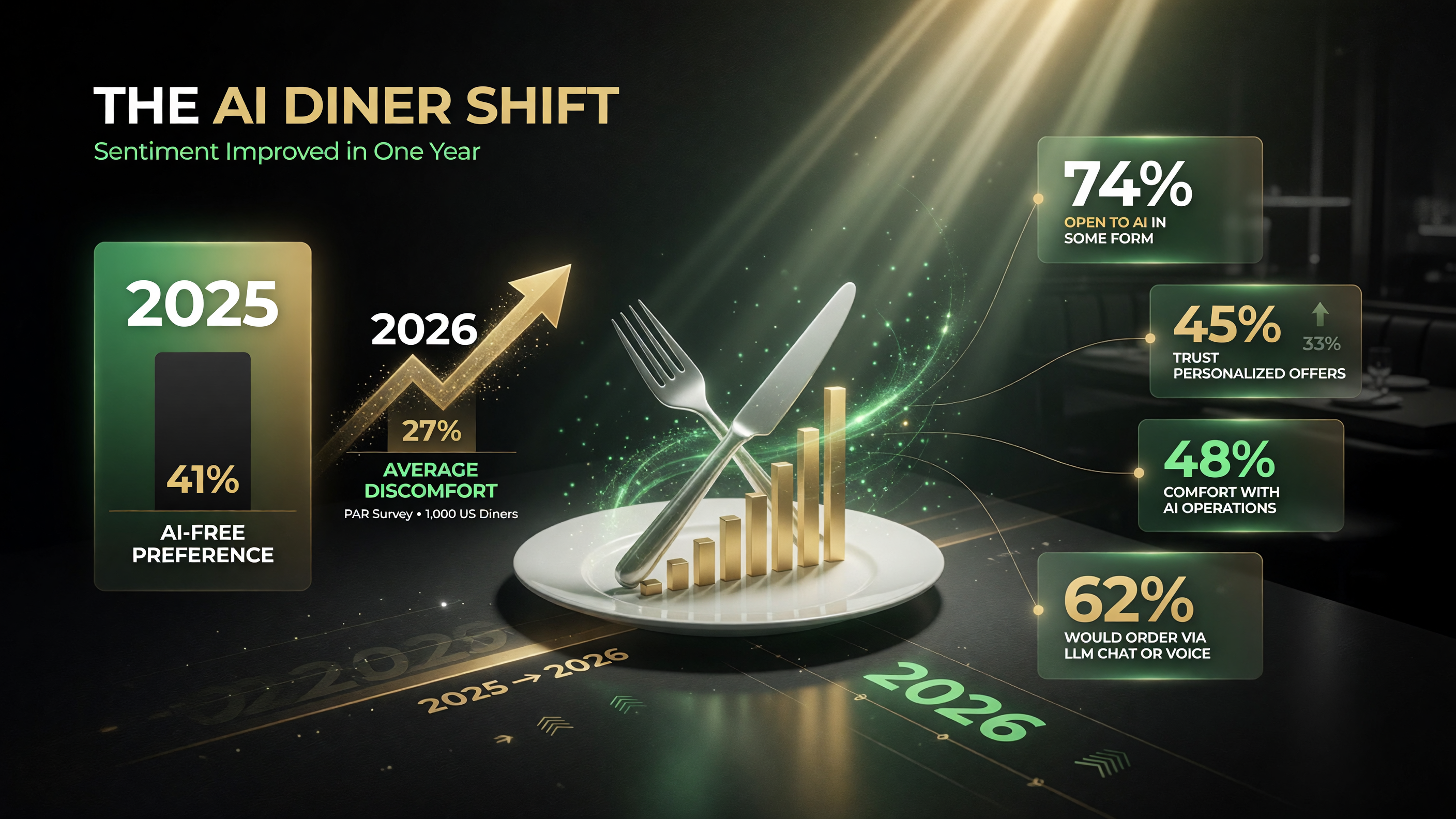
Diner AI sentiment shifted sharply from 2025 to 2026 in PAR’s survey of 1,000 US consumers: the share who would choose an AI-free restaurant fell from 41% to 27%, while 74% are now open to restaurant AI in some form and 62% would order through an LLM.
Diner AI Sentiment: 2025 vs 2026 Side by Side
To see how much attitudes have moved, here is the direct year-over-year comparison from PAR’s two surveys.
| Diner Sentiment Metric | PAR 2025 Survey | PAR 2026 Survey | Direction |
|---|---|---|---|
| Diners who would choose an AI-free restaurant | 41% | 27% (avg discomfort) | Strongly down (more openness) |
| Diners open to restaurant AI in some form | — | ~74% | New high-water mark |
| Trust in AI for personalized offers (dining history) | 33% | 45% | Up 12 points |
| Comfort with AI handling operational decisions | — | 48% | High acceptance |
| Would order through an LLM (overall) | — | 62% | Majority open to AI ordering |
What Diners Want in Exchange for Accepting AI
The acceptance is conditional, and the conditions are the part restaurant owners cannot afford to ignore. The report is titled “AI on the Diner’s Terms” for a reason: guests are willing to let AI in, but only on three clear terms.
1. Transparency Is the #1 Trust Signal
43% of consumers rank transparency as the top trust signal for AI in restaurants. They want to know when AI is being used, what it is doing, and how their data plays a role. Hidden AI — the kind guests discover only when something goes wrong — is the fastest way to burn the goodwill this report shows they now have.
2. Control
Diners want the ability to opt in or out — to use AI when it helps and reach a human when it does not. The willingness to order through an LLM is conditional on “the right offer or conditions,” which means guests want agency over when the AI steps in.
3. Access to Humans
This is the line independents already-too-often cross. Diners are fine with AI at the point of order and behind the counter — but they want a human available when they need one. AI that wallpapers over the human element is what drives guests away, even as AI that supports the human element brings them back.
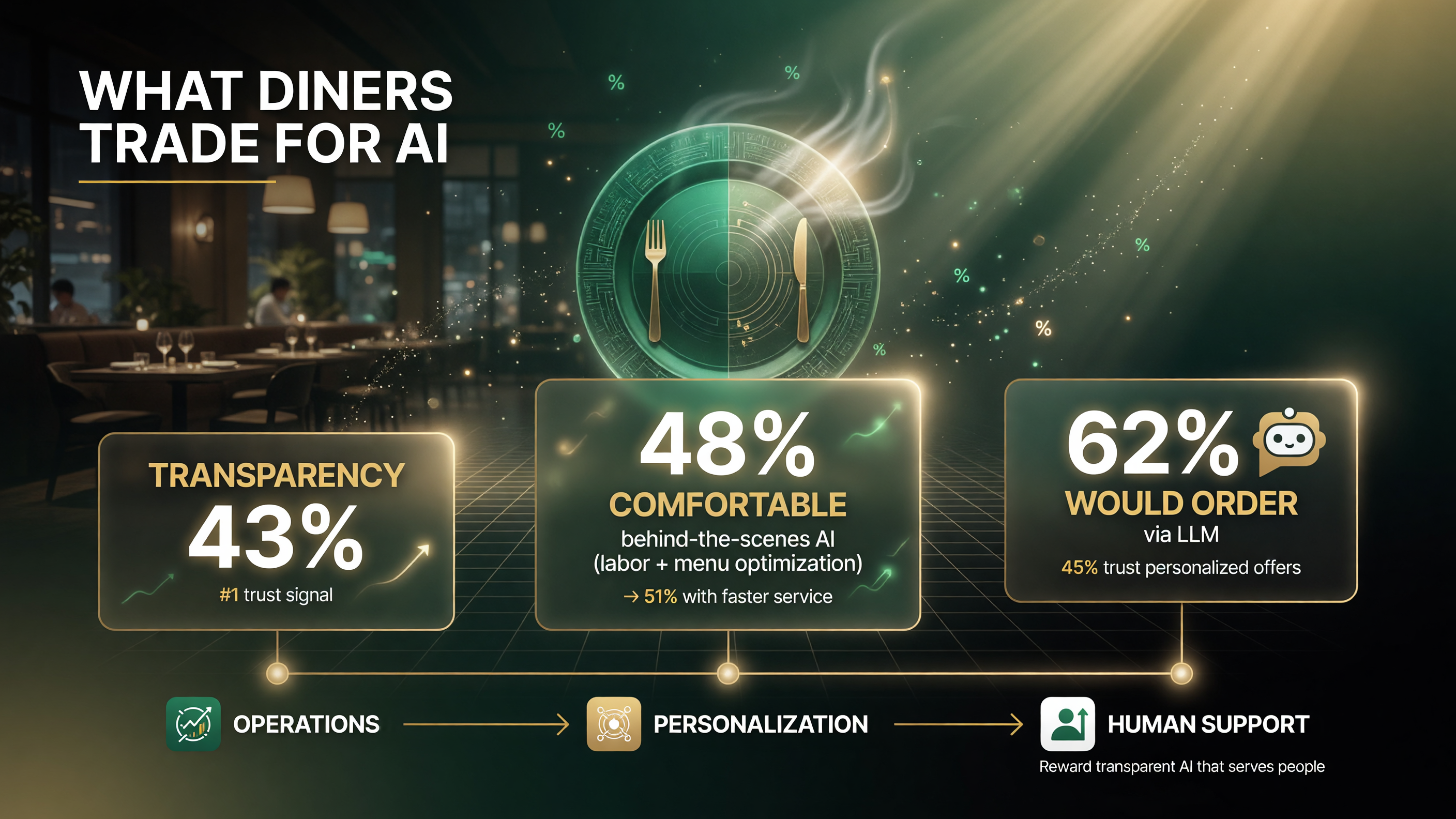
Diners trade tolerance for AI when it is transparent and stays behind the scenes: 43% rank transparency as the top trust signal, 48% are comfortable with operational AI (rising to 51% when it speeds service), and AI that supports people rather than replacing them earns the reward.
Operational AI vs Customer-Facing AI: Where to Win
The PAR data gives restaurant owners a clear, evidence-based blueprint for where AI investment pays off with guests versus where it risks alienating them.
| AI Use Case | Guest Response (Diner Survey) | Best Approach for Owners |
|---|---|---|
| Operations (labor scheduling, menu/inventory optimization) | 48% comfortable; 51% when it improves consistency and speeds service | Prioritize — this is your highest-ROI, lowest-risk AI |
| Personalized offers from dining history | 45% trust it (up from 33%) | Use for loyalty; be explicit about data use |
| Ordering via LLM / chatbot | 62% would order; 70-74% among Gen Z, Millennials, parents | Offer as an option; keep voice/human ordering available |
| Replacing visible staff at the counter | Higher discomfort; control + human access required | Proceed carefully; always keep a human reachable |
| Net signal | Guests reward useful, transparent AI | AI supports people; it does not replace them |
Why Diners’ AI Sentiment Is Shifting Now
Understanding why the mood changed helps you apply it honestly rather than chase a trend. The 14-point drop in discomfort did not happen on its own. It tracks three real-world shifts every US operator has felt in 2025 and 2026:
First, AI ordering went mainstream and stopped being novel. Drive-thru voice AI, kiosks, and AI-powered apps are now common enough that millions of diners have actually used them. Familiarity breeds comfort — the consumer who has placed a drive-thru order with a voice assistant or tapped through a kiosk no longer imagines AI as a strange or threatening thing. PAR’s own data points to this: slightly more than half of consumers (51%) are comfortable with AI in the express purpose of shortening wait times and making service more consistent, which are exactly the outcomes guests have experienced.
Second, the value became visible to the guest. Early restaurant AI was often invisible or, worse, annoying — a chatbot that could not answer a simple question. The current generation of AI is better at the guest-facing moments: faster ordering, accurate recommendations, and fewer perceived mistakes. When guests see AI making their experience smoother, they stop treating it as a threat and start treating it as a convenience.
Third, diners learned AI does not have to mean replacing people. The industry has largely settled on AI as a support layer — behind-the-counter automation that frees staff to do the hospitality that machines cannot. As that framing has spread, and as more restaurants keep visible human staff while using AI quietly in the background, guests have recalibrated what “AI in a restaurant” actually means to them. It no longer signals “no humans here.”
None of this means every guest is on board. 27% still feel some discomfort, and no restaurant should design for the assumption that AI is universally welcomed. But the direction of travel is clear, and it favors operators who deploy AI thoughtfully.
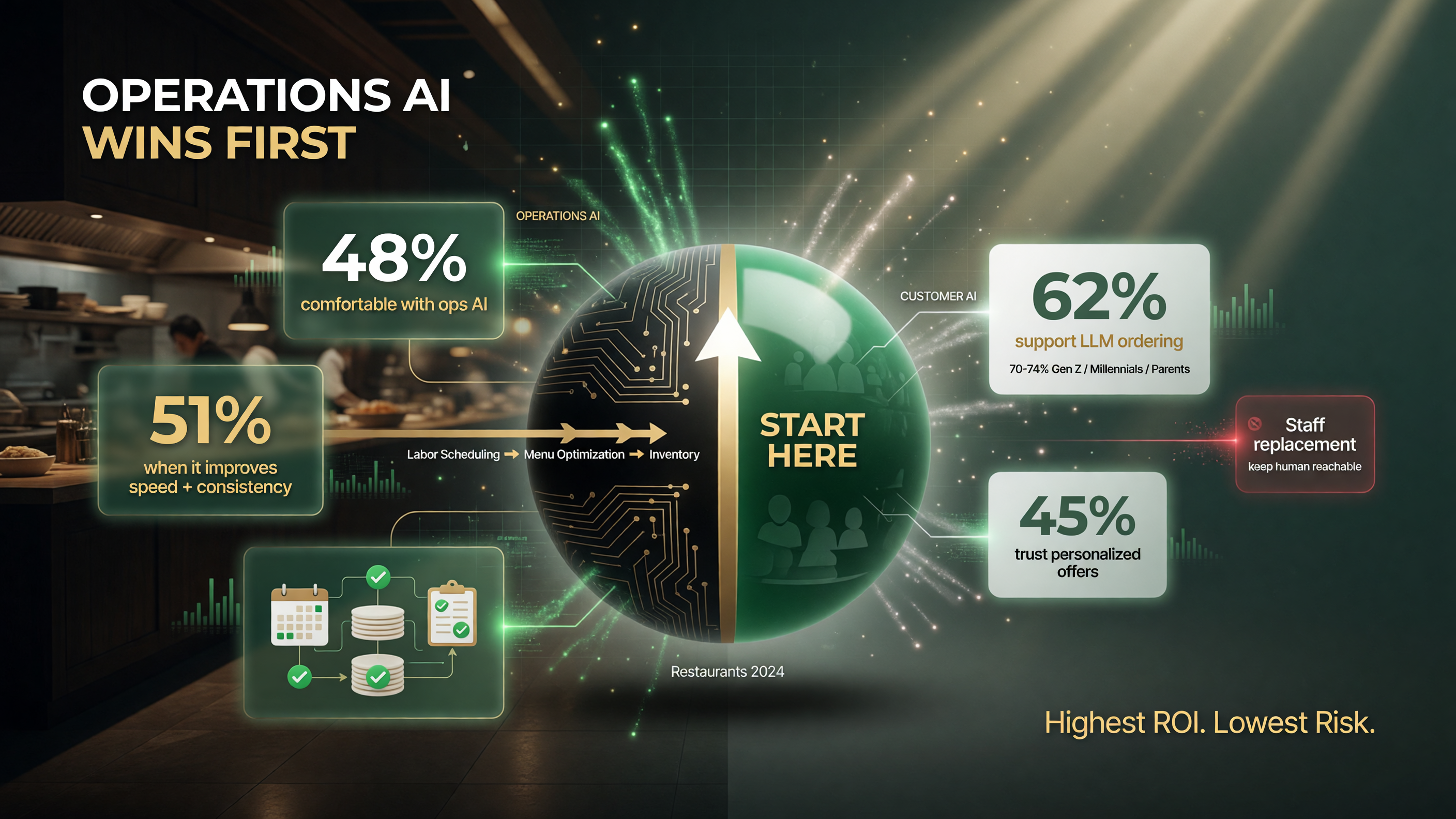
Operational AI is the highest-ROI, lowest-risk place to start: labor scheduling, menu, and inventory optimization hit 48% comfort (51% when it improves consistency), while ordering via LLM draws 62% support and 70-74% among younger and parent diners.
Where This Leaves Drive-Thru, Kiosk, and Table Service
It helps to translate PAR’s survey into the three places a diner actually interacts with a restaurant: drive-thru, kiosk, and table service. The acceptance data plays out differently at each one.
Drive-thru is the natural home for voice and ordering AI. The guest’s goal is speed and accuracy, which is precisely what AI ordering is built to improve — and it is the environment where guests are least likely to object, because there was never much face-to-face interaction to begin with. PAR’s data on LLM ordering supports this: given the right conditions, 62% of consumers will order through an AI system, and that willingness peaks in fast, transaction-oriented settings.
Kiosks sit in a comfortable middle. A kiosk is a familiar, opt-in device — the guest chooses to use it. Guests who do not want it can wait in the regular line and order from a person. That built-in control is exactly what PAR’s survey says guests want: the ability to engage with AI on their own terms. Well-designed kiosks that keep a staff member nearby tend to be accepted because they preserve both speed and choice.
Table service is where the human element matters most. This is the environment where diners value the face-to-face experience, and where AI should stay furthest in the background. Here, AI is best used operationally — helping staff with upselling suggestions, allergy-aware menu data, or predicting a busy shift so scheduling is right — rather than replacing the server at the table. That matches PAR’s finding that guests are most comfortable when AI supports service rather than stands in for it.
What This Means for Independent Restaurant Owners
The PAR report is commissioned by a major restaurant-technology vendor, so it should be read with that lens in mind — but the consumer data is independently fielded and the trend is consistent with what operators across the industry are reporting. Three operational takeaways stand out for independents:
- Invest in behind-the-scenes AI first. Labor forecasting, inventory management, and menu optimization are the AI uses diners are most comfortable with, and they are the ones that cut your costs and tighten your operations. This is where the lowest risk and highest return live.
- Stand up an AI ordering option — but never force it. With 62% of diners (and 70-74% of younger/parent demographics) willing to order through an LLM, an AI ordering channel is becoming a real expectation. Offer it alongside phone and in-person ordering; keep the human route open.
- Be transparent and stay human. 43% call transparency the top trust signal. Tell guests when AI is helping — whether that is faster service, better recommendations, or smoother ordering — and make sure a human is always one step away. Diners have not approved AI on the restaurant’s terms; they approved it on theirs.
If you are weighing where to start with AI in a busy kitchen or dining room, the direction from this data is unambiguous. For the independent operator exploring the practical side of restaurant automation, PAR’s restaurant AI coverage on this site walks through the tools and tactics that match the use cases diners are actually comfortable with. Start with the operations you can improve now, deploy AI ordering as an option, and keep the human touch front and center.
Frequently Asked Questions
What is PAR’s “AI on the Diner’s Terms” report?
It is a 2026 Industry Report by PAR Technology based on an online survey of 1,000 US adult consumers fielded in June 2026 by Dynata. It measures American diners’ attitudes toward AI in restaurants and compares them to PAR’s 2025 survey, finding that discomfort with restaurant AI has fallen sharply and that most diners now accept AI when it is transparent, controllable, and keeps humans accessible.
Are US diners more comfortable with restaurant AI now?
Yes. Average discomfort with restaurant AI fell to 27% in 2026, down from 41% in 2025 who said they would choose an AI-free restaurant. Nearly 3 in 4 diners are now open to restaurant AI in some form, with the highest acceptance for operational AI and AI ordering.
What AI use cases do diners accept most?
Diners are most comfortable with operational AI — 48% accept AI handling decisions like labor scheduling and menu/inventory optimization, rising to 51% when it improves service consistency and shortens wait times. 62% would order through an LLM chatbot given the right conditions, with even higher shares among Gen Z, Millennials, and parents.
What do diners want before they accept AI?
Three things: transparency (43% rank it the top trust signal), control over when AI steps in, and access to a human when they need one. Diners reject hidden AI and AI that replaces staff visibility, but reward AI that supports service.
Should an independent restaurant adopt AI ordering?
The data says yes as an option, not a mandate. With 62% of US diners willing to order through an LLM — and 70-74% among parents, Millennials, and Gen Z — offering an AI ordering channel alongside phone and in-person ordering positions your restaurant where guest behavior is heading, while keeping the human route open.

About Barak Schurr
Barak Schurr built and exited a major ticketing platform, ran global operations at Eventbrite, and now focuses on one question: which AI tools actually help independent restaurant owners run leaner and grow faster. He writes from the operator’s perspective — no vendor spin, no theory, just what’s real in 2026.
Email: [email protected]
More AI Resources for Your Business