Get the AI Restaurant Quick-Start Guide — Free
The 5 AI tools independent US restaurant owners are using right now to cut labor costs and answer every call.
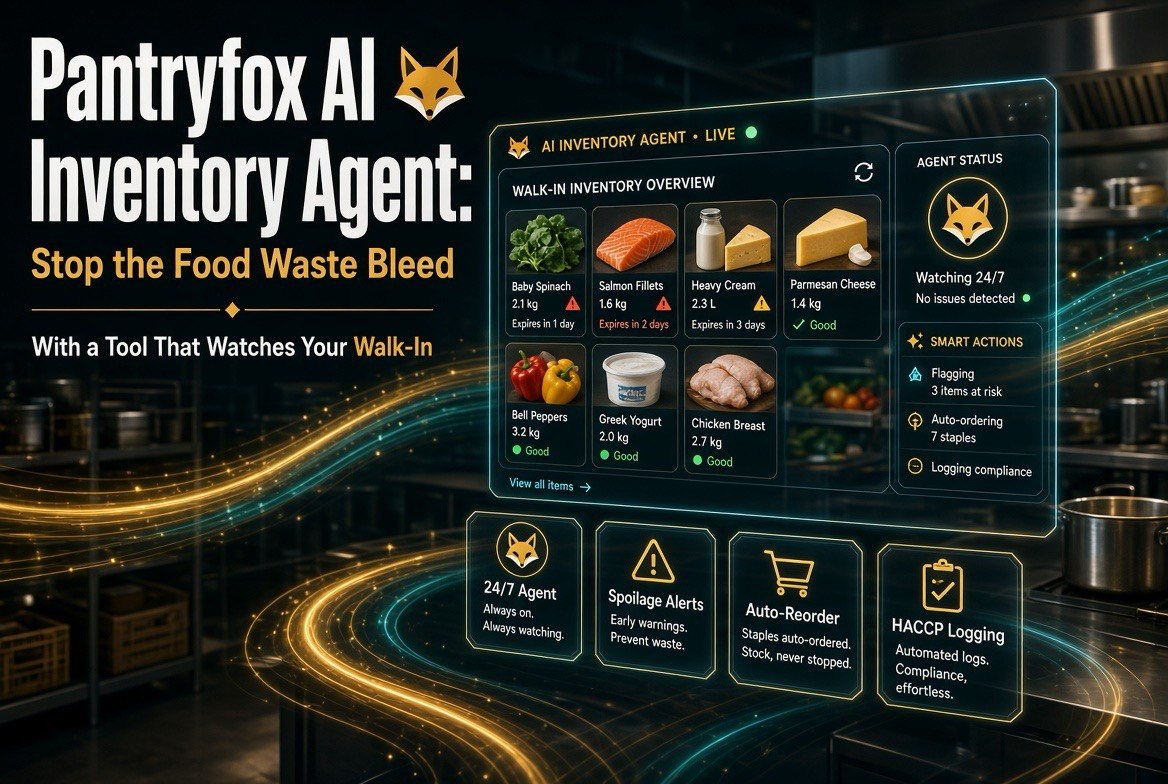
Pantryfox AI Inventory Agent: Stop the Food Waste Bleed With a Tool That Watches Your Walk-In
⚡ Expert Summary: Pantryfox is a 24/7 AI inventory agent built for independent restaurants. It watches your stock continuously, flags what’s about to spoil, auto-orders the staples you’re running low on, and logs every check against HACCP — all on a flat monthly fee. The pitch is straight at the two numbers that keep operators up at night: the 4-10% of food that typically goes to waste and the labor hours lost to manual counts. This is the AI that handles the back-of-house grind so you can run the pass.
Walk into the walk-in on any given Wednesday and you already know what you’ll find. The case of tomatoes you bought on Saturday is sweating at the back. The salmon that was supposed to move on the weekend special is one day past prime. And you’re staring down a food cost percentage that’s drifted two points higher than it should be, again, because nobody caught it in time.
That sliver — the portion of every order that never makes it to the plate — is where restaurants quietly lose money. Industry estimates across food-service reporting put typical food waste for independent operators between 4% and 10% of purchases. On a kitchen doing $50,000 in monthly food spend, that’s $2,000 to $5,000 walking out the back door every single month. Not because of a dramatic failure, but because of a hundred small misses: an over-order, a forgotten par, a product past its window.
Pantryfox, a 24/7 AI inventory agent that launched for the restaurant industry this week, is built to stop that bleed. And it’s part of a broader pattern worth paying attention to — a wave of back-of-house AI agents designed not for the giant chains, but for the independent operators who run most of America’s restaurants.
What Pantryfox Actually Is
Pantryfox describes itself as a 24/7 AI agent that watches over your inventory so you don’t have to. The core idea is simple: instead of a weekly (or, honestly, a whenever-you-have-a-spare-minute) manual count with a clipboard, you get a system that continuously tracks what you have, what’s aging, and what you’re about to run out of.
The three jobs it’s built to handle map directly onto the pains every kitchen manager knows by name:
1. Spoilage Tracking
It monitors your stock and flags items approaching their shelf-life windows. The goal is to catch the salmon and the cases of produce before they hit the waste bin, so you can move them — a special, a prep adjustment, a deli-run — while they’re still worth something. It turns silent, hidden waste into visible, actionable signal.
2. Automated Reordering
It watches your usage patterns and auto-orders the staples you’re running low on. This attacks the two failure modes at once: the over-order that leaves you with dead stock, and the under-order that leaves you short on a Friday service. It learns your rhythm, so the ordering matches actual demand rather than a guess made under deadline pressure.
3. HACCP Logging
It logs every inventory check against HACCP, the food-safety framework that regulations and inspections are built around. The compliance record that used to be a binder you filled in during rare quiet moments becomes a continuous, automatic log. For operators who’ve had a health inspector point at a cold-holding gap, this is the difference between a smooth visit and a citation.
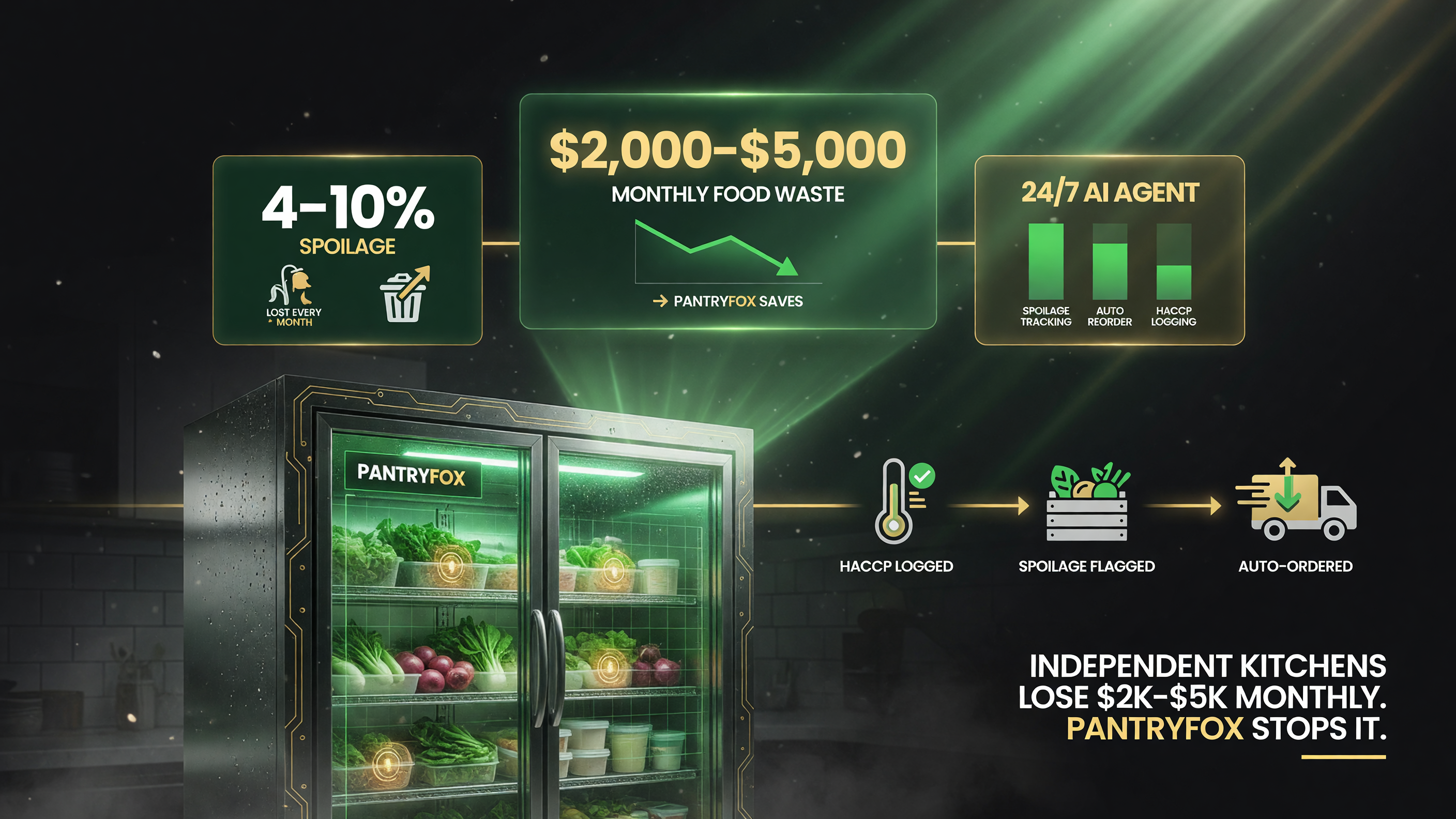
Pantryfox runs on three pillars: continuous spoilage tracking, automatic reordering of staples you are running low on, and HACCP logging on every check. On a $50,000 monthly food spend, the 4-10% that usually goes to waste is $2,000-$5,000 lost every month.
The Flat-Fee Pitch and Who It’s For
Pantryfox pairs that capability with a flat monthly fee. For an independent operator, that pricing model matters almost as much as the features. Restaurant software has a nasty habit of nickel-and-diming: per location, per user, per integration, per “module.” A flat fee means the cost is predictable, which means you can run a clean cost-benefit before you ever sign.
And the target audience is explicit: independent restaurants. This is not a system designed around 800-unit chains with enterprise IT teams. It’s built for the owner-operator who wears the manager hat, the purchasing hat, and the bookkeeping hat. The people who need the tool to be simple because they don’t have a department to manage it.
That’s a meaningful positioning call, because most inventory and waste-management tech in recent years got built for scale — complex, expensive, and overkill for a 60-seat independent. Pantryfox is betting that the independent operator — who runs the overwhelming majority of US restaurants — has been underserved and is ready for an agent that handles the grunt work.
Why This Window Is Different: Agents, Not Just Dashboards
It’s worth being precise about what’s actually new here, because “inventory software” has existed for years. The shift with Pantryfox, and with the back-of-house agents launching alongside it this week, is from dashboard to agent.
Old inventory software showed you a screen and expected you to act. You looked at the par levels, you checked the dashboard, and you still did the work. An agent is different. It takes action — it flags the item, it places the order, it writes the log — and you supervise rather than execute. That distinction is the entire point of this generation of kitchen tools.
Pantryfox isn’t alone in this. This week also saw Cinderloop, another back-of-house agent aimed at independent restaurants, enter the conversation with a focus on the same operational layer. When two fresh launches in the same week target the same operator with the same agent-first philosophy, it’s not a coincidence — it’s a signal that the independent-restaurant market has reached a tipping point for AI adoption on the back-of-house side.
The Real Numbers on the Table
Let’s ground this in what the math actually looks like for a typical independent kitchen, because “saves you money” is meaningless without real figures.
| Metric | Without AI inventory | With Pantryfox-style agent |
|---|---|---|
| Monthly food waste (typical) | 4-10% of purchases | Targeted reduction, visible & tracked |
| Hours on manual counts (per week) | 3-5+ hours of manager/boH time | Continuous, automated — minimal hours |
| Order accuracy | Guess-based, deadline pressure | Usage-based, learns your rhythm |
| HACCP record | Manual binder, filled when time allows | Automatic, continuous log |
| Pricing model | N/A (manual/labor) | Flat monthly fee |
Do the arithmetic with your own numbers and the case gets hard to ignore. If you’re losing even 4% of a $50,000 monthly food spend to waste and recovered half of it through better tracking and smarter ordering, that’s $1,000 a month back into your pocket — before you even count the labor hours freed up from manual counts and the risk avoided on a HACCP visit. The question stops being “can I afford it” and becomes “can I afford a manageable flat fee to stop handing $12,000 a year to the trash can and the labor ledger?”
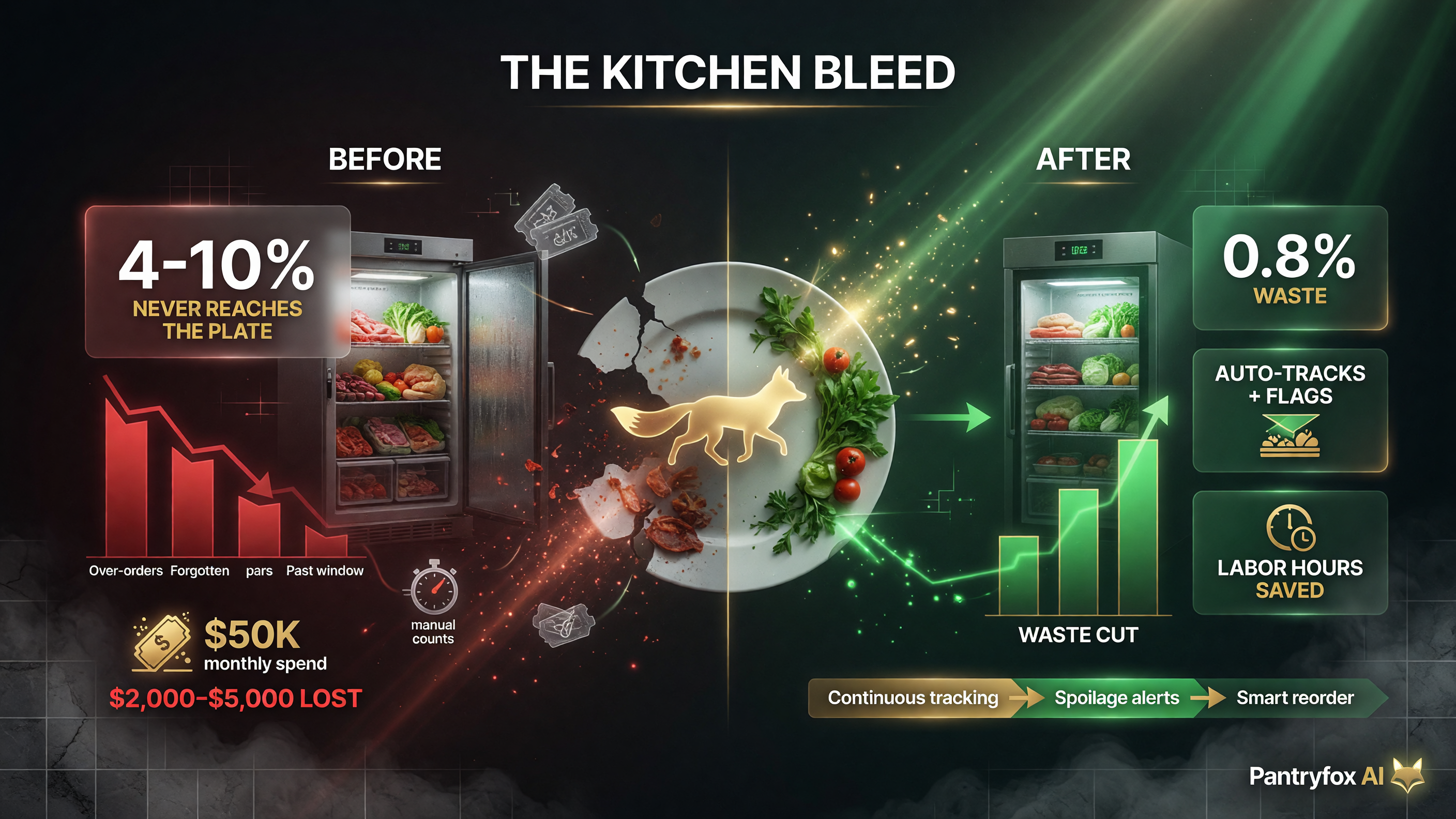
Before Pantryfox, 4-10% of every order never reaches the plate, draining a $50,000 monthly food spend by $2,000-$5,000. Pantryfox tracks every item continuously, flags spoilage before it happens, and auto-orders so the waste bleed and the manual-count labor hours stop.
What This Means for Your Back-of-House
If you’ve been running on a binder, a felt marker, and a tray of pars, the practical change is bigger than it sounds. The manager who used to spend three hours on inventory now spends that shift on the line, on the floor, on prep, or actually closing out service properly. The person who used to write the Friday order from memory now has a system that watched last week’s actual usage and built the order to match it.
The HACCP angle is the sleeper benefit. In most jurisdictions, a health inspector will ask to see your temperature and cold-holding logs. Handing over a continuous, automatic log — instead of a binder with gaps — changes the tenor of that interaction completely. It moves you from “hoping we’re covered” to “here’s the record, on every item, continuously.”
Pantryfox vs. the Manual Status Quo
Put side by side, the difference between an AI inventory agent and the manual process most independents run becomes stark.
| Task | Manual method | Pantryfox AI agent |
|---|---|---|
| Taking stock | Clipboard, count, hope it’s right | Continuous tracking, no clipboard |
| Catching spoilage | Found on the walk-in dive, often too late | Flags items before they hit the window |
| Placing orders | Memory + pressure, miss or over-order | Auto-orders from actual usage patterns |
| Compliance | Binder filled in spare moments | Automatic HACCP log on every check |
| Net effect | Hidden loss + busywork | Visible savings + time back |
Neither column is hypothetical. Every independent operator reading this has lived the left column. The question is how much longer they’ll accept it.
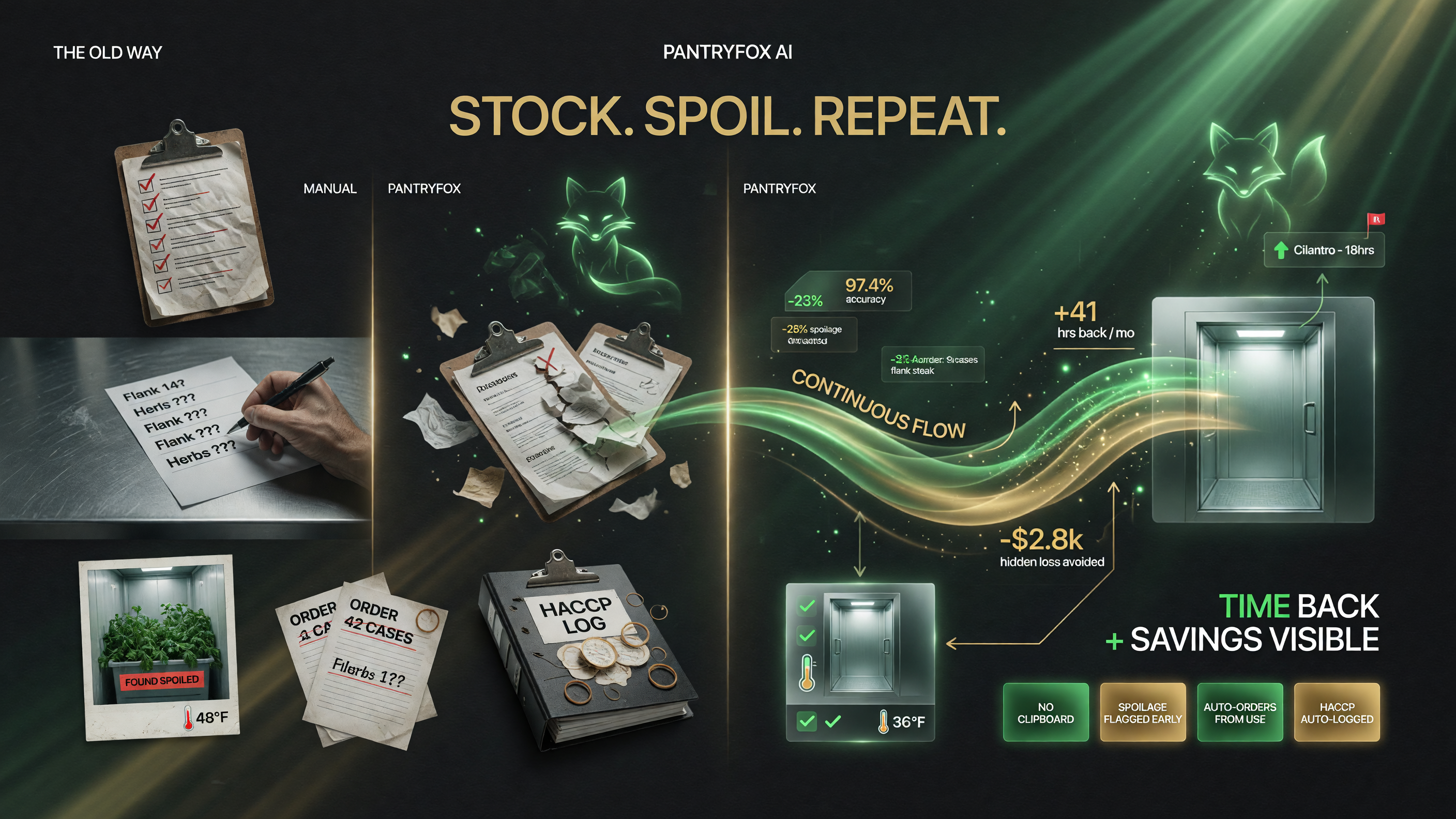
Row by row, the manual status quo loses: clipboards and count-and-hope tracking, spoilage found on the walk-in dive too late, orders from memory under deadline pressure, and a HACCP binder filled in spare moments. Pantryfox replaces each with continuous tracking, early spoilage flags, auto-ordering from actual usage, and an automatic HACCP log.
Who Should Jump In First
Pantryfox is a fresh launch, so it’s wise to be clear-eyed about who gets the most value. The early adopters should be operators who already feel the pain acutely: those with high food-cost variance, those who’ve had a health-inspection scare, those who are paying a manager for hours that should go to service — and those who simply know, in their gut, that too much product is dying in the walk-in every month.
Operators with a single well-run location and strong manual systems may find the payoff smaller. But anyone running multiple units, or anyone whose weekends are spent chasing orders, is the profile that gets the fastest return. The flat fee makes it low-risk to start on one location and expand if it delivers.
What to Watch Before You Sign Up
Because Pantryfox just launched, verify these three things before committing:
First, integration with your ordering channels. Confirm it can place or suggest orders through the vendors and supply systems you actually use, not just a generic marketplace. An agent that auto-orders through the wrong channel is worse than none.
Second, how it learns your menu. Ask how quickly it syncs to your changing menus, specials, and seasonal turnover. A system that doesn’t understand you run a clam special every Friday will mis-forecast your shellfish order.
Third, HACCP record reliability. Get clarity on exactly what gets logged, how it’s timestamped, and whether it meets your jurisdiction’s inspection requirements. An automatic log is only valuable if it’s the log the inspector wants to see.
How to Get Started
When you’re ready to stop the bleed, the path is straightforward:
- Map your current waste and ordering pain points — where are you losing the most, and where are the gaps in coverage?
- Run Pantryfox on one location or one category first, so you can judge it against your real numbers without betting the whole house.
- Let it flag spoilage and start auto-ordering your highest-volume staples.
- Watch the weekly waste and food-cost trend, not just the daily noise.
- Extend to full menu coverage once it’s proven itself on your kitchen’s actual rhythm.
Pantryfox isn’t a silver bullet, and no software fixes a kitchen that’s mis-managed at the root. But it targets the single largest silent drain in most independent restaurants — the food that never makes it to a plate and the hours that burn chasing it. For the operator who’s done handing money to the walk-in, that’s a trade worth making.
Frequently Asked Questions
What is Pantryfox?
Pantryfox is a 24/7 AI inventory agent built for independent restaurants. It tracks stock continuously, flags items approaching spoilage, auto-orders staples based on usage, and logs every check against HACCP, all on a flat monthly fee.
How does Pantryfox reduce food waste?
It watches your inventory continuously and flags items before they hit their shelf-life window, so you can move them while they’re still usable instead of discovering them spoiled in the walk-in. This turns hidden waste into visible, actionable signal.
Does Pantryfox automate ordering?
Yes. It tracks your usage patterns and auto-orders the staples you’re running low on, attacking both the over-order that leaves dead stock and the under-order that leaves you short on service. It learns your ordering rhythm over time.
Is Pantryfox HACCP-compliant?
Pantryfox logs every inventory check against HACCP, creating a continuous, automatic food-safety record. Operators should confirm the log format meets their specific jurisdiction’s inspection requirements.
Who is Pantryfox for?
It’s built for independent restaurants and owner-operators, not large chains. The flat-fee pricing and simple design target the operators who run most of America’s restaurants and don’t have an enterprise IT team to manage complex software.

About Barak Schurr
Barak Schurr built and exited a major ticketing platform, ran global operations at Eventbrite, and now focuses on one question: which AI tools actually help independent restaurant owners run leaner and grow faster. He writes from the operator’s perspective — no vendor spin, no theory, just what’s real in 2026.
Email: [email protected]
More Resources for Restaurant Operators