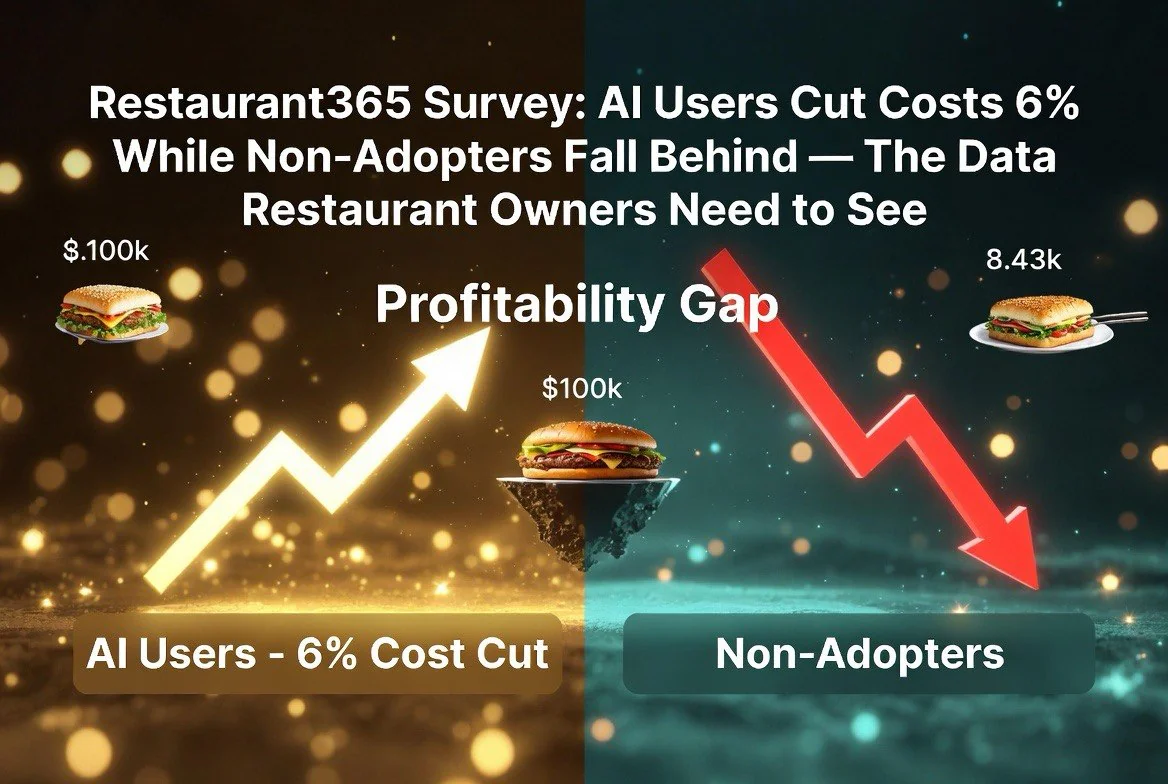
Restaurant365 Survey: AI Users Cut Costs 6% While Non-Adopters Fall Behind — The Data Restaurant Owners Need to See
⚡ Expert Summary: Restaurant365’s 2026 mid-year report surveyed 420+ operators across nearly 10,000 US locations and found a widening profitability gap between AI adopters and non-adopters. 69% of operators are now actively using or piloting AI for reporting and analytics, and those who have adopted report 6%+ cost reductions, improved food cost management, and measurable labor savings. Meanwhile, the 31% who have not adopted AI face growing competitive pressure — and the gap is accelerating. Here is the breakdown every independent restaurant owner needs to understand.
The New Restaurant Profitability Gap
Restaurant365’s 2026 State of the Restaurant Industry Mid-Year Report, released in July 2026, identified what it calls a “Restaurant Profitability Gap” — the measurable financial difference between operators who have adopted AI for back-office operations and those who have not.[1]
The data comes from more than 420 restaurant operators representing nearly 10,000 locations across the United States, covering QSR, fast casual, casual dining, fine dining, pizza, coffee, and other concepts.[2]
The headline finding: at the start of 2026, only about 25% of operators had implemented or planned to implement AI for back-office functions like reporting and analytics. By mid-year, that number jumped to 69% actively using or piloting AI.[3] That is nearly a threefold increase in six months — and the change is creating two classes of restaurant businesses.
What AI Adopters Are Actually Seeing
The survey asked operators who are actively using AI about the measurable outcomes they have achieved. The numbers are specific enough to matter:
| Metric | AI Adopters Reporting Improvement |
|---|---|
| Reduced food costs | 61% |
| Reduced labor costs | 62% |
| Saved time every week | 88% |
| Overall cost reduction of 6% or more | Nearly one-third of adopters |
The 88% savings on time is the most striking number. It means nearly nine out of ten operators who have deployed AI for back-office work report meaningful time savings every single week. For independent restaurant owners who are already wearing every hat — managing inventory, scheduling staff, handling payroll, responding to reviews — that time savings translates directly into either lower labor costs or more attention paid to the guest experience.[2]
The 6%+ cost reduction reported by nearly a third of adopters is significant because restaurant profit margins in 2026 remain razor-thin. According to the same report, 87% of operators saw food costs rise in the first half of 2026, and 77% saw labor costs increase.[1] A 6% reduction against rising costs means the gap between breaking even and turning a profit is increasingly determined by whether you use AI.
Where the Gap Is Widest: The Independent Operator Problem
While the survey does not break out independent operators versus chains in every metric, the implications for single-location and small-chain operators are clear from the data:
- Implementation cost barrier — 29% of operators cite implementation cost as a barrier, and this number is almost certainly higher for independents who lack the capital reserves of multi-unit operators[2]
- Data privacy concerns — 37% of operators cite data privacy and security concerns, which disproportionately affect independents who do not have dedicated IT staff to evaluate vendor security[2]
- Output accuracy confidence — 34% worry about AI output accuracy, reflecting the reality that independents cannot afford to absorb mistakes from automated systems that make bad predictions[2]
- Uncertainty about where to start — 18% say they do not know where to begin, which for an independent operator without a technology background is a real blocker[2]
The challenge for independent operators is structural, not a reflection of unwillingness. AI adoption in restaurants has been led by larger chains that have dedicated technology teams, existing data infrastructure, and the budget to experiment. Independent operators — who make up the majority of restaurant businesses in the US — do not have those advantages, and the gap is widening as chains accelerate their AI investments.
Where AI Is Being Deployed in Restaurants Right Now
The survey identified the specific back-office functions where AI adoption is happening fastest:
1. Reporting and Analytics (69% of adopters) — AI-powered reporting is the most common use case. Operators are using AI to generate daily sales reports, analyze labor costs against revenue, track food cost variance, and identify trends without manually pulling data from multiple systems. The time savings here are immediate because traditional restaurant reporting requires exporting data from POS, payroll, inventory, and scheduling systems separately.
2. Scheduling (active adoption) — AI-driven scheduling tools analyze historical traffic patterns, weather data, and local events to predict staffing needs. For operators using AI scheduling, the labor cost reductions show up in the first month as overstaffing during slow periods is reduced and understaffing during rushes is eliminated.
3. Inventory Forecasting (active adoption) — AI inventory tools predict what to order, when, and in what quantity based on historical usage, upcoming promotions, and seasonal patterns. The 61% of adopters reporting reduced food costs point to this as a primary driver — less waste, fewer emergency orders, and better supplier negotiation data.
What This Means for Restaurant Owners Not Using AI
If you are an independent restaurant owner in the US and you have not deployed AI for any back-office function, the 2026 data suggests you are leaving money on the table. The question is not whether AI delivers measurable ROI for restaurant operations — the data says it does. The question is whether the specific tools available today are accessible enough for your operation.
The good news: the tools landscape has matured significantly. Restaurant365 itself offers AI-powered reporting, and platforms like AI restaurant management tools covered on AI Table Review are increasingly designed for independent operators rather than large chains.
The most practical starting point is reporting and analytics — the single highest-adoption use case and the one with the lowest implementation barrier. If you use a modern POS system, you likely already have data that an AI tool can analyze. The question is whether you are using that data or leaving it in a dashboard you check once a month.
The Tools That Are Bridging the Gap
The 2026 market for restaurant AI tools is increasingly segmented by operator size and technical capability. For independent operators specifically, several categories of AI tools are reducing the adoption barrier:
- AI-powered POS analytics — Platforms like Toast and Square increasingly include AI-driven insights as built-in features rather than add-ons, reducing the separate-implementation burden
- Voice AI ordering — Tools that handle phone orders 24/7 reduce labor costs without requiring back-office software changes
- AI scheduling platforms — Standalone tools that integrate with existing POS systems to predict staffing needs without replacing the entire tech stack
- Inventory AI add-ons — Lightweight tools that sit on top of existing inventory management processes rather than requiring a full system replacement
The common thread: the best tools for independent operators are the ones that work with existing systems rather than requiring a complete technology overhaul. If a tool asks you to replace your POS, your scheduling software, and your inventory system, it is not designed for independents.
How to Start Without Getting Overwhelmed
The biggest mistake independent operators make is trying to adopt everything at once. Based on the survey data, here is a three-stage approach that aligns with what actual adopters did:
- Start with one function — Pick reporting and analytics first. It has the highest adoption rate (69%) and the lowest implementation complexity. Most modern POS systems already have AI reporting features you might not be using.
- Measure the impact for 60 days — Track your food cost percentage, labor as a percentage of sales, and time spent on weekly reporting before and after implementing one AI tool. If you see improvement, the ROI justifies the next step.
- Add scheduling or inventory forecasting — Once reporting is working, add AI scheduling or inventory forecasting as the second function. Two AI tools covering three back-office functions will put you ahead of the majority of operators.
The 6% cost reduction that a third of adopters are seeing is not theoretical. It is the difference between a profitable restaurant and one that struggles to stay open in a market where food costs are rising for 87% of operators.
Why the Gap Will Widen Before It Narrows
The trend lines from the R365 survey point to an accelerating divide. As more operators adopt AI, the tools improve through more training data and better integrations. Each improvement makes AI more valuable for adopters, widening the gap between them and non-adopters.
For independent operators, the risk is that waiting another six months means falling further behind because the early adopters are not just saving money — they are building operational data that makes their AI tools smarter. A restaurant that starts AI-powered inventory forecasting in January 2026 has seven months of historical prediction data by August. A restaurant that starts in January 2027 starts from zero while the competition has refined its models for a full year.
This is not a reason to panic. It is a reason to start with one tool, one function, one measurable outcome — and build from there.
What Restaurant365 Itself Offers for AI Adoption
Restaurant365 is not just reporting on the trend — the company is building the tools. Its R365 AI platform provides AI-powered reporting, scheduling, and inventory forecasting directly within the platform that over 45,000 restaurant locations already use.[3]
For operators already on Restaurant365, the AI features are available without a separate implementation or integration project. The platform handles the data integration layer, and the AI tools are designed to work with the data operators are already inputting — payroll hours, invoice amounts, sales data from POS integrations.
This matters because one of the biggest barriers to AI adoption for independents is data fragmentation. If your payroll is in one system, your POS in another, and your inventory tracking in a spreadsheet, integrating them for AI analysis can cost more than the AI tools themselves. All-in-one platforms like R365 reduce that barrier significantly.
For operators not on an all-in-one platform, the path is still workable. Standalone AI tools that integrate with major POS systems (Toast, Square, Clover) and common payroll providers are increasingly available at price points designed for single-location operations rather than enterprise chains.
FAQ
What is the Restaurant365 Restaurant Profitability Gap?
The profitability gap is the measurable financial difference between restaurant operators using AI for back-office functions like reporting, scheduling, and inventory forecasting versus those who have not adopted AI. AI adopters report 6%+ cost reductions on average.
What percentage of restaurants are using AI in 2026?
According to Restaurant365’s survey, 69% of operators are actively using or piloting AI for reporting and analytics, and 62% have implemented AI in at least one back-office function as of mid-2026.
Does AI actually reduce restaurant costs?
Yes. 61% of AI adopters report reduced food costs, 62% report reduced labor costs, 88% save time every week, and nearly one-third report overall cost reductions of 6% or more according to the R365 survey of 420+ operators.
What are the biggest barriers to AI adoption for independent restaurants?
The top barriers are data privacy concerns (37%), confidence in AI output accuracy (34%), implementation cost (29%), and not knowing where to start (18%). These barriers disproportionately affect independent operators without dedicated IT support.
What is the best starting point for AI in a restaurant?
Reporting and analytics is the most common starting point, with 69% adoption among AI-using operators. It has the lowest implementation barrier and produces the most immediate time savings.

About Barak Schurr
Barak Schurr built and exited a major ticketing platform, ran global operations at Eventbrite, and now focuses on one question: which AI tools actually help independent restaurant owners run leaner and grow faster. He writes from the operator’s perspective — no vendor spin, no theory, just what’s real in 2026.
Email: [email protected]
More Restaurant AI Resources