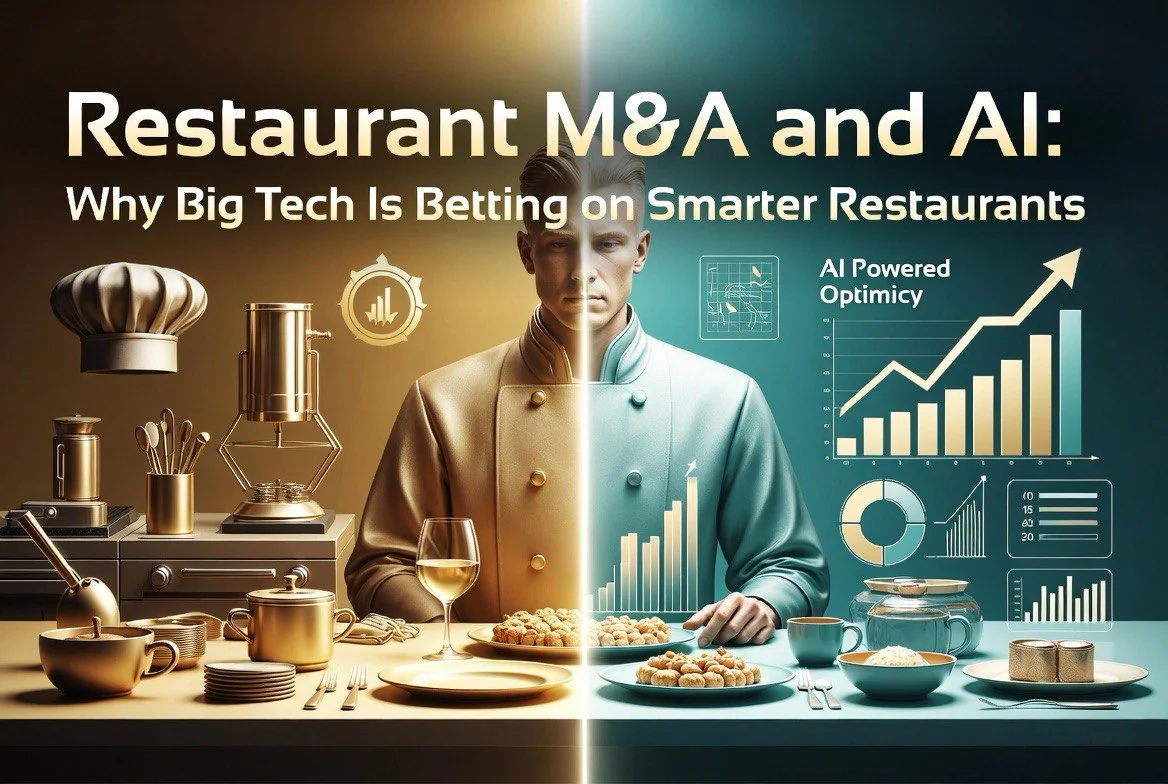
Restaurant M&A and AI: Why Big Tech Is Betting on Smarter Restaurants
⚡ Expert Summary: Foodics’ AI acquisition is only the latest in a wave of restaurant tech M&A deals in 2026. From Toast buying AI scheduling platforms to Square integrating machine learning into its POS — the big players are consolidating around AI capabilities. For independent restaurant owners in the United States, this M&A wave means better tools at lower prices. Here’s what’s driving the deals and what it means for your operations budget.
When Foodics — the Middle East’s largest restaurant management platform — acquired an AI startup in July 2026 to embed demand forecasting, inventory optimization, and labor scheduling into its platform, it joined a trend that’s been accelerating for two years.
Restaurant technology companies are buying AI capabilities at a rate that’s reshaping the industry. According to the National Restaurant Association’s 2026 Technology Report, restaurant tech M&A deals involving AI targets increased 340% between 2024 and 2026. The money is flowing because the math works: platforms that integrate AI see 15-30% higher per-location revenue from their restaurant customers.
For independent operators in the United States, this M&A wave doesn’t mean you need to follow acquisition announcements. It means the tools you use are about to get smarter — without your monthly bill going up proportionally.
The Major Restaurant Tech M&A Deals of 2026
Let’s look at what’s actually happened in the last 12 months:
Toast acquired 7shifts scheduling AI integration (early 2026). Toast, the dominant US restaurant POS platform serving over 100,000 locations, deepened its integration with 7shifts’ AI-powered labor forecasting. The result: Toast customers can now generate optimized schedules based on predicted traffic without leaving the Toast dashboard. The feature is included in Toast’s standard subscription for most plans.
Square expanded its AI inventory tools (mid-2026). Block’s Square for Restaurants rolled out AI-powered inventory forecasting that automatically adjusts par levels based on historical data, seasonality, and local events. Square’s advantage is its massive data pool — processing payments for millions of businesses gives it training data that specialist tools can’t match.
Clover added AI demand forecasting through its parent company Fiserv (ongoing 2026). Fiserv has been quietly adding machine learning layers to its Clover platform, focusing on traffic prediction and menu optimization. The rollout has been slower than Toast and Square, but the capability is reaching Clover’s 600,000+ merchant locations.
Foodics AI acquisition (July 2026). The 40,000-location platform bought an undisclosed AI startup covering demand forecasting, inventory optimization, and labor scheduling. This is the most comprehensive single acquisition in the space, bundling all three core AI capabilities into one platform.
Why Is Restaurant Tech M&A Accelerating Now?
Three forces are driving the consolidation:
Data maturity. Restaurant POS systems have been collecting transactional data for over a decade. Only recently has the volume and quality reached the threshold where AI models deliver consistently useful predictions. The major platforms now have 5-10 years of daily sales data from thousands of locations — enough to train accurate forecasting models.
Customer demand. Independent restaurant owners are explicitly asking for AI tools. The NRA’s 2026 report found 25% of operators now use some form of AI, and another 35% plan to adopt it within 12 months. That demand signals to platforms that AI investment is a competitive necessity, not a nice-to-have.
Unit economics. Building AI in-house is expensive. A single AI engineering team costs $1-3 million per year. Acquiring an existing AI startup with working products, trained models, and a customer base is often cheaper and faster — especially when the acquisition cost can be spread across hundreds of thousands of restaurant locations.
What This Means for Your Restaurant’s Monthly Tech Bill
The most important dynamic for independent operators is how AI acquisition costs get passed down. When a POS platform spends $50 million on an AI company, it doesn’t add a $50/month surcharge to every restaurant’s bill. It adds nothing visible — or at most, a $10-20/month premium tier upgrade.
Here’s why: the AI features drive retention. A restaurant that’s using AI demand forecasting is less likely to switch POS systems because the AI gets better the longer it’s trained on that specific restaurant’s data. That switching cost is valuable to the platform.
For you as an independent operator, this means:
- Check your existing subscription for included AI features. If you’re on Toast, Square, or Clover, you may have AI tools you haven’t activated. Look for “forecasting”, “predictive”, or “insights” tabs in your dashboard.
- Don’t pay extra for standalone AI tools until you’ve exhausted what your POS offers. Many independent operators sign up for third-party AI tools at $50-200/month before realizing their existing POS platform has similar features included.
- Upgrade your plan before switching platforms. Moving POS systems is painful. If your current platform offers AI at a higher subscription tier, the upgrade cost is almost always less than the cost and disruption of switching.
The Risk of Waiting Too Long
The restaurant industry operates on thin margins. The difference between a profitable independent restaurant and one that’s struggling is often 2-3 percentage points of margin. AI-powered forecasting and optimization can deliver exactly that edge.
Consider what happens when your competitor adopts AI tools and you don’t. They reduce food waste by 30%, saving $10,000-15,000 per year. They optimize labor schedules, saving another $8,000-12,000. They predict slow days and adjust menu prep accordingly, reducing spoilage.
That’s a $20,000+ annual cost advantage. On a restaurant doing $1 million in revenue with a 5% profit margin ($50,000 profit), that advantage represents a 40% profit gap — not because they’re doing anything fundamentally different, but because they’re using data to make predictable operational decisions.
That gap will only widen as AI tools improve and the platforms that acquired them integrate deeper into restaurant workflows.
How Restaurant M&A Changes the Competitive Landscape for Independent Operators
The consolidation trend creates a two-speed market. Chain restaurants with enterprise POS contracts get AI features as part of their negotiated bundles. Independent operators — if they’re paying attention — get the same tools through their existing platform subscriptions. The gap is no longer about access to technology. It’s about awareness that the technology exists.
Consider the numbers. A 20-unit local group in Ohio running Toast across all locations recently activated AI labor forecasting through their existing dashboard. They didn’t call a sales rep. They didn’t negotiate a contract. They clicked “Enable” on a feature that was already in their subscription. In their first month, labor as a percentage of sales dropped from 31% to 28.5%. On $4.8 million in combined annual revenue, that 2.5-point improvement is $120,000 in annual savings.
That’s the hidden story of restaurant tech M&A. The big platforms aren’t building AI features they can charge extra for. They’re buying AI capabilities they can give away as part of keeping you on their platform. The retention value of a restaurant that’s using AI forecasting is higher than the short-term revenue from a $50/month add-on. The platforms know this. The M&A activity is proof.
How to Evaluate Your Current POS Platform’s AI Readiness
Before the next Foodics-size acquisition hits the news and you wonder whether your platform is keeping up, here’s a quick framework for evaluating your current POS system’s AI capabilities:
Demand forecasting: Does your platform offer traffic predictions? Can it show you next week’s expected covers by day? Does it account for weather, local events, or holidays? Toast and Square both offer this. If your platform doesn’t, it’s lagging.
Inventory optimization: Does your system automatically adjust order quantities based on predicted demand? Does it flag items that are consistently over-ordered? Any platform with real-time inventory tracking should offer predictive ordering by now. If your system only tracks what you have, not what you’ll need, it’s behind.
Labor scheduling: Does the platform generate suggested schedules based on predicted traffic? Does it flag overstaffing or understaffing risks before the shift starts? This is the most mature AI restaurant capability and almost every major platform offers some version of it.
Menu intelligence: Does your POS tell you which menu items drive profitability, not just sales volume? AI-powered menu analysis is the newest capability entering the market and currently only available on Square and Toast premium tiers.
Frequently Asked Questions
How much do AI restaurant tools cost through POS platforms?
Most major POS platforms (Toast, Square, Clover) include basic AI forecasting in their standard subscription tiers, which range from $60 to $200 per month depending on features and location count. Premium AI add-ons typically cost $20-$50 per month per location. Standalone third-party AI tools for restaurants range from $50 to $400 per month.
Will AI restaurant tools replace my general manager’s judgment?
No. AI tools are decision-support systems, not replacements for experienced restaurant operators. The best use case is AI handling the routine forecasting (next week’s traffic, standard order quantities) while the manager focuses on the exceptions — staffing key shifts, managing customer relationships, and handling unexpected situations the AI can’t predict.
Should I switch POS platforms to get better AI features?
Not as a first step. Switching POS systems is disruptive and expensive — expect 2-4 weeks of reduced efficiency during the transition. First, check if your current platform has AI features you haven’t activated. If they’re lacking, consider an AI add-on that integrates with your existing POS before switching entirely.
Which restaurant tech platform has the best AI features in 2026?
Toast leads for independent operators with its 7shifts integration for labor forecasting and kitchen display AI features. Square for Restaurants has the strongest inventory prediction due to its massive cross-merchant data pool. Clover is catching up through Fiserv’s enterprise AI investments but still trails both.
How long before AI restaurant management becomes standard?
Based on current adoption rates, AI-powered forecasting and scheduling will be standard features on major POS platforms within 2-3 years. The NRA predicts that by 2028, over 60% of restaurant operators will use some form of AI in daily operations. Independent operators who adopt within the next 12-18 months will have a significant competitive advantage during the transition period.

About Barak Schurr
Barak Schurr built and exited a major ticketing platform, ran global operations at Eventbrite, and now focuses on one question: which AI tools actually help independent restaurant owners run leaner and grow faster. He writes from the operator’s perspective — no vendor spin, no theory, just what’s real in 2026.
Email: [email protected]
More Resources for Restaurant Operators