Get the AI Restaurant Quick-Start Guide — Free
The 5 AI tools independent US restaurant owners are using right now to cut labor costs and answer every call.
AI in the Restaurant Back Office: How 44% of Operators Are Already Using It (and How You Can Too)
⚡ Expert Summary: Nearly half of US restaurant operators are already using AI, and another quarter are planning to — that’s roughly 7 in 10 moving toward adoption, driven by back-office tools that write marketing, answer phone calls, handle reviews, and forecast labor instead of just “automating” the front desk. The 44% adoption figure comes from Popmenu’s 2026 research and points to a real shift: AI’s biggest restaurant win isn’t robots or self-ordering kiosks, it’s taking the busywork off the operator’s plate. Here’s what the data says, which back-office tasks AI handles best, and how an independent operator can start without a big budget.
The 44% Number Everyone’s Quoting — and What It Actually Means
Software platform Popmenu published research in 2026 showing that 44% of US restaurant operators were already using AI, with an additional 25% planning to adopt it in the next year. Combine those two groups and you get roughly 69% of operators either using AI now or intending to within twelve months.
That number matters for a few reasons beyond the headline. First, it signals that AI has moved from the corporate flagship chains into the independent and small-chain space — the operators Popmenu specifically surveys. Second, it reveals where the value actually sits: not in gimmicky front-of-house gadgets, but in back-office workloads that eat an owner’s evenings. And third, it gives every operator still on the fence a clear benchmark — your competitors aren’t asking whether to use AI anymore, they’re deciding which tasks to hand over first.
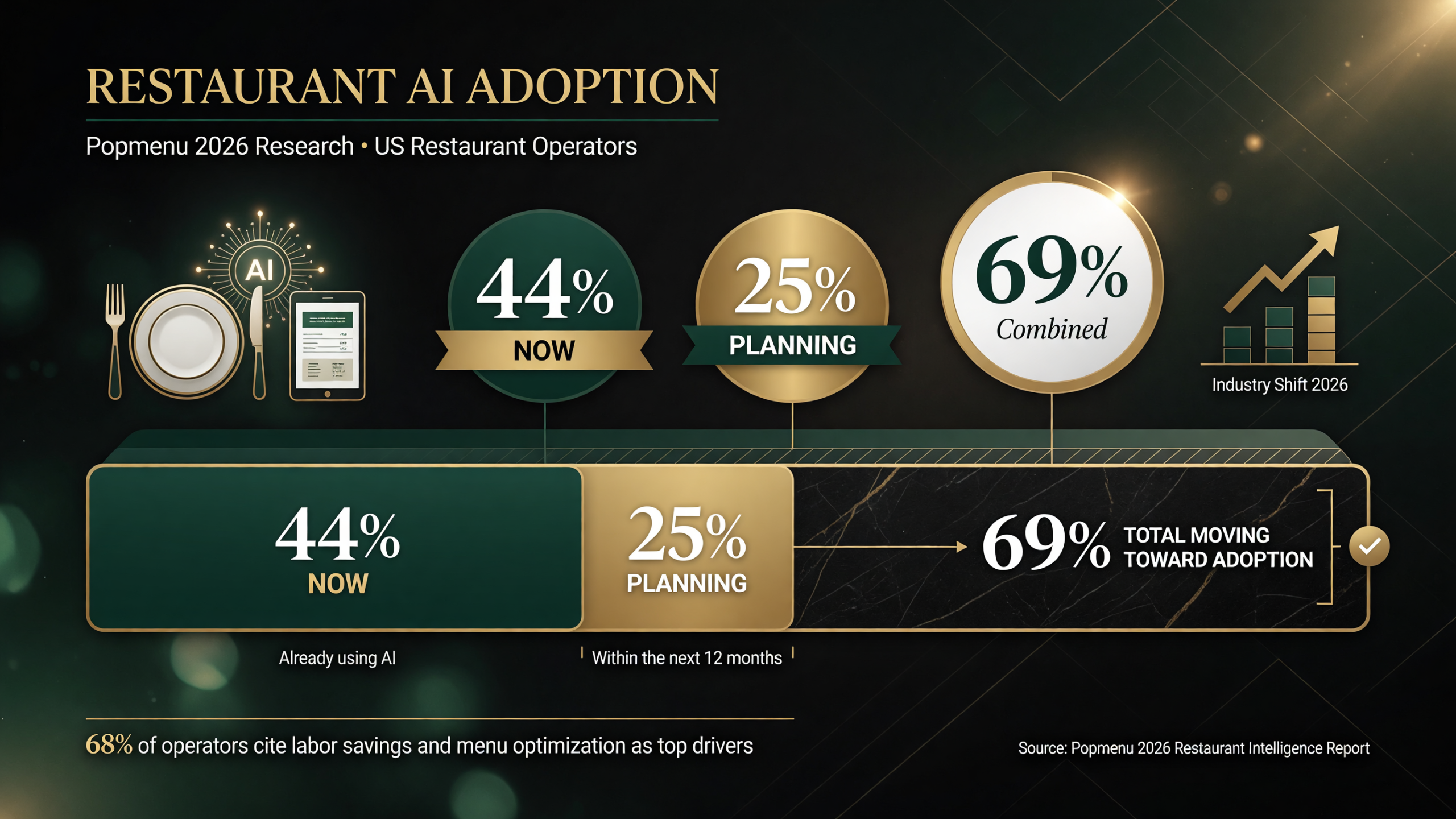
Roughly 7 in 10 US operators are already using AI or planning to within the year — adoption has moved into the independent and small-chain space.
Why the Back Office Is AI’s Biggest Win in Restaurants
Restaurants romanticize the front of house: the dining room, the line, the presentation. But the owner’s real enemy is the back office — the marketing emails that never get written, the phone calls that go to voicemail, the reviews that pile up unanswered, the schedule that eats a Tuesday night. These are the tasks that burn out operators and stall small restaurants from scaling.
AI’s advantage here is that back-office work is repetitive, text-heavy, and rule-driven — exactly the kind of work language models handle well. Answering a call, drafting a weekly special email, categorizing Yelp feedback, forecasting next week’s labor — each is individually small, but together they’re the difference between an owner who closes the laptop at 6 and one who’s still answering messages at midnight. That’s the real adoption story behind the 44% figure.
Which Back-Office Tasks AI Handles Best Right Now
Not every back-office chore is ready for automation. The ones that work share three traits: they’re repetitive, they don’t require the physical presence of a human, and the cost of an AI miss is low enough to correct. The standouts in restaurant back offices today:
- Phone answering and reservation handling. AI voice agents answer calls, take reservations, and answer hours and menu questions around the clock. They don’t put callers on hold, and they capture bookings that used to go to voicemail at 9 PM.
- Review management and reputation. AI reads reviews across Google, Yelp, and Facebook, categorizes sentiment, surfaces urgent complaints, and drafts thoughtful responses that keep the operator’s voice. A steady stream of polite, on-brand review replies is a real local-search ranking factor.
- Marketing content and email. Weekly specials, event announcements, and seasonal promos are tedious to write, but a well-prompted AI drafts them in seconds from your menu and recent sales data, leaving you to approve rather than create from a blank page.
- Labor and demand forecasting. AI models pull in your reservation book, local event calendar, weather forecast, and historical sales to predict covers and the staffing they need — cutting both overstaffing waste and understaffing chaos.
- Inventory and ordering support. Tools flag low stock, suggest order quantities, and highlight high-waste items so you buy smarter and trim food cost without a spreadsheet addiction.
The pattern is consistent: AI takes the repetitive text, scheduling, and forecasting work off your plate while you focus on the people, the food, and the decisions that need a human eye.
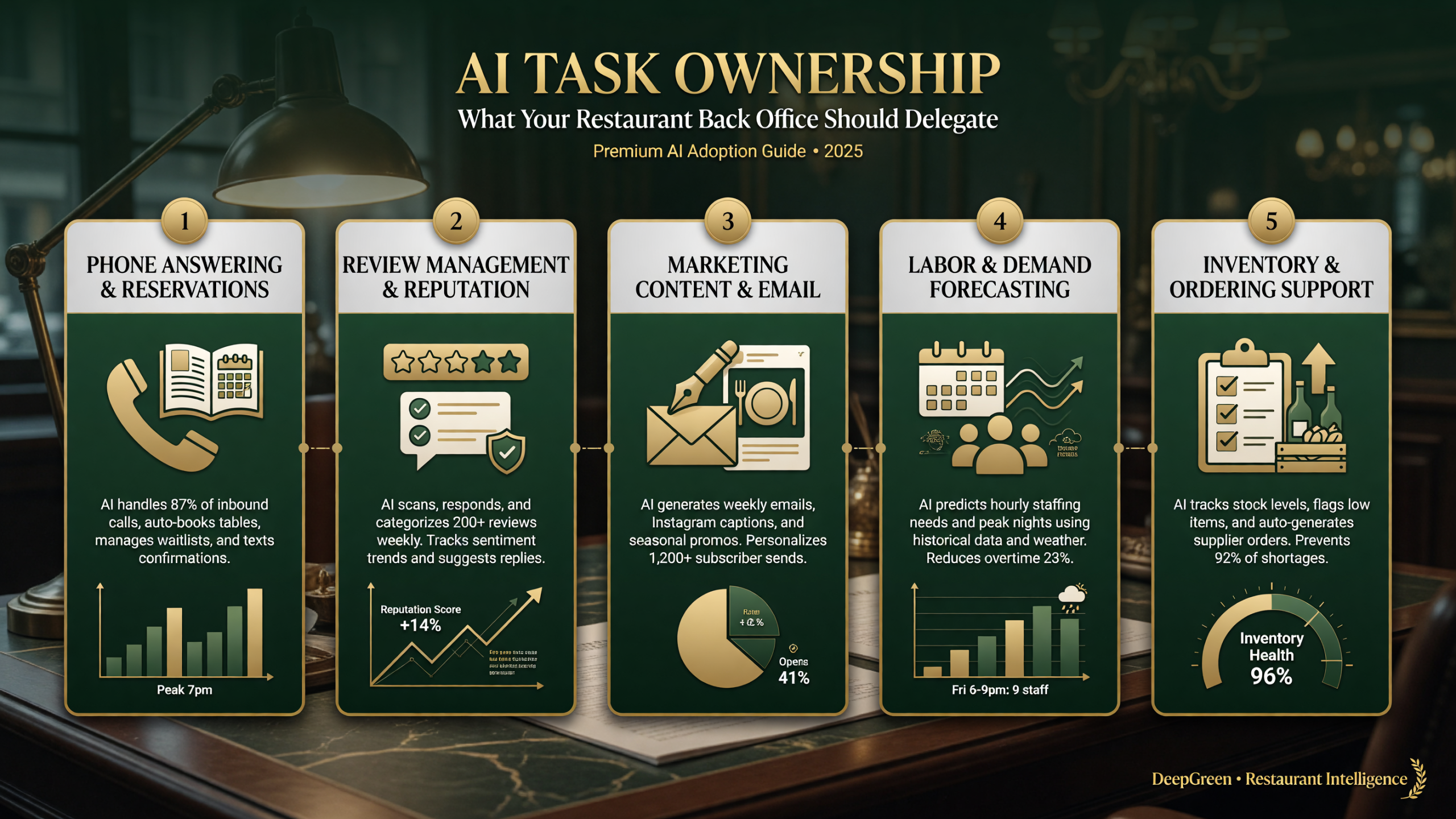
The back-office tasks AI handles best are repetitive and text-heavy: calls, reviews, marketing, forecasting, and ordering — the busywork that eats an owner’s evenings.
Real Numbers: What Back-Office AI Saves You
Put a concrete value on the adoption. A single unanswered reservation call is a table that may never book — and restaurants routinely miss a meaningful share of after-hours calls that go to voicemail and never get returned. An AI phone agent that recovers even one or two of those bookings per week pays for its subscription by the end of the month.
Take the labor side instead. The National Restaurant Association’s 2026 State of the Restaurant Industry report found roughly a quarter of operators already using AI, with labor cost pressure among the top problems they’re trying to solve. A modest improvement in forecasting — trimming 1% off labor overstaffing, or catching a busy night you understaffed — is real money on a weekly basis across a 10- or 20-person payroll.
And review response is the easiest win to measure. Restaurants that respond to reviews consistently rank better in local search and convert more lookers into bookers. When AI drafts those responses in your voice, the cost of consistency drops to nearly zero — you clear a backlog that used to take an evening, then keep it clear forever.
How Independent Operators Start Without a Big Budget
You don’t need an enterprise IT budget to capture the back-office win. The adoption curve for independents is steep because the cheapest, highest-ROI tools are now affordable at the single-restaurant scale. A realistic starting path:
- Pick the single task that hurts most. Don’t buy a platform for every use case at once. Choose the one job that eats the most of your week — usually phone answering, reviews, or marketing content — and solve just that first.
- Use the tools you already have. Review and email tools often attach to the POS or marketing suite you already pay for. Check for AI features you’re already entitled to before adding a new subscription.
- Automate one process end-to-end. Take a task you currently do manually and let AI do it for a month. Manage it by exception — you only step in when the AI needs a nudge. That’s the fastest way to see the real value.
- Measure the before and after. Track the number the tool should move — booked calls, responded reviews, hours spent on scheduling. A concrete before/after number is what turns adoption from a novelty into a habit.
- Add the next task only after the first sticks. Sequence the adoption. When phone answering is running on its own, add reviews. When reviews are handled, add forecasting. Each win funds and de-risks the next.
Common Mistakes to Avoid in Back-Office AI
Operators who try back-office AI and quietly drop it usually hit one of these walls. Avoid them and the tool will actually stick:
- Buying everything at once. A full AI stack on day one overwhelms your team and makes it impossible to tell what’s working. Start with one task and expand after you’ve proven it.
- Automating without review. AI content and AI responses need a human check, especially for sensitive topics like a bad review or a labor dispute. Approval workflows keep you in control without costing the time you’re saving elsewhere.
- Skipping the data hygiene. Forecasting and ordering tools are only as good as your POS data. Fix duplicate items, inaccurate counts, and inconsistent categories first, or the AI forecasts garbage.
- Ignoring the customer-experience handoff. If an AI answers calls, make sure a human is easy to reach when the caller needs one. The tool should handle routine asks, not create a wall.
- Expecting zero errors. No AI is perfect. Expect and tolerate a few misses in exchange for the hours reclaimed — a weekly 15-minute review of the tool’s output keeps quality high without defeating the purpose.
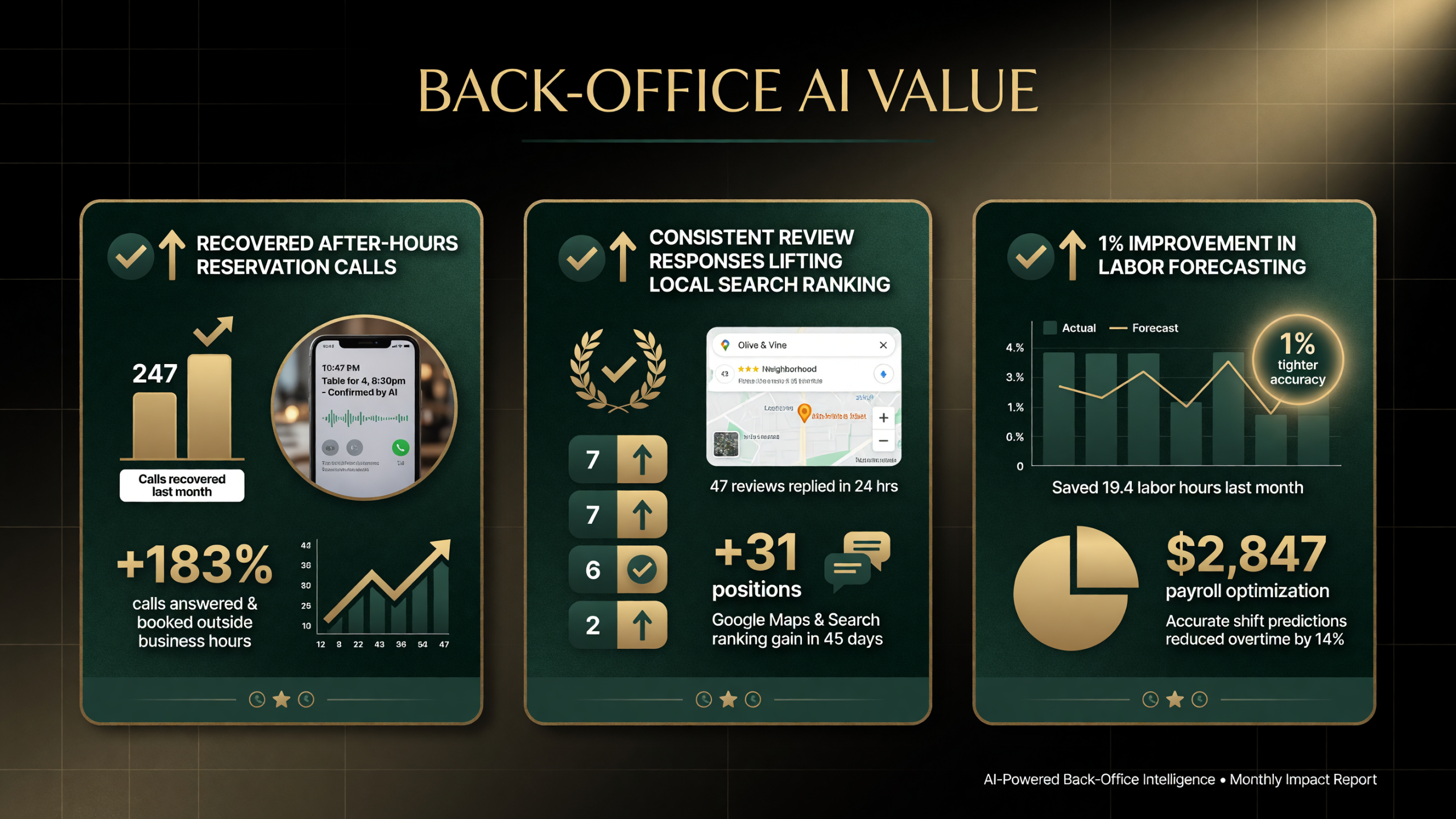
Recovered bookings, consistent review replies, and better labor calls compound into real money — most of it from tasks that once happened after close.
What to Look For in a Back-Office AI Tool
Not every product living under the “restaurant AI” umbrella earns your subscription. Before you commit, demand these four things:
- Restaurant-native training. The tool should understand service industry realities — peak hours, review culture, labor laws, food cost — not generic business prompts. A general-purpose chatbot isn’t the same as a tool built for operators.
- POS and reservation integration. It has to read your actual bookings, sales, and inventory from the systems you already run, not require you to re-enter data by hand.
- You stay in the loop. You want approval-based workflows and clear visibility into what it’s saying and doing on your behalf. An autonomous black box is a liability at the counter of a guest experience business.
- Clear, honest pricing. Per-location pricing with a free trial beats opaque per-feature licensing. Test it on your actual workload for a month before you scale it.
The Bottom Line: The 69% Is Coming Either Way
Here’s the competitive reality the Popmenu data exposes. Roughly 7 in 10 operators are already using AI or plan to within the year. That means the cost of running a restaurant the “old way” isn’t staying flat — it’s rising, as your competitors reclaim hours, capture more bookings, answer more reviews, and staff their busiest shifts more accurately with the same payroll.
You don’t have to be first, and you don’t have to buy everything. But the evidence is clear that back-office AI is now a mainstream operational lever, not an early-adopter experiment. The operators who pick their single most painful task, automate it end-to-end, and prove the value in a month will be the ones who aren’t playing catch-up when the rest of the market arrives.
The back office has always been where restaurant dreams go to die — a pile of small tasks that quietly consume an owner’s life. AI’s adoption story is simply this: that pile is now optional. Whatever hurts most in your week, there’s a tool for it, and your competitors are already using theirs.
FAQ
What does the 44% restaurant AI adoption figure mean?
Popmenu’s 2026 research found that 44% of US restaurant operators already use AI, with another 25% planning to adopt it within the year — about 69% moving toward adoption. It signals AI has moved from chain restaurants into the independent and small-chain space, mostly for back-office tasks like phone answering, review management, marketing content, and labor forecasting.
Which restaurant back-office tasks can AI actually handle now?
The best-fit tasks are repetitive, text-heavy, and rule-driven: answering phones and taking reservations, managing reviews and reputation, drafting marketing and email content, forecasting labor and demand, and supporting inventory and ordering. These are the big wins because they’re the busywork that eats an operator’s evenings without needing a human physically present.
How much can a small independent restaurant save with back-office AI?
It varies, but the wins compound fast. Recovering even a couple of after-hours reservation calls a week pays for a phone-agent subscription by month’s end. A 1% improvement in labor forecasting, plus consistent review responses that lift local search ranking, add up to real money on a weekly basis across a small payroll.
Do I need a big budget to start using restaurant AI?
No. The highest-ROI tools are now affordable at the single-restaurant scale, and many attach to the POS or marketing suite you already pay for. The recommended path is to pick the one task that hurts most, automate it end-to-end for a month, measure the before/after, and only then add the next task.

About Barak Schurr
Barak Schurr built and exited a major ticketing platform, ran global operations at Eventbrite, and now focuses on one question: which AI tools actually help independent restaurant owners run leaner and grow faster. He writes from the operator’s perspective — no vendor spin, no theory, just what’s real in 2026.
Email: [email protected]
More Restaurant Tech Resources