Get the AI Restaurant Quick-Start Guide — Free
The 5 AI tools independent US restaurant owners are using right now to cut labor costs and answer every call.
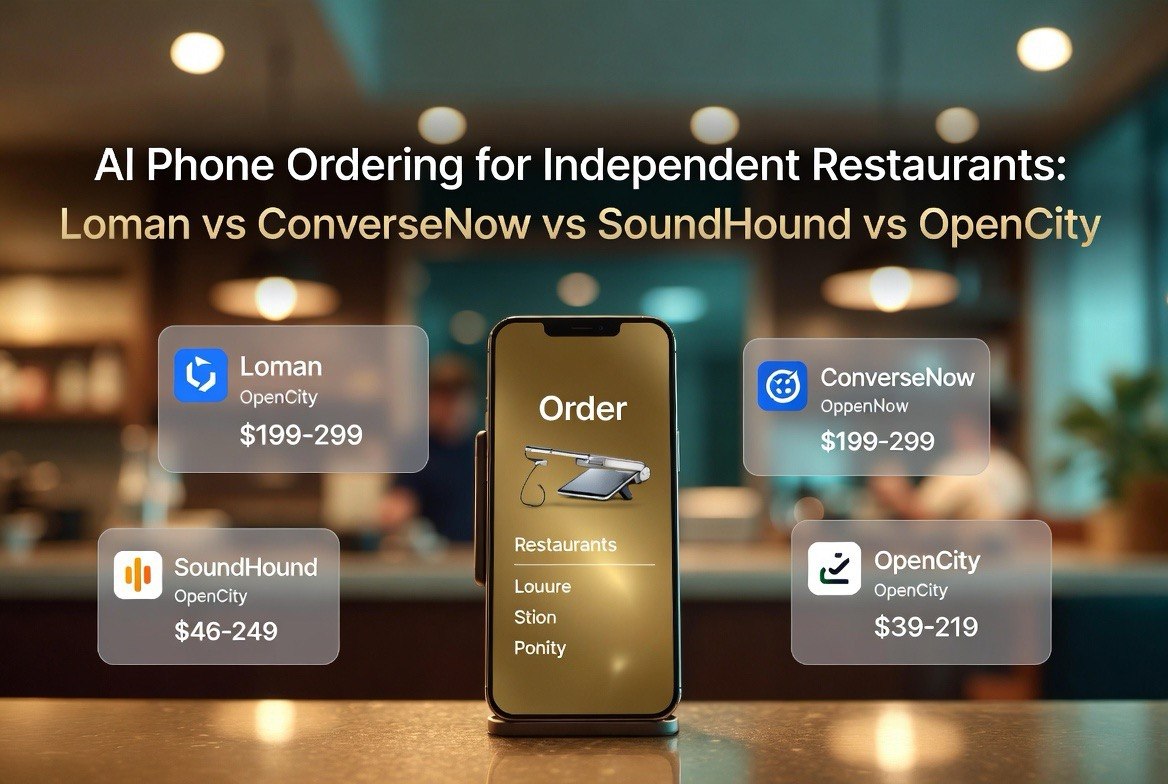
AI Phone Ordering for Independent Restaurants: Loman vs ConverseNow vs SoundHound vs OpenCity
⚡ Expert Summary: If you run an independent restaurant, your phone is leaking money. Every missed call is a lost order — and on a busy Friday, independents can miss 20–40% of inbound calls. AI phone ordering now takes those calls, answers in seconds during peak times, takes the full order, and pushes it straight to your POS. The tools are not all the same, though. Loman ($199–299/mo) is built for independents and integrates with Square, Toast, and Clover. ConverseNow and SoundHound lean enterprise. OpenCity targets drive-thru and multi-unit chains. For a single location or a small group of stores, Loman is the standout — and this guide breaks down exactly why, plus what to check before you sign.
Why Your Restaurant Is Losing Money on the Phone
Here’s the number that should make every independent owner sit up. Studies of the quick-service and fast-casual segment consistently show that a meaningful share of incoming calls go unanswered during peak hours — and each unanswered call is a sale that walks to a competitor who picked up. Industry data points to missed-call rates between 20% and 40% during busy periods at independent restaurants, depending on staffing and volume.
The math is brutal. If a call averages a $25 order and you miss 10 calls a day, that’s $250 a day and roughly $7,500 a month in orders that never happened. Over a year, that’s close to $90,000. No owner would knowingly leave that on the table, yet it happens automatically every time a host or manager is too busy to grab the phone.
AI phone ordering exists to close exactly that gap. The voice agent answers on the first ring, takes the order in natural conversation, confirms items and totals, and sends everything to your POS. Your staff keeps serving the dining room and the drive-thru; the machine handles the phone.
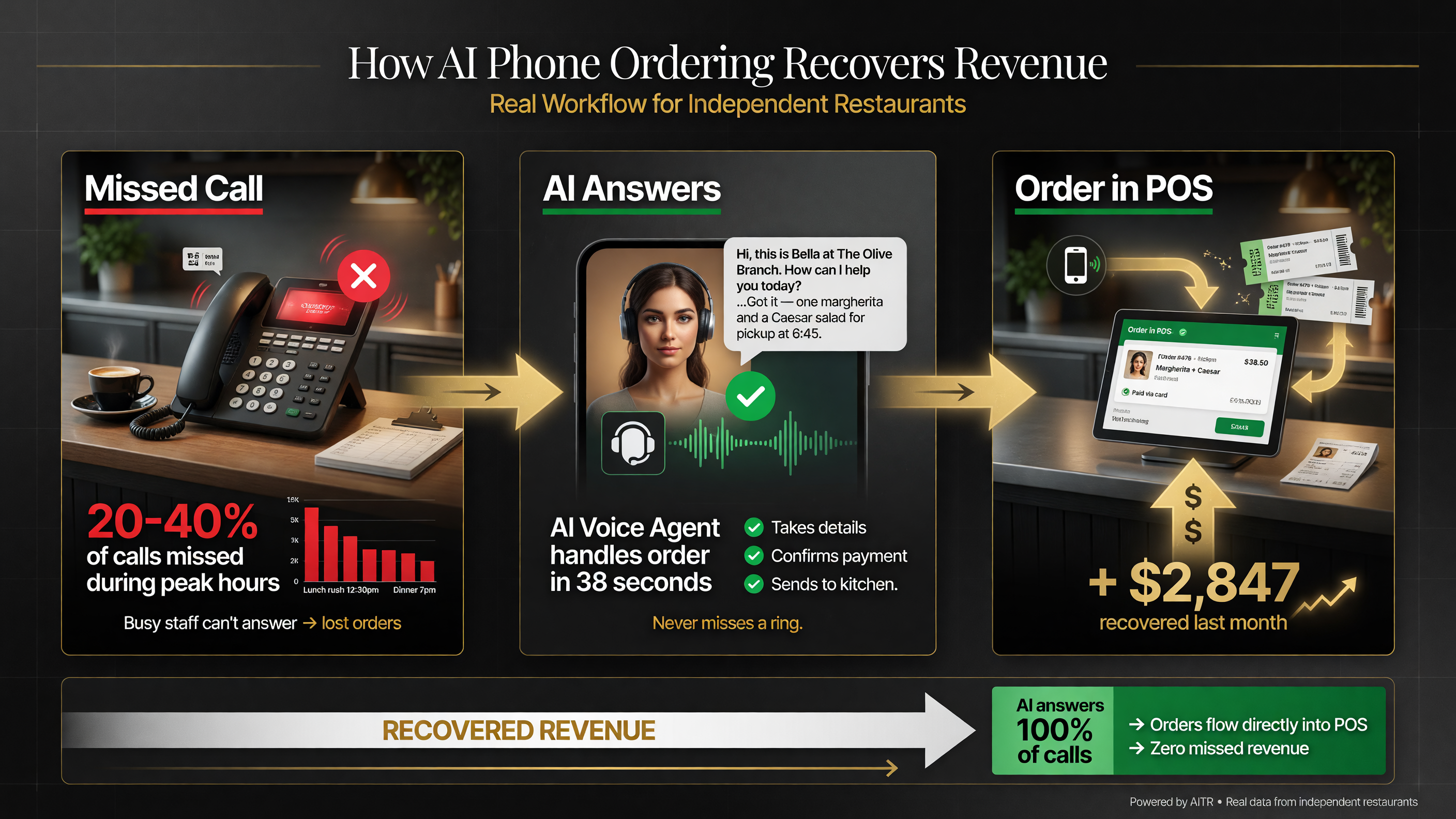
How an AI phone agent turns a missed call into a completed order flowing straight into your POS.
The Four Contenders at a Glance
Before we get into the details, here’s the landscape. These four names come up constantly when independents shop for AI phone ordering, and they compete on very different turf. The table below summarizes where each one sits so you can quickly see which category fits your operation.
| Platform | Best For | Rough Pricing | Key Edge |
|---|---|---|---|
| Loman AI | Independent & small multi-unit | $199–299/mo | Square, Toast, Clover integrations |
| ConverseNow | Chains & large franchises | Custom / enterprise | Scale and multi-brand menus |
| SoundHound | Enterprise drive-thru & kiosks | Enterprise quote | Voice AI across ordering channels |
| OpenCity | Drive-thru & multi-unit QSR | Enterprise quote | Drive-thru-focused voice ordering |
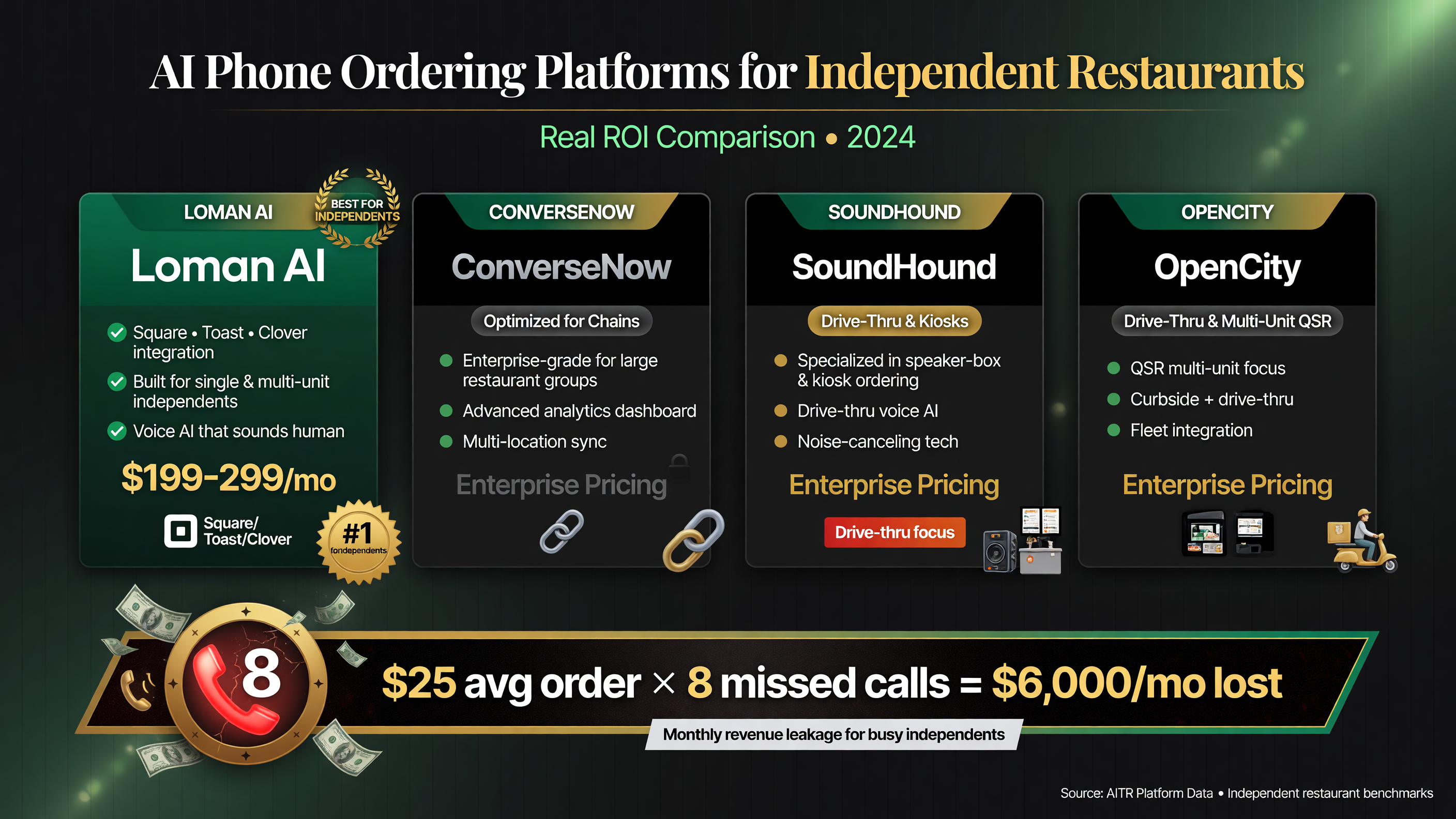
The four AI phone ordering options side by side, with the missed-call revenue math below.
Loman AI: The Independent’s Pick
Loman AI has carved out precisely the niche most owners need: the independent restaurant and the small multi-unit operator. Its headline advantage is that it plugs into the POS systems independents actually use — Square, Toast, and Clover — which means the order doesn’t just get written down, it gets entered into your real order flow. No double-entry, no manual re-keying, no transcription errors.
Pricing in the $199–299 per month range is the other thing that makes Loman approachable. That’s not pocket change, but it’s a fraction of a part-time host’s hourly costs, and the ROI case is straightforward: if the agent recovers even a handful of missed orders a day, it pays for itself before the month is out.
For an independent owner, this pairing of right-size pricing and POS integrations that already exist in your kitchen is what separates Loman from the enterprise players. The enterprise tools aren’t bad — they’re just built for a different customer with a different budget and a different menu scale.
ConverseNow and SoundHound: Built for the Big Guys
ConverseNow focuses on chains and large franchise operators. Its strength is handling enormous, constantly changing menus across hundreds of locations — the kind of scale an independent simply doesn’t need. It’s a powerful tool, but it’s priced and designed for an organization with dedicated ops and IT teams to manage the rollout.
SoundHound is the household name in voice AI, and its restaurant work spans drive-thru ordering, in-store kiosks, and phone ordering. Again, the focus is enterprise and multi-channel: the same voice engine powering a national drive-thru program or a complex kiosk network. For a single store, that capability is overkill, and the pricing reflects enterprise procurement, not small-business budgets.
The honest takeaway: ConverseNow and SoundHound are excellent at what they do, but what they do is solve problems your independent restaurant doesn’t have. Buying an enterprise tool for a one-location operation is like renting a warehouse for a food cart.
OpenCity: Drive-Thru and Multi-Unit Focus
OpenCity rounds out the list with a drive-thru-first orientation. It’s aimed at quick-service and multi-unit operators who want AI to handle the ordering lane — the peak-pressure environment where speed is everything. If you run a drive-thru and have several locations, OpenCity deserves a close look.
For a dine-in independent with table service and a phone at the counter, drive-thru focus is less relevant. The lesson is about fit: match the tool’s specialty to your operation’s actual ordering channels. A dine-in spot needs a phone agent. A drive-thru chain needs a drive-thru agent. Trying to stretch one tool across a channel it wasn’t built for usually ends in disappointment.
Table: What to Check Before You Sign
| Checklist Item | Why It Matters |
|---|---|
| Your POS is supported | Square, Toast, Clover are common; confirm before you commit |
| Handles your menu complexity | Modifiers, combos, allergies, and special requests must work |
| Escalates to a human on request | Customers need an off-ramp when the agent gets stuck |
| No double-entry to your POS | Order should flow straight in, not be re-keyed by staff |
| Transparent reporting | Calls answered, orders taken, missed calls recovered |
How to Decide on Your First AI Phone Ordering Tool
Asking “which AI phone ordering tool is best” is the wrong question. The right question is “which one fits my operation’s size, POS, and ordering channels.” Here’s a simple decision path for an independent owner.
Step 1: Confirm the POS integration
Your ordering agent is only valuable if it writes orders into the system your kitchen uses. If you run Square, Toast, or Clover, Loman’s native integrations make it the most turnkey option. If you’re on a less common POS, verify what any vendor supports before you even look at price.
Step 2: Right-size the scope
Single location, dine-in and phone? You need a phone agent, not a drive-thru platform. Small group of stores sharing a menu? A small multi-unit setup still fits independent-oriented tools. Growing into enterprise scale with hundreds of locations? That’s when ConverseNow, SoundHound, or OpenCity enter the picture.
Step 3: Test on your real menu
Every demo handles a clean menu perfectly. Run a pilot with your actual items, your modifiers, and your special requests. You need to hear how it handles “can I get the salmon, but no capers, extra lemon, and can you make it a combo?” That’s where the tools separate.
Step 4: Check the human escalation
There will be calls the AI can’t handle — the angry regular, the complicated catering order, the customer who just wants to talk to a person. Make sure the agent gracefully transfers to a human instead of fumbling. This single feature protects you from the worst-case scenario of an AI that frustrates your best customers.
Step 5: Measure missed-call recovery
Before and after, count your missed calls and your order volume. Did the answering rate go up? Did phone orders increase? If the tool isn’t measurably recovering revenue you were losing, it isn’t earning its $200–300 a month. Run it for 30 days with real numbers, then decide.
The Labor Angle: Your Staff Is Too Busy to Answer
It’s worth naming the real reason calls go unanswered: it’s rarely that owners don’t care about the phone — it’s that the people who would answer are busy doing the work that pays the bills. On a Friday night, the same two or three staff members are taking tables, running food, bussing, handling the register, and working the pass. The phone rings, and there’s simply no one free to pick it up. This isn’t negligence; it’s the structural reality of running a lean operation on thin margins.
Industry labor data reinforces the tension. Quick-service and fast-casual restaurants operate with some of the thinnest margins and highest turnover in retail, and managers are routinely stretched across roles. When you add a phone ordering agent, you’re not replacing a person — you’re adding a dedicated employee who never takes a break, never gets pulled into the dining room, and never puts a caller on hold to seat a walk-in. The AI becomes the team member whose only job is the phone, and it costs a fraction of what a human in that role would.
That framing matters when you pitch it to yourself or your partners. You’re not buying software that competes with your staff; you’re hiring the one role you could never afford to fill with a person — the always-available, never-distracted order taker. The dining room keeps the humans, and the phone gets the machine. It’s a division of labor that makes sense the second you think about it structurally.
What a Good AI Phone Ordering Call Actually Feels Like
Here’s what a well-tuned AI phone agent should sound like to your customer. The phone rings once. A warm, clear voice answers: “Thanks for calling [Your Restaurant]. Are you looking to place an order today?” The customer says, “Yeah, I’d like the grilled chicken combo, and my wife wants the veggie bowl, no onions.”
The agent confirms each item, catches the modifier, reads back the order, gives a total, asks about pickup or delivery timing, and confirms the payment method. It handles the back-and-forth naturally, including the customer who changes their mind or asks “what comes with the combo?” When the call ends, the order is already in the kitchen’s POS queue, formatted correctly, with the modifier noted. No one on your floor was interrupted. No one scribbled a note that got misread.
The best tools get the details right: they speak slowly enough to be understood, they avoid the robotic hesitation that makes callers hang up, and they know when to hand off to a human. A customer who says “actually, I have a question about a catering order” should get transferred to a person, not fumble through voice menus. This human-handoff moment is where the good tools separate from the cheap ones, and it’s exactly what you should demand in any demo.
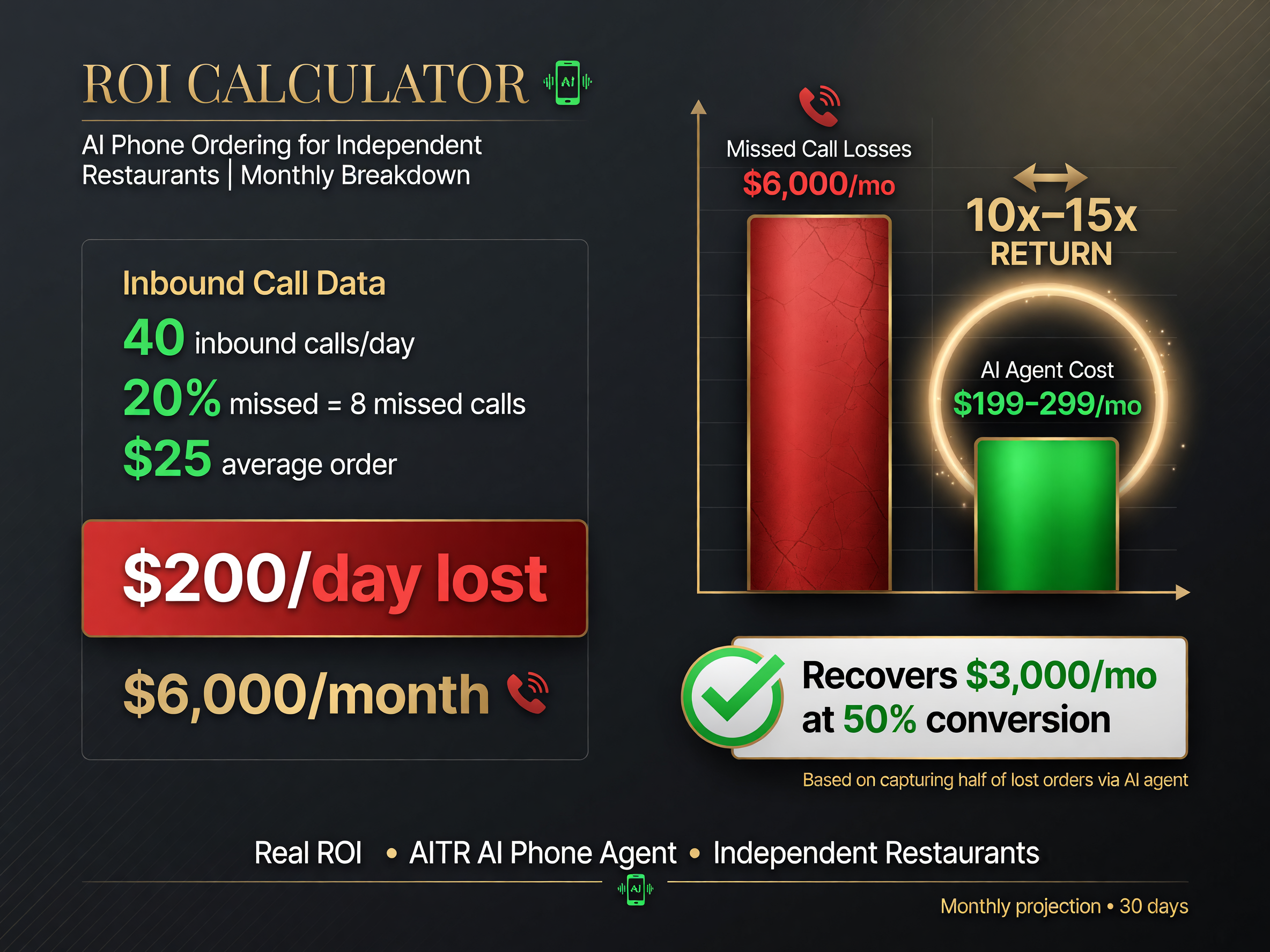
The ROI case: $6,000 a month in missed-call losses against a $199-299 tool cost.
The ROI Case: Do the Math Yourself
Let’s put a real number on it. Say your independent restaurant takes 40 inbound calls a day and currently misses 8 of them (20%). At a $25 average order, that’s $200 a day in missed sales — $6,000 a month. An AI agent that answers those 8 calls and converts even half of them (4 orders) recovers $100 a day, or $3,000 a month, against a $199–299 tool cost.
That’s a multiple of 10x to 15x return before you count the secondary benefits: staff no longer interrupted mid-service, fewer order transcription errors, and the phone answered during the exact minutes when your team is busiest. The ROI isn’t theoretical — it’s arithmetic.
FAQ: AI Phone Ordering for Independent Restaurants
Independent restaurants don’t win by buying the biggest, most feature-rich tool on the market. They win by buying the tool that fits — the one that integrates with their POS, matches their scale, and recovers the revenue the phone is silently leaking. For most independents, Loman AI’s combination of Square/Toast/Clover integrations and $199–299 pricing makes it the clear first call. Just run the 30-day test, watch your missed-call count, and let the numbers decide.
About the Author

About Barak Schurr
Barak Schurr built and exited a major ticketing platform, ran global operations at Eventbrite, and now focuses on one question: which AI tools actually help independent restaurant owners run leaner and grow faster. He writes from the operator’s perspective — no vendor spin, no theory, just what’s real in 2026.
Email: [email protected]