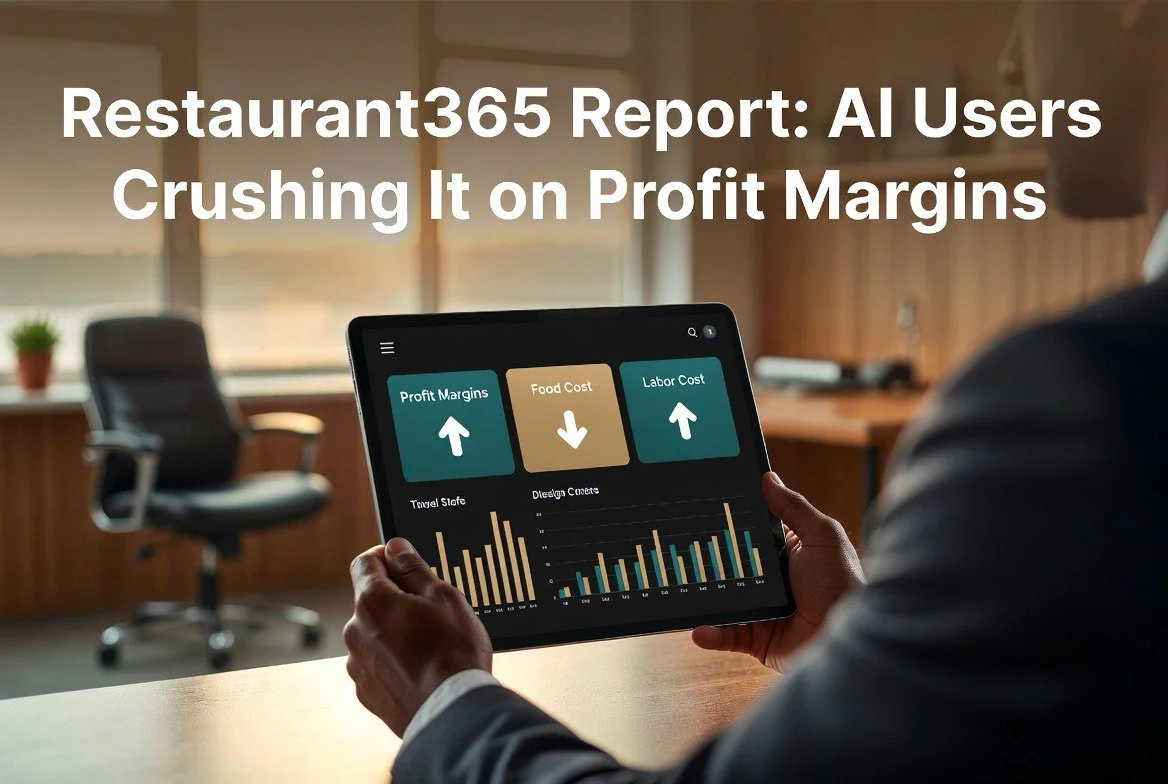
Restaurant365 Report: AI Users Crushing It on Profit Margins
⚡ Expert Summary: Restaurant365’s 2026 State of the Restaurant Industry Mid-Year Report surveyed 420+ operators representing nearly 10,000 U.S. locations and found that AI-adopting restaurants are reporting significantly lower food costs and labor costs than non-adopters. The report identifies a widening “Restaurant Profitability Gap” driven by back-of-house AI tools for scheduling, inventory forecasting, and analytics.
Every independent restaurant owner knows the feeling: you work a double on Friday, the dining room is full, tickets are stacking up, and at the end of the night you look at the P&L and wonder where the money went. Food costs crept up. Labor ran over. The week’s margin evaporated before you had a chance to see it happen.
That experience is not inevitable. And according to a major new industry report, the difference between restaurants that escape this cycle and restaurants that stay trapped in it comes down to one factor: whether they use AI to manage their operations.
Restaurant365 released its 2026 State of the Restaurant Industry Mid-Year Report in mid-July, based on a survey of more than 420 restaurant operators representing nearly 10,000 U.S. locations across quick-service, fast casual, casual dining, fine dining, pizza, and coffee concepts. The headline finding is stark: operators using AI are pulling ahead of those who are not, and the gap is widening.
The Profitability Gap Is Real
The report coins the term “Restaurant Profitability Gap” to describe what happens when AI adopters use operational data to make better decisions while non-adopters continue managing by instinct. The numbers are difficult to ignore:
61% of AI-adopting operators report reduced food costs. Nearly one-third of those saw reductions of 6% or more. In an industry where food costs typically run 28-35% of revenue, a 6% reduction on that line item can mean the difference between a profitable month and a break-even one. For a restaurant doing $1 million in annual revenue, a 6% food cost reduction puts roughly $18,000 back on the bottom line.
62% report reduced labor costs. Labor is the other major cost driver for U.S. restaurants, typically consuming 28-35% of revenue. AI-powered scheduling tools that predict traffic patterns and optimize shift coverage are driving these reductions without cutting service quality. The report suggests AI adopters are not simply reducing headcount but deploying staff more efficiently against actual demand.
88% of AI adopters say they save time every week. This is the metric that resonates most with independent operators who wear every hat in the building. Time saved on scheduling, inventory counting, and reporting is time spent on guests, menu development, and the parts of running a restaurant that actually generate revenue.
Where AI Is Having the Biggest Impact
The report identified several back-of-house applications where AI adoption has surged since the start of 2026. The most significant area is reporting and analytics, with approximately 69% of operators actively using or piloting AI-powered tools in this category. This makes intuitive sense: the ability to convert raw operational data into actionable insights is the foundation of better decision-making across every other area of the business.
| AI Application | % Operators Using/Piloting | Primary Benefit |
|---|---|---|
| Reporting and analytics | 69% | Real-time visibility into costs and trends |
| Inventory forecasting | 48% | Reduced waste, fewer stockouts |
| Labor scheduling | 52% | Optimized labor spend against demand |
| Demand forecasting | 44% | Better prep levels, less waste |
| Menu engineering | 37% | Data-driven pricing and item optimization |
The food cost reduction numbers deserve special attention. Most independent operators count inventory by hand, estimate usage, and adjust based on gut feel. AI-powered inventory systems track usage in real time, predict when items will run out, and even suggest order quantities based on historical patterns and upcoming events. The result is less waste, fewer emergency supply orders, and a much tighter handle on cost of goods sold.
What This Means for Independent Restaurant Owners
The Restaurant365 report arrives at a time when U.S. restaurant operators are facing persistent pressure from elevated food costs, labor shortages, and changing customer expectations. The gap the report identifies is not theoretical. If AI-adopting operators are consistently achieving lower food costs, lower labor costs, and better margins, then non-adopters are effectively subsidizing their competitors’ efficiency advantage.
The good news is that the tools driving these gains are not exclusive to large chains with dedicated technology teams. The same AI-powered scheduling, inventory, and analytics platforms that work for 500-location chains are now available to independent operators at accessible price points. Restaurant365 itself, as an all-in-one restaurant management platform, covers these categories. But there are also standalone tools for each area.
For labor scheduling, platforms like 7shifts and Sling have integrated AI features that predict traffic and optimize shift assignments. For inventory and food cost management, MarketMan and CrunchTime offer AI-powered forecasting. For overall analytics and reporting, Restaurant365, Toast, and SpotOn all provide dashboards that surface actionable intelligence from operational data.
The critical insight from the report is that these tools compound. Inventory forecasting alone might save 2-3% on food costs. Labor scheduling alone might save 2-3% on labor costs. But operators using multiple AI tools in combination are reporting significantly larger total improvements. The data suggests that the Restaurant Profitability Gap is not driven by any single tool but by the systematic application of AI across multiple operational areas.
AI Adoption Is Accelerating Fast
One of the more striking findings in the report is how quickly AI adoption has spread. The survey found that the majority of operators who are using AI today started within the past 12 months. The technology has moved from experimental to standard practice in the first half of 2026 alone. This acceleration is driven by three factors: the tools have become significantly easier to use, the pricing has become accessible for independent operators, and the competitive pressure is becoming impossible to ignore.
When a neighboring restaurant starts running 6% lower food costs because of an AI inventory system, the decision to adopt is no longer about innovation. It is about staying competitive. The Restaurant365 report essentially documents the early stages of a structural shift in restaurant operations, and the early adopters are building advantages that latecomers will struggle to close.
Caveats and Considerations
The Restaurant365 report is sponsored by a company that sells restaurant management software, which means the findings should be evaluated with appropriate context. The AI-adoption benefits it identifies are consistent with other industry data, but the specific percentages come from a survey of Restaurant365’s customer base and broader industry respondents, who may be more tech-forward than the average operator.
Additionally, AI implementation requires an upfront investment of time and attention. Training staff on new systems, configuring the software to match your specific operation, and learning to trust AI-generated recommendations all take effort. The operators who are seeing the best results are those who committed to the implementation process rather than expecting plug-and-play results.
Data quality also matters. AI forecasting tools are only as good as the data they have to work with. Operators who have been tracking their costs, sales, and inventory consistently will get better results from AI tools than operators who need to start from scratch. The first step toward AI-driven operations is good data hygiene.
Where to Start
For an independent restaurant owner looking at this report and wondering where to begin, the most practical first step is analytics and reporting. Understanding your current numbers is the foundation for everything else. Most POS systems already collect the data you need; the question is whether you are using it effectively. A platform like Restaurant365 or even a simpler analytics tool connected to your existing POS can start surfacing insights within days.
From there, inventory forecasting is the highest-ROI next step for most operators. Food cost is the largest controllable expense in most restaurants, and AI-powered forecasting consistently delivers measurable reductions. Labor scheduling optimization can follow once you have confidence in your demand forecasting.
Frequently Asked Questions
FAQ
What is the Restaurant365 2026 Mid-Year Report?
The Restaurant365 2026 State of the Restaurant Industry Mid-Year Report is a survey of 420+ restaurant operators representing nearly 10,000 U.S. locations. It analyzes AI adoption trends and their impact on restaurant profitability, released in July 2026.
What is the Restaurant Profitability Gap?
The Restaurant Profitability Gap is a term from the Restaurant365 report describing the widening performance difference between AI-adopting operators and non-adopters. AI users report significantly lower food costs, labor costs, and better overall margins.
What percentage of restaurants are using AI in 2026?
Approximately 69% of operators are using or piloting AI for reporting and analytics, 52% for labor scheduling, 48% for inventory forecasting, and 44% for demand forecasting.
How much can AI save on restaurant food costs?
The report found that 61% of AI-adopting operators reported reduced food costs, with nearly one-third seeing reductions of 6% or more. For a restaurant doing $1M in annual revenue, that equals roughly $18,000 in additional profit.
Can independent restaurants afford AI tools?
Yes. AI-powered scheduling, inventory, and analytics tools are now available at price points accessible to independent operators. Many integrate with existing POS systems.
Where should a restaurant owner start with AI adoption?
Start with analytics and reporting to understand your current numbers, then move to inventory forecasting as the highest-ROI next step.

About Barak Schurr
Barak Schurr built and exited a major ticketing platform, ran global operations at Eventbrite, and now focuses on one question: which AI tools actually help independent restaurant owners run leaner and grow faster. He writes from the operator’s perspective — no vendor spin, no theory, just what’s real in 2026.
Email: [email protected]
More AI Resources