Get the AI Restaurant Quick-Start Guide — Free
The 5 AI tools independent US restaurant owners are using right now to cut labor costs and answer every call.
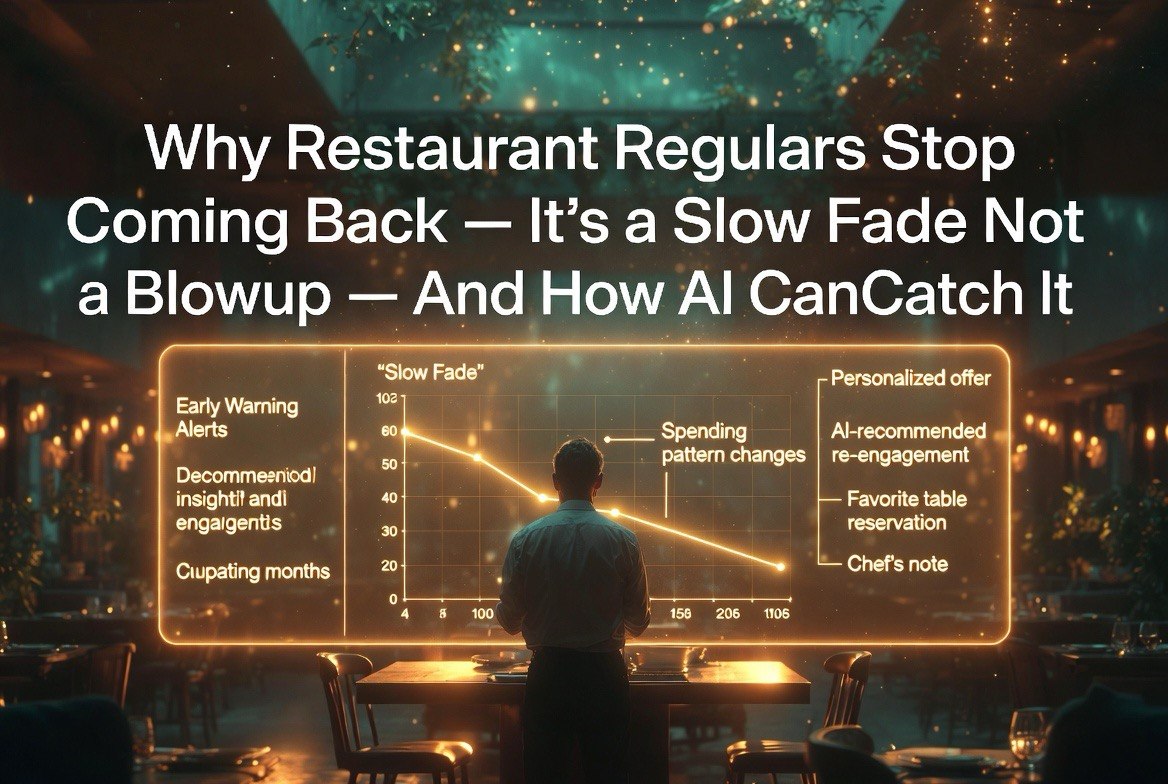
Why Restaurant Regulars Stop Coming Back — It’s a Slow Fade, Not a Blowup (and How AI Can Catch It)
⚡ Expert Summary: A new Toast survey reveals that most restaurant customers don’t stop coming after one bad experience. They drift away gradually — often feeling unrecognized. For independent operators who rely on regulars, this slow fade is a silent revenue killer. Here’s how AI-powered loyalty and analytics tools can detect the drift before customers ghost you for good.
According to the National Restaurant Association, US restaurants spend over $300 billion annually on labor costs, making operational efficiency critical for independent operators.
The Silent Revenue Killer in Your Dining Room
A new survey sponsored by Toast and published on Restaurant Dive in June 2026 revealed something that should worry every independent operator. When customers stop coming to a restaurant, they don’t typically leave after one bad meal or one rude server. They drift away gradually over weeks and months.
Toast calls it “the slow fade.” And it’s bad news for restaurants that rely on repeat business.
The survey found that most customers don’t have a single breaking point. Instead, they start coming less frequently, ordering less when they do visit, and eventually stop altogether. The reasons vary: they feel unrecognized, the experience became predictable, a new option opened closer to home, or they simply fell out of the habit.
For chain restaurants with loyalty programs and marketing automation to 2 million email subscribers, this slow fade is manageable. They have the data infrastructure to detect it and the marketing machinery to respond.
For an independent restaurant owner managing front-of-house, ordering, payroll, and social media simultaneously, the slow fade is invisible until the revenue drop hits the P&L statement three months later.
The Toast Data: What the Slow Fade Actually Looks Like
Toast’s survey, published in mid-June 2026, analyzed customer behavior patterns across thousands of restaurants on its platform. The headline finding: most customers don’t stop coming after one bad night. They drift off gradually, often feeling unrecognized.
The data shows that the typical slow fade follows a predictable pattern. First, visit frequency drops by 30-50% over four to six weeks. Then, average check size declines as the customer orders less. Finally, the customer stops coming entirely, usually with no formal feedback.
For the independent operator, the critical window is the first four weeks. If you catch the frequency drop in that window, you have a strong chance of re-engagement. If you wait until the customer has been gone for two months, the re-engagement rate drops by more than half.
This is not a theory. This is data from actual POS transactions across thousands of restaurants. The slow fade is measurable, predictable, and preventable.
Why Regulars Are Your Most Vulnerable Revenue Source
The dependency on regulars is higher for independents than for chains. A 2025 study by the National Restaurant Association found that repeat customers account for an average of 67% of revenue at independent restaurants. Losing one regular who visited twice a week at $30 per visit costs you over $3,000 per year.
Losing ten regulars costs you $30,000. That is the difference between a profitable year and a loss for many small operators.
The problem is detection. A customer who used to come every Thursday for dinner and now comes every other Thursday hasn’t stopped. They’re still in your POS system. They still count as a returning customer. But their visit frequency has dropped 50%. In another month, they’ll be coming once a month. Two months after that, they’ll be gone.
If you catch this pattern in week two, you can respond with a personal outreach. If you catch it in month four, you’ve already lost them.
How AI Detects the Slow Fade
AI-powered analytics tools are now available to independent restaurants at affordable prices. These tools connect to your POS and analyze customer visit patterns in ways that are impossible to track manually.
Frequency Tracking at Scale
AI tools can track visit frequency for every customer in your system. They calculate each customer’s baseline behavior — how often they visit, what they typically spend, how long between visits — and flag deviations in real time.
A customer who visited every Tuesday for three months and then missed two Tuesdays in a row gets flagged automatically. The AI doesn’t wait for the revenue impact to show up in your monthly reports. It alerts you immediately.
Spending Trend Analysis
The slow fade isn’t just about frequency. Customers also reduce their spending before they stop coming entirely. Someone who used to order an appetizer and a cocktail with dinner now just orders water and an entree. Someone who brought their whole family now comes alone.
AI can detect these spending changes at the individual customer level. A downward trend over three to six visits triggers an alert that a customer may be slipping.
Sentiment Tracking from Reviews and Social Media
AI sentiment analysis tools scan your Google reviews, Yelp mentions, and social media tags for signals of discontent. A regular who used to leave five-star reviews but has gone silent for two months may be drifting. A customer who used to tag your restaurant on Instagram and hasn’t posted in six weeks may have moved to a competitor.
These signals are easy to miss when you’re running a restaurant. AI doesn’t miss them.
How to Respond When AI Flags a Fading Regular
Detection is only half the battle. The response matters just as much. Here are strategies that work for independent operators.
Personalized Outreach
When AI flags a regular whose visit frequency has dropped, reach out personally. A handwritten note, a text message, or an email from the owner saying “We noticed we haven’t seen you in a while and wanted to say we miss you” carries enormous weight with regulars.
The key is that the outreach must feel personal, not automated. If you use a loyalty platform, customize the message. “Your favorite table by the window is waiting for you” is better than “Come back for 10% off your next visit.”
Surprise and Delight Triggers
AI can identify the right moment for a surprise gesture. A regular who’s been coming in their usual pattern for months gets a free dessert on their next visit. A customer who always orders the same thing gets a “try this on us” for a new menu item they haven’t tried.
These micro-gestures cost very little but rebuild the emotional connection that keeps customers coming back.
Menu and Service Adjustments
If the AI detects that multiple regulars are showing the same fading pattern, the problem may not be individual — it may be systemic. Several regulars dropping off after a menu change suggests the change was wrong. Multiple regulars coming less often after a staff change suggests the new server isn’t connecting with customers.
AI can identify these cluster patterns and help you diagnose the root cause before it becomes a significant revenue problem.
How to Set Up AI-Driven Retention in One Week
Setting up an AI retention system doesn’t require technical expertise or a large budget. Most platforms are designed for operators who have never used AI before.
Day one: Choose your platform. SevenRooms or Toast Loyalty are the strongest options for most independents. Sign up and connect your POS. This typically takes 30 minutes.
Day two: Import your customer data. Most platforms pull your existing order history directly from your POS or payment processor. If you have been running for years, you will have a rich dataset of customer behavior ready to analyze.
Day three: Let the AI establish baselines. The platform needs a few days of data to calculate normal patterns. It identifies who your regulars are, what typical frequency looks like, and what normal spending patterns are.
Day four: Set up your first alert. Configure the AI to flag any customer whose visit frequency drops by more than 40 percent from their baseline over a two-week period. This catches the slow fade early.
Day five: Train your team on the response protocol. Write a simple SOP: when the AI flags a fading regular, the owner or manager sends a personal text or email within 24 hours. Keep it simple and genuine.
Day six: Start your first outreach campaign. The AI may already be flagging customers who started fading before you set up the tool. Those are your highest-priority re-engagement targets.
Day seven: Review your first week of alerts and responses. Adjust the alert thresholds if needed. You are now running a proactive retention system that catches the slow fade months before you would spot it on your P&L statement.
The Tools That Make This Possible
Several affordable platforms now offer AI-powered customer analytics for independent restaurants:
SevenRooms — Built for restaurants, offers guest profiles, visit tracking, and automated marketing triggers based on visit patterns. Starting around $180 per month.
Toast Loyalty — Integrated with Toast POS, offers frequency tracking and automated reward triggers. Included with Toast’s higher-tier plans.
Kickfin — Primarily a tip management tool, but its customer analytics module tracks visit frequency and spending trends.
Belly — Affordable loyalty platform with AI-driven customer segmentation and visit tracking. Starting around $100 per month.
SpotOn — Offers guest data platform with AI-powered analytics for visit frequency, spending trends, and automated re-engagement campaigns.
Each of these tools costs less than one lost regular per year. The ROI math is simple: if the tool helps you retain three to five regulars, it pays for itself. If it helps you retain a dozen, it’s a significant profit driver.
The Human Element Still Wins
None of this replaces the human connection that makes independent restaurants special. AI can detect the slow fade, but only your team can rebuild the relationship. The best use of these tools is giving you the information you need to act personally.
Train your staff to recognize regulars and greet them by name. Build a culture where front-of-house remembers preferences. Use the AI data as a supplement, not a replacement, for genuine hospitality.
The restaurants that survive and thrive in the coming years will be the ones that use AI to enhance their human touch, not replace it. The slow fade is real, and it’s been costing independent operators revenue for decades. The only thing that has changed is that you can now see it coming.
Frequently Asked Questions
How do I choose the right AI tool for my restaurant?
Start by identifying your biggest operational pain point — labor scheduling, inventory waste, review management, or customer retention. Most AI platforms offer free trials, so test two or three tools against your specific workflow before committing.
Do small restaurants need AI tools?
Yes. Independent restaurants operate on thinner margins and have fewer staff than chains, which means AI tools deliver a higher relative ROI by automating tasks that would otherwise fall on an overworked owner or manager. Many tools start under $100 per month.
How long does it take to implement AI in a restaurant?
Most AI tools for restaurants can be set up in under an hour with no technical expertise required. Integration with existing POS and reservation systems typically takes an additional 30 minutes. Full adoption by staff usually happens within two weeks.
Is AI secure for restaurant customer data?
Reputable AI restaurant platforms comply with PCI DSS for payment data and SOC 2 for operational data. Always verify a tool’s security certifications before integrating with your POS or reservation system. Most major platforms publish their compliance documentation publicly.
Will AI tools replace my restaurant staff?
No. AI handles data analysis, scheduling optimization, and routine customer responses — tasks that currently consume 30-40% of a manager’s time. This frees your team to focus on food quality, guest experience, and operational excellence, which AI cannot replicate.
More AI Resources