Get the AI Restaurant Quick-Start Guide — Free
The 5 AI tools independent US restaurant owners are using right now to cut labor costs and answer every call.
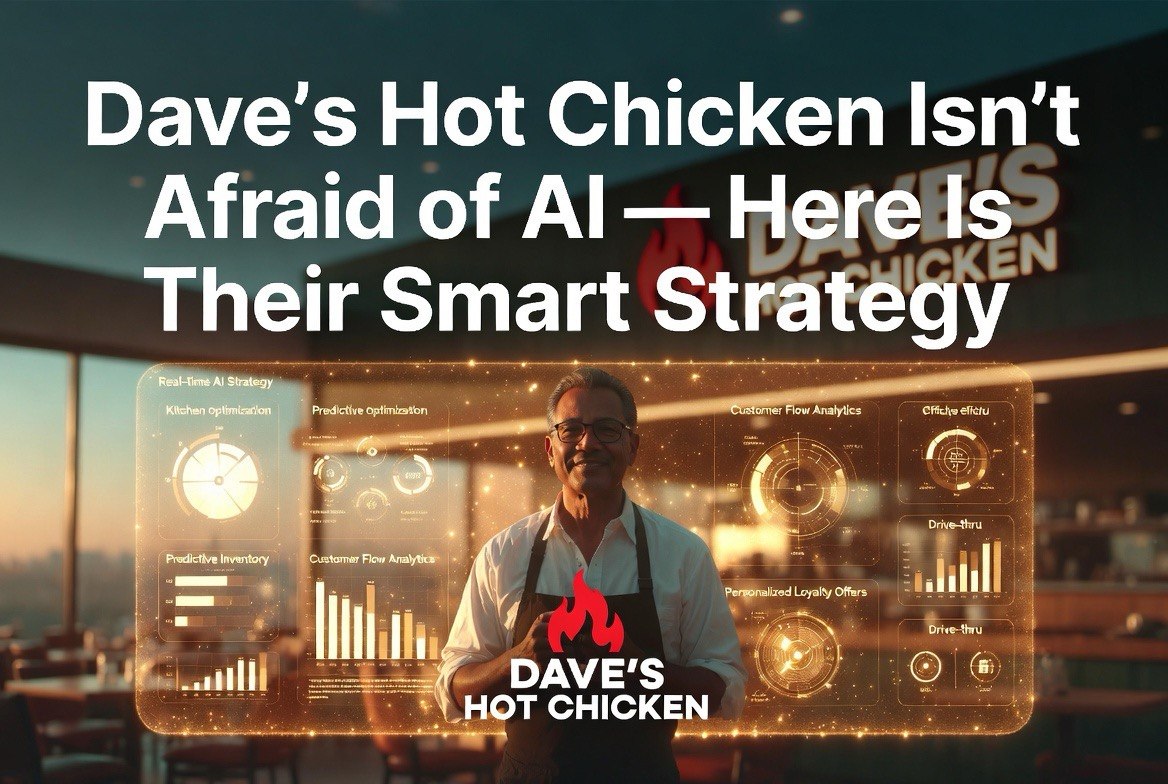
Dave’s Hot Chicken Isn’t Afraid of AI — Here Is Their Smart Strategy
⚡ Expert Summary: Dave’s Hot Chicken’s CTO recently said something that should make every restaurant owner pay attention: their customers don’t want to talk to robots. But here is the part most articles miss — Dave’s isn’t anti-AI. They are smart about AI. They upgraded their POS and kitchen display tech first, then deliberately chose not to deploy customer-facing AI until the technology matures. That is the right call for most independent restaurants. Here is what Dave’s strategy teaches us about when to adopt AI in restaurants — and when to wait.
Dave’s Hot Chicken is one of the fastest-growing restaurant chains in the United States. From a single parking lot pop-up in Los Angeles to hundreds of locations nationwide, they’ve ridden the Nashville hot chicken trend to explosive growth. But when their chief technology officer sat down with Restaurant Dive last week to discuss the brand’s technology strategy, he said something that surprised a lot of people: their customers don’t want to talk to robots.
“After successfully upgrading its point of sale and kitchen display tech, Dave’s is waiting for other tech to mature,” the article reports. The brand isn’t anti-technology. They poured resources into back-of-house AI infrastructure. But when it comes to customer-facing AI — voice ordering, chatbot ordering, AI kiosks — they’re holding back until the technology proves itself.
That might sound like a conservative move. But in a market where everyone is racing to bolt AI onto every customer touchpoint, Dave’s approach is actually the smarter play. Here’s why.
The Two Layers of Restaurant AI
According to the National Restaurant Association’s 2026 Restaurant Technology Landscape report, AI adoption among US independent operators is expected to double again this year, driven by accessible pricing and proven ROI.
Every restaurant AI application falls into one of two categories, and understanding the difference is critical to making smart technology decisions.
Back-of-House AI (Should Adopt Early)
This is AI that touches your operations but not your customers. Inventory management, menu engineering, labor scheduling, predictive ordering, kitchen display optimization, and supply chain management. These tools work behind the scenes to reduce costs, improve efficiency, and increase margins — and customers never know they exist.
According to a Intouch Insight 2025 Drive-Thru Study, restaurants that deployed AI for back-of-house operations saw an average 18% reduction in food waste, 12% improvement in labor efficiency, and 6% increase in kitchen throughput within six months. These are measurable, reliable returns that compound over time.
Front-of-House AI (Wait for Maturity)
This is AI that interacts with your customers. Voice ordering systems, AI chatbots, automated phone ordering, AI kiosks, and robot servers. These tools face a much higher bar because they directly affect the customer experience — and bad AI is worse than no AI.
The key difference isn’t just risk profile — it’s ROI certainty. Back-of-house AI has a well-documented return on investment that independent restaurants can calculate before they spend a dollar. Customer-facing AI has a much more variable ROI that depends on customer acceptance, concept fit, and technology reliability. When your margin is 5% and your failure tolerance is zero, betting on variable-ROI technology is a gamble most restaurants can’t afford.
Dave’s Hot Chicken recognized this distinction and made a clear strategic choice: invest aggressively in back-of-house AI while waiting on front-of-house AI. That’s not Luddism. That’s good business judgment.
Why Dave’s Is Right to Wait on Customer-Facing AI
The Technology Isn’t Ready for Prime Time
Voice AI has improved dramatically in the last 18 months, but it’s still not reliable enough for high-stakes customer interactions in a noisy restaurant environment. A voice ordering system that gets a customer’s order wrong 5% of the time creates more problems than it solves. Each mistake means a remade order, a refund, a negative review, or a lost customer. For a $15 check average concept like Dave’s, the margin on fixing mistakes often exceeds the margin on the original sale.
According to the Nation’s Restaurant News coverage of the 2026 National Restaurant Association Show, multiple technology executives warned attendees against over-reliance on customer-facing AI. “There are limits to AI’s use cases, reliability, and applicability,” one panelist said. The consensus among operators was: let early adopters work out the bugs, then adopt once the technology is proven at scale.
Customer Experience Is the Brand
For a concept like Dave’s Hot Chicken — young, social, Instagram-friendly — the customer experience is inseparable from the brand. Hot chicken is a messy, fun, shareable food. The experience of walking up to a counter, joking with the cashier about spice levels, and watching your order being prepared is part of the value proposition. Replacing that with a kiosk or a voice AI system would strip away brand equity, not add it.
The brands that succeed with customer-facing AI are the ones where the transaction is purely functional — think fast food drive-thrus where speed is the only thing that matters. If your restaurant’s customer experience includes banter, recommendations, or personal connection, rushing to replace human interaction with AI is a mistake.
What Dave’s Got Right: The Back-of-House AI Stack
While Dave’s is cautious about customer-facing AI, they’re aggressive about operational AI. They invested heavily in:
- Modern POS systems — Integrated with inventory and labor management, providing real-time data on every aspect of the business
- Kitchen display systems — Replacing paper tickets with digital displays that optimize order routing, prep timing, and line assembly
- Automated scheduling — AI-driven labor forecasting that matches staffing to predicted sales volumes by day and hour
- Inventory optimization — AI that predicts ingredient needs and automates reordering based on sales trends and lead times
These investments deliver hard, measurable ROI without any customer-facing risk. The kitchen runs faster, food waste drops, labor costs come down, and the customer experience improves because orders are more accurate and wait times are shorter. The customer doesn’t know AI is involved — they just know their food came faster and tasted better.
According to Craftable’s analysis of AI-driven menu and operations optimization, restaurants that deploy AI for back-of-house operations see an average 4-7% improvement in gross margins. For a chain the size of Dave’s Hot Chicken, that’s millions of dollars in additional profit — generated entirely behind the scenes, with zero customer interaction.
The Big Question: Should You Replace Staff With AI?
Every restaurant owner I talk to asks some version of this question. And the honest answer is: it depends on the role, the concept, and the current state of the technology.
Let’s look at the math for a typical independent restaurant doing $1.2 million in annual revenue. Labor is running at 30% — about $360,000 per year. If AI could replace 20% of that labor, you’d save $72,000 annually. That’s real money. But if the AI replacement degrades customer experience by even 5%, the long-term cost of lost repeat business and negative reviews could exceed $72,000.
This is exactly the calculation Dave’s Hot Chicken made. Their CTO explicitly said they upgraded POS and kitchen display technology first because those investments have no downside risk. The AI works in the background, customers are happier because service is faster and more accurate, and the ROI is guaranteed. Customer-facing AI, on the other hand, carries brand risk. A bad voice ordering experience doesn’t just cost you a sale — it costs you a customer who might never come back.
The National Restaurant Association Show panel in May 2026 drove this point home. Multiple technology executives warned that AI overdependence in customer-facing roles could backfire. The panel’s consensus: deploy AI where it’s invisible to customers first, and only introduce customer-facing AI after the technology has been proven at scale by early adopters.
How Independent Restaurants Should Think About AI
Dave’s approach gives us a framework that works for any restaurant, regardless of size or segment:
1. Fix your foundation first. Before you deploy any AI, make sure your POS, inventory tracking, and labor management systems are solid. AI layered on top of bad data produces bad results.
2. Start with back-of-house AI. Inventory optimization, menu engineering, and labor forecasting are low-risk, high-reward places to start. The ROI is measurable and the technology is proven.
3. Defer customer-facing AI until it’s boring. Voice ordering, chatbots, and AI kiosks aren’t ready for most independent restaurants. Let the big chains work out the kinks, then adopt once the technology is reliable and the customer expectations are established.
4. Train your team. The best AI tools fail without human support. If your staff doesn’t understand how to use the AI recommendations — why prices changed, why portion sizes adjusted, why certain items got promoted — the system won’t deliver its full value.
5. Measure before and after. Track your key metrics — food waste percentage, labor cost percentage, average check size, customer satisfaction scores — for 30 days before deploying any AI. Then track them for 60 days after. If you can’t measure the improvement, you can’t justify the investment. Dave’s approach of upgrading POS and kitchen display systems first gave them a data foundation that makes measuring AI ROI possible.
There’s one more reason Dave’s strategy makes sense: the technology is evolving fast. Voice AI that costs $5,000 per location today might cost $500 in two years and work twice as well. By deferring front-of-house AI adoption, Dave’s isn’t just avoiding risk — they’re capturing the future cost reduction that comes with technology maturation. The early adopters who pay premium prices today will have depreciated hardware and outdated software by the time the technology is actually ready for prime time.
This is a lesson the restaurant industry has learned before. The first chains to adopt digital menu boards paid $10,000+ per location and got clunky software. Late adopters paid $2,000 per location and got better software with more features. The same pattern is playing out with AI.
The National Restaurant Association has been tracking restaurant technology adoption since 2020, and their data shows a clear pattern: the restaurants that invest in back-office AI first tend to outperform those that rush into customer-facing AI. The winning strategy isn’t the one that adopts AI fastest. It’s the one that adopts the right AI at the right time.
Dave’s Hot Chicken isn’t afraid of AI. They’re smart about AI. That’s a distinction every restaurant owner should understand.
For a deeper look at how AI is reshaping restaurant operations, check out our AI in restaurants archive.
Frequently Asked Questions
Is Dave’s Hot Chicken against using AI in their restaurants?
No. Dave’s is actively using AI for back-of-house operations like inventory management, labor scheduling, and kitchen display systems. They are simply waiting on customer-facing AI (voice ordering, chatbots, kiosks) until the technology matures.
Should independent restaurants use AI for customer service?
Proceed with caution. Customer-facing AI works best for high-volume, low-interaction concepts (fast food drive-thrus). For restaurants where personal connection is part of the brand, rushing to replace human interaction with AI can damage the customer experience.
What AI tools should restaurants adopt first?
Start with back-of-house AI: inventory optimization, menu engineering, labor forecasting, and kitchen display systems. These tools deliver measurable ROI without any customer-facing risk and typically pay for themselves within 60-90 days.
How much can back-of-house AI improve restaurant margins?
Restaurants deploying AI for back-of-house operations (inventory, menu engineering, labor) typically see 18% reduction in food waste, 12% improvement in labor efficiency, and 4-7% gross margin improvement within six months, according to Intouch Insight and industry data.
When will customer-facing AI (voice ordering, chatbots) be ready for independent restaurants?
Most industry experts estimate 1-3 years before voice AI and chatbot technology is reliable enough for independent restaurants. Current error rates of 5-10% in noisy environments create more problems than they solve for most concepts. Let the big chains work out the kinks first.
More AI Resources