Get the AI Restaurant Quick-Start Guide — Free
The 5 AI tools independent US restaurant owners are using right now to cut labor costs and answer every call.
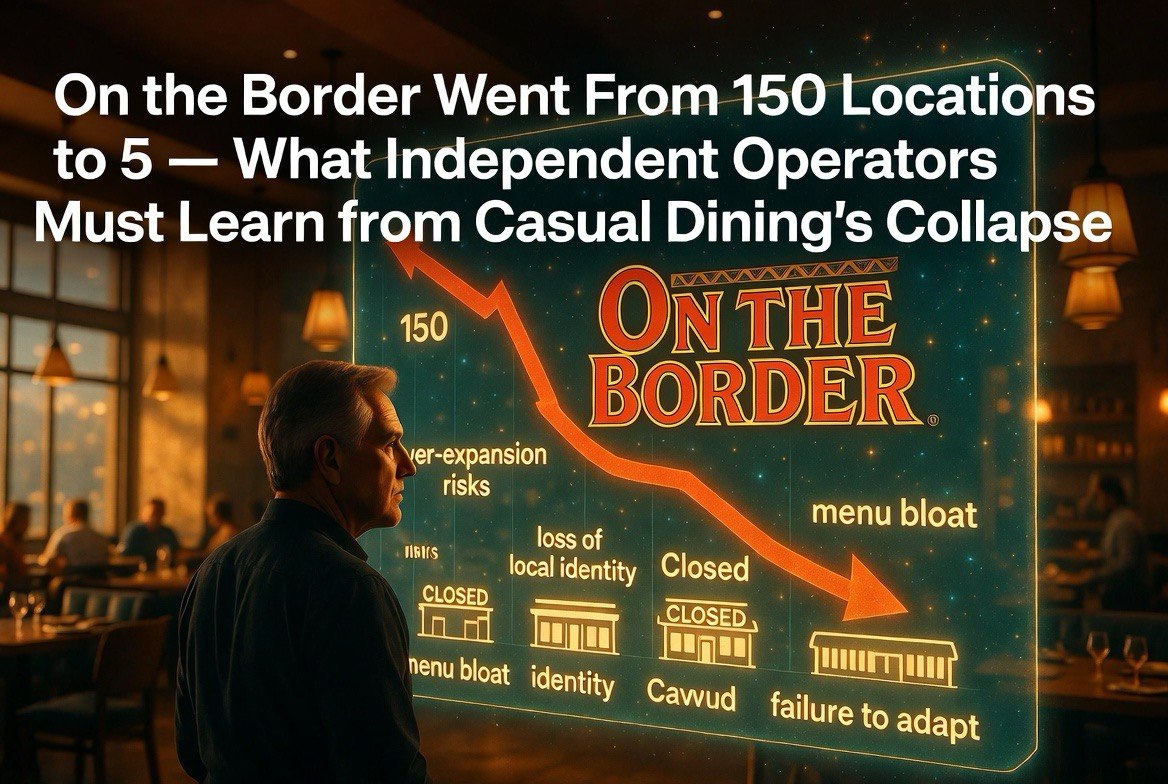
On the Border Went from 150 Locations to 5 — What Independent Operators Must Learn from Casual Dining’s Collapse
⚡ Expert Summary: On the Border closed all its corporate restaurants last week, reducing the once-150-location chain to just 5 franchised stores. The Tex-Mex chain was left out of casual dining’s revival despite industry-wide momentum. For independent operators, this collapse is not about pricing or food quality — it is a case study in what happens when operations technology and margin discipline fall behind.
On the Border Mexican Grill & Cantina now has exactly 5 restaurants left in the United States. The American Tex-Mex chain, which once spanned 150 locations across the country, closed all of its company-owned restaurants last week — a collapse that has implications for every independent operator in the US restaurant industry.
The chain, which once operated 150 locations across the country, closed all of its company-owned restaurants last week after emerging from Chapter 11 bankruptcy earlier this year. The closures amount to roughly 30 restaurants shuttered in a single week. All that remains are five franchised locations, according to the chain’s website.
The chain’s statement reads like an obituary: “an incredibly tough decision,” “deeply grateful to the guests and team members who supported On the Border for so many years.”
But tough decisions do not happen in a vacuum. On the Border’s collapse was years in the making — and independent operators who learn the right lessons from it will be better positioned to survive the market forces that killed it.
What Actually Killed On the Border
It would be easy to blame the usual suspects: rising food costs, labor shortages, competition from fast-casual concepts. Those factors played a role, but they were not the cause. Every restaurant faces those pressures. The question is which ones survive them.
On the Border was acquired out of bankruptcy by Pappas Restaurants with about 60 company-operating restaurants remaining. Within months, Pappas determined that roughly 30 of those were not viable. The remaining 30 closed in the latest wave. The chain went from 60 to 5 in under a year.
Restaurant Dive reported that On the Border was “left out of casual dining’s revival” — a key phrase that points to the real cause. The casual dining segment has rebounded significantly. Chains like Chili’s, Applebee’s, and Texas Roadhouse posted strong same-store sales growth in late 2025 and early 2026. The market conditions were favorable. On the Border wasn’t killed by a bad economy — it was killed by business decisions made years earlier.
Three structural problems stand out:
- Technology debt. While competitors invested in AI-driven operations — predictive inventory, automated scheduling, digital ordering systems — On the Border fell behind. The chain did not have the operational data infrastructure to identify which locations were bleeding cash until it was too late. By the time the numbers were clear, the debt was insurmountable.
- Menu bloat. On the Border’s menu grew over years without pruning. A bloated menu drives up food cost, increases prep complexity, slows down the kitchen, and makes inventory management harder. For a chain already running thin margins, the operational drag from menu complexity accelerated the decline.
- Real estate overhang. The chain was locked into leases in shopping centers and suburban strip malls that no longer generated the traffic needed to support full-service dining. When the pandemic shifted dining patterns, On the Border could not shed its real estate fast enough to match the new reality.
What Independent Operators Can Learn
On the Border’s collapse is a case study in operational neglect. Here is what you can steal from their failure:
1. Technology adoption is not optional in 2026. The chains that survived the casual dining shakeout — Chili’s, Texas Roadhouse, Outback — all American operators that invested in AI-driven operations between 2022 and 2025. Predictive inventory systems cut food cost variance. Automated scheduling reduced manager hours on admin. Digital ordering integration captured off-premise revenue. On the Border did not make those investments. The gap between technologically enabled operators and legacy operators is no longer a small edge — it is a survival threshold.
2. Margin discipline beats revenue growth. The temptation when times are good is to grow. The discipline when times are tough is to prune. On the Border expanded aggressively into markets that did not have the population density or traffic patterns to support full-service Tex-Mex. Independent operators with a single location should be ruthlessly focused on margin per square foot, not expansion. A restaurant that does $1.2 million in annual sales at 12% net margin (roughly $144,000) is healthier than one doing $2 million at 3% net margin ($60,000).
3. Menu complexity is a silent killer. Every item on your menu costs more than its ingredients. It costs prep time, line space, inventory complexity, and training overhead. On the Border’s bloated menu made every location harder to run. Independent operators should audit their menu quarterly: if an item contributes less than 5% of sales and has above-average prep time, it should go. The kitchen works faster, the inventory is simpler, and the margin improves.
4. Real estate flexibility matters more than location prestige. On the Border’s lease obligations became a death sentence. Independent operators should negotiate shorter lease terms with renewal options, or look for restaurant spaces that can be converted to other uses if the concept needs to change. A 5-year lease with two 3-year options is safer than a 15-year lease in a premium location.
The Technology Lesson Is the Most Important
Every independent operator should walk away from the On the Border story understanding one thing: the technology gap between 2022 and 2026 has become a survival threshold.
Chains like Chili’s invested in what they called “operational AI” — systems that predict how many customers will walk through the door on a Tuesday night, adjust food prep accordingly, and schedule the exact number of staff needed. These systems are now available to independent operators at prices that make economic sense for a single location.
Let me run the math for a typical independent restaurant doing $15,000 in weekly sales:
Predictive inventory (MarketMan, BlueCart, XtraCHEF): $150-400 per month. Reduces food waste by 12-18%. At 30% food cost on $780,000 annual sales ($15,000 x 52 weeks), food spend is $234,000. A 12% waste reduction on that means roughly $28,000 in food that is currently thrown away would now be sold. Realistic savings after accounting for the technology not capturing 100% of waste: approximately $3,000-5,000 per year. The software pays for itself 10 times over.
Automated scheduling (7shifts, Schedulefly, Push Operations): $50-150 per month. Saves managers 2+ hours per week per location. At $35/hour for a manager’s time, that is $3,640 in reclaimed labor per year. The schedule quality also improves — fewer understaffed shifts, less overtime, better shift coverage. The soft savings from reduced labor variance often exceed the direct time savings.
Digital ordering integration (Toast, Square, ChowNow): Already built into most modern POS systems. The marginal cost is effectively zero. Yet according to the National Restaurant Association’s 2026 technology survey, 22% of independent restaurants still do not offer online ordering through their own website. If you are not offering it, you are leaving 15-25% of potential revenue to third-party delivery apps that charge 20-30% commission.
These three systems cost under $700 per month combined. The ROI on any single one pays for all three. On the Border did not make these investments over the last four years. Your restaurant does not have to make the same mistake.
The difference between a restaurant that survives and one that closes in 2026 is often this: the one that survives runs on data and automation. The one that closes runs on gut feeling and spreadsheets. On the Border ran on gut feeling. The results are visible across 150 empty locations.
What This Means for Your Restaurant
The On the Border story is not about a failing chain. It is about what happens when operational efficiency falls behind the industry baseline — and specifically, what happens when a restaurant fails to adopt AI-driven operations that have become the new standard.
The restaurant industry in 2026 is bifurcating: operators who adopt AI survive and thrive; operators who do not will find themselves in On the Border’s position within 3-5 years. This is not speculation. It is what the data shows. Chili’s, Texas Roadhouse, and Outback all invested in AI-driven operations between 2022 and 2025 — predictive inventory, automated scheduling, AI-powered kitchen monitoring — and all three posted strong same-store sales growth in 2025-2026. On the Border did not make those investments and now has 5 locations.
The cause and effect is not coincidental. When Chili’s deployed AI-powered inventory management across its system, the chain reported a 10% reduction in food cost variance within the first year — savings that dropped directly to the bottom line. When Texas Roadhouse deployed AI scheduling, the chain maintained service scores while reducing manager overtime by 15%. These are not theoretical benefits. They are documented operational improvements that compound over time.
The AI tools that could have saved On the Border are now available to independent operators. The chain did not have access to anything proprietary. The exact same AI-powered inventory management systems that Chili’s uses (MarketMan, XtraCHEF) are available to any restaurant with a Toast or Square POS. The same predictive scheduling tools (7shifts, Push Operations) are subscription-based and work on a single location. The same digital ordering platforms (Toast Online Ordering, ChowNow) integrate in under an hour.
On the Border did not lose because of bad food, bad service, or bad locations — though those existed. The chain lost because it ran 150 locations on intuition while its competitors ran on data. For an independent operator, the lesson is personal: you do not need 150 locations to be at risk. You need one location running on spreadsheets while your competitors run on AI.
You do not need 150 locations to apply these lessons. A single restaurant with tight margins, smart AI tools, and disciplined operations is more sustainable than a multi-location operation running on intuition and spreadsheets.
Frequently Asked Questions
How do I choose the right AI tool for my restaurant?
Start by identifying your biggest operational pain point — labor scheduling, inventory waste, review management, or customer retention. Most AI platforms offer free trials, so test two or three tools against your specific workflow before committing.
Do small restaurants need AI tools?
Yes. Independent restaurants operate on thinner margins and have fewer staff than chains, which means AI tools deliver a higher relative ROI by automating tasks that would otherwise fall on an overworked owner or manager. Many tools start under $100 per month.
How long does it take to implement AI in a restaurant?
Most AI tools for restaurants can be set up in under an hour with no technical expertise required. Integration with existing POS and reservation systems typically takes an additional 30 minutes. Full adoption by staff usually happens within two weeks.
Is AI secure for restaurant customer data?
Reputable AI restaurant platforms comply with PCI DSS for payment data and SOC 2 for operational data. Always verify a tool’s security certifications before integrating with your POS or reservation system. Most major platforms publish their compliance documentation publicly.
Will AI tools replace my restaurant staff?
No. AI handles data analysis, scheduling optimization, and routine customer responses — tasks that currently consume 30-40% of a manager’s time. This frees your team to focus on food quality, guest experience, and operational excellence, which AI cannot replicate.