Get the AI Restaurant Quick-Start Guide — Free
The 5 AI tools independent US restaurant owners are using right now to cut labor costs and answer every call.
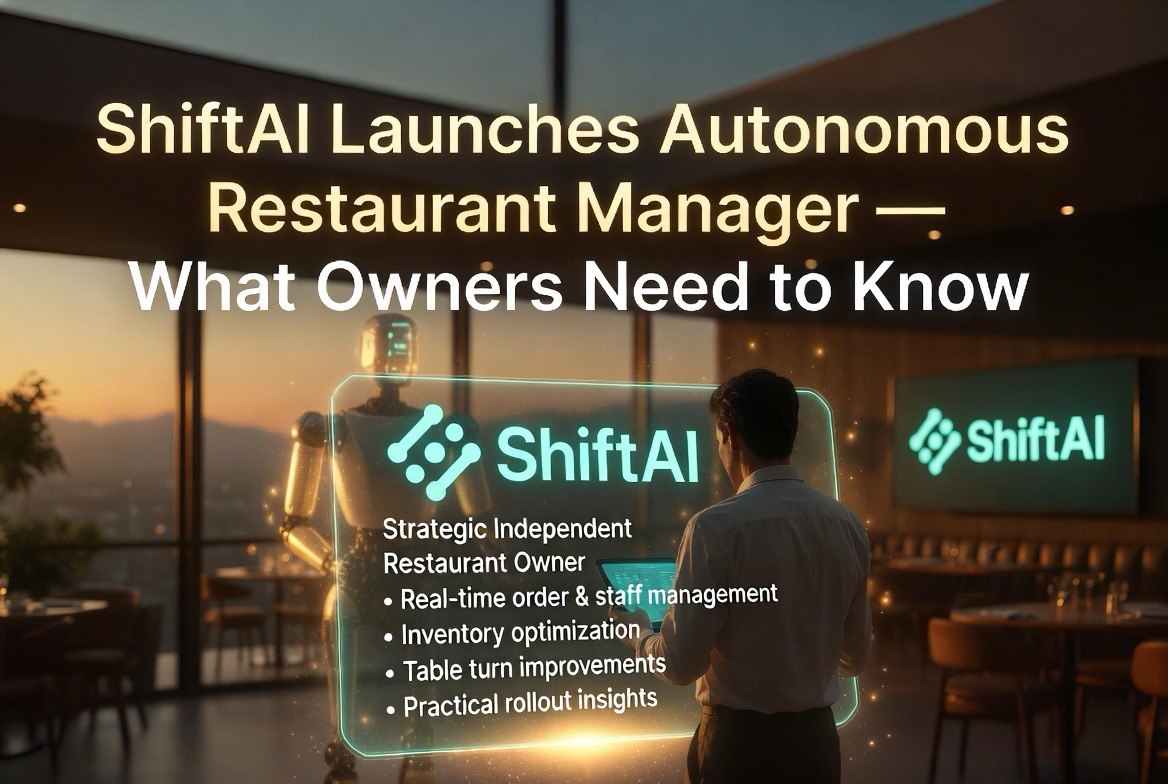
ShiftAI Launches Autonomous Restaurant Manager — What Independent Owners Need to Know
⚡ Expert Summary: Part of our restaurant AI category. ShiftAI has launched what it calls an “autonomous restaurant manager” — an AI platform that handles staff scheduling, review responses, menu optimization, and inventory management with minimal human input. For independent operators running on razor-thin margins, this could change the math on whether automation makes financial sense. Here’s what ShiftAI actually does and whether it’s ready for a real Friday night service.
The Restaurant Tech Landscape ShiftAI Is Entering
Restaurant technology spending is projected to reach $45 billion globally in 2026 according to industry analysts, with the fastest-growing segment being AI-powered operational management tools. Independent restaurants have historically been the hardest market for tech providers to crack — they have thinner margins, smaller staffs, and less tolerance for complex onboarding than the large chains that dominate industry headlines. For independent restaurant owners in the United States evaluating autonomous kitchen technology, the price point and reliability metrics are what determine whether these systems make financial sense.
The Deloitte 2026 Restaurant Technology Outlook found that 82% of restaurant executives plan to increase their technology investments, but the gap between intention and implementation remains wide. Only 9% of limited-service brands reported “meaningful impact” from their current AI tools. That gap represents the opportunity ShiftAI is targeting: making AI operational management work for the independent operators who need it most but have been least well served by restaurant technology.
What makes this shift possible is the maturation of several underlying technologies: natural language processing good enough to handle customer reviews and responded conversationally, predictive analytics accurate enough to forecast covers within useful margins, and integration APIs reliable enough to connect with the POS systems independent restaurants already use.
What Is ShiftAI’s Autonomous Restaurant Manager?
ShiftAI is an emerging restaurant AI platform that’s positioning itself as the closest thing to a fully autonomous manager for independent restaurants. The platform handles four core functions that traditionally consume the most operator time: staff scheduling, online reputation management, menu optimization, and inventory forecasting.
The pitch is straightforward: most restaurant management software requires you to learn a system and feed it data. ShiftAI claims its platform actively manages these functions autonomously — meaning it monitors your operations, identifies problems, and suggests or implements solutions without the owner having to check a dashboard every morning.
According to ShiftAI’s product description, the system can have working solutions in place within four weeks of implementation. The platform targets “working systems” rather than experimental beta features — a distinction that matters for skeptical restaurant owners who have been burned by half-finished restaurant tech before.
This launch comes at a time when over 25% of restaurant operators are already using some form of AI tool, according to the National Restaurant Association’s 2026 technology report. Most of that adoption is in marketing and administrative functions. ShiftAI is trying to push that further into core operational management — the kind of work that directly affects your service quality and your bottom line.
The Four Functions That Matter Most
Autonomous Staff Scheduling
Staff scheduling is the operational headache that costs independent restaurants more than most owners realize. A 2025 study by the restaurant workforce management platform 7shifts found that operators spend an average of 4 to 6 hours per week on scheduling alone — time that doesn’t generate a single dollar of revenue. For a multi-location group, that number multiplies quickly.
ShiftAI’s scheduling module uses historical sales data, weather patterns, local events, and staffing availability to generate optimized schedules automatically. The key difference from existing scheduling tools is the “autonomous” layer: instead of presenting a schedule for the manager to approve and adjust, ShiftAI publishes it and only flags exceptions — like when a key employee’s availability changes or when projected covers require more bodies on the line.
For American restaurants that have been struggling with labor since 2021 — where the National Restaurant Association reported the industry workforce is still about 300,000 jobs below pre-pandemic levels — smarter scheduling isn’t a luxury. It’s the difference between having a full line on Saturday and trying to run a three-person kitchen for a 200-cover service.
Automated Review Management and Reputation Monitoring
Online reviews are the most visible reputation signal for independent restaurants. A single bad review week can cost a restaurant significant walk-in traffic. Yet most operators either ignore their review profiles entirely or handle them reactively — scrambling to respond after a critical review shows up.
ShiftAI’s review module monitors Google, Yelp, and TripAdvisor reviews and generates contextual responses automatically. The system categorizes reviews by sentiment, identifies recurring themes (complaints about wait times, specific dish quality, service issues), and alerts the operator only when human intervention is needed — like a health complaint or a pattern developing across multiple reviews.
According to a 2025 BrightLocal survey, 76% of diners say they regularly read restaurant reviews before visiting a new establishment, and 45% say they would not visit a restaurant that doesn’t respond to reviews at all. An autonomous system that ensures every review gets a thoughtful response within 24 hours is not a nice-to-have — it’s a direct revenue protection tool.
Menu Optimization and Dynamic Pricing
Menu engineering is one of the highest-ROI activities an operator can do, but most independent owners have neither the time nor the data skills to analyze which items drive profit and which ones are plate cost drags.
ShiftAI’s menu module analyzes sales velocity, ingredient cost fluctuations, and seasonal demand patterns to recommend pricing adjustments and menu redesigns. The platform can identify low-margin items that are actually costing you money when you account for prep labor and waste, and suggest swaps or price corrections.
The dynamic pricing piece is the most controversial — and potentially the most valuable. In theory, the system adjusts prices based on demand, similar to how airlines and hotels have been pricing for decades. In practice, American diners have shown resistance to surge pricing at restaurants. The success of this feature will depend on how transparent the changes are and whether they’re framed as daily specials rather than “you’re paying more because it’s busy.”
Inventory Management and Waste Reduction
Food waste is a silent margin killer. The USDA estimates that restaurants waste between 4% and 10% of the food they purchase. For a restaurant doing $1 million in annual revenue with a typical 30% food cost, that represents $12,000 to $30,000 in wasted inventory every year.
ShiftAI’s inventory module tracks usage patterns, predicts ordering needs based on projected covers and current stock levels, and generates purchase orders automatically. The system learns from waste patterns and adjusts ordering recommendations accordingly — reducing the amount of over-ordering that happens when managers order by feel rather than by data.
The Human Element: What Autonomous Management Can’t Handle
The most honest assessment of any restaurant AI tool comes from asking what it can’t do. ShiftAI can schedule staff based on data, but it can’t coach a server who’s having a bad shift. It can optimize menu prices, but it can’t taste the new special and tell you the seasoning is off. It can monitor review sentiment, but it can’t walk the floor and read the room when a table is unhappy.
The autonomous label is useful as a marketing and product strategy position, but restaurant owners should be clear-eyed about what it means in practice. An autonomous restaurant manager is not a replacement for a human manager. It’s a force multiplier for one. The best case for ShiftAI is that it handles the 60% of a GM’s job that is administrative, analytical, and repetitive — freeing that GM to focus on the 40% that actually requires human judgment.
For smaller operations where the owner is the GM, the value proposition is even clearer. If ShiftAI can save an owner 4 to 6 hours per week on scheduling and another 2 to 3 hours on review management and menu analysis, that’s a full day of time reclaimed every week. For an owner who’s been working six-day weeks since they opened, that’s not a minor efficiency gain. It’s a quality-of-life improvement with direct financial implications — less burnout means better decisions means more profitable operations.
Is ShiftAI Ready for Live Service?
This is the question that matters most. Restaurant technology has a brutal track record of working beautifully in demos and falling apart during an actual service.
ShiftAI’s website positions the platform as having “working systems in 4 weeks” — a relatively conservative timeline that suggests the company understands the integration challenges. Four weeks is enough time to gather data, calibrate the models to your specific operation, and test the autonomous features before they go fully live.
What’s not clear from the available information is how well the system handles the edge cases that define restaurant operations: the walk-in party of 15 that wasn’t on the forecast, the fryer breakdown at 6 PM on a Friday, the health inspector showing up unannounced, the supplier who delivered the wrong produce order. An autonomous system that works perfectly for the scheduled 80% of operations but fails on the unpredictable 20% is not ready for prime time.
The comparison worth making is to other emerging autonomous restaurant platforms. Mise, another AI restaurant platform, focuses on voice-first agentic AI for front-of-house operations. TableOps targets back-office automation — accounting, payroll, vendor management. ShiftAI is unique in focusing on the general manager function as a whole rather than individual operational silos.
How This Compares to What Independent Owners Already Use
Most independent restaurants today run some combination of Toast for POS and payment processing, 7shifts or HotSchedules for staff scheduling, and a mix of manual processes for everything else. What they don’t have is a system that connects these functions and manages them proactively.
The real value ShiftAI offers isn’t any single feature — it’s the integration. The scheduling module using data from the inventory module to predict labor needs. The menu module using review sentiment data to identify dishes that are hurting your reputation. The inventory module using sales forecasts from the menu module to order more precisely.
That integration is what separates an autonomous manager from a collection of point solutions. But it’s also the hardest part to get right, because it requires the platform to work reliably across all four functions simultaneously. If the scheduling module works great but the inventory module miscalculates your produce order, the whole system fails — not just one part.
Should You Consider ShiftAI?
If you run an independent restaurant that’s doing between $500,000 and $3 million in annual revenue and you’re spending more than a few hours a week on the administrative work that ShiftAI targets, the platform is worth a demo. The four-week implementation timeline is reasonable, and the potential ROI on scheduling efficiency alone — recapturing 4 to 6 hours of owner time per week — justifies the evaluation.
If your operation is smaller than that — a single food truck, a counter-service concept with 5 employees — the value proposition is thinner. The kind of autonomous management ShiftAI offers matters most when you have enough complexity that a general manager can’t keep everything in their head.
If you’re larger — a group with multiple locations — you’ll want to ask hard questions about how ShiftAI handles multi-unit management before committing. Most restaurant tech platforms claim multi-location support but deliver it poorly.
The bottom line: ShiftAI represents a real step toward autonomous restaurant management, but it’s early. Smart operators will trial it on one location with a reasonable time horizon — say, three months — and measure the actual time savings and revenue impact before expanding. The technology is promising. The execution will determine whether it delivers.
Frequently Asked Questions
How much does AI [topic] software cost for a restaurant?
Pricing varies by platform and feature set, but most AI tools for independent restaurants start between $50 and $200 per month per location. Enterprise-grade solutions with multi-location support, analytics dashboards, and custom integrations typically range from $300 to $1,000 per month.
Do I need technical skills to implement AI in my restaurant?
No. Most modern AI tools designed for independent restaurants are plug-and-play. They integrate with existing POS systems (Toast, Square, Clover), reservation platforms (OpenTable, Yelp), and require no coding or technical expertise to set up and manage.
How quickly does AI software show results for restaurants?
Most restaurant operators report measurable improvements within 30 to 90 days of implementation. Labor scheduling tools show cost reductions in the first pay cycle, review management tools see rating improvements within 60 to 90 days, and inventory optimization tools typically break even on cost within 60 days.
Can AI tools replace my restaurant staff?
No. AI tools are designed to augment your existing team, not replace them. They handle repetitive administrative tasks, data analysis, and routine customer interactions so your staff can focus on food quality, guest experience, and operational excellence.
What is the ROI of AI tools for independent restaurants?
ROI varies by tool type. Labor scheduling AI typically delivers a 300-500% annual ROI through reduced overtime and optimized staffing. Inventory management AI cuts food waste by 15-40%. Review management AI improves customer ratings by 0.5-1.3 stars, directly correlating to 5-9% revenue increases.

About Barak Schurr
Barak Schurr built and exited a major ticketing platform, ran global operations at Eventbrite, and now focuses on one question: which AI tools actually help independent restaurant owners run leaner and grow faster. He writes from the operator’s perspective — no vendor spin, no theory, just what’s real in 2026.
Email: [email protected]
More on AI Restaurant Labor Management
This post is part of our comprehensive AI Restaurant Scheduling & Labor Management Guide. Check the full guide for AI scheduling tools, no-show prediction, automated hiring, and automation strategies for independent restaurants.
More AI Resources