The Industry Is About to Ban AI Agents That Are Undetectable
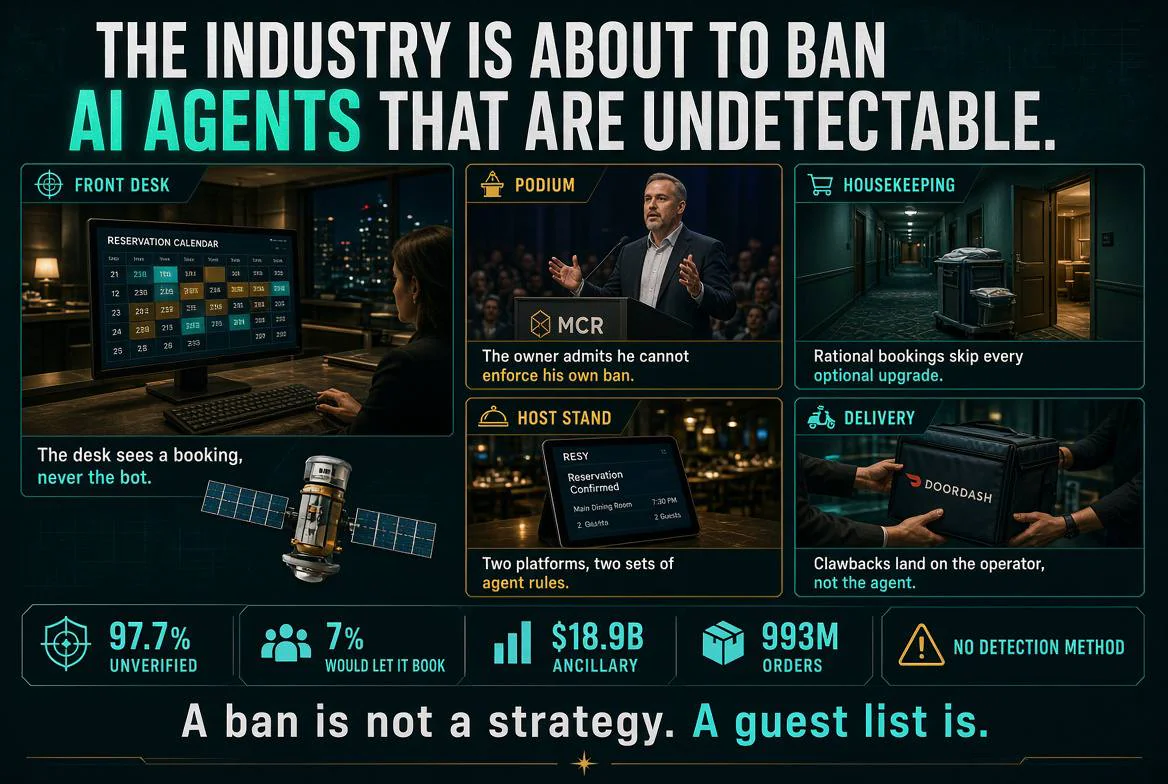
⚡ Expert Summary: On November 11, 2026, the chief executive of the third-largest hotel owner in the United States stood up at a conference and said he wants to ban AI agents from booking his rooms — then admitted he has no idea how. Tyler Morse of MCR Hotels: “Everyone is going to ban the agents. I can’t figure out how to do it.” The reason he can’t is that the agent is designed to look like a customer, and the numbers say almost none of them carry a verifiable identity. For an independent restaurant or hotel operator, the ban is not the story. The story is that the layer deciding who gets your table is being built right now, by platforms you do not sit on.
The panel was the Skift Commerce Summit in New York, on November 11. Tyler Morse runs MCR Hotels — 150 properties, more than 25,000 rooms across 37 states, roughly $4 billion in assets under management, the third-largest hotel owner in the country by room count. He also owns the software his hotels run on: a property management system called Stayntouch and an operations platform called Optii. He is not a technophobe complaining about the internet. He is an operator with full visibility into his own distribution stack, saying he cannot see the thing he wants to stop.
His quote, as recorded by Hospitality Net’s Terence Ronson: “Everyone is going to ban the agents.” Followed immediately by: “I can’t figure out how to do it.”
Read those two sentences in order and you have the entire problem in front of independent hospitality. Every operator who understands the threat will try to write the same clause. Almost none of them will be able to enforce it. And the party that solves detection is not going to be a restaurant with eleven tables or a 60-room boutique hotel. It is going to be whoever owns the interface the agent talks to.
Why Morse Actually Wants the Ban
He said the quiet part on the record, and he said it in the language of revenue rather than security. According to Ronson’s account, Morse argued that agents “make more rational decisions” — and that this is exactly the problem, because rational decisions are bad for upsell.
That is the whole argument, stripped of politeness. A human booking a room at 11pm on a phone, tired, is a person who will accept the $29 breakfast bundle, the upgraded view, the late checkout. An agent comparing the same room against eleven other properties will take the cheapest compliant option and decline everything that is not required. It does not get upsold. It does not impulse-buy. It is the customer every revenue manager dreams of and every ancillary-revenue model is built to avoid.
The size of what is at stake is not speculative. US hotel ancillary revenue grew from $13.3 billion in 2019 to $18.9 billion in 2022 — a 10.2% compound annual growth rate, well ahead of room revenue growth over the same span. Parking alone runs at 80%-plus margins. True ancillary fees sit at 10-15% of revenue with a stated path to 20-30%. That is the number an agent quietly deletes, one declined upgrade at a time.
| Revenue line | The number | What an agent does to it |
|---|---|---|
| US hotel ancillary revenue, 2022 | $18.9 billion, up from $13.3 billion in 2019 (10.2% CAGR) | Declines every optional add-on by default |
| Parking margin | 80%+ | Compares against off-site lots and books the cheapest |
| Ancillary share of total revenue | 10-15% today, targeted at 20-30% | The growth plan is the exact line item the agent removes |
| Note volumes, meanwhile | DoorDash: “several hundred” agent orders against 993 million in Q3 2026 | The ban is being written before the traffic arrives |
And here is the number that should stop the panic and redirect it. On DoorDash’s Q3 2026 call, orders originating from outside agents — Meta’s Muse, Instinct, Fo — totalled “several hundred” for the quarter, against 993 million total orders. Uber reported four rides during Halloween week and roughly 500 Uber Eats orders against about 320 million trips and orders in the same period.
So the ban is not a response to volume. It is a positioning move made before volume, by an industry that has watched what happened to every other sector that let an interface grow between it and its customer without owning the interface.
The Seven Percent Problem
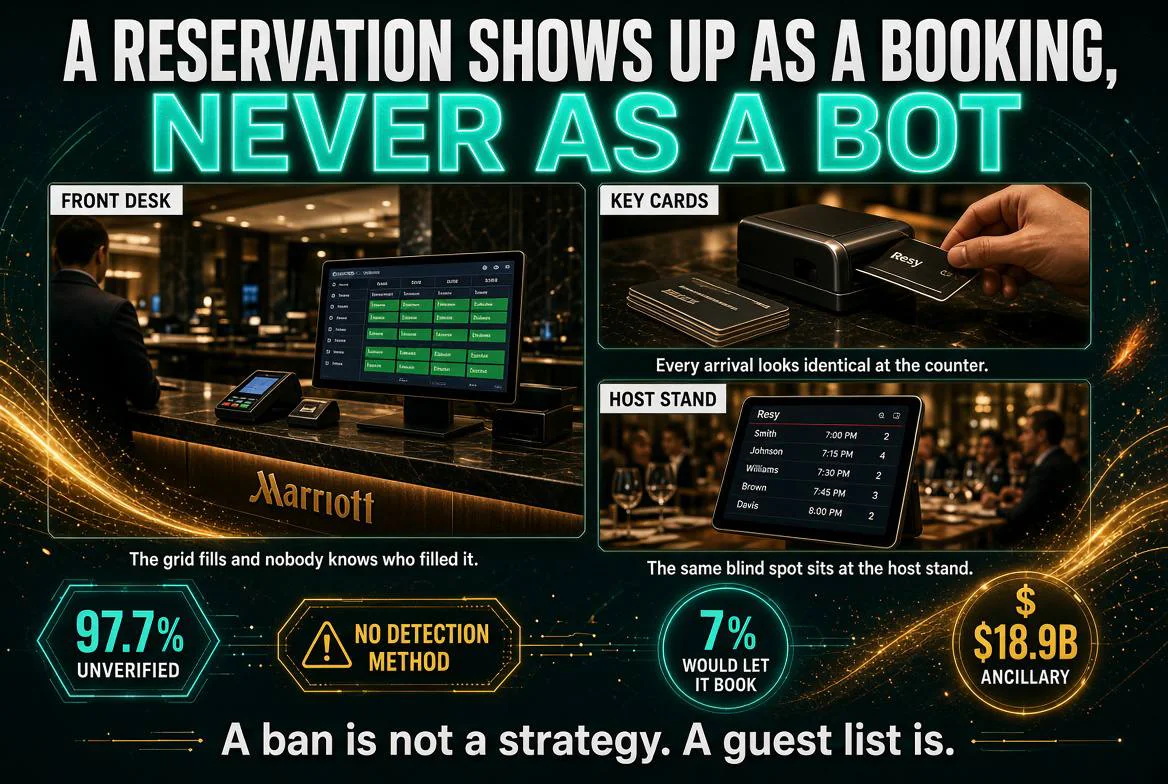
Ronson pulled a number out of Agoda’s 2027 Asia Travel Pulse that reframes the whole debate. Fifty-three percent of travellers plan trips with AI. Only 7% would let it book for them. Only 6% fully trust it to do so.
Ronson’s reading of that gap is the sharpest line in the coverage: “Treat the 7% as a deadline.”
The gap between 53% planning and 7% booking is the entire battleground. It is not stable. It will close, and it will close in the direction of whatever makes booking frictionless. If the hotel industry spends the next two years trying to write contractual bans that nobody can enforce, it will have spent the two years it had to build the alternative — a guest-list model, an authorised-agent model, a distribution channel it actually controls — arguing with a contract instead.
The Detection Problem Is Not a Hotel Problem
The reason Morse cannot enforce his own ban was spelled out in the same week, in a different industry, by a different operator. Gary Leff, writing on View from the Wing on November 11: “A contractual ban isn’t a technical one.” If an AI agent completes a purchase through Expedia, the airline sees an Expedia booking. It does not see how the booking was made, who directed it, or what software drove it.
The same blind spot exists in hospitality, and it is worse, because hospitality distribution already runs through more intermediaries per transaction. A restaurant reservation routed through an OTA, a hotel booking routed through a GDS, a delivery order routed through a platform — in every case, the operator sees the intermediary, never the method.
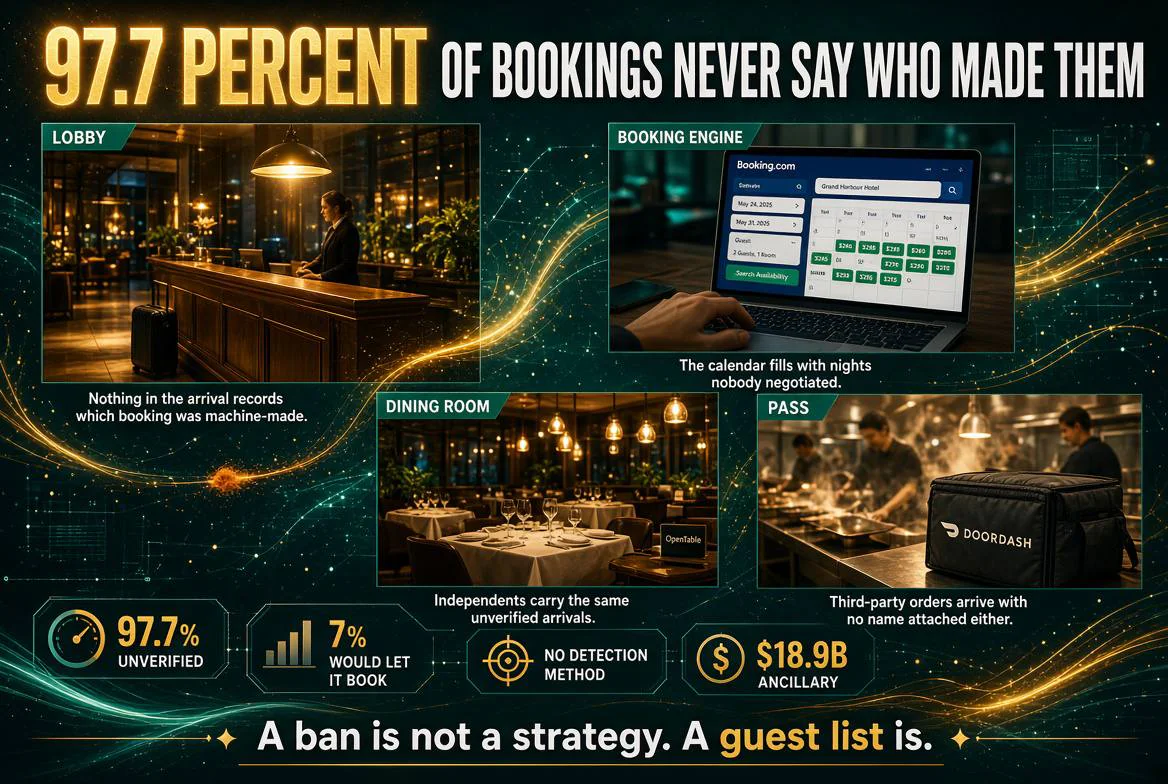
The telemetry backs this up. Bot-defence firm Arkose Labs reported on October 20, 2026 that 97.7% of legitimate agent sessions it observed carried no verified identity. That is a vendor’s number about its own market, so treat it as directional rather than audited. But the direction is uncontested: agents are built to be indistinguishable from browsers, because indistinguishability is precisely what makes them work.
| Who said it | What they conceded | What it means for your books |
|---|---|---|
| Tyler Morse, MCR Hotels | “Everyone is going to ban the agents. I can’t figure out how to do it.” | The owner of the software cannot detect the agent |
| Gary Leff, View from the Wing | “A contractual ban isn’t a technical one.” | You see the OTA, not the agent behind it |
| Arkose Labs, October 2026 | 97.7% of legitimate agent sessions carried no verified identity | Identity is the missing infrastructure, not the missing policy |
| Terence Ronson, Hospitality Net | “A ban is not a strategy. A guest list is.” | Control the list, not the language |
What the market is actually building is identity. Visa’s Trusted Agent Protocol gives agents a cryptographic identity and a declared spending intent — the agent presents credentials and a mandate, and the merchant can see both. That is what detection looks like when it is solved properly. It is also infrastructure the operator does not own, cannot audit, and will be charged for. Which is the same position hospitality has been in with every distribution technology since the first GDS terminal.
The Platforms Are Already Letting Them In
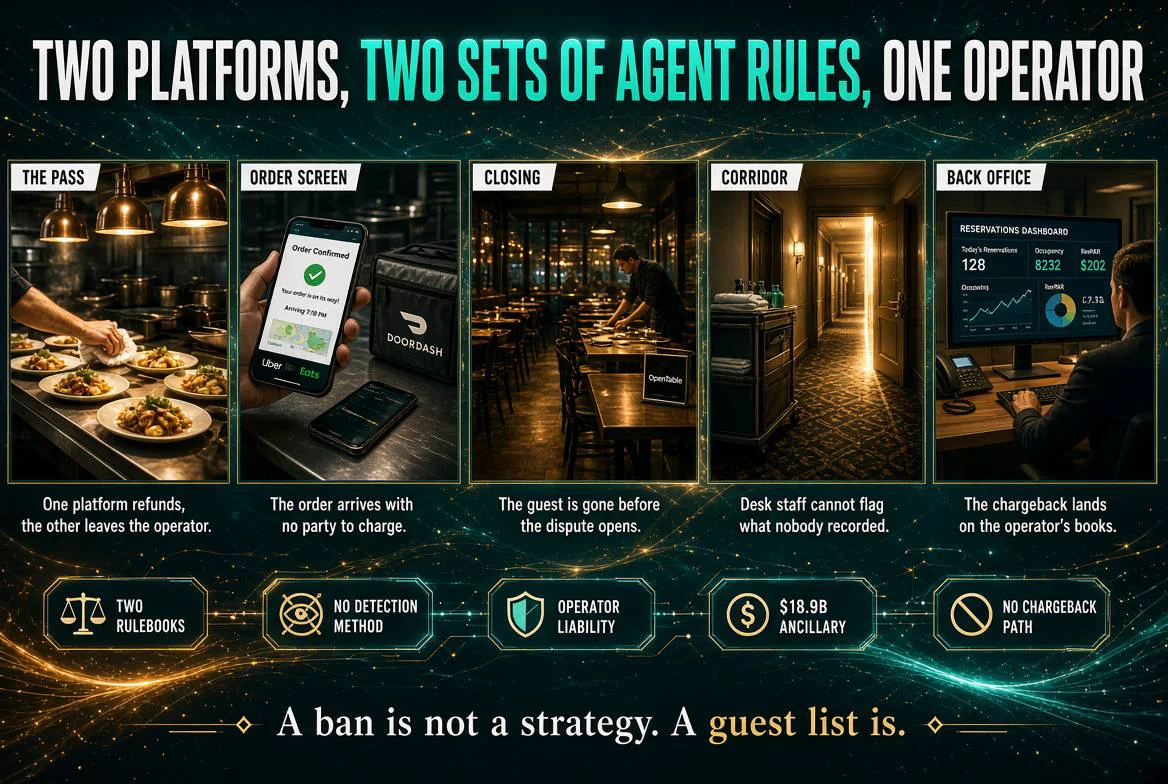
While the ban debate runs, the reservations layer is quietly opening. Resy runs a zero-tolerance bot policy and disables accounts along with all associated reservations, yet Resy inventory is already bookable inside Claude since April and inside ChatGPT since this summer. OpenTable’s terms prohibit “automated assistants” unless authorised.
Both positions are simultaneously true and they expose the real structure: the platform decides. As Ronson put it, “Which ones get in is currently the platform’s call.” A restaurant with a Resy account and an OpenTable account has agreed to two different sets of agent rules it did not negotiate, on two platforms it cannot audit, for the same table inventory.
The hotel side moved faster. On November 10, 2026, OpenAI acquired Odessia — an IATA-accredited AI travel agency founded by Francis Davidson, formerly of Sonder. Odessia claims $60 million a year in “planned” travel, notably not booked travel, and roughly 2,000 hotels with perks. Read the word “planned” carefully. A platform has just bought the planning layer, and the booking layer is next, and the perks programme is how it gets the hotel inventory it needs to do it.
The distribution economics of that acquisition are already visible elsewhere. In Singapore and Japan, Agoda is bookable through Meta’s Muse. Ronson’s warning about what that does to the operator is the one every independent should pin to the wall: if the platform takes a cut on top of the OTA’s, the operator pays twice for the same transaction — once for the reservation it already paid for, and again for the privilege of being found.
The Chargeback Gap Nobody Has Closed
There is a second exposure that has nothing to do with who books and everything to do with what happens when the booking goes wrong, and it is specific to delivery. DoorDash and Uber Eats both allow refund clawbacks of 25% to 100% of the item price plus tax, with dispute windows of 14 days at DoorDash and 30 days at Uber. Both prohibit automated or third-party dispute filing by merchants.
Read that combination again. An agent places an order. The customer disputes it — accurately or not. The platform claws back the item price plus tax. And the operator is contractually barred from filing an automated defence, which means the only defence available is a human, in a back office, inside a 14-day window, per order.
Citi has already said publicly, per Skift on November 11, that AI companies should bear the cost of wrong bookings. That is a bank arguing about who pays. Nobody has yet written the rule that decides it, and until that rule exists, the operator eats the difference by default.
What an Independent Operator Can Actually Do
The honest answer is that you cannot ban detection you cannot perform, so stop treating the contract as the control. Four things are within reach.
Know which channel is which. The agent arrives disguised as an OTA, a GDS or a delivery platform. Audit your reservation log for the channels you do not recognise, because that is where agent traffic surfaces first — not as “AI,” but as an unfamiliar intermediary.
Treat the 7% as a clock, not a fact. The gap between planning and booking is the time you have to decide what an authorised booking looks like at your property. Decide the perks, the rate fence and the terms while you still have leverage, before the platform sets them for you.
Get on a guest list before someone builds one for you. If a platform is going to compile the list of who may book your inventory, the alternative is a list you own — a direct channel, a loyalty identifier, an authorised-partner arrangement with terms you wrote.
Price for the rational customer. An agent will not take the $29 breakfast bundle. If ancillary revenue is 10-15% of your P&L and the agent strips the optional half of it, the rate has to carry the margin instead. That repricing is happening whether or not anyone announces it.
What the Record Does Not Say
The reporting has real gaps and they matter for how much weight to put on any of this. No hotel has documented banning an agent, and no enforcement action exists. No other chain has announced equivalent terms; Morse is speaking for MCR, not for the industry, despite saying “everyone.” MCR has not disclosed its distribution mix, so the size of its own exposure is unknown. Nobody from OpenAI, Meta, Google or Agoda has responded on the record to the ban framing. And no regulator — not the FTC, not any state authority — has said whether a hotel may refuse an agent-assisted booking that arrived through a legitimate intermediary.
What is not in doubt is the direction. Every operator with the technical literacy to see the problem has concluded the same thing in public: the ban is desirable, the enforcement is impossible, and the layer that solves it will be owned by someone who is not them. The only open question is whether they build a list before someone builds it for them.
Morse wants the ban. Ronson has the better line. A ban is not a strategy. A guest list is. The window between those two sentences is the window an independent operator still controls — and it is closing at roughly the speed the agents are getting better at looking like customers.
Frequently Asked Questions
What did Tyler Morse actually say about banning AI agents?
Speaking at the Skift Commerce Summit on November 11, 2026, the MCR Hotels chief executive said agents “make more rational decisions,” which he framed as bad for upsell, then stated: “Everyone is going to ban the agents. I can’t figure out how to do it.” The admission of unenforceability came in the same breath as the call for the ban.
Why can’t hotels and restaurants detect AI agents?
Because the agent arrives disguised as a legitimate intermediary. If an agent books through an OTA or a GDS, the operator sees the intermediary, not the method. Arkose Labs reported in October 2026 that 97.7% of legitimate agent sessions it observed carried no verified identity, which means many agents are technically indistinguishable from an ordinary browser session.
How much revenue is actually at risk from agent bookings?
The exposure is ancillary, not room. US hotel ancillary revenue reached $18.9 billion in 2022, up from $13.3 billion in 2019, and ancillary fees run 10-15% of total revenue with a stated path to 20-30%. An agent that declines every optional add-on removes the highest-margin line in the booking, which is precisely why Morse opposes it while booking volumes remain negligible.
Are agent bookings actually a meaningful volume yet?
No. DoorDash reported “several hundred” agent-originated orders in Q3 2026 against 993 million total orders. Uber reported four rides during Halloween week and roughly 500 Uber Eats orders against about 320 million trips and orders. The ban is being written well ahead of the traffic.
What does “a ban is not a strategy, a guest list is” mean?
It is Terence Ronson’s line in Hospitality Net. His argument is that refusing agents by contract does nothing, because the agent routes around the front door and the operator cannot tell. What works instead is controlling who is authorised to book your inventory — a list you own, on terms you set, rather than one compiled by a platform on terms you did not negotiate.
What can an independent restaurant or hotel do right now?
Audit reservation channels for unfamiliar intermediaries, decide what an authorised booking looks like at your property while you still have leverage, build a direct channel and loyalty identifier you control, and reprice so the rate carries the margin that optional upsells used to. The contract will not protect you; the list and the rate can.

About Barak Schurr
Barak Schurr built and sold a major ticketing platform, ran global nightlife operations at Eventbrite, and now spends his time working out which AI tools actually help independent restaurants and hospitality operators — and which ones just cost them money. No hype. No fluff. Just what works.
Email: [email protected]
More AI Resources for Your Business