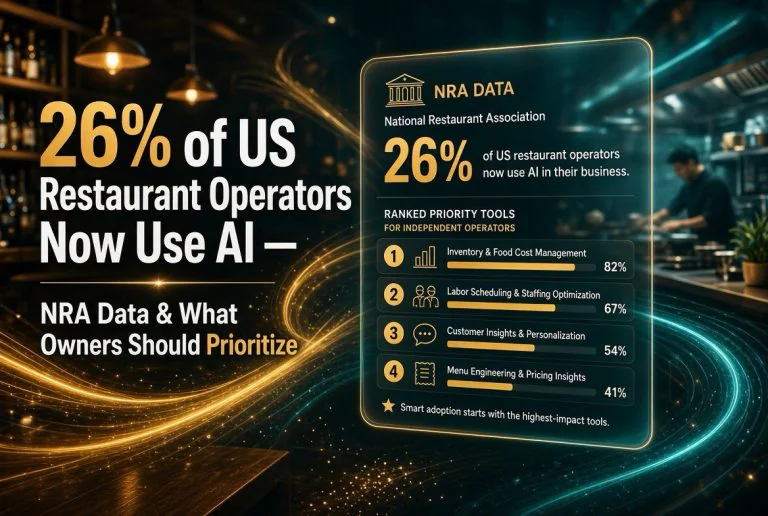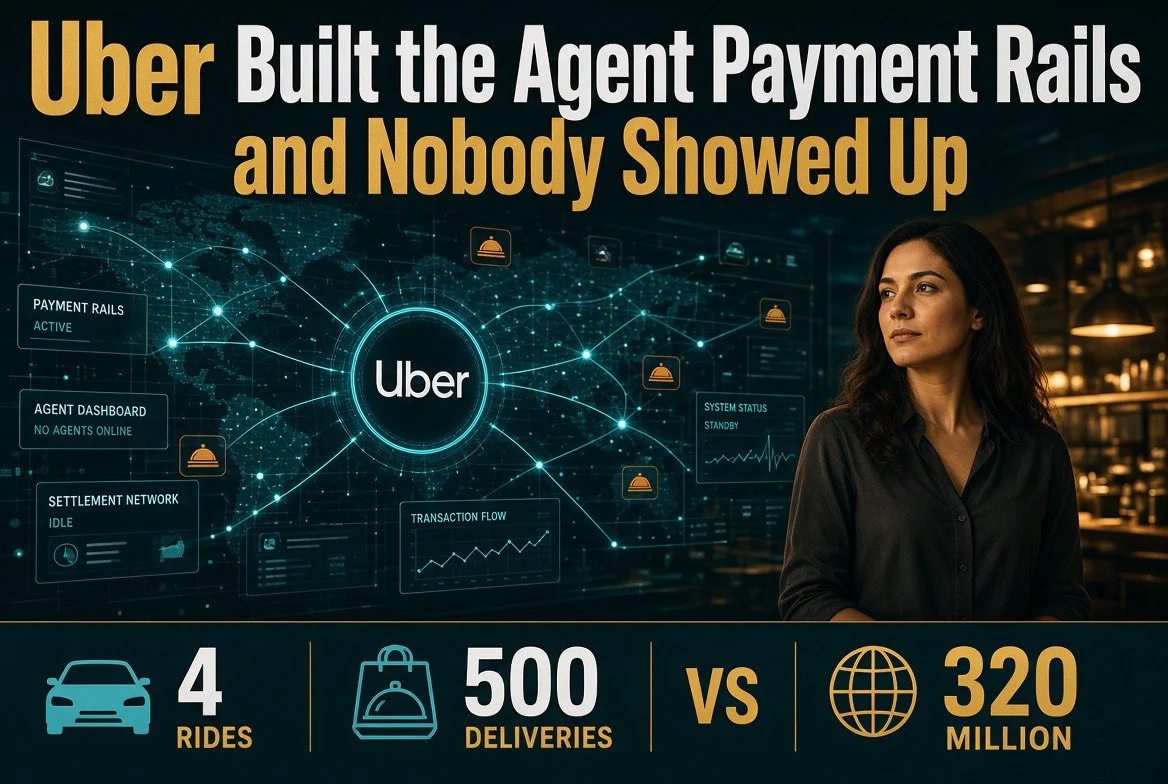
Uber Built the Agent Payment Rails and Nobody Showed Up
⚡ Expert Summary: Uber told investors on November 4 that third-party AI agents fulfilled four rides and roughly 500 food deliveries in a single week — against about 320 million trips across its platforms. That is 0.00016% of one week’s volume, and the rides figure works out to about one in 80 million. Uber has spent years building the payment rails, the merchant integrations and the fulfillment network that shopping agents are supposed to run on. The rails are live. The traffic is not. For independent restaurant operators, this is the most useful number published all year: the agent apocalypse that vendors are selling you is not arriving on a schedule you need to panic about, and the automated ordering systems already in your drive-thru still lean on a human roughly seven times out of ten.
Dara Khosrowshahi spent a good part of the Q3 call sounding less like a man describing a revolution and more like a man describing a pilot program that has not yet found its users. The numbers back him up. Four rides. Five hundred deliveries. One week. Three hundred and twenty million trips.
Run that division yourself. It does not need spin applied. The agent economy, as measured by the one company that built the most complete infrastructure for it, is a rounding error on a rounding error.
This matters to you for a reason that has nothing to do with Uber’s stock price. You have been sold a story for two years: that AI agents will soon be ordering your food, booking your tables, negotiating your supply contracts, and managing your staff, and that if you do not adopt immediately you will be left behind by operators who did. The Uber data is the first honest measurement of how fast that is actually happening at the consumer layer. And the answer is slow enough that you can think clearly about it.
Uber told investors that third-party AI agents fulfilled four rides and roughly 500 Eats orders in one high-volume week, against about 320 million total platform trips. The delivery rail exists and the ordering habit does not, while the drive-thru voice systems already running at scale still hand roughly seven orders in ten to a person wearing a headset.
What Uber Actually Said, In Numbers
The disclosure came during prepared remarks and Q&A on the November 4 earnings call, with CFO Balaji Krishnamurthy framing the agent volumes against a single high-volume week rather than aggregating them across the quarter — a detail that makes the comparison starker, not softer, because the week in question included Halloween, one of the busiest order nights of the year for delivery platforms.
Translation: they picked the best possible week to measure this in, and the number was still four rides.
| Metric | Volume | Share of Total |
|---|---|---|
| Rides via third-party AI agent | 4 | 0.00000125% (≈1 in 80 million) |
| Uber Eats orders via AI agent | ~500 | ~0.00016% |
| Total platform trips, same week | ~320,000,000 | 100% |
| Agent share of all Uber volume | ~504 transactions | ~0.00016% |
Read the last row again. If every agent transaction on Uber that week — rides and deliveries combined — were one restaurant’s order, it would be a slow Tuesday at a single mid-volume location. Uber operates at a scale where that is invisible. You operate at a scale where 504 orders is a good day. Both statements are true, and only one of them gets written about.
The Rails Were Never the Hard Part
Here is what makes the number more interesting than it looks. Uber did not fail to build this. Uber built it thoroughly.
The company has merchant integrations across a delivery network that touches most of the independent restaurants in the US. It has payments infrastructure, pricing systems, identity verification, driver supply, dispute resolution, and a fleet that can physically complete a fulfillment promise. If a shopping agent needed somewhere to plug in, Uber is one of the few places with a legitimate socket. The company has said it will work with third-party agents while prioritizing its own direct-to-consumer relationships and avoiding dependence on any single player — the language of a company that is hedging, not one that is racing.
So the bottleneck is not technical. It is behavioral. Consumers are not yet handing their purchase decisions to an agent at any meaningful rate, and the ones who do are not finding that the experience beats tapping a button in an app they already have open.
Uber built the socket, wired the power, and left the lights on. Nobody plugged in.
For a restaurant owner, that distinction changes what you should spend money on this quarter. Infrastructure for an agent-driven future is a 2028 problem. The automation already running in your operation today is a this-week problem, and it has a measurable human cost attached to it.
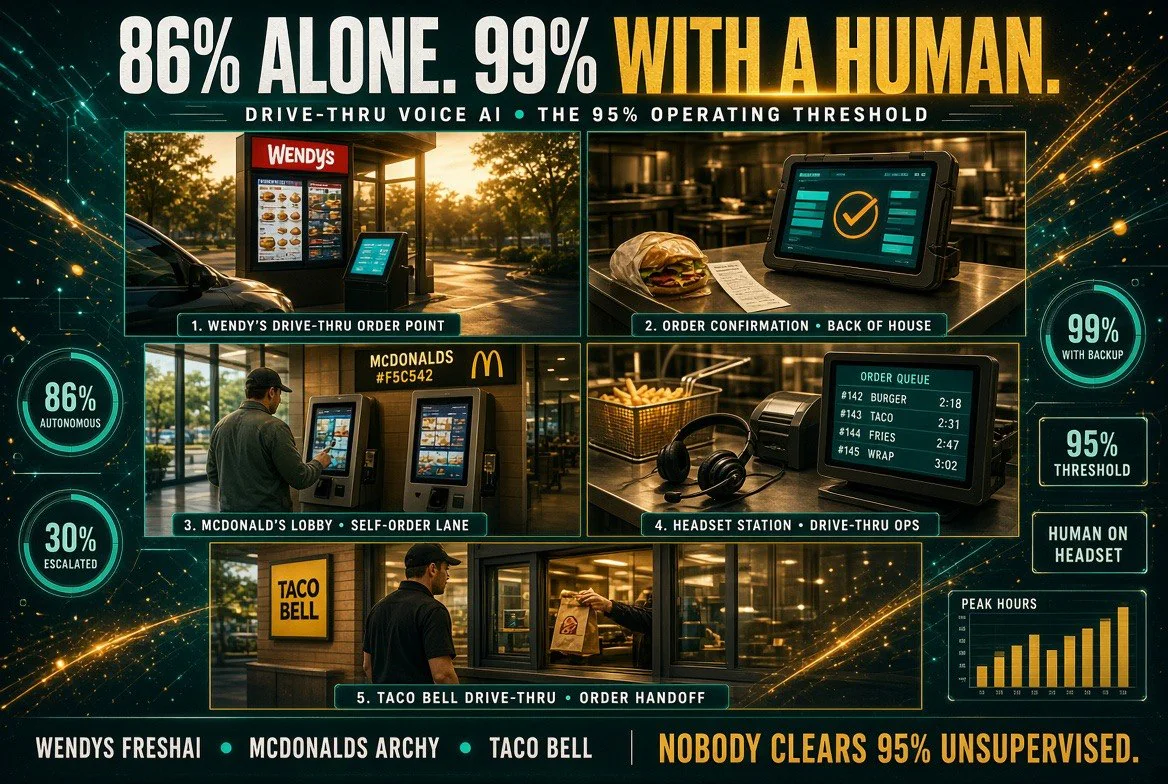
The accuracy figures that actually matter sit inside the drive-thru, not the investor deck: Wendy’s reports 86% of orders handled autonomously and about 99% once a person is standing by, while deployments still escalate roughly three orders in ten to a human on the headset. The 95% line is where automation starts beating staffing cost, and no shipped system clears it unsupervised.
The Honestly Boring Reality Inside Your Drive-Thru
While the agent layer waits for demand that has not arrived, voice AI ordering has been quietly deployed at genuine scale across US quick-service — and the operating data from those deployments is far more useful to an independent operator than any agent projection.
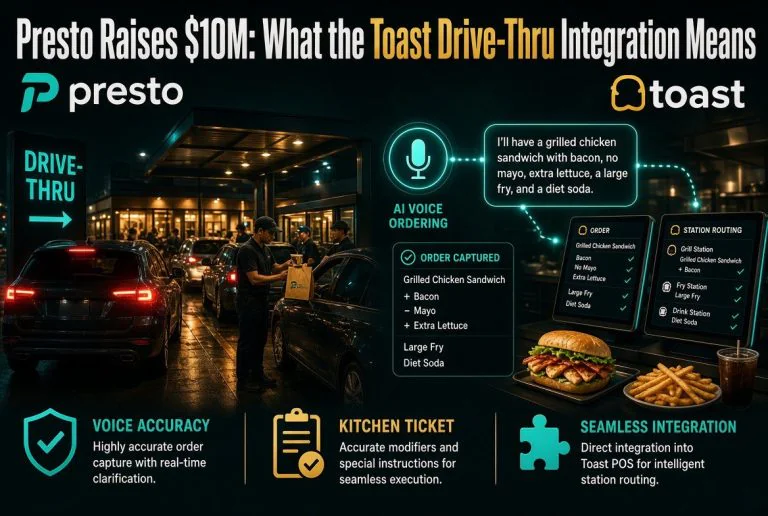
Presto, one of the larger drive-thru voice vendors, reports a human intervention rate of around 70% on its systems. That is not a bug report. It is the designed architecture: the voice AI takes the order at the speaker, handles the routine majority of interactions, and hands off to a human in the store when the order gets complicated, the audio gets muddy, or the customer gets frustrated. Nearly three orders in ten need somebody on the headset.
That number should reframe how you read every vendor pitch you receive this year. When a company tells you its voice AI handles your drive-thru, the honest translation is that it handles most of your drive-thru and escalates the rest — and the rest is exactly where the labor cost lives, because escalations cluster at peak.
The Accuracy Table Nobody Puts in the Sales Deck
Order accuracy is the only voice AI metric that matters to your P&L, because a wrong order is a remake, a refund, a longer line, and a customer who remembers. The published figures across the major deployments look impressive until you read what they are actually measuring.
| System | Reported Accuracy | What It Really Measures | Operator Reality |
|---|---|---|---|
| McDonald’s / IBM pilot | Low-to-mid 80% | Order completion without escalation | Ended the partnership; too many handoffs at volume |
| Wendy’s FreshAI | 86% autonomous / ~99% with human backup | Two different numbers measuring two different things | The 99% requires a person standing by |
| McDonald’s Archy | ~90% | Vendor-reported, pilot conditions | Improvement over the IBM era, still short of threshold |
| Drive-thru operating threshold | 95% | Where automation stops costing you more than staff | Nobody in the market clears it unsupervised |
The Wendy’s line is the one to study, because it contains the whole industry in a single slash. Eighty-six percent autonomous. Ninety-nine percent with human backup. The gap between those two figures is not a technology gap — it is a headcount, and the headcount is thirteen percent of your orders.
The 95% threshold in the last row is the number worth pinning above your desk. Below it, you are paying for a system and paying for the person who covers the system. Above it, the math starts working for you instead of against you. No deployed drive-thru voice product currently clears that line without supervision, which is precisely why every serious rollout still keeps a human on the headset.
Why Burger King Backed Out While Taco Bell Leaned In
The two chains made opposite bets on the same technology in the same period, and the difference tells you what actually determines whether this works.
Burger King’s franchisees pulled back after customer complaints clustered around the experience itself — the friction of talking to a system that mishears, the delay when the handoff happens, the feeling of being processed. Taco Bell kept going, pushing voice AI across a growing footprint of locations with a human-in-the-loop model and, by its own accounting, a small percentage of orders requiring intervention.
The technical difference between those deployments was smaller than the operational one. Taco Bell’s advantage was not a better model. It was a menu structure and an operating culture that made escalation cheap — the person taking over the order was already there, already trained, and already paid for.
The chains that won with voice AI did not remove the human. They made the human the failover and priced the system around that.
If you run one to ten locations, that is the entire lesson. You are not buying autonomy. You are buying a first-pass filter that handles the easy orders and hands you the hard ones, and you should price it against the labor hours it removes rather than the labor hours the brochure claims.
The Trust Gap That Explains All of It
Operators and vendors are looking at the same technology and seeing different things, and the survey data makes the split visible.
Back-office AI adoption has climbed from roughly 25% to 69% among independent operators over the recent measurement period — scheduling, inventory forecasting, invoice processing, review responses. Those tools work, they touch a task with a clear before-and-after, and they do not put a customer in front of a machine that might misunderstand them.
Customer-facing AI trust sits at around 6%. The gap between those two numbers is not irrationality. Operators are running the same calculation Uber’s customers are running: the back-office tool has a measurable return and a recoverable failure mode, and the drive-thru voice agent has an unmeasurable return and a failure mode that happens in front of a paying customer with a line of cars behind them.
Both groups are behaving exactly like people who understand downside. That is why the agent economy is at 0.00016% and rising slowly instead of arriving like a wave.
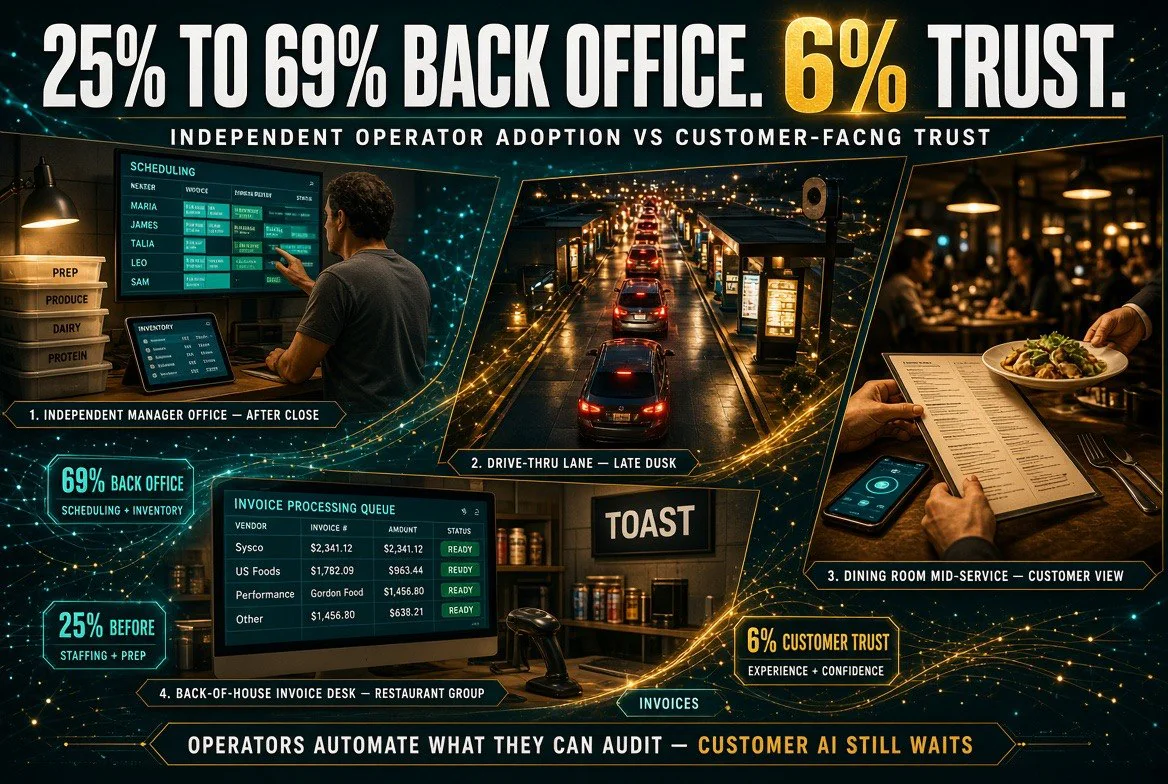
Back-office AI adoption among independent operators has climbed from roughly 25% to 69% because scheduling, inventory and invoice tools produce a measurable before-and-after. Customer-facing AI trust sits near 6%, and the gap is not irrationality: a back-office failure is recoverable, while a drive-thru voice agent failing in front of a paying customer with a line of cars behind is not.
What This Means for Your Restaurant This Quarter
The temptation, after reading a number like four rides, is to conclude that none of this matters yet and go back to running the dining room. Half right. The consumer-facing agent layer is genuinely not your problem in 2026. The automation already inside your operation is.
Work through these in order rather than all at once.
Audit what is already deployed. List every AI system touching an order, a schedule, or a customer, and for each one ask who covers its failure mode. If the answer is nobody, that is not automation, that is an uninsured risk.
Demand the escalation rate, not the accuracy rate. When a voice vendor pitches you, ask what percentage of orders get handed to a human and what that percentage looks like on a Friday at seven. The published accuracy figure is measured on the orders the system handled. Your labor cost lives in the ones it did not.
Price against hours removed, never hours promised. Take the labor hours the system actually eliminated in your last two weeks of operation and divide the monthly cost by that number. If the vendor will not give you a trial long enough to produce that figure, you have your answer.
Keep the human on the headset during peak. Every deployment that is working — Taco Bell included — uses a person as the failover. Staffing for that is not a failure of the AI strategy, it is the strategy.
Do not build for agents. If a third-party shopping agent someday sends you orders, it will arrive through your existing POS or your existing delivery integrations, not through a project you need to start now. The infrastructure providers are doing that work at their own expense, with results that are four rides a week.
The honest summary is that the agent future is real, slower than advertised, and much less urgent than the automation already sitting in your kitchen making decisions about your schedule. Uber measured it for everyone this week, and the measurement was tiny.
That is good news. It means you have time to get the boring parts right before anyone is forcing your hand.
Frequently Asked Questions
How many orders did AI agents place on Uber? Roughly 500 food deliveries and four rides during a single high-volume week in Q3 2026, against about 320 million total platform trips in the same week. That works out to roughly 0.00016% of volume.
Are those Uber numbers cumulative or per week? Per week. CFO Balaji Krishnamurthy matched the figures to one strong week — the week including Halloween — rather than aggregating them across the full quarter.
Should a restaurant owner add an AI ordering agent now? Only if you can measure what it removes. The consumer agent layer is not yet sending meaningful order volume; voice ordering at the drive-thru is deployed at real scale but still relies on human escalation for roughly 30% of orders.
What is a realistic drive-thru voice AI accuracy rate? Deployed systems report between the low-80s and about 90% autonomous accuracy, with the better ones reaching near-99% only when a human is available to take over. The operating threshold where automation beats staffing cost is around 95%.
Why did Burger King pull back while Taco Bell expanded? Burger King’s rollout drew customer complaints about the interaction experience and franchisees pulled back. Taco Bell’s model kept a human as an active failover, which made the escalation cheap and the failures invisible to most customers.
What should I ask a voice AI vendor before signing? The escalation rate at peak, the labor hours the system actually removed in comparable locations, the trial length, and what happens to an order when the system cannot complete it. Skip any vendor who answers with accuracy percentages instead.

About Barak Schurr
Barak Schurr built and exited a major ticketing platform, ran global operations at Eventbrite, and now focuses on one question: which AI tools actually help independent restaurant owners run leaner and grow faster. He writes from the operator’s perspective — no vendor spin, no theory, just what’s real in 2026.
Email: [email protected]
More Resources for Restaurant Operators