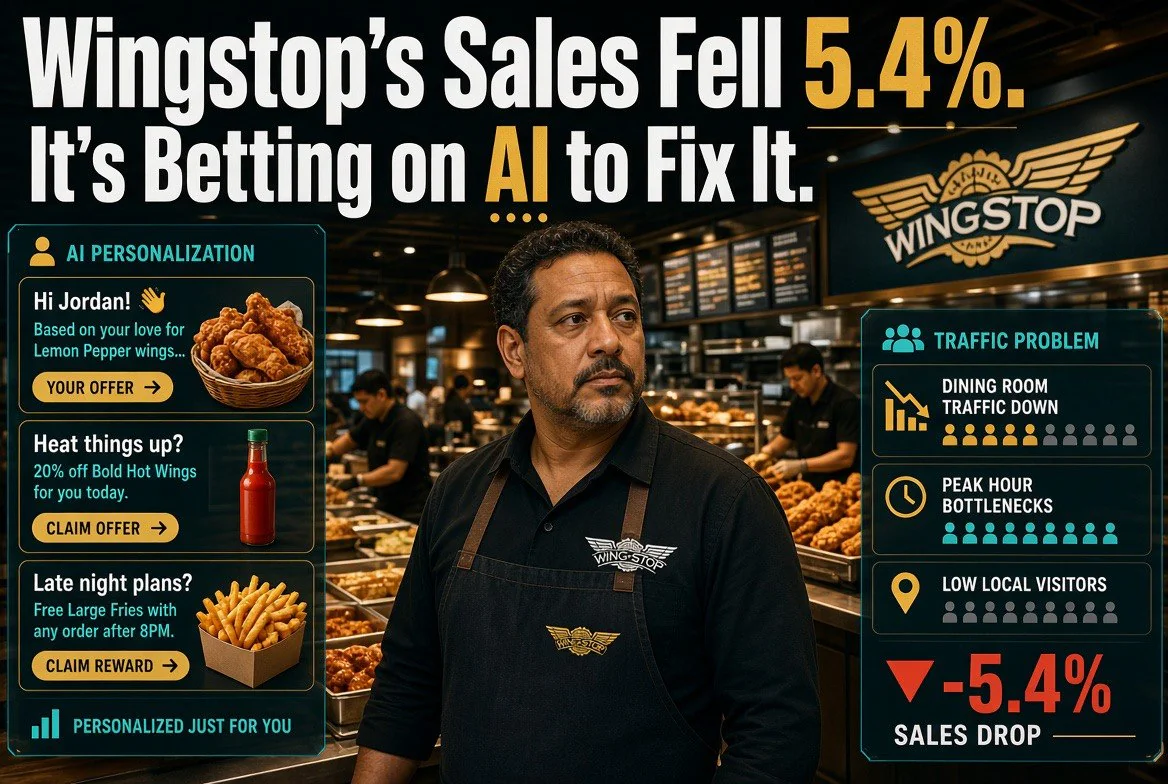
Wingstop’s Sales Fell 5.4%. It’s Betting on AI to Fix It.
⚡ Expert Summary: Wingstop posted a 5.4% same-store sales decline in Q3 and told investors the fix is taking longer than expected. The plan has three parts: lean harder on value messaging, push group occasions, and use AI to send personalised offers and menu suggestions based on what each guest orders. That last part is the one every independent operator will copy. Here is the argument I would make before you do: personalisation is a margin tool, not a traffic tool. It gets more out of the guests you already have. If your problem is that people stopped walking in, AI cannot fix that, and buying it as if it can is how a 5.4% problem becomes a 9% problem.
Wingstop is a good chain having a bad stretch, and the way it is talking about that stretch tells you exactly what the software industry has convinced restaurant executives to buy.
The third quarter came in with same-store sales down 5.4%. Chief executive Michael Skipworth, on the earnings call, said the company is beginning to see positive signals from the changes it has made, but that the improvement in sales performance is taking longer than anticipated and the macro trends it is seeing among customers have intensified over the last few months. That is the sentence of a man who has already spent the money.
What got spent is the part worth studying. Restaurant Dive reported the chain’s plan: sharper value messaging, a push on group occasions, and artificial intelligence used to send guests personalised offers and menu suggestions based on their preferences. New technology deployments. Increased emphasis on operational consistency.
Read that list again as an operator rather than an investor. Two of those three are marketing decisions. The third is a promise.
What Wingstop Is Actually Buying
Personalisation is not a mystery once you strip the labelling off it. The chain collects what each guest orders, which locations they order from, what time, what they add, what they never add, and what they stopped ordering. Then it uses that history to shape the offer that lands in front of them next time.
At Wingstop’s scale, that is a real advantage. A guest who orders lemon pepper wings and never orders fries can be shown a lemon pepper bundle instead of a generic discount. A guest who orders for four people on a Friday gets a group occasion prompt on a Thursday. A lapsed guest gets a different message than a regular. None of that requires a machine to be clever. It requires the machine to remember, which humans at a 2,000-unit chain cannot do by hand.
At one location, it is a different calculation entirely. Your POS already knows what a regular orders. Your best server knows it better. The question is not whether marketing personalisation is technically possible for an independent restaurant, because it is. The question is whether it addresses the reason your covers are down.
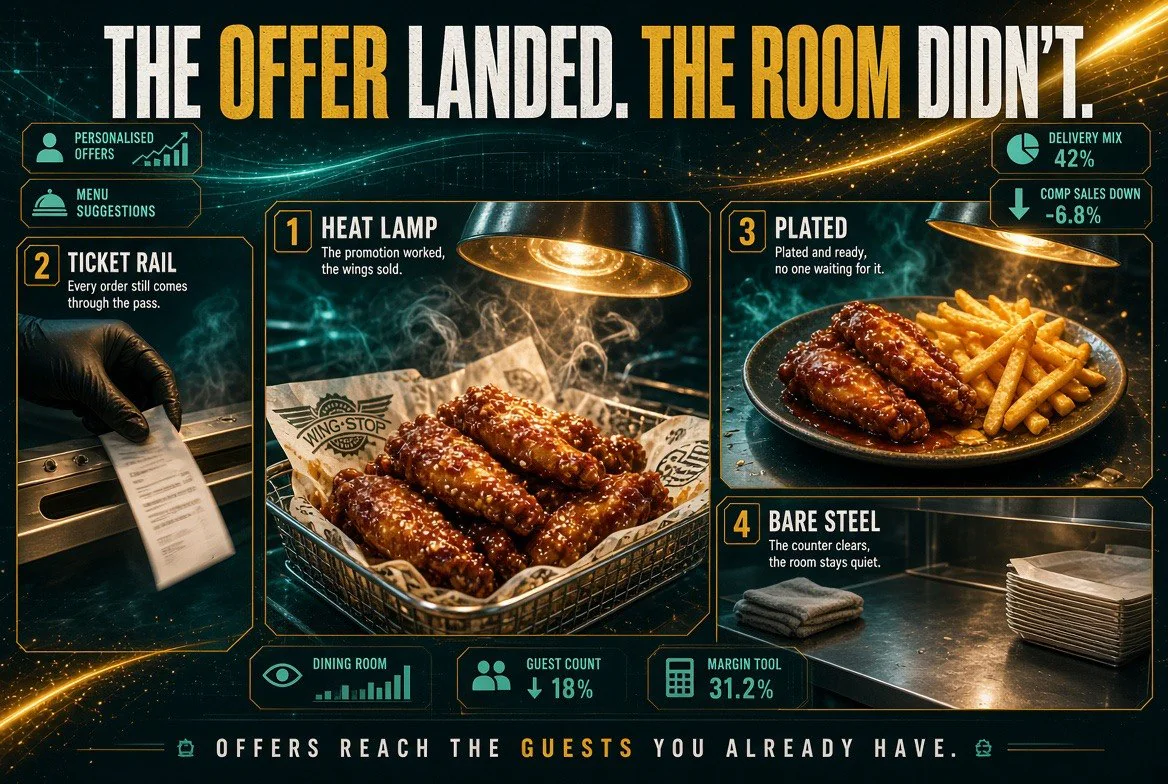
The Diagnosis Problem Nobody Wants to Have
Skipworth has been consistent about the cause since earlier earnings calls: the chain’s core guest is under significant economic pressure, and that pressure is hitting Wingstop harder than its competitors.
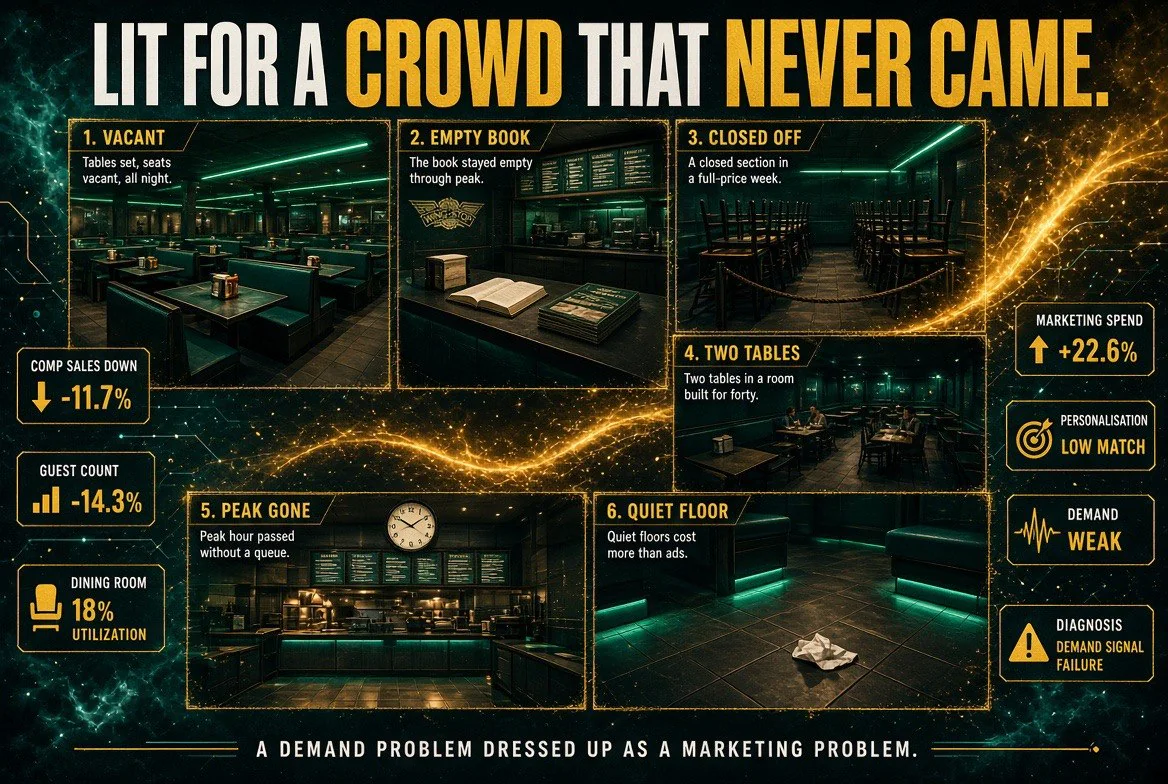
That is a diagnosis of a demand problem. Your guest has less money and is choosing between your chicken and something else at the supermarket. Personalisation does not put money back in that guest’s pocket. It changes how you ask them to spend what they have left.
Those are different problems and they need different tools. A traffic problem needs reach, price architecture, and a reason to come in that did not exist last month. A margin problem needs smarter offers to the people already coming. Personalisation is excellent at the second one. It is structurally bad at the first, because it works on a base of existing, identified guests, and the guests you lost are precisely the ones who stopped generating the data you would personalise against.
This is the trap I would flag to any operator reading the Wingstop plan and reaching for the same playbook. If comps are down because fewer people walk through the door, an offer engine aimed at your existing customer list cannot reverse it. It will make your remaining guests spend slightly more, which shows up in average ticket, which looks like progress on a dashboard, and which does not replace the covers you lost.
| What Changed | Personalised Offers Fix It | Personalised Offers Do Not Fix It |
|---|---|---|
| Your regulars are ordering one fewer side | Yes, a bundle prompt against their history | Not the issue |
| A lapsed guest has not ordered in 90 days | Yes, a win-back offer to a known identity | Only if they are in your database at all |
| Foot traffic in your trade area fell | No, you cannot personalise to strangers | This is the real problem and it needs reach |
| Your core guest cut their eating-out budget | Marginally, on the ones who still come | Needs a price and value answer, not a smarter offer |
| Service inconsistency is costing repeat visits | No, this is an operations problem | Fix the pass before you buy the platform |
That table is the whole argument, and it is worth applying honestly to your own numbers before you take a vendor meeting. Which row are you actually in? If you cannot answer, you are about to buy software for the wrong problem.
The Group Occasions Bet Is the Interesting One
Buried in the middle of the plan is the part I think is genuinely smart, and it is not the AI.
Wingstop is emphasising group occasions. That is a demand strategy, not a margin strategy. A group order is a bigger ticket, but more importantly it is an occasion someone has to plan for, which means it competes on convenience and value for a whole table rather than on one person’s impulse. Chains that win group orders build habits: the office that orders wings on a Thursday orders wings again the following Thursday.
Here is where personalisation earns its keep, and it is a narrow use. If you know a guest placed a group order three weeks ago, the most valuable thing your system can do is remind them at the right moment. That is not clever AI. That is a calendar with a memory. It is also, measurably, the highest-return automation in most independent restaurants, and it costs a fraction of a personalisation platform.
Value Messaging Is Having a Moment, and AI Is Not the Reason
The chain’s renewed focus on its value proposition and flavour is, frankly, the most operator-legible thing in the whole strategy. When your guest is under economic pressure, you either show them a reason your price is worth it or you show them a lower price. Flavour and value are the Wingstop version of staying honest about what the customer can actually afford.
Look at what else the quarter brought across the category and the pattern is unmistakable. Value menus, promotional price points, and discount-driven traffic are everywhere, and the chains leaning hardest on them are the ones reporting the best numbers. Nobody in this stretch is winning on novelty.
The AI piece sits on top of that, not underneath it. Personalisation decides who gets which value message. It cannot invent a value message that works. If your offer is unremarkable and your service is average, AI makes you faster at delivering an offer nobody wanted.
| Decision | What the Vendor Shows You | What You Should Measure Instead |
|---|---|---|
| Personalisation platform rollout | Opens, clicks, offer redemptions | Guest count per week versus the same week last year |
| Loyalty or CRM software | Sign-ups and database size | Repeat visit frequency per identified guest |
| Menu suggestion engine | Average ticket lift | Average ticket lift that survives the next price change |
| Win-back campaign | Redemption rate on the offer | How many of those guests came back a second time unprompted |
| Discount depth | Volume of discounted orders | Contribution margin after the discount, per cover |
The right-hand column is the one that decides whether you keep the platform when the contract renews. Every left-hand column can be true while your restaurant loses money, and vendors know it.
What an Independent Operator Should Take From This
You are not Wingstop and you should not read this story as a green light to buy a personalisation platform. You should read it as a rare public look at a big chain’s diagnosis, and diagnoses are free to learn from.
First, name your actual problem before you shop. Write down last month’s guest count and last year’s same month. Not revenue, guest count. If the count is down and the average ticket is flat, you have a traffic problem and no personalisation platform on earth will fix it. If the count is flat and the ticket is down, you have a margin problem and smarter offers are exactly the right tool.
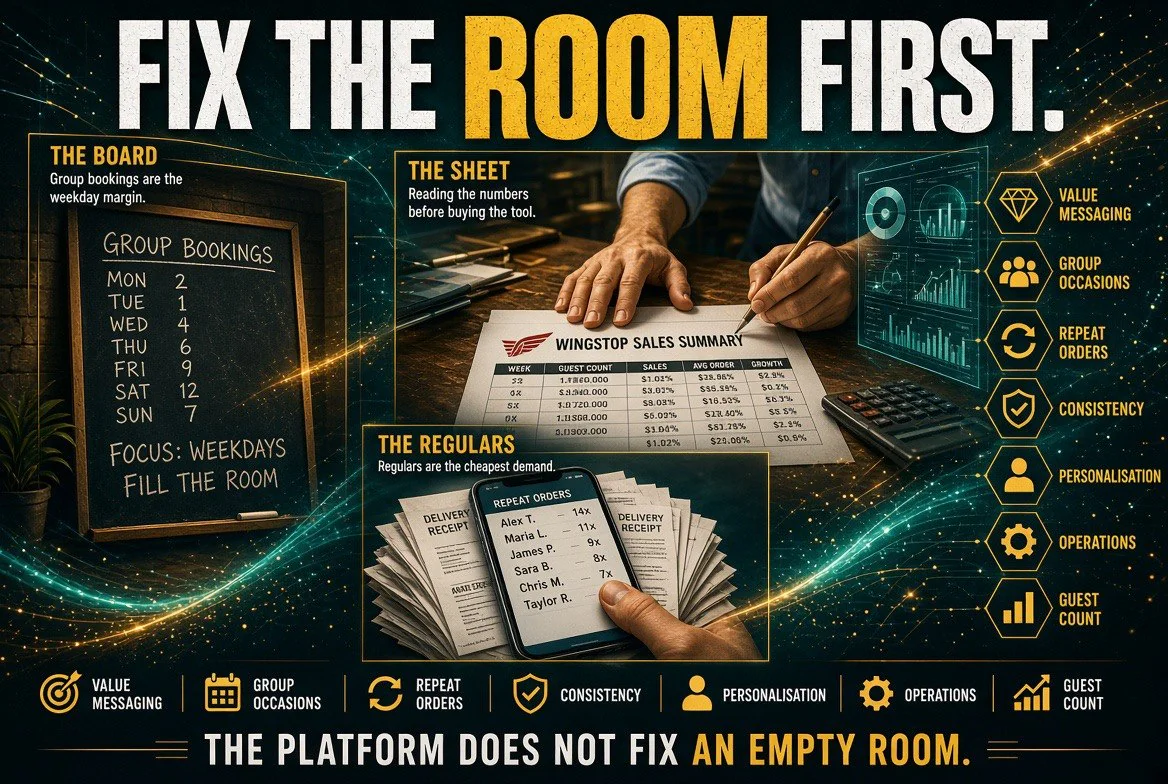
Second, chase the group occasion. It is the highest-return thing in Wingstop’s list and needs the least technology. Build a set-menu or platter that feeds four at a price that reads as obvious value, then get it in front of the offices, teams, and family groups already near you. A reminder system for repeat group buyers is worth more than a personalisation engine in a single-site restaurant.
Third, fix operations before you buy intelligence. Wingstop’s own plan includes an increased emphasis on operational consistency, and it is telling that it sits alongside the AI rather than beneath it. A guest who gets a great personalised offer and then waits 40 minutes does not come back, and the platform will happily report that the offer was redeemed.
Fourth, be suspicious of average ticket as a headline metric. It is the number every personalisation vendor leads with, and it is the number most easily inflated by raising prices on people who were already going to walk in. Track frequency and guest count alongside it or the ticket number is telling you a story you want to hear.
The Thing Wingstop Has That You Do Not
Wingstop can absorb a five percent decline for several quarters while it tests a marketing strategy. It has the balance sheet, the unit count, and the investor patience for a bet that takes longer than anticipated. When Skipworth says the improvement is taking longer than anticipated, the sentence is survivable for him in a way it would not be for you.
An independent restaurant running the same playbook has one quarter to be right. That asymmetry is the entire reason to be skeptical of chain strategies dressed up as industry best practice. The chain can afford to be wrong about personalisation for a year. You cannot, and the software contract will outlast your patience either way.
Which brings me to the honest version of what Wingstop is doing. It is buying time and options. Value messaging, group occasions, personalisation, consistency: one of those will be the reason the number turns, and management does not yet know which. That is not a criticism. It is what a competent large operator does in an uncertain year, and it is exactly what a small operator cannot afford to do because the cost of running four experiments at once is four times the cost of running the one you needed.
So pick one. If I were running a single site reading this, I would pick the group occasion and the operational consistency, in that order, and leave the personalisation platform on the wish list until the guest count is stable. Then, and only then, spend money on getting more out of each guest.
Frequently Asked Questions
What exactly is Wingstop doing with AI?
According to reporting on the chain’s marketing strategy, Wingstop is using artificial intelligence alongside other tools to send guests personalised offers and menu suggestions based on their preferences. That sits inside a wider plan covering value messaging, group occasions and operational consistency.
Did AI cause Wingstop’s same-store sales to fall?
No. The 5.4% decline came despite marketing shifts and new technology deployments, not because of them. Management attributes the weakness to pressure on its core guest and to macro trends that intensified during the quarter.
Will personalised offers fix a drop in guest counts?
Generally no. Personalisation works on guests you can already identify and reach, so it improves frequency and ticket size among people who are still coming. If your problem is that fewer people walk through the door, you need reach and a value message, not a smarter offer engine.
Should an independent restaurant copy this strategy?
Copy the group occasion push and the operational consistency work first, because both address demand and execution without a platform contract. Treat the personalisation layer as a margin tool to add once guest counts are stable, not as a rescue plan for falling traffic.
How do I know if I have a traffic problem or a margin problem?
Compare guest count this month with the same month last year. If the count is down and the average ticket is flat, it is traffic. If the count is flat and the ticket is down, it is margin. The two need different tools and mixing them up is how operators buy the wrong software.
What should I measure after buying a personalisation tool?
Not opens, clicks or redemptions. Measure guest count per week against the same week last year, repeat visit frequency per identified guest, and contribution margin per cover after discounts. A tool can win on the first set of numbers while the restaurant loses money.

About Barak Schurr
Barak Schurr built and exited a major ticketing platform, ran global operations at Eventbrite, and now focuses on one question: which AI tools actually help independent restaurant owners run leaner and grow faster. He writes from the operator’s perspective — no vendor spin, no theory, just what’s real in 2026.
Email: [email protected]
More Resources for Restaurant Operators