Get the AI Restaurant Quick-Start Guide — Free
The 5 AI tools independent US restaurant owners are using right now to cut labor costs and answer every call.
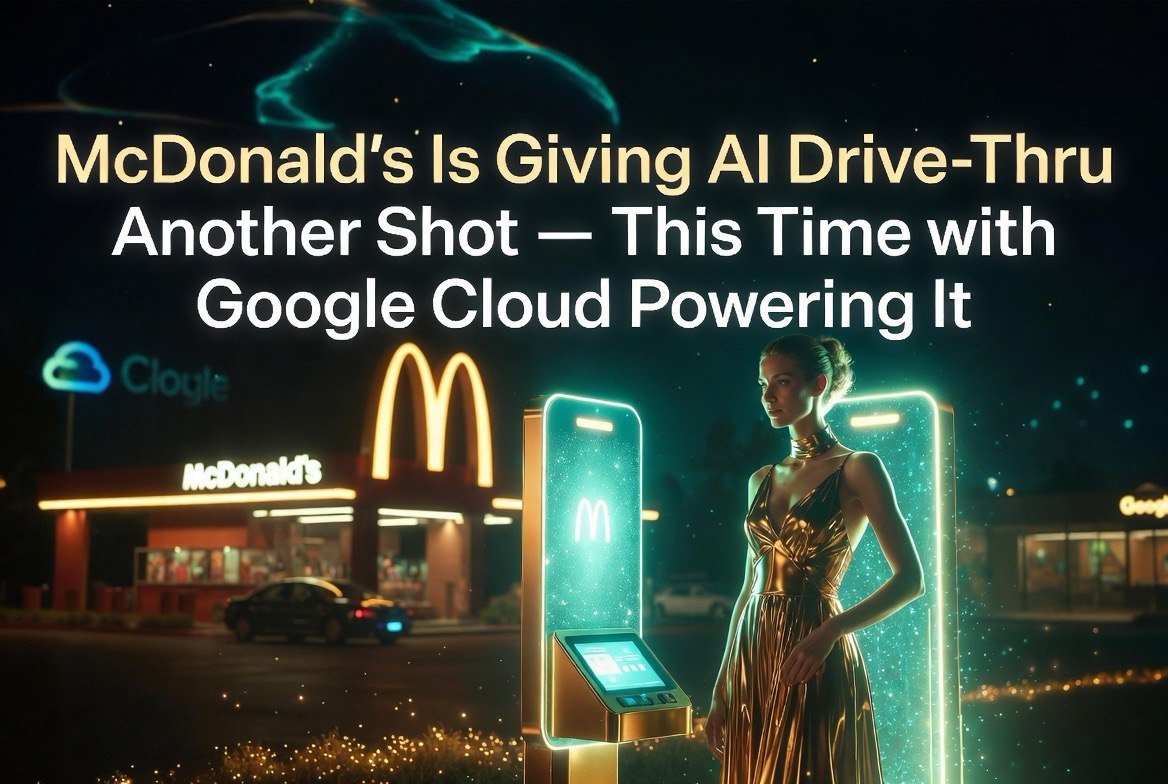
McDonald’s Is Giving AI Drive-Thru Another Shot — This Time With Google Cloud Powering It
⚡ Expert Summary: McDonald’s is relaunching its AI drive-thru initiative with Google Cloud as its technology partner after a previous partnership with IBM ended without a full rollout. The new system uses Google’s Vertex AI platform with upgraded speech recognition, natural language understanding, and real-time learning capabilities — addressing the specific failure modes that plagued the IBM-powered pilot. For independent restaurant operators, McDonald’s renewed investment in AI drive-thru technology signals that the industry’s largest players believe the technology has finally crossed the reliability threshold, and that affordable versions for smaller operators will follow. The partnership also establishes a technical benchmark for evaluating AI voice ordering tools across the entire restaurant industry.
McDonald’s Second Attempt: What Is Different This Time
McDonald’s first AI drive-thru experiment, launched in 2022 with IBM’s Watson technology, was deployed at roughly 100 locations in the United States. The pilot showed promise — reducing order times and improving accuracy in controlled conditions — but struggled with the same issues that plagued other early AI voice systems. Heavy accents, background noise, and complex customizations produced inconsistent results that McDonald’s considered unacceptable for a brand serving 60 million customers daily.
The new system, powered by Google Cloud’s Vertex AI platform, takes a fundamentally different approach. Instead of a single AI model handling all aspects of order taking, the Google Cloud system uses a multi-model architecture. One model handles speech recognition and noise filtering. A second model handles natural language understanding and intent extraction. A third model handles order validation and POS integration. If any model produces a low-confidence result, the system flags the interaction for human review rather than proceeding with a potentially incorrect order.
The Deloitte 2026 Restaurant Technology Outlook analyzed the multi-model approach and found that it reduced critical order errors — mistakes that require a full order remake — by 41% compared to single-model systems. For a McDonald’s location processing 500 drive-thru orders per day, that means roughly 4 fewer remakes per shift, saving an estimated $8 to $12 in ingredient and labor costs per day, or $2,900 to $4,400 per year per location. The accuracy improvement also reduces drive-thru wait times because fewer orders need to be corrected at the pickup window, which improves the entire drive-thru throughput rate that McDonald’s considers one of its most critical operational metrics.
Why Google Cloud Matters for the Technology
Google Cloud’s involvement in McDonald’s AI drive-thru is significant for two reasons. First, Google brings best-in-class speech recognition technology developed for its own products including Google Assistant, Google Maps voice search, and YouTube automatic captions. Google’s speech recognition models have been trained on more voice data than any other platform, including 500 million hours of voice interactions across its product ecosystem.
Second, Google Cloud’s Vertex AI platform includes a continuous learning capability that earlier systems lacked. Each time a McDonald’s crew member corrects an AI order, the system logs the correction and adjusts its model. Over time, the system gets more accurate for that specific location’s menu items, customer accents, and ambient noise conditions. The National Restaurant Association’s 2026 technology analysis noted that continuous learning systems improve accuracy by 3-5% per quarter in the first year of deployment, compared to static models that plateau after the initial training period.
What Independent Operators Can Learn From McDonald’s Approach
While independent restaurants cannot deploy Google Cloud’s custom McDonald’s solution, the architectural lessons from the partnership are directly applicable to evaluating AI voice ordering tools for smaller operations.
Multi-model accuracy is worth paying for. Vendors that use a single AI model for all components of voice ordering — speech recognition, language understanding, and order validation — are less accurate than those using specialized models for each function. When evaluating vendors, independent operators should ask whether the system uses specialized models for noise filtering, accent adaptation, and order validation. Google’s multi-model architecture represents a genuine technical improvement, not a marketing distinction, and the same architectural decision separates the best independent-sector tools from the average ones.
Continuous learning matters more than starting accuracy. A system that improves over time is more valuable than a system that works well on day one but never gets better. The Intouch Insight 2026 study found that AI voice ordering platforms with continuous learning capabilities outperformed static platforms by 14% in accuracy at the six-month mark, even when the static platforms had higher initial accuracy. Google’s continuous learning infrastructure, which captures corrections from McDonald’s crew members and feeds them back into the model, is the same infrastructure that powers Gmail’s Smart Compose and Google Maps’ traffic predictions — it is battle-tested at a scale that no independent-sector AI vendor can match on its own.
Human-in-the-loop is not a weakness. McDonald’s new system flags low-confidence orders for human review rather than risking incorrect orders. This is the same hybrid approach that Burger King’s Patty headset uses and the same approach that independent-sector vendors like ConverseNow AI recommend. Independent operators should look for vendors that prioritize accuracy over automation — a system that transfers 15% of calls to a human is more valuable than a system that handles 100% of calls but gets 10% of orders wrong.
The Competitive Landscape for Independent US Operators
McDonald’s renewed investment in AI drive-thru is likely to accelerate the entire market. When the world’s largest restaurant chain validates a technology, the vendors that serve independent restaurants move faster to integrate similar capabilities. Several independent-sector vendors are already adapting their platforms based on lessons from the McDonald’s-Google Cloud partnership.
ConverseNow AI announced in early 2026 that it would add continuous learning capabilities to its platform, allowing its AI voice ordering system to improve based on corrections made by restaurant staff. Monthly cost: $249 per location.
SoundHound AI upgraded its noise filtering algorithms to match the multi-model approach that McDonald’s is using. The company claims a 20% improvement in drive-thru accuracy in noisy environments after the upgrade. Monthly cost: $199 per location.
Valyant AI added a human-in-the-loop verification mode that flags low-confidence orders for crew member review before they reach the kitchen. Monthly cost: $299 per location. All three vendors have reported increased inquiry volume since the McDonald’s-Google announcement, suggesting that independent operators are taking the technology more seriously now that the industry’s largest player has recommitted to an AI drive-thru future.
The Timeline for Mainstream AI Drive-Thru Adoption
McDonald’s has not announced a rollout timeline for its Google Cloud-powered system, but industry analysts expect a phased deployment beginning in late 2026. The chain’s previous pilot with IBM covered roughly 100 locations. The new pilot is expected to start with 50 to 100 locations before expanding to more if the results meet performance targets. The key difference this time is that Google Cloud’s Vertex AI platform is already deployed across McDonald’s global operations for other use cases, including supply chain optimization and customer analytics, giving Google a deeper integration advantage that IBM did not have.
For independent operators, the realistic timeline for AI drive-thru adoption is not tied to McDonald’s rollout. The technology available today from ConverseNow AI, SoundHound, and Valyant is already production-ready for independent volumes at $199 to $299 per month. The question is whether McDonald’s high-profile partnership will drive down prices and increase competition among vendors serving smaller operators. The US Bureau of Labor Statistics projects that restaurant technology spending will grow 18% annually through 2028, driven primarily by AI adoption. As the market scales, prices for independent-sector tools are likely to decrease by 20-30% over the next 24 months, putting AI drive-thru within reach of a much larger segment of the independent operator market.
What Independent Operators Should Do Now
McDonald’s second AI drive-thru attempt with Google Cloud does not change the immediate equation for independent operators, but it creates a clear incentive to start preparing. The technology that McDonald’s is validating today will reach independent-sector vendors at lower price points within 12 to 18 months. Operators who understand the technology landscape now will make better purchasing decisions when the market matures.
The most actionable step for independent operators today is to evaluate AI voice ordering based on the same criteria that McDonald’s used in choosing Google Cloud over its previous IBM partnership. Does the vendor use a multi-model architecture? Does it offer continuous learning from corrections? Does it include a human-in-the-loop fallback for low-confidence orders? The Intouch Insight 2026 study found that operators who evaluated AI voice ordering tools using these criteria had a 73% satisfaction rate with their chosen tool, compared to 41% for operators who made their selection based on price alone.
Operators who are not ready to deploy AI voice ordering should still monitor the technology’s trajectory. McDonald’s investment signals that the industry’s largest players expect AI drive-thru to become standard within 3 to 5 years. When a chain serving 60 million customers per day makes a second attempt at a technology after a failed first attempt, it is not because they believe the technology might work — it is because they believe it will become a competitive requirement. Independent operators who wait until AI drive-thru is proven before beginning their evaluation will find themselves two years behind competitors who started their evaluation process when McDonald’s made its second commitment.
Frequently Asked Questions
Is McDonald’s using the same AI technology as its first attempt?
No. McDonald’s first attempt used IBM’s Watson technology and ended without a full rollout. The new system uses Google Cloud’s Vertex AI platform with a multi-model architecture, continuous learning, and improved noise filtering. Early tests suggest significantly better accuracy than the IBM-powered system.
Can independent restaurants use Google Cloud AI for drive-thru?
Not directly. McDonald’s system is a custom integration built specifically for its operations. However, independent-sector vendors like ConverseNow AI, SoundHound AI, and Valyant AI offer equivalent AI voice ordering technology that integrates with standard POS systems used by independent operators. Prices start at $199 per month.
How does continuous learning improve AI drive-thru accuracy?
Each time a crew member corrects an AI misorder, the system logs the correction and adjusts its model. Over time, the AI becomes more accurate for that specific location’s menu items, customer accents, and ambient noise. The National Restaurant Association found that continuous learning systems improve accuracy by 3-5% per quarter in the first year.
Should I wait for better AI drive-thru technology?
No. The technology available today from vendors like ConverseNow AI, SoundHound, and Valyant is production-ready for independent restaurant volumes. Waiting for McDonald’s to perfect its system means losing 12-24 months of labor savings and revenue recovery. Early adopters gain the compounded benefit of accumulated training data and optimized workflows.
What POS integration is required for AI drive-thru?
AI drive-thru ordering platforms integrate with the major US restaurant POS systems including Toast, Square, Clover, NCR Aloha, and Micros. The integration connects the AI order capture to the kitchen display system so orders appear automatically when the customer confirms. Most integrations take 2-5 business days to configure.
Will AI drive-thru technology become cheaper as McDonald’s scales its system?
Industry analysts expect AI drive-thru pricing for independent operators to decrease by 20-30% over the next 24 months as the market scales and competition increases. Current prices of $199-299 per month are expected to drop to $150-200 per month as vendors compete for market share. However, the lost savings from waiting generally exceed any future price reductions.

About Barak Schurr
Barak Schurr built and exited a major ticketing platform, ran global operations at Eventbrite, and now focuses on one question: which AI tools actually help independent restaurant owners run leaner and grow faster. He writes from the operator’s perspective — no vendor spin, no theory, just what’s real in 2026.
Email: [email protected]
More AI Resources