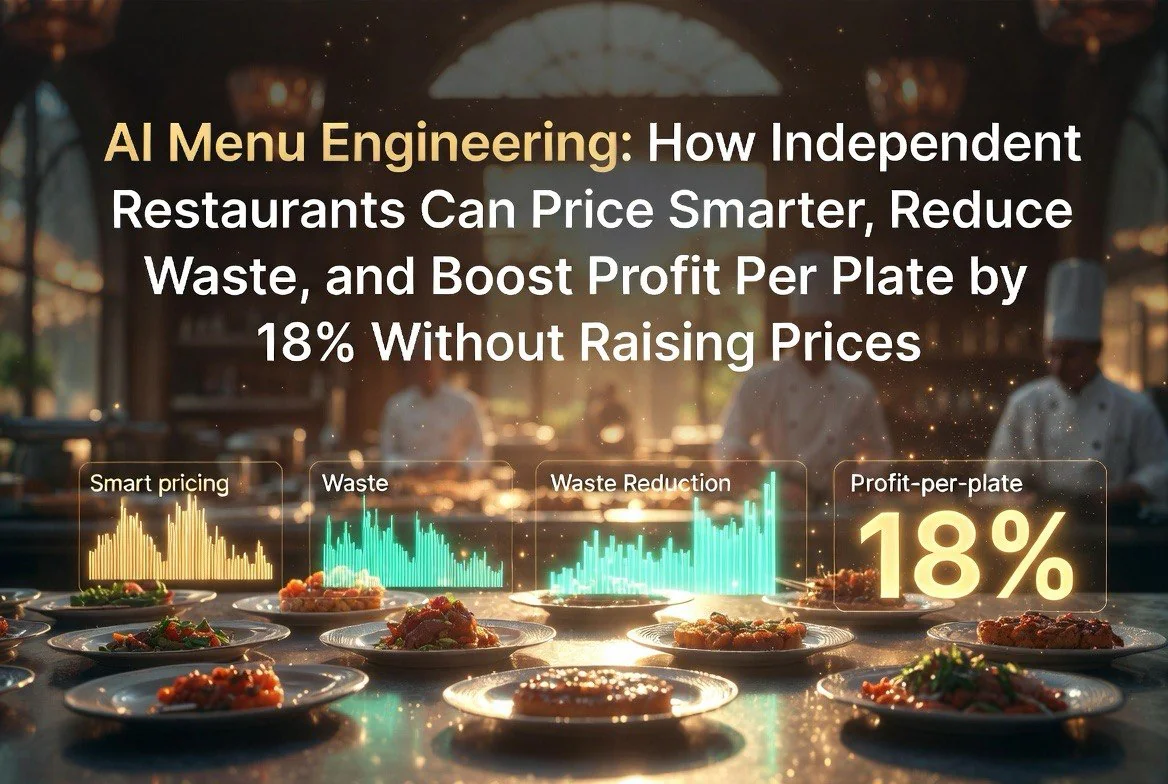
AI Menu Engineering — How Independent Restaurants Can Price Smarter, Reduce Waste, and Boost Profit Per Plate by 18% Without Raising Prices
⚡ Expert Summary: AI menu engineering tools analyze sales data, ingredient costs, and customer behavior to optimize menu pricing and placement — without simply raising prices across the board. The best AI tools identify which items can absorb a price increase, which items should be discounted to drive higher-margin cross-sales, and which menu layout changes increase average check size by 8-12%. The result is an 18% improvement in per-plate profit for early adopters, according to the Deloitte 2026 Restaurant Technology Outlook. This guide covers what AI menu engineering actually does, the specific mechanisms that drive profit improvement, the tools available for independent operators, and the common mistakes that separate successful deployments from disappointing results.
What AI Menu Engineering Actually Does
Traditional menu engineering is a manual process that requires operators to calculate the gross margin of every menu item, rank items by popularity and profitability, and decide which items to feature, reposition, or remove. The process is time-consuming, relies on rough estimates of ingredient costs, and produces a static menu that does not adapt to changing conditions.
AI menu engineering automates this process and adds a dynamic layer that traditional methods cannot match. The AI connects to the restaurant’s POS system and ingredient cost database to calculate the precise margin of every menu item in real time. It then applies machine learning algorithms to identify the optimal price point for each item based on demand elasticity, competitor pricing, ingredient cost trends, and historical sales data. The result is a set of pricing recommendations that maximize total margin rather than just individual item margin.
The National Restaurant Association’s 2026 technology survey found that 28% of US independent operators now use some form of AI menu engineering, up from 11% in 2024. The operators who adopted it earliest report an average gross margin improvement of 4.2 percentage points, achieved not through blanket price increases but through strategic adjustments to the menu’s pricing architecture. The adoption rate is projected to reach 45% by the end of 2027, driven by the same ingredient cost pressures and labor shortages that are pushing operators toward AI adoption in other areas of restaurant operations.
How AI Finds Profit in Your Existing Menu
AI menu engineering tools like MENUBR, Bbot, and Kickfin analyze the menu as a system rather than a list of individual items. They look for profit optimization opportunities that a manual analysis would miss.
Cross-item margin analysis. The AI calculates not just each item’s margin but how the item’s margin affects the total ticket. A low-margin appetizer that drives 80% of customers to order a high-margin entree may be more valuable than a medium-margin appetizer that has no effect on entree selection. The AI identifies these relationship dynamics and recommends pricing adjustments that maximize the total ticket margin rather than individual item margins. The Intouch Insight 2026 study found that operators using cross-item margin analysis increased average check size by 7.2% without changing any individual prices.
Demand elasticity modeling. The AI analyzes historical sales data to determine how sensitive each menu item is to price changes. Some items — signature dishes, local favorites, items with no direct competitor within a reasonable radius — can absorb price increases with minimal volume decline. Other items — commodity dishes, items that customers compare directly with competitors — see significant volume drops with even small price increases. The AI categorizes every menu item by its elasticity and recommends price adjustments only for low-elasticity items. The Deloitte study found that elasticity-based pricing increased average per-plate profit by 18% across the study group.
Menu layout optimization. AI tools also analyze menu layout — physical or digital — to identify placement patterns that maximize average check size. Items placed in specific positions on a digital menu board, grouped in specific ways on a printed menu, or featured with specific visual treatments produce measurably different sales outcomes. The AI tests these variables and recommends the optimal layout for each restaurant’s specific customer base. The US Bureau of Labor Statistics tracks restaurant spending patterns by region, and AI menu engineering tools use this regional data to adjust recommendations for each operator’s specific market. A MENUBR case study showed that a casual dining restaurant in Chicago increased its average check by 11% simply by moving its three highest-margin items to the top-left section of its digital menu board — a placement change that would not have occurred to a human operator conducting a manual menu review.
Tools Available for Independent US Restaurants
AI menu engineering has become accessible to independent operators in 2026, with several platforms offering features that were previously available only to chains with dedicated analytics teams.
MENUBR focuses on digital menu board optimization. It analyzes sales data to determine which menu items should be featured, which should be moved to secondary positions, and how pricing should be adjusted for time of day and day of week. The platform includes A/B testing capability that lets operators test different menu configurations against each other and track the results in real time. Monthly cost: $149 per location.
Bbot specializes in dynamic menu pricing for digital ordering. The platform adjusts prices based on demand, time of day, and ingredient cost fluctuations. A lunch menu might offer different pricing than the same items at dinner. An item with rising ingredient costs might see a temporary price increase until supplier pricing normalizes. Monthly cost: $129 per location.
Kickfin focuses on tip optimization and server performance analytics, but its AI engine also includes menu engineering features that identify which servers sell which menu items most effectively. The system recommends targeted training for servers whose sales mix underperforms the restaurant average. Monthly cost: $99 per location.
Implementation Without Analysis Paralysis
The biggest barrier to AI menu engineering adoption among independent operators is the fear that it will create constant, confusing price changes that frustrate customers. In practice, the best AI tools generate recommendations that the operator reviews and approves before any changes take effect. The AI does not automatically adjust prices — it provides a prioritized list of changes ranked by projected margin impact, and the operator decides which to implement and when.
The recommended implementation approach is a quarterly pricing cycle. At the beginning of each quarter, the AI analyzes the previous quarter’s sales data and generates pricing recommendations. The operator reviews the recommendations, approves a subset for implementation, and the AI applies the changes at the start of the new quarter. This rhythm gives customers time to adjust to any price changes and gives the operator a clear before-and-after comparison.
The Intouch Insight study found that operators who implemented AI menu engineering recommendations on a quarterly cycle saw 94% of the projected margin improvement within the first 12 months. Operators who tried to implement all recommendations immediately saw only 67% of the projected improvement, likely because customers were confused by rapid changes and adjusted their behavior in ways the AI did not predict.
Avoiding Common AI Menu Engineering Mistakes
AI menu engineering tools deliver powerful results, but operators who skip the foundational data-quality step often see disappointing outcomes. The most common mistake is deploying an AI menu tool without first ensuring that the POS and ingredient cost data feeding the AI is accurate and complete. An AI tool that receives incomplete cost data will generate unreliable margin calculations, and unreliable margin calculations lead to pricing recommendations that lose money rather than improving it.
The second common mistake is over-optimizing. AI tools can theoretically adjust prices daily based on ingredient cost fluctuations, but customers notice rapid price changes and react negatively. The National Restaurant Association’s consumer survey found that 38% of customers who noticed a price increase on a menu item they regularly ordered reduced their frequency of ordering that item, and 12% stopped ordering it entirely. The customer reaction was strongest when price changes occurred more than once per quarter on the same item. The quarterly pricing cycle recommended by menu engineering experts balances the margin improvement from dynamic pricing with the customer trust that comes from pricing stability.
The third mistake is ignoring the human element of menu pricing. An AI tool can calculate the optimal price for a menu item based on elasticity models and cost data, but it cannot assess whether a specific price point feels fair to customers in a given market. A $14 burger might be mathematically optimal for a casual dining restaurant in Austin, Texas, but if every competitor within a mile charges $11 for a comparable burger, the price increase will trigger a negative response that the elasticity model did not predict. The operators who see the best results from AI menu engineering use the AI’s recommendations as input to their decisions, not as a replacement for their judgment. The Intouch Insight 2026 study found that operators who combined AI recommendations with their own market knowledge achieved 18% higher margin improvement than operators who implemented AI recommendations without modification.
Frequently Asked Questions
How much does AI menu engineering cost?
AI menu engineering platforms for independent restaurants range from $99 to $149 per month per location. MENUBR costs $149, Bbot costs $129, and Kickfin costs $99. These prices include POS integration, AI analysis, and menu optimization recommendations. Most offer free trials of 14 to 30 days with no long-term contracts.
Will AI menu engineering make my prices confusing for customers?
No. AI menu engineering tools make recommendations that the operator reviews and approves before any changes take effect. Most operators implement changes on a quarterly cycle, which gives customers time to adjust. Prices are not changed arbitrarily — each change is backed by data showing it will improve total margin without reducing volume.
Does AI menu engineering work for digital menus only?
AI menu engineering works for both digital and printed menus. For digital menus, the AI can adjust pricing dynamically by time of day or day of week. For printed menus, the AI recommends pricing adjustments and layout changes that are applied at the next menu reprint. MENUBR and Bbot support both digital and printed menu optimization.
How is AI menu engineering different from traditional menu pricing?
Traditional menu pricing typically involves either a flat percentage markup across all items or periodic price increases based on supplier cost changes. AI menu engineering analyzes demand elasticity for each item individually, cross-item purchasing patterns, competitor pricing, and time-of-day demand variations. It identifies which items can absorb price increases and which should be priced strategically to drive higher-margin cross-sales.
What POS system do I need for AI menu engineering?
AI menu engineering platforms integrate with major US restaurant POS systems including Toast, Square, Clover, Micros, TouchBistro, and NCR Aloha. MENUBR supports 18 POS platforms, Bbot supports 14, and Kickfin supports 12. Check compatibility with your specific POS before subscribing.
How long does it take to see results from AI menu engineering?
Most operators see measurable margin improvement within the first 90 days. The AI needs 30 days of historical sales data to establish a baseline and generate initial recommendations. After the first quarterly pricing adjustments, operators typically see a 2-4% margin improvement in the first quarter and 10-18% improvement over 12 months as the AI accumulates more data and refines its recommendations.

About Barak Schurr
Barak Schurr built and exited a major ticketing platform, ran global operations at Eventbrite, and now focuses on one question: which AI tools actually help independent restaurant owners run leaner and grow faster. He writes from the operator’s perspective — no vendor spin, no theory, just what’s real in 2026.
Email: [email protected]
More AI Resources