Olo Wants to Kill the 30% Delivery Commission
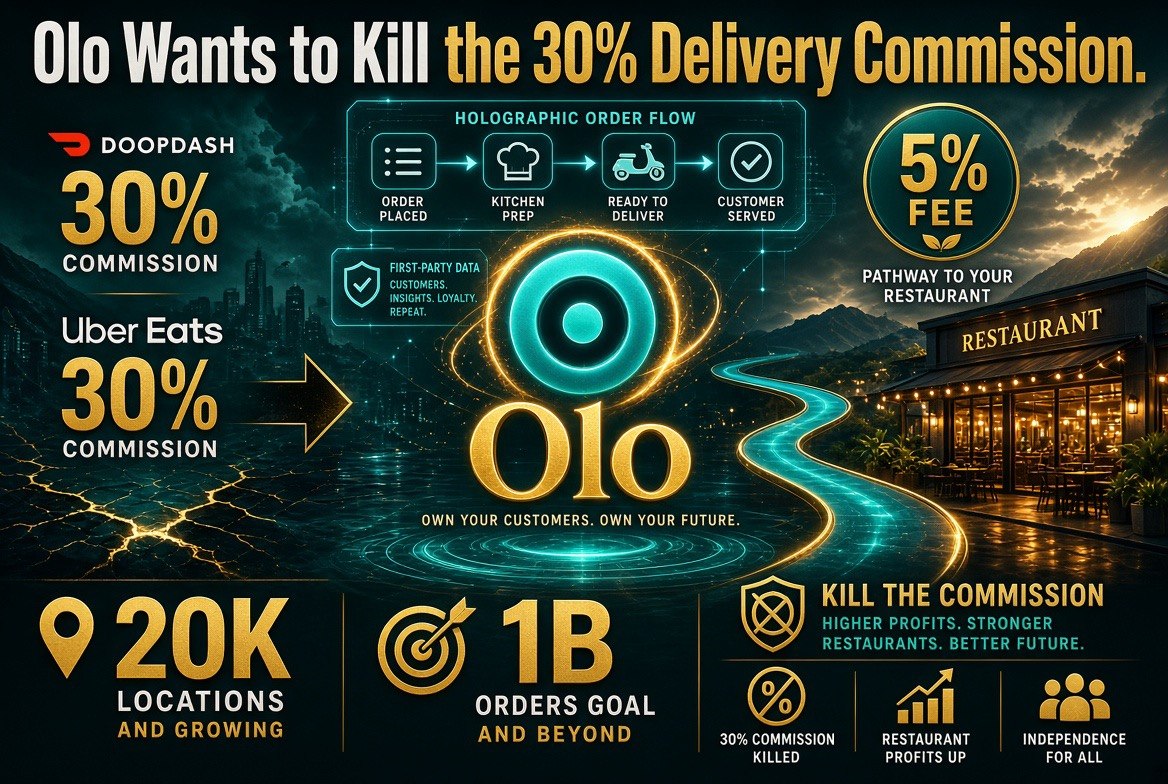
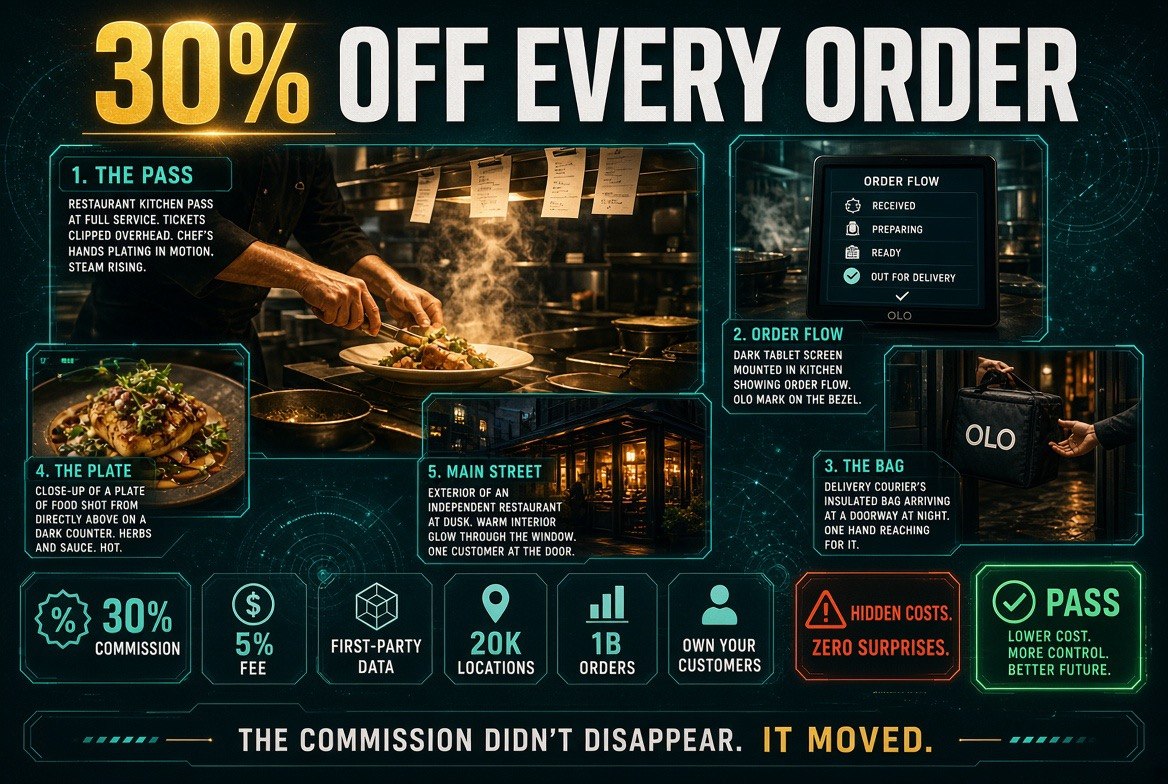
⚡ Expert Summary: Olo is launching a consumer app that charges a 5% network fee instead of the 15-30% commission third-party marketplaces take from restaurants. Starting with about 20,000 locations across 250 brands, aiming for a billion orders a year by 2030. It is not a charity move. Olo keeps the first-party data, the order arrives looking exactly like a direct order, and the drivers still come from DoorDash and Uber Eats. The commission did not disappear. It moved.
Noah Glass runs Olo. He has one number he wants you to remember, and he says it plainly: delivery marketplaces charge restaurants a commission that can run as high as 30% on an order. To survive it, operators mark their menus up on those platforms. The guest pays the difference.
“Because the delivery marketplaces charge the restaurants a commission, restaurants have offset that by charging a higher price on the marketplaces,” Glass told Restaurant Dive.
That is the whole theory of the Olo app. Same food, lower menu price, and the reason it can be lower is not that Olo discovered efficiency nobody else found. It is that Olo decided to take 5% instead of 30% — and to charge it to the guest, at the top of the menu and at checkout, in a line the operator cannot hide from.
The Math Nobody Puts on the Menu
Here is the arithmetic the 30% actually represents, because operators live it and vendors quote it.
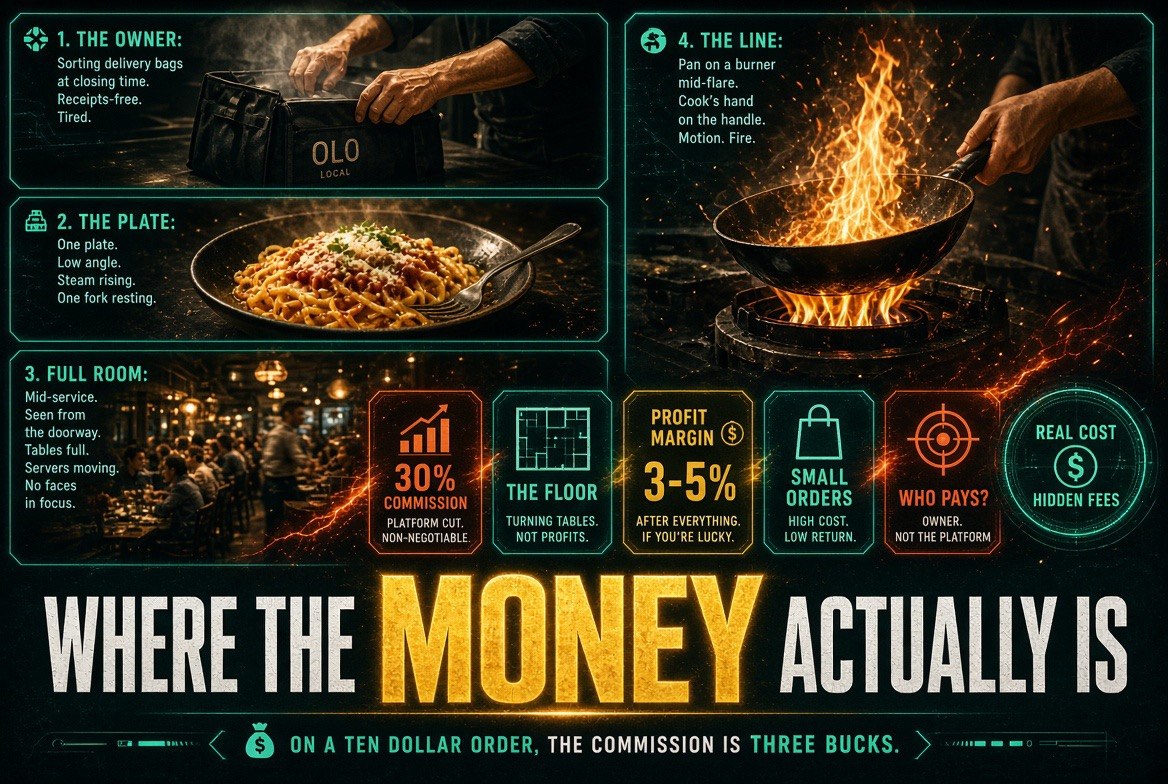
On a $40 delivery order, a 30% commission is $12 to the platform. To protect the same $40 of food revenue, an operator raises the menu price on the marketplace to roughly $57. The guest pays $57 plus fees plus tip, and concludes delivery is a luxury. The restaurant still nets about what it would have made on a $40 in-store sale, minus packaging, minus the labor to make it, minus the risk of a refund the platform decides unilaterally.
That is not a pricing decision. It is a squeeze that everyone involved pretends is a pricing decision.
| Cost Line | Third-Party Marketplace | Olo App | Your Own Website |
|---|---|---|---|
| Fee basis | Commission up to 30% of order | 5% network fee, charged to guest | Processing only |
| Menu price strategy | Marked up to absorb commission | Lower than marketplace pricing | Normal in-store pricing |
| Customer data | Platform owns or gates it | Operator keeps it, first-party style | Fully yours |
| Order routing | Platform captures and relays | Through Olo Dispatch, arrives as first-party | Direct to your POS |
| Delivery labor | Platform drivers | Best quote across services, same drivers | Yours, or a white-label deal |
| Guest discovery | High, that is the product | Moderate, multi-brand browse | You have to earn every visit |
Look at the third row and the fifth row together. Olo is not selling you margin on delivery. It is selling you back something you never should have lost: the identity of the person who ordered, and an order that lands in your system as if they had walked in and phoned it in themselves.
What Olo Is Actually Selling, and It Is Not the 5%
Glass describes the product as “a sort of second-party ordering platform — something between third-party options like DoorDash and Uber Eats and expensive first-party delivery.” That phrasing is worth reading twice, because it tells you exactly what Olo thinks its own position is.
“The order, when it arrives, looks exactly to the restaurant as if it came through that first-party ordering platform,” he said. Operators keep the consumer data. Delivery orders run through Olo Dispatch, which “will ping all the different delivery services that serve that restaurant, and then we’ll find the best quote for that order.”
So follow the money through the whole chain. The guest pays a 5% network fee to Olo and pays whatever delivery charge the restaurant sets. Olo keeps the fee and the relationship. The restaurant keeps the customer record. And the driver — the person actually holding the bag — is usually affiliated with DoorDash, Uber Eats, or another aggregator, working a white-label arrangement like Uber Direct or DoorDash Drive that pays a set fee instead of a commission.
The aggregators are not being robbed here. They get volume for their drivers, and driver retention is the thing that keeps a delivery network alive. It is a deal where everyone can claim a win, which is usually a sign that the restaurant is the one holding the checkbook.
The Big Middle Is Where the Money Is
The strategic argument in the pitch is genuinely smart, and it is worth understanding because it is the part that could actually work.
Glass splits delivery guests into three groups. Some are loyal to marketplaces and will always order there, because they like variety and want to be surprised. Some are loyal enough to a brand to use its own app. And then there is the middle.
“There’s this big middle in the normal distribution curve of guests who aren’t quite loyal enough to a brand to download their app, don’t want to pay 15% to 30% more, find delivery really expensive, but do want to have the convenience of food ordering for pickup and delivery with multiple brands,” he said.
That is the honest description of most delivery customers, and nobody has served them well. They are too fickle to download forty apps and too price-sensitive to eat a marked-up marketplace menu every week.
Olo’s app already carries about 20,000 locations across 250 brands, and the company plans to extend it across its roughly 90,000 locations before opening it to the wider industry. Glass wants a billion orders a year by about 2030 — roughly the volume Olo’s entire ecosystem of ordering channels handles today. He has about 40 million existing customers to market into.
He is also honest that this will not happen overnight. “It may take a degree of refinement and iteration to hit on a set up that works for a wide base of consumers,” he allowed. Translation: this is a bet on consumer habit, and consumer habits in food ordering are sticky in the direction of the apps people already have.
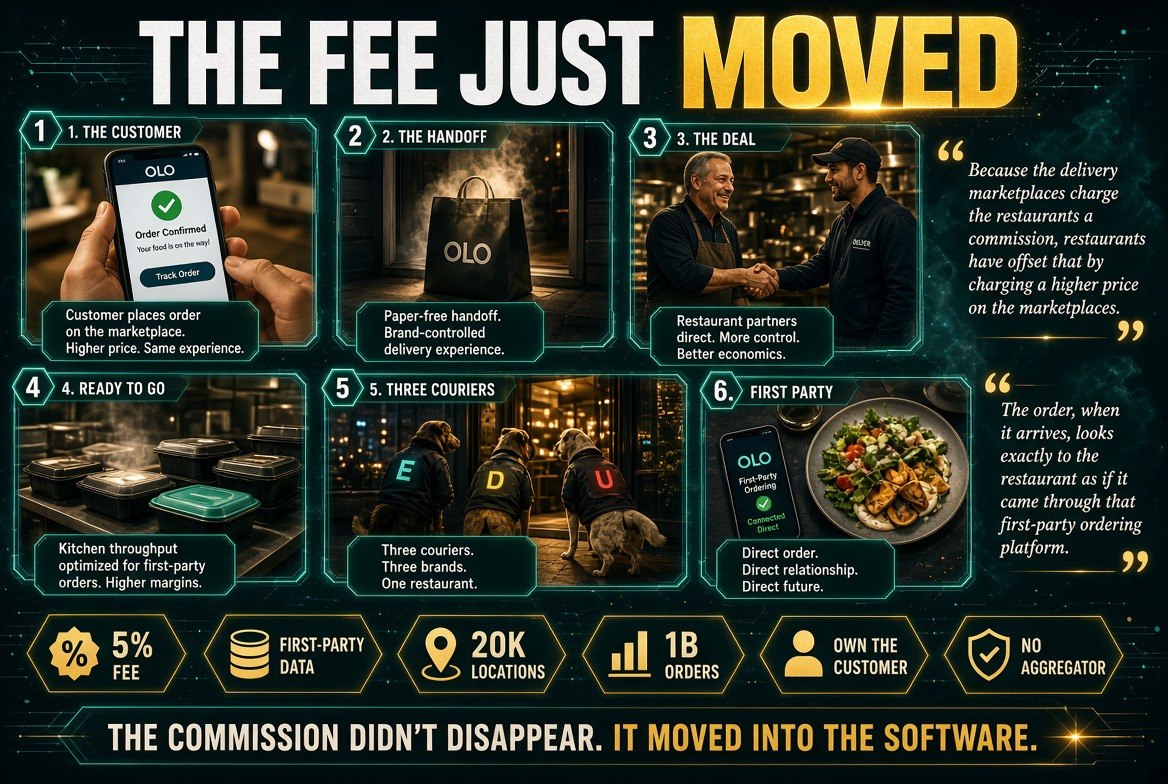
The Commission Did Not Disappear. It Moved.
Here is the part of the announcement that will not be printed in the press release, and it is the part operators should think hardest about.
Olo charging guests 5% instead of charging restaurants 30% is a real improvement in who bears the cost. But it is not the elimination of the middleman. It is the arrival of a better-positioned middleman — one that sits between the restaurant and the guest, owns the surface where the guest browses, sets the fee structure, and controls the routing logic that decides which driver service gets the order.
Glass is candid about one thing that matters: guests who balk at the 5% fee are free to order through the restaurant’s owned channels, which remain advantageous to Olo because first-party is its core business. That sentence is the whole relationship in miniature. Olo profits either way. You only profit on one of those paths.
That is not a criticism of Olo. It is a description of every platform that ever intermediated a relationship, from OpenTable to Grubhub to the card networks. The question for an operator is never whether the fee is fair today. It is what the fee becomes after the habit is formed and the alternative is gone.
The Counter-Argument, In Its Own Terms
Fair is fair: the case for ignoring this whole thing is strong, and Glass makes half of it himself.
Most independent operators do not have the volume to matter to a national consumer app. Twenty thousand locations across 250 brands means the launch inventory is chains — the Chipotles and the McDonald’s of the world — not the 1,600-square-foot Thai place on the corner. If you run one or two units, you may well be watching this from the outside for years.
And a consumer app is the hardest product in food service to make work. Discovery apps live or die on demand density, and demand density is what DoorDash and Uber Eats already bought with a decade of driver subsidies and television advertising. Olo is entering that fight with 40 million existing customers and a 5% fee, which is a respectable weapon but not an obvious one.
The counter-argument to the counter-argument: the operators who get hurt by commissions are not the chains, who negotiate them down, but the independents who cannot. A platform that normalizes a 5% fee for the guest changes the reference price for everybody. Once a guest has ordered the same burrito for 5% more instead of 30% more, the marketplace menu markup becomes visible in a way it never was. That is a pricing conversation every restaurant benefits from, whether or not they get the app.
What an Operator Should Actually Do This Month
One thing, and it is not signing up for anything.
Find out what your marketplace markup actually is, and what your effective commission has been for the last ninety days. Pull the reports. Most operators know their commission percentage and have never calculated the marked-up menu price they charge to cover it. Put those two numbers next to your in-store price for the same item. Whatever the gap is, that is the number that determines whether a 5% alternative is a lifeline or a rounding error.
Then ask your POS or ordering vendor one question in writing: if a guest orders through a third-party app that routes into my system as first-party, do I own that customer’s data, and can I export it? If the answer is anything other than an unqualified yes, you have learned more from the exchange than from the entire announcement.
| Question to Ask | Why It Matters | Answer That Should Worry You |
|---|---|---|
| What is my effective commission over 90 days? | The headline rate is never the real rate after refunds and promotions | “It is just the standard 30%” |
| What markup am I charging on marketplace menus? | That markup is your true commission cost, paid by the guest | Nobody has ever calculated it |
| Do I own data from orders routed through a third party? | Determines whether you can remarket without paying again | “We can share aggregated insights” |
| Can I export that data any time, unmetered? | Portability is the difference between a list and a hostage | “Export is available on the enterprise tier” |
The Only Number That Decides This
Olo wants a billion orders a year by 2030. Twenty thousand locations now, ninety thousand on the roadmap, forty million customers already in the funnel. A 5% fee that the guest can see, and a menu price that no longer hides the commission.
If it works, the 30% becomes an indefensible number in public, and every operator negotiating a renewal has a new reference point. If it fails, it fails the way every consumer food app fails: not enough guests, not enough repeat orders, and a quiet shutdown eighteen months from now that nobody writes about.
Either way, the thing worth watching is not the app. It is whether the 30% survives being said out loud.
Frequently Asked Questions
What is the Olo app and what does it cost restaurants?
Olo is launching a consumer-facing app for delivery and takeout across its restaurant partners. It charges guests a 5% network fee, disclosed at the top of the menu and at checkout, rather than charging restaurants a commission like third-party marketplaces do.
How much commission do delivery marketplaces charge?
Commissions can range as high as 30% on an order, according to Olo CEO Noah Glass. Restaurants typically offset that by raising menu prices on the marketplace, so the guest pays the difference.
How many restaurants are on the Olo app?
About 20,000 restaurant locations across 250 brands at launch, according to Glass. Olo plans to extend it to roughly 90,000 locations before opening it to the restaurant industry as a whole.
Do restaurants keep customer data from Olo app orders?
Yes. Orders arrive looking exactly as if they came through the restaurant’s own first-party ordering platform, so operators keep the consumer data and can use it to build a fuller picture of guest behavior.
Who delivers the orders?
Drivers, often affiliated with DoorDash, Uber Eats, or other aggregators through white-label deals like Uber Direct or DoorDash Drive. Olo Dispatch pings the delivery services serving that restaurant and picks the best quote.
Is this cheaper than DoorDash or Uber Eats?
For the guest, generally yes, because the menu price is not marked up to absorb a commission and the fee is 5% rather than 15-30%. For the restaurant, it depends on whether the order volume and data access offset the network fee.
What happens if a guest does not want to pay the 5%?
They can order through the restaurant’s owned channels instead. Olo notes that first-party orders remain advantageous to the company because first-party is its core business.
When will the app be available broadly?
Olo is starting with its existing partner locations and expanding across its roughly 90,000 locations before opening it to the wider industry. Glass said the app may need refinement before it works for a wide base of consumers.
Does this eliminate delivery commissions?
No. It shifts the fee from a 15-30% commission paid by the restaurant to a 5% network fee paid by the guest, and it introduces Olo as the platform between restaurant and guest. The intermediary role does not disappear.
What should independent restaurants do right now?
Calculate the real markup on marketplace menus and the effective commission over 90 days, then get written answers from your ordering vendor about whether you own and can export customer data from orders routed through third parties.
About Barak Schurr
Barak Schurr built and exited a major ticketing platform, ran global operations at Eventbrite, and now focuses on one question: which AI tools actually help independent restaurant owners run leaner and grow faster. He writes from the operator’s perspective — no vendor spin, no theory, just what’s real in 2026.
Email: [email protected]
More Resources for Restaurant Operators