How Coca-Cola Is Using AI to Improve Its Operations: What Independent Restaurants Can Steal
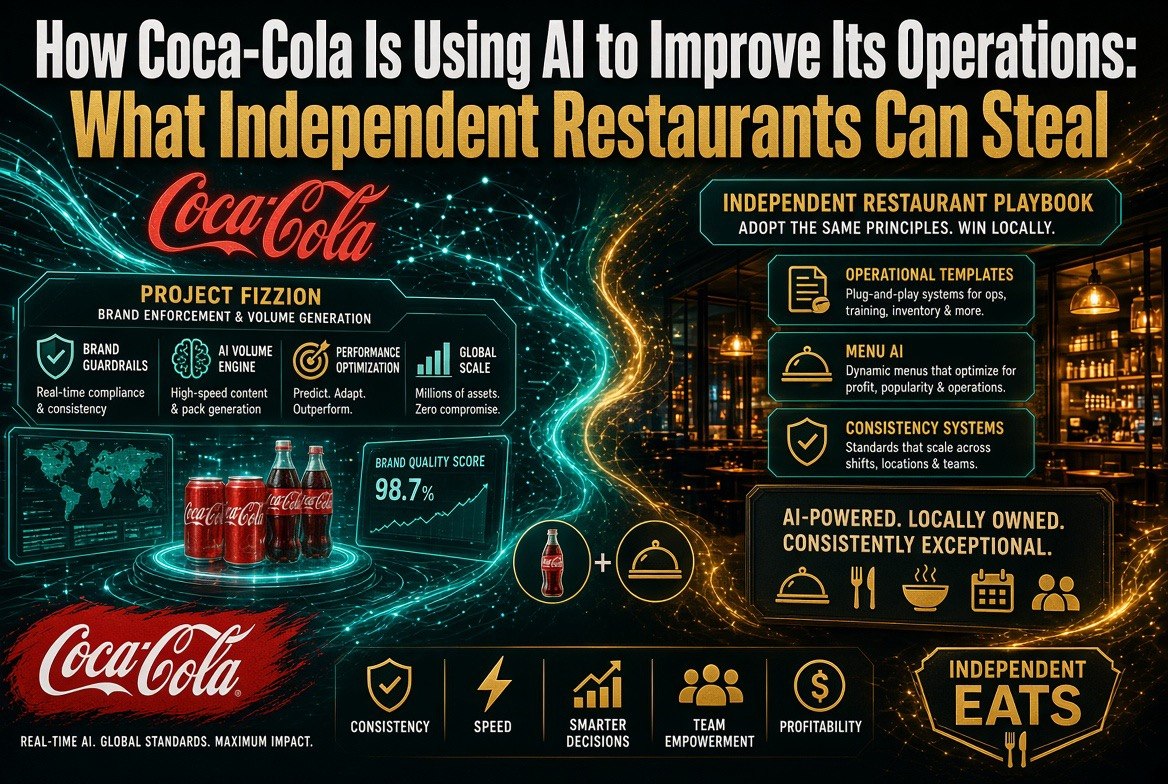
⚡ Expert Summary: Coca-Cola is not using AI to pour drinks — it is using AI to run the machinery around the drink: brand governance across 200+ markets, content production at volume, localization, and marketing analytics. The flagship is Project Fizzion, an Adobe-built system that turns Coca-Cola’s brand guidelines into a machine-readable “StyleID” applied inside Illustrator and Photoshop, so designers stay on-brand in real time instead of waiting for a review queue. For an independent restaurant, the transferable lesson is not the technology — it is the operating principle: encode your standards once, then automate enforcement, so consistency stops depending on somebody remembering.
Coca-Cola sells roughly 2.2 billion drinks a day. That number is the whole reason its AI strategy looks the way it does. A company operating at that volume does not have a marketing problem where somebody needs a cleverer idea — it has an operations problem where thousands of executions across more than 200 markets have to stay recognizably Coca-Cola while still speaking to local tastes.
That is the problem AI is actually solving inside Coca-Cola in 2026, and it is a far more interesting story than the “brand makes AI ad, internet objects” cycle most coverage focuses on. Strip the headlines away and you find a company using AI as infrastructure — governance, reproduction, localization, and measurement — not as a novelty generator.
For independent restaurant owners, that distinction matters. You are not running 200 markets, but you are running the same structural problem in miniature: your brand shows up in menus, signage, delivery apps, social posts, and third-party listings, and every one of those is a place where it can drift. What Coca-Cola built to solve the problem at scale is a blueprint you can shrink.
Project Fizzion: Encoding the Brand Book So Machines Can Enforce It
The centerpiece of Coca-Cola’s AI operations story is Project Fizzion, built with Adobe and rolled out alongside a refreshed global visual identity. The mechanics are worth understanding because the concept transfers directly to a restaurant.
Historically, a brand system like Coca-Cola’s lived in long static documents — guidelines that told humans what the logo proportions, colors, spacing, and typography should be, and left enforcement to review cycles and the diligence of whoever was executing. Fizzion converts those guidelines into a machine-readable format Coca-Cola calls a StyleID. That identity encodes the design rules so tools can apply them automatically across formats and regions.
The system lives inside Adobe Creative Cloud applications like Illustrator and Photoshop. As a designer works, Fizzion captures their choices and applies brand rules in real time. Once trained, a StyleID can generate localized campaign variations while keeping each execution aligned to the brand.
That last sentence is the operational breakthrough. Localization used to be the point where brands fell apart — a Thailand adaptation, a Brazil adaptation, and a Germany adaptation each made by different teams with different interpretations. Fizzion shifts the work from “create from scratch within guidelines” to “select from generated, already-compliant options.”
The Philosophy Behind It: Designers Lead, AI Follows
The most quoted line from the rollout came from Adobe, describing the working principle as “Designers lead, and AI follows.” Coca-Cola’s global vice president of design, Rapha Abreu, framed the aim as embedding AI so that “creativity can move faster, without losing its soul.”
That framing is not just corporate positioning. It is an architectural decision with real consequences, and it is the single most useful thing in the entire Coca-Cola AI story for a small operator.
A restaurant owner has two ways to use AI on brand work. Option one is to hand the AI the creative task — “make me a menu” — and accept whatever comes back, then clean up the mess. Option two is to do what Coca-Cola did: define the rules once, encode them, and let the AI operate strictly inside them, with a human still choosing the execution.
The second approach costs more upfront and produces far fewer disasters. It also means the AI output is never the surprise — the human decision remains the point of judgment.
| Operational function | How Coca-Cola applies AI | What it replaces |
|---|---|---|
| Brand governance | Project Fizzion + StyleID applied in Adobe CC in real time | Manual review of each execution against static guideline documents |
| Localization | StyleID generates localized campaign variations inside brand rules | Separate regional teams rebuilding assets from scratch |
| Content volume | Generative AI in advertising production; Microsoft partnership for Gen AI initiatives | Every asset shot, edited, and versioned by hand |
| Concept testing | AI-assisted research and concept exploration before spend | Slow, expensive rounds of consumer testing |
| Product and store innovation | Innovation labs exploring automated beverage formats like dirty soda and refreshers | Manual prep at the counter, one drink at a time |
| Common thread | Automate the repeatable layer | Not the human judgment |
Why the Microsoft Partnership Is the Other Half of the Story
Project Fizzion governs how the brand appears. The Microsoft partnership addresses how much of it gets produced. Coca-Cola and Microsoft partnered to accelerate generative AI initiatives, and the company has publicly linked that work to advertising production and marketing operations.
The strategic logic is straightforward once you see the pressure. When brand governance is automated, the constraint on output stops being “can we keep it on-brand” and becomes “can we supply the volume.” A brand operating in 200+ markets with localized campaigns needs an enormous pipeline of assets. Generative tools fill that pipeline; Fizzion keeps it from drifting.
Those two systems only make sense together. Generative AI without governance produces on-brand-looking garbage at scale. Governance without generation protects standards while starving the operation of content. Coca-Cola built both, and that pairing is the actual insight.
Coca-Cola’s AI Has a Public Cost, and That Matters Too
Any honest account of Coca-Cola’s AI operations has to include the backlash. In late 2024, the company’s AI-generated Christmas ad drew criticism from viewers and creative professionals. Rather than retreating, Coca-Cola doubled down on AI commercial production in 2025, and its 2026 identity work has continued the pattern.
By 2025, Coca-Cola’s CEO was publicly articulating a limit, saying the company wants “to make ads with people in it” — a line that acknowledges where AI output falls short in the eyes of audiences. That is a genuinely instructive position for a smaller operator: the company with the most resources to automate everything chose to hold a line on human presence in the work that carries emotional weight.
The lesson is not “AI is bad” or “AI is fine.” It is that audience tolerance is a business constraint, and it varies by surface. Nobody minds if the back-of-house scheduling is algorithmic. People mind when the thing that is supposed to feel human feels synthetic. Smart operators draw that line deliberately before their customers draw it for them.
What an Independent Restaurant Should Actually Copy
Coca-Cola’s budget is not replicable. Its operating model is. Here is the translation, function by function.
1. Write down your standards once — properly
Coca-Cola’s guidelines existed as documents for decades before they became machine-readable. The document was never the problem; enforcement was. If your restaurant has no written standard for menu typography, logo placement, photo style, and voice, you cannot automate anything, because there is nothing to encode.
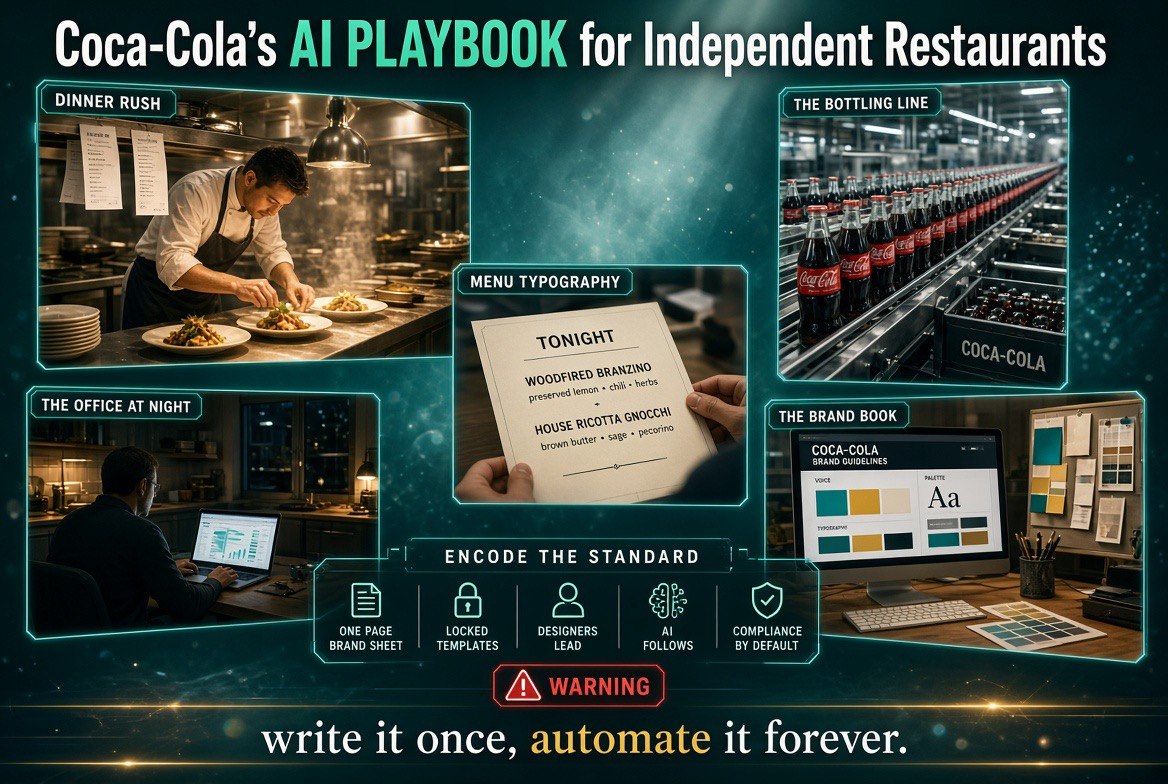
Spend one afternoon writing a one-page brand sheet: exact colors, exact fonts, how your logo may and may not be used, the tone of your captions. That page is your version of the guideline document, and it is the prerequisite for everything else.
2. Encode it into your tools, not your memory
You will not build a StyleID. You can do the cheap equivalent: build templates in Canva or your design tool with locked colors and fonts, save your menu layout as a template, and keep a folder of approved photo treatments. The point is that the compliant option should be the easy option.
When the easy path is also the correct path, consistency stops depending on whether the person doing the work that day remembers the rules.
3. Automate the repeatable layer only
The Coca-Cola pattern is consistent: automate governance, reproduction, and localization. Do not automate the judgment about what the brand should say. For a restaurant that means AI for menu descriptions in your voice, social caption drafts, hours and FAQ answers, review response drafts, listing updates across delivery apps, and the boring republishing work most operators never get to.
It does not mean handing the AI your guest experience decisions. Coca-Cola’s CEO kept a line on human presence in ads; you should keep one on hospitality, service recovery, and anything a guest reads when they are already upset.
4. Use AI to test before you spend
Big brands use AI-assisted research to explore concepts before committing budget. A restaurant equivalent is cheap and immediate: use a model to pressure-test a menu change, a price move, or a new service format against the objections your regulars will actually raise. You will not get statistically valid research, but you will catch the obvious flaw before you print 500 menus.
5. Expect the backlash and plan for it
Coca-Cola learned publicly that audiences react to AI where they did not expect it. If you put AI-generated food photography on your menu and the images do not match what arrives at the table, you have created the same problem in a smaller package. Use AI to help you write, organize, and systematize. Do not use it to fake the thing the guest is actually buying.
The Restaurant Version of the Coca-Cola Stack
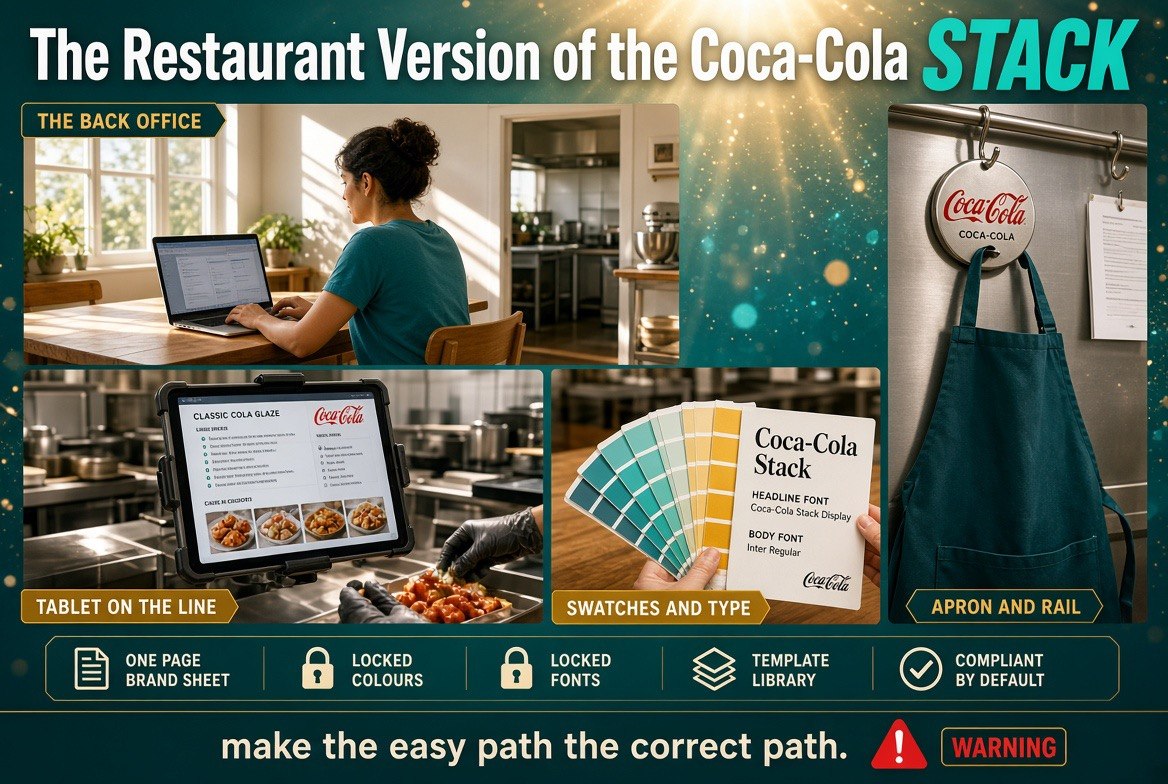
Here is what a realistic small-operator version of Coca-Cola’s architecture looks like, mapped side by side.
| Layer | Coca-Cola | Independent restaurant |
|---|---|---|
| Rule source | Global brand guidelines encoded as a StyleID | One-page brand sheet: colors, fonts, logo rules, voice |
| Enforcement | Fizzion applies rules live inside Illustrator and Photoshop | Locked templates in Canva or your design tool; approved photo folder |
| Production | Generative AI plus Microsoft partnership for ad volume | One AI assistant for captions, menu copy, and listing updates |
| Localization | StyleID generates localized variations across 200+ markets | Same post adapted for each delivery platform and neighborhood channel |
| Human line | Ads should still have people in them; designers lead | Real food photos, real hospitality, human replies when a guest is unhappy |
| Cost | Enterprise licensing with Adobe and Microsoft | One afternoon plus a subscription you already pay for |
Where Coca-Cola’s Approach Breaks Down for a Restaurant
Honesty requires the limits, not just the lessons.
Scale is the whole premise. Fizzion exists because 200+ markets produce an enforcement load humans cannot handle. A single restaurant with two locations has maybe twenty brand touchpoints a month. You do not need a governance system; you need a template folder and the discipline to use it.
Coca-Cola’s AI is about consistency, not hospitality. Nothing in this stack touches the thing that actually decides whether a guest returns — the food, the service, the room. A restaurant can have perfectly automated marketing and die anyway. The AI is a multiplier on a working operation, never a substitute for one.
The creative backlash is asymmetric. Coca-Cola survived its AI Christmas ad controversy because it has a century of brand equity to absorb the hit. A neighborhood restaurant does not. One AI-generated dish photo that misrepresents the plate is a refund and a bad review, not a news cycle.
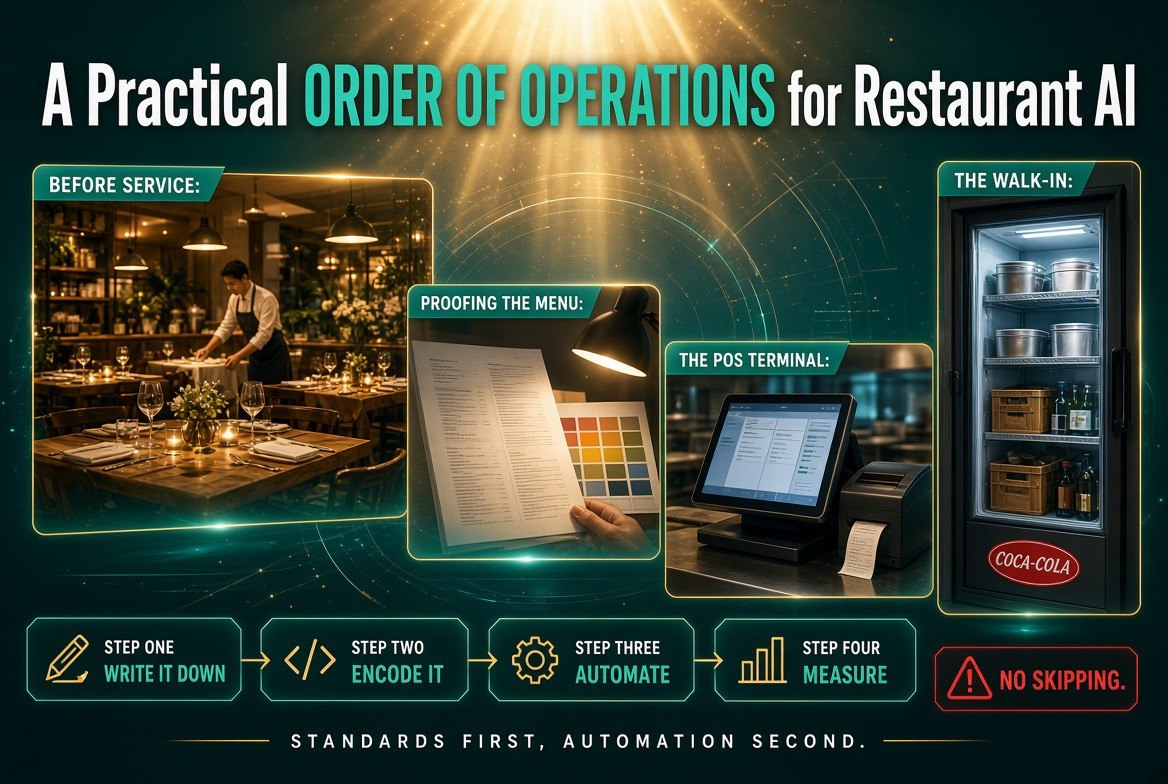
A Practical Order of Operations
If you want to run this playbook, the sequence matters more than the tools.
- Week one: Write the one-page brand sheet. No technology involved.
- Week two: Build locked templates for menu, social, and signage. Make the compliant version the fast version.
- Week three: Pick one repetitive content job — listing updates or caption drafts — and hand it to AI with the brand sheet as the instruction set.
- Month two: Add a second job only after the first one is running without you checking every output.
- Ongoing: Keep human review on anything a guest reads when they are upset, and keep real photos of real food.
That is the whole Coca-Cola lesson compressed into a small operator’s calendar. Define the standard. Encode it so machines enforce it. Automate the volume. Hold the human line where it counts.
The Bottom Line
Coca-Cola’s AI story in 2026 is not a story about artificial creativity. It is a story about a 140-year-old company admitting that its bottleneck was never ideas — it was the cost of enforcing consistency and the cost of producing volume in 200+ markets. Project Fizzion and the Microsoft partnership attack exactly those two costs.
An independent restaurant has the same two costs, at a thousandth the scale. You can copy the architecture without copying the invoice: one page of standards, templates that enforce them, AI pointed at the repetitive work, and a clear-eyed decision about where a human must still be the one doing it.
That is a better use of AI than another clever ad. It is also the only version that survives contact with a paying guest.
Frequently Asked Questions
What is Coca-Cola’s Project Fizzion?
Project Fizzion is an AI system Coca-Cola built with Adobe to manage how its brand is applied across more than 200 markets. It converts the company’s brand guidelines into a machine-readable format called a StyleID, which is applied inside Adobe Creative Cloud applications like Illustrator and Photoshop so that design work stays on-brand in real time rather than waiting for manual review.
How is Coca-Cola using AI in its operations?
Coca-Cola applies AI mostly to the operational layer around the product: brand governance and consistency through Project Fizzion, high-volume content production through its generative AI work and Microsoft partnership, localized campaign variations, concept testing before spend, and beverage format innovation in its labs. The common thread is automating repeatable work while keeping humans in judgment roles.
Does Coca-Cola use AI to create its advertising?
Yes. Coca-Cola has produced AI-generated advertising, including a Christmas ad in late 2024 that drew public criticism. The company continued investing in AI commercial production afterward, while its CEO has publicly stated a preference for ads that still feature real people.
What can a small restaurant learn from Coca-Cola’s AI strategy?
The transferable principle is encoding your standards once so tools can enforce them, instead of relying on people to remember rules. For a restaurant that means a one-page brand sheet, locked templates for menus and social posts, and AI pointed at repetitive content work like listing updates and caption drafts, with humans retained for hospitality and anything a guest reads while upset.
Do small restaurants need enterprise AI tools like Coca-Cola’s?
No. Project Fizzion exists because Coca-Cola faces an enforcement load across 200+ markets that humans cannot handle. A single restaurant or small group has a fraction of those touchpoints, so a template folder in a design tool you already pay for accomplishes the same governance function at effectively no added cost.
Is AI content risky for a restaurant brand?
It can be. Coca-Cola absorbed criticism over AI-generated advertising partly because it has a century of brand equity to fall back on. An independent restaurant does not have that buffer, and AI-generated food photography that does not match what arrives at the table creates refunds and bad reviews. Use AI for writing, organizing, and systematizing, and keep real photos of real food.

About Barak Schurr
Barak Schurr built and exited a major ticketing platform, ran global operations at Eventbrite, and now focuses on one question: which AI tools actually help independent restaurant owners run leaner and grow faster. He writes from the operator’s perspective — no vendor spin, no theory, just what’s real in 2026.
Email: [email protected]
More AI Resources for Your Business