Get the AI Restaurant Quick-Start Guide — Free
The 5 AI tools independent US restaurant owners are using right now to cut labor costs and answer every call.
Presto Raises $10M for Drive-Thru Voice AI: What the Toast Integration Really Changes
⚡ Expert Summary: Presto raised $10 million in late September to expand its drive-thru voice AI business — capital that follows a separate $10 million round from January, led by Metropolitan Partners Group. No valuation was disclosed, and the two announcements are not the same round. The move that actually matters for independent operators came a week earlier: Presto’s integration with Toast, announced September 21, lets orders captured by Presto Voice land directly in the Toast POS and flow to the kitchen. Presto is targeting midsize and emerging multilocation quick-service brands. If you run one to twelve locations, this is the first realistic path to voice ordering without ripping out the POS you already know how to use.
Somebody finally noticed the obvious thing about drive-thru voice AI: the hard part was never hearing the customer. Speech recognition has been good enough for years. The hard part is what happens in the four seconds after the AI hears the order — whether a correct kitchen ticket appears at the right station, with the right modifiers and the right price, without a human reaching in to fix it.
That is why Presto’s Toast integration is a bigger deal than the $10 million raise attached to the same story. The money keeps the lights on. The integration is what makes the product installable in a restaurant that already has a POS it likes.
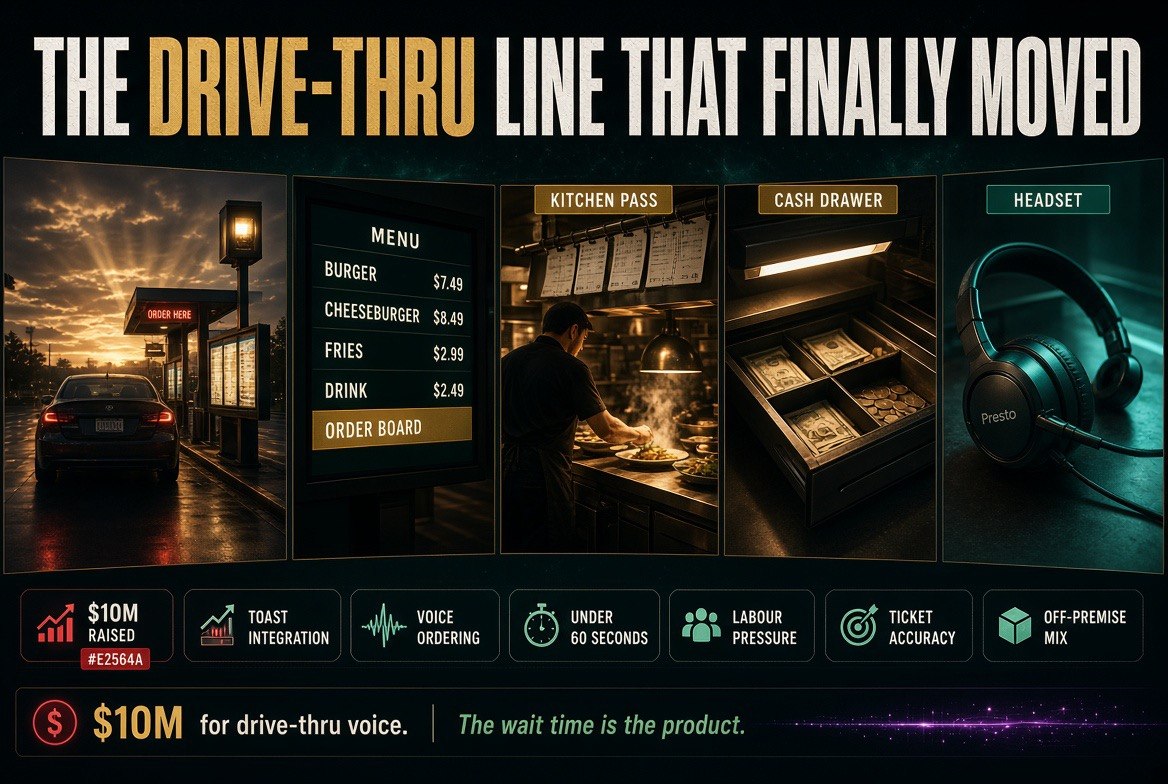
$10M into drive-thru voice. The whole bet is the wait time, not the software.
What Presto Actually Raised — and Why the Details Matter
The financing was announced September 28 and came from investors affiliated with Remus Capital along with other existing investors. Reports confirmed one detail that gets lost in headline coverage: this is not the same as the $10 million Presto announced in January, which was led by Metropolitan Partners Group with participation from Remus Capital, Link Ventures, and strategic investors.
Presto did not disclose a valuation or the financing structure in the September announcement, so the two rounds should not be treated as equivalent. Anyone summarizing this as “Presto raised $20 million” is flattening two different transactions into one number that nobody at the company confirmed.
What the company did say is more useful than the number. Presto attributed the round to expanded deployments with existing customers, additional customer launches, and continued product development. CEO Krishna Gupta put it plainly: “We are investing heavily in product and operations.”
Read that as an admission of where the work actually is. Presto is not raising to invent voice ordering — that product exists. It is raising to deploy and support it at scale, which is the unglamorous half of restaurant technology and the half that determines whether an operator’s pilot survives contact with a Friday dinner rush.
Notably absent from the announcement: an updated installation count or detailed performance results. That omission is its own signal. When a company raises money and does not lead with deployment numbers, the burden of proof shifts to customer references and to your own test, not to the pitch deck.
| Detail | September 28 Announcement | January Announcement |
|---|---|---|
| Amount | $10 million | $10 million |
| Lead investors | Investors affiliated with Remus Capital + existing investors | Metropolitan Partners Group, with Remus Capital, Link Ventures, and strategic investors |
| Valuation disclosed | No | No |
| Stated use of funds | Expanded deployments, new customer launches, product development | Not specified in the same detail |
| Update to install count | None provided | None provided |
If a vendor’s own fundraising coverage is light on operational proof, your pilot design has to compensate. That means measuring the things the press release does not, in your own restaurant, before you sign anything beyond a test.
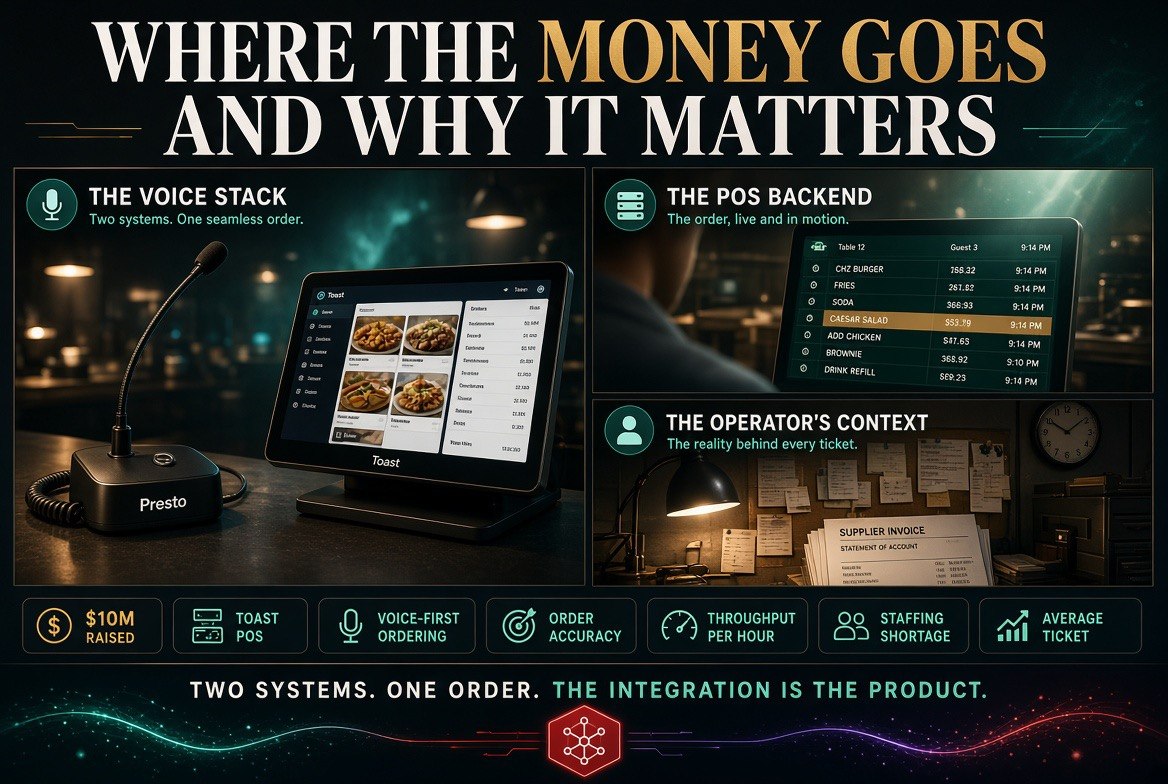
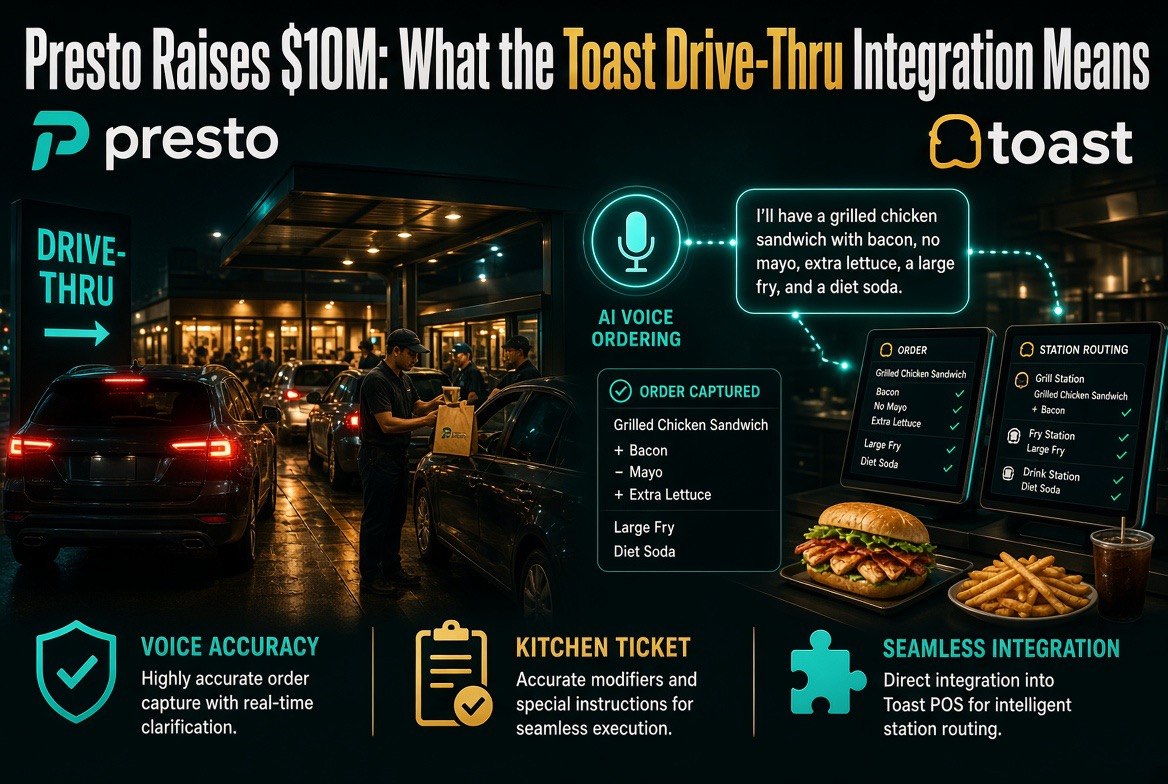
Two systems, one order — the voice stack on the left, the POS backend on the right. The integration is the product.
The Toast Integration — Why This Is the Actual News
Announced September 21, a week before the raise, the Toast integration lets orders captured by Presto Voice enter the Toast POS and move to the kitchen. Presto named midsize and emerging multilocation quick-service brands as the expansion opportunity.
That sentence is doing a lot of work. Presto is not chasing the biggest chains, which have the engineering staff to build custom integrations and the leverage to demand them. It is chasing operators who are too big for a single-location workaround and too small to have a team building connections between systems. That is a specific, underserved middle — and a large share of independent and franchisee operators sit inside it.
The practical value is straightforward: compatibility with the POS you already run means voice automation becomes a manageable project instead of a systems replacement. No second POS. No duplicate menu maintenance. No training staff on a new interface they will resent by week three.
But the integration solves a specific failure mode, and understanding which one explains why voice AI has disappointed so many operators. Understanding words is only useful if the resulting order contains correct items, correct prices, and correct modifiers, and reaches the appropriate preparation station. A system can repeat an order back to you with flawless confidence while producing a kitchen ticket that an employee has to stop and fix.
That gap — convincing conversation, broken ticket — is where most voice AI pilots quietly die. The operator hears a perfect order confirmation, walks away, and finds out fifteen minutes later that the kitchen got the wrong thing. Toast integration attacks that gap directly by removing the translation layer between the voice system and the ticket printer.
It also changes the competitive picture rather than ending it. Toast introduced a unified drive-thru offering in April and named Incept AI among its voice-ordering partners, saying more integrations would follow. Presto joining that ecosystem means it now competes against other providers inside the same restaurant infrastructure. For buyers, that is good news: you can compare voice providers without changing your POS, and evaluate them on order accuracy, response speed, implementation effort, and support instead of on platform lock-in.
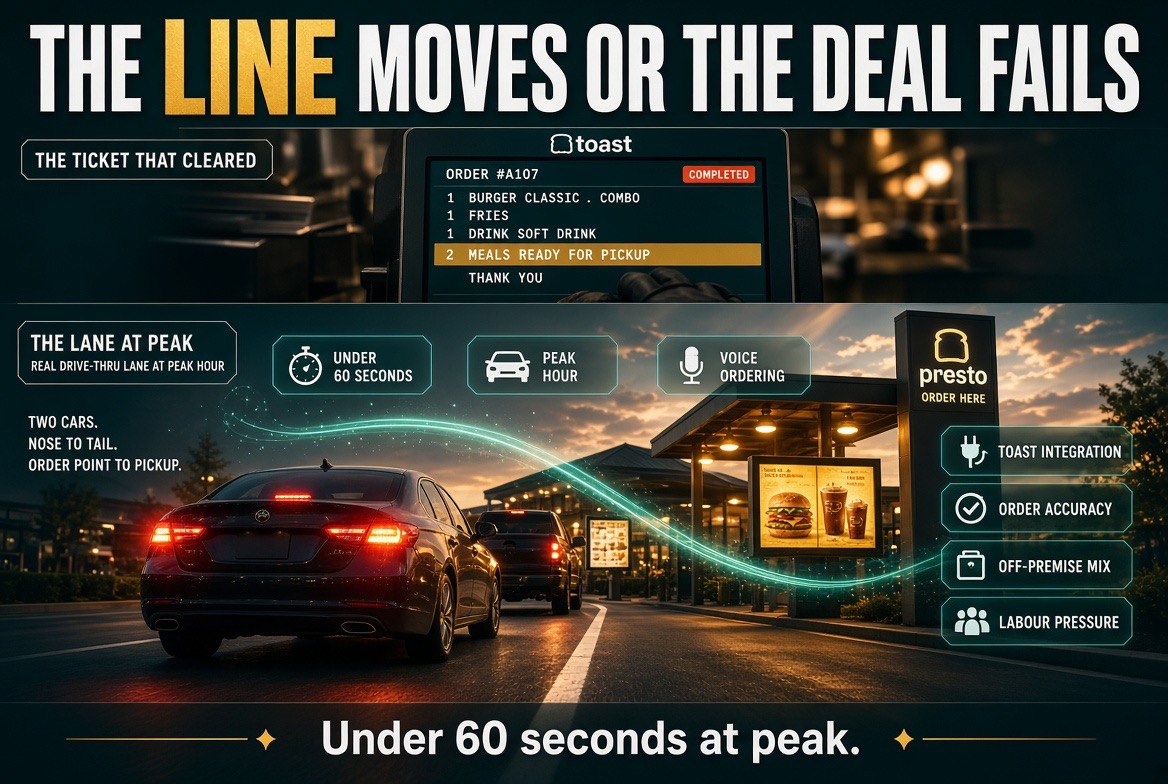
Under 60 seconds at peak. Everything else is a detail.
What to Test Before You Sign — The Whole Transaction
Because the integration makes a pilot easy to start, the risk shifts from “can I install this” to “is it actually accurate in my restaurant.” Those are different questions, and the second one is where money gets lost.
The specific thing to test is the entire transaction end to end — not the voice interaction in isolation. Most evaluations stop at the speaker. The failures happen after it.
| What to Test | How to Run It | What a Failure Looks Like |
|---|---|---|
| Mid-order changes | Order, then change a size, swap a side, and remove an ingredient halfway through | The ticket shows the original item, or both versions, or drops the modification entirely |
| Modifier pricing | Order items with add-ons and substitutions that carry upcharges | Correct item, wrong price — a systematic margin leak on every such order |
| Prep station routing | Order a mixed basket that spans fry, grill, and cold stations at peak volume | Items land at the wrong station, or one ticket splits into work nobody noticed |
| Recovery from confusion | Mumble, interrupt mid-sentence, change your mind twice, speak with an accent | The system guesses instead of escalating — and the guess arrives as a real ticket |
| Peak-hour latency | Run the test during your actual rush, not a Tuesday at 3pm | Response lag that lengthens the lane and costs more cars than the labor it saves |
Presto’s configuration options help here in a way that is easy to overlook. The platform supports several operating models, ranging from fully autonomous AI to systems with remote human oversight or assistance when difficulties arise. That flexibility means the honest question is not “autonomous or not” but where you want the human on the escalation ladder — and how quickly the system hands off when it is out of its depth.
There is also a menu-management cost that most evaluations skip. Presto introduced Menu Unification in February 2025 to organize disparate menu data and support centralized management across locations. That capability matters more as deployments grow, because every additional restaurant brings local variation the ordering system must handle accurately. A promotional item available at one location and absent at another. Different pricing. Different substitutions and permitted combinations. If those differences require repeated manual configuration, expansion gets expensive for both the operator and the vendor — and the cost lands on whoever agreed to maintain the data. Establish before signing who owns menu updates and how fast a change reaches the ordering system.
The Voice, the Partners, and the Realistic Timeline
Presto’s partnership with ElevenLabs, announced in September 2025, covers voice synthesis, quality, and analytics, beginning with ElevenLabs voices in drive-thrus. Clearer, more natural speech genuinely does make an ordering exchange easier to follow — and it matters more than it sounds, because customers who struggle to understand the system talk louder, repeat themselves, and slow the lane.
But natural-sounding speech is not the same as accurate understanding. A voice that sounds human raises expectations, and unmet expectations produce complaints faster than a robotic voice that sets the bar low. Evaluate synthesis alongside the system’s ability to understand corrections and recover from misunderstandings — the two are frequently confused, and only one of them produces a correct ticket.
On customer proof, the most concrete signal is Dairy Queen, which expanded its testing with Presto in April, moving from corporate-store trials to a broader pilot involving select franchisees. That progression is meaningful because it tests the system across more operating conditions. It is also not the same as a systemwide rollout, and the gap between the two is where franchise technology projects normally stall — locations differ in equipment, volume, staffing, and tolerance for anything that slows the lane.
Worth knowing if you are evaluating Presto as a company rather than a product: this business traces to 2008, when Rajat Suri founded the original Presto while studying at MIT. Its early work was tabletop ordering and payment for full-service restaurants before the focus shifted to drive-thru voice. The current company emerged from a December 2024 asset sale in which a consortium led by Remus Capital, including Link Ventures and Metropolitan Partners Group, acquired assets from Presto Automation. That transaction created the privately held Presto Phoenix, retained the voice platform, technology, and team, and brought an $18 million capital injection.
That history is relevant for one practical reason: this is a company carrying years of restaurant technology experience under a newer ownership structure and a much narrower focus. Narrow focus is usually good for product quality and bad for vendor diversification. If you buy into a single-purpose voice provider, know what happens to your lane if the funding environment changes.
What This Means for Your Restaurant
Treat the Toast integration as the reason to look, not the reason to buy. It removes the biggest practical objection — replacing your POS — and it means a pilot is now a contained project rather than a systems migration. That justifies a test. It does not justify skipping the test.
Design the pilot around the kitchen ticket, not the conversation. Measure order accuracy on modified items, upcharge accuracy, and correct station routing. Those three numbers predict your actual outcome far better than any demo, because they are the places where money silently leaks.
Decide your escalation threshold in advance. Presto offers configurations from autonomous to human-assisted. Pick the point where the system must hand off, write it into your operating standard, and tell your crew — because the people covering the lane are the ones who will live with a bad call at 7pm on a Friday.
Pin down menu data ownership. Ask who maintains per-location variations and how quickly a price change reaches the ordering system. If the answer is “you do, manually, per store,” that cost multiplies with every location you add, and it is the single most common place where an AI rollout’s economics quietly invert.
Check compatibility before the sales call. Confirm your drive-thru equipment is supported and that your volume justifies the configuration you are buying. Voice AI is most defensible in high-volume lanes where labor is genuinely strained. In a low-volume lane, the math is harder and no integration changes it.
Frequently Asked Questions
How much did Presto raise in September 2026?
Presto raised $10 million, announced September 28, 2026, from investors affiliated with Remus Capital and other existing investors. This is separate from the $10 million Presto announced in January, which was led by Metropolitan Partners Group. No valuation or financing structure was disclosed for the September round, so the two should not be added together or treated as one transaction.
What does the Toast integration actually do for a restaurant?
It allows orders captured by Presto Voice at the drive-thru to enter the Toast POS directly and flow to the kitchen, rather than requiring a separate connection or manual re-entry. For operators already running Toast, that removes the biggest implementation barrier — you do not replace your POS to test voice ordering.
Does the Toast integration guarantee accurate orders?
No. It removes the translation layer between the voice system and the kitchen ticket, which addresses one major failure mode. Accuracy still depends on whether the system handles mid-order changes, modifier pricing, and prep-station routing correctly in your specific restaurant at your specific volume. That has to be tested directly.
Is Presto already deployed at scale?
Presto has not published an updated installation count or detailed performance results. The most concrete recent proof point is Dairy Queen, which expanded from corporate-store trials to a pilot involving select franchisees in April 2026. That is genuine validation across more operating conditions, but it is not a systemwide rollout.
What should an independent operator measure during a voice AI pilot?
Four numbers: order accuracy on modified items, upcharge pricing accuracy, correct prep-station routing, and response latency during your actual peak service. Track them against your current human-run lane. If accuracy on modified and upcharged items is not high, the system will cost you more in remakes and margin than it saves in labor.

About Barak Schurr
Barak Schurr built and exited a major ticketing platform, ran global operations at Eventbrite, and now focuses on one question: which AI tools actually help independent restaurant owners run leaner and grow faster. He writes from the operator’s perspective — no vendor spin, no theory, just what’s real in 2026.
Email: [email protected]
More Resources for Restaurant Operators