Get the AI Restaurant Quick-Start Guide — Free
The 5 AI tools independent US restaurant owners are using right now to cut labor costs and answer every call.
How to Cut Restaurant Utility Costs With AI in 2026
⚡ Expert Summary: Utility costs are the third-largest controllable expense for most independent US restaurants — after labor and food — yet almost nobody audits them. AI tools can now read your utility bills, catch billing errors, forecast energy demand, and shave 12-30% off the line without a single equipment replacement. This guide shows you exactly how to do it in seven steps.
You know the number that kills your margin. It is not the rent, and it is not the food cost — you watch those. It is the utility bill that arrives every month, gets paid without a second look, and climbs another few percent while you are focused on the floor. Labor gets scheduled, food gets counted, and utilities get ignored.
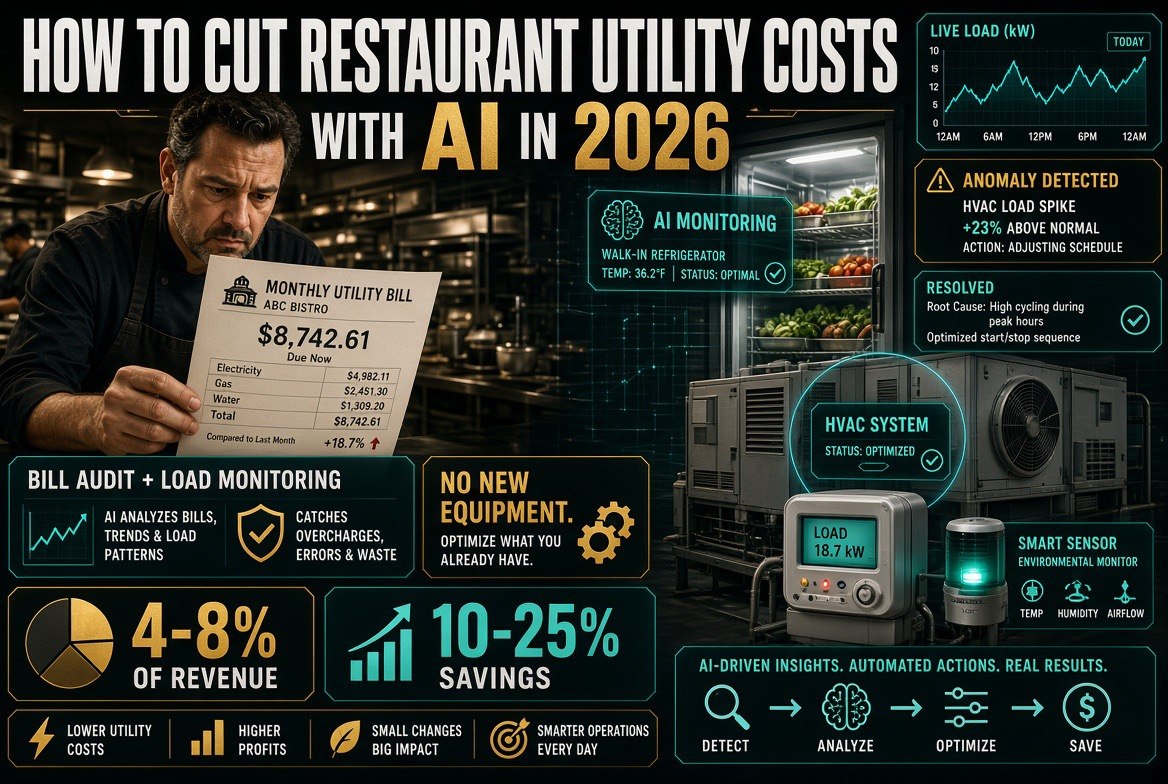
That is the leak. Energy is one of the most controllable cost lines in a restaurant and one of the least examined. For most independent US operators, utilities run 4-8% of revenue, and a meaningful slice of that is pure waste: equipment running when it should not, HVAC fighting an open kitchen door, refrigeration drifting out of spec for months before anyone notices.
AI does not run your equipment. What it does is make the invisible visible — it reads the meter data, reads the bills, watches the compressor cycles, and tells you where the money is going. Here is the complete playbook.
Why Restaurant Utility Costs Are So Hard to Control
Restaurants are one of the hardest commercial spaces to manage for energy. The reason is structural, not a discipline problem.
A restaurant is a 4,000–8,000 square-foot box containing commercial refrigeration, gas-fired cooking equipment, high-volume ventilation, hot water, and lighting — all running on overlapping schedules with a building envelope that is designed to leak air (because you are moving a lot of it). A typical US restaurant uses around 250,000 BTU per square foot per year, several times a typical office building.
Now layer on the operational reality: nobody on staff owns the utility bill. The GM pays it. The owner glances at it. The chef does not think about it. There is no single person whose job is to reduce it, and the data lives in a PDF that arrives 30 days after the usage already happened.
That lag is the core problem. By the time you see the number, the behavior that caused it is a month in the past. AI closes that lag — it turns a monthly retrospective into a live signal.
What AI Can Actually Do About a Utility Bill
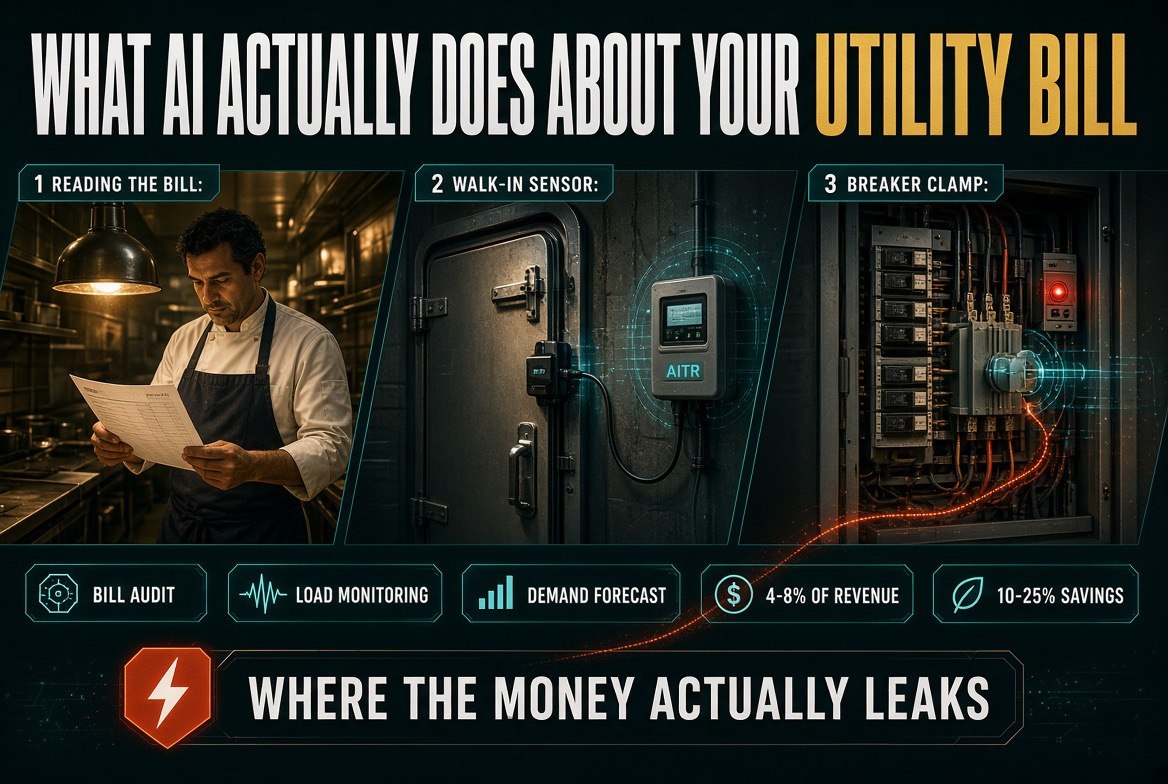
Before you spend a dollar, understand what the technology does and what it does not. There are three distinct functions, and they are often sold together but solve different problems.
| AI Function | What It Does | Typical Savings |
|---|---|---|
| Bill auditing / rate analysis | Reads every utility bill, flags billing errors, wrong rate plans, and unexplained spikes | 2–8% (error recovery) |
| Load monitoring / anomaly detection | Sensors plus ML watch equipment cycles and flag a compressor or HVAC unit drifting out of spec | 10–25% (waste elimination) |
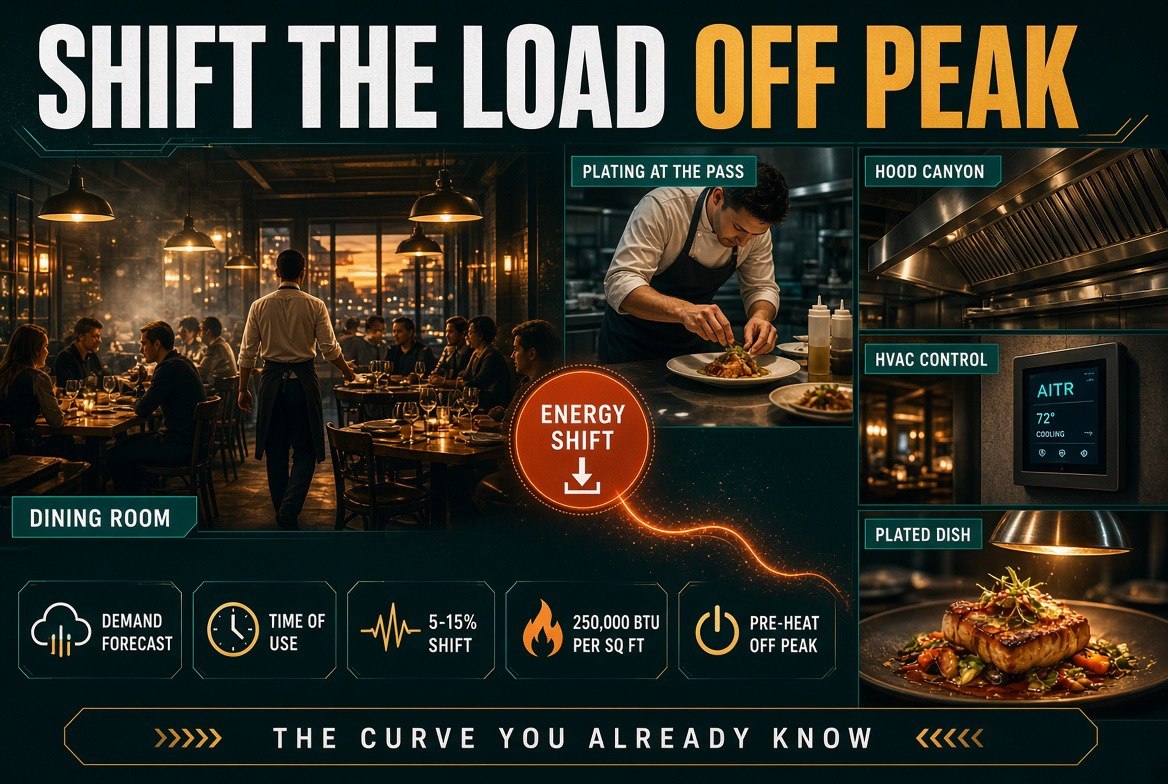
| Demand forecasting / scheduling | Predicts peak load and shifts pre-heating, cooling, and prep to lower-cost windows | 5–15% (time-of-use shifting) |
The savings stack. A single-site operator who audits bills, fixes two or three billing errors, and catches one failing compressor in a year will typically recover the cost of the software several times over. Multi-unit operators see more, because the anomalies repeat across locations.
Step 1: Pull Twelve Months of Utility Data Into One Place
You cannot optimize what you cannot see, and right now your utility history is almost certainly scattered: a stack of PDFs, an online portal login you have forgotten, and a paper bill the bookkeeper files somewhere.
What to do: Gather 12 consecutive months of electricity, gas, and water bills for each location. If you use a bill-pay platform or your accountant has them, export from there. Twelve months is the minimum — you need a full seasonal cycle before AI can tell a trend from a spike.
Why it works: AI anomaly detection needs a baseline. A single month tells you nothing. A year tells the model what your restaurant’s normal winter and summer profile looks like, which is exactly what makes an outlier visible.
Tool recommendation: Any bill-management platform that accepts a PDF upload and parses line items will work. If you already use a restaurant accounting platform, check whether it ingests utility bills — many now do, and consolidating into the system your bookkeeper already opens removes friction.
Step 2: Run an AI Bill Audit Before You Invest in Hardware
This is the step that pays for itself first and costs almost nothing. Utility billing errors are common — wrong meter reads, rate plans that no longer match your usage profile, demand charges assessed on the wrong window, and taxes applied incorrectly.
What to do: Upload 12 months of bills to an AI auditing tool or hand them to a service that does AI-assisted utility audits. Ask it two questions: is there any charge here that does not match actual usage, and are we on the rate plan that fits our load profile?
Why it works: Rate plans are priced for specific usage shapes. A restaurant that shifted to more electric cooking, or added a second walk-in, can be on a plan that made sense three years ago and is now costing hundreds a month. AI compares your actual load against the rate schedule and finds the mismatch, which a human reading 12 PDFs will not do reliably.
Tool recommendation: Start with whatever your utility’s own portal offers for plan comparison — it is free — then use an AI audit service for the deeper error check. Document every finding. Some utilities allow retroactive correction for billing errors, so a dated audit trail matters.

Step 3: Install Metering on the Equipment That Actually Drinks Power
Know where the load is before you try to move it. In most restaurants, three systems dominate: refrigeration (walk-ins, reach-ins, prep tables), HVAC/ventilation, and cooking equipment. Lighting and hot water follow.
What to do: Put sub-metering or smart sensors on refrigeration and HVAC first. These are the two systems where a slow failure is both expensive and invisible — a compressor short-cycling for six weeks shows up as a higher bill and a slightly warm walk-in nobody reported.
Why it works: The moment you can see consumption per circuit, the conversation changes from “the bill is high” to “circuit 14 is drawing 40% more than it did in June.” That is an addressable problem with a specific fix.
Tool recommendation: Non-invasive current transformers that clamp onto a breaker do not require an electrician to rewire anything and can be installed during a slow service. Pair them with software that does the pattern recognition; the sensor is commodity, the analytics layer is where the value is.
Step 4: Let AI Forecast Demand and Shift Your Load
If your utility prices by time of use — and increasingly US utilities do — the cost of a kilowatt-hour depends on when you use it. AI forecasting turns that from a trap into an opportunity.
What to do: Feed the forecasting model your sales history, reservation data, weather, and local events. Let it predict tomorrow’s load, then use that forecast to schedule pre-heating, dishwashing, and HVAC recovery into cheaper windows.
Why it works: Restaurants have a highly predictable demand curve — you know when Friday service hits. The problem is that equipment warming and cooling does not have to follow it exactly. Shifting the flexible portion of your load off-peak is one of the few savings levers that costs nothing in guest experience.
Tool recommendation: If you already run AI demand forecasting for food prep, the same sales forecast can drive energy scheduling. Do not buy a second forecasting system — connect the one you have to your building controls where possible, and otherwise act on its output manually.
Step 5: Fix the Building Envelope and Ventilation Balance
Here is where a lot of restaurant energy disappears: the kitchen exhaust is pulling conditioned air straight out of the dining room, and the makeup air is coming in through the front door in February.
What to do: Get the ventilation balanced so that exhaust and makeup air are matched, and have an AI-assisted HVAC schedule generated against your actual occupancy rather than a fixed timer. Verify door seals, gaskets, and hood filters — these are cheap fixes with outsized effect.
Why it works: A kitchen exhaust system can move enormous volumes of air. If the makeup air is not conditioned and balanced, you are paying to heat and cool air that immediately leaves the building. Correcting the balance is a one-time cost that reduces the bill every month after.
Tool recommendation: A controls system that can run an occupancy- and weather-aware schedule beats a fixed timer decisively. Even a basic smart thermostat with scheduling logic is better than a static setpoint, and it delivers a visible data trail you can act on.
Step 6: Watch for the Compressor That Is About to Fail
The single most expensive utility event in a restaurant is a refrigeration failure. You do not just lose the food — you lose it all at once, overnight, and the replacement compressor costs more than a year of the savings you were chasing.
What to do: Set thresholds on your refrigeration monitoring so that any unit drawing outside its normal envelope for more than a set window raises an alert. Route the alert to the person who can actually dispatch a technician, not into a dashboard nobody opens.
Why it works: Compressors rarely fail instantly. They degrade — drawing more current over weeks as they labor. AI catches that trend before it becomes a 3 AM food-loss event, and the same signal is your early warning for a refrigerant leak.
Tool recommendation: Combine the monitoring with your preventive maintenance calendar. The value is in the response, not the alert — an alert with no owner is just noise.
Step 7: Measure, Compare, and Repeat Every Month
Saving once is not saving. The point is a lower baseline, permanently, and that requires a monthly loop.
What to do: Set a monthly review where you compare actual consumption against the forecast, log the variance, and question any month that misses by more than a set percentage. Feed the findings back into the model.
Why it works: Restaurants drift. Equipment ages, staff habits change, a new fryer gets added, a patio door starts living open. A monthly loop catches drift while it is still cheap to correct.
Tool recommendation: Use the reporting your monitoring platform already produces. If you run multiple locations, benchmark them against each other — a unit that is 20% above its peers on energy per cover has a story worth reading.
What This Is Worth, Realistically
Nobody can promise you a specific percentage, and you should be suspicious of anyone who does. What the data supports is a range, and even the low end is real money at restaurant scale.
| Restaurant Type | Typical Annual Utility Spend | Conservative AI-Driven Savings (10%) | Strong Result (20%) |
|---|---|---|---|
| Small café / counter service | $18,000–$28,000 | $1,800–$2,800 | $3,600–$5,600 |
| Full-service, 1 location | $35,000–$55,000 | $3,500–$5,500 | $7,000–$11,000 |
| High-volume / 24-hour | $70,000–$110,000 | $7,000–$11,000 | $14,000–$22,000 |
| Multi-unit (per location) | $35,000–$55,000 | $3,500–$5,500 | $7,000–$11,000 |
The ranges are estimates for illustration, built on typical US restaurant energy spend per square foot. Your actual numbers depend on climate, equipment age, and utility rates — which is exactly why step 1 is pulling your own data rather than trusting a generic benchmark.
If you want to go further, the same discipline that cuts utilities also cuts food and labor cost. Our guide to cutting restaurant food waste by 30% with AI and our breakdown of cutting labor cost 20% with AI scheduling follow the same pattern: find the invisible leak, instrument it, and fix the cause rather than the symptom.
AI vs Traditional Energy Management: What Actually Changes
Energy management is not new. What changed is the cost of the intelligence layer, and that changes who can afford to play.
| Factor | Traditional Energy Consultant | AI-Assisted Monitoring |
|---|---|---|
| Sampling frequency | Quarterly walkthrough, monthly bill review | Continuous, per-circuit, minute-level |
| Finds billing errors | Yes, on manual review | Yes, automatically across all months |
| Predicts equipment failure | Rarely — depends on technician judgment | Core function — trend analysis on current draw |
| Response time to anomaly | Weeks to months | Hours |
| Cost for a single-site operator | Retainer, typically out of reach | Software subscription, accessible |
| Owner’s visibility | A report you read once | A live dashboard plus alerts |
The honest read: an energy consultant still has a role for a full retrofit or a major capital project. Where AI wins is the day-to-day — catching the drift, the error, and the failing compressor while they are still small problems. Most independent US operators will never hire a consultant. Almost all of them can afford monitoring software, and that is the entire shift.
Common Mistakes That Kill the Savings
Operators who try this and get nothing back usually make one of four mistakes. Each is avoidable.
Mistake 1: Buying sensors and never acting on alerts. Monitoring without a designated owner is decoration. Decide in advance who receives an alert and what they do in the next hour.
Mistake 2: Optimizing before auditing. Chasing a 5% scheduling saving while a billing error is bleeding 8% every month is backwards. Audit first — it is cheaper and often bigger.
Mistake 3: Treating the forecast as a report. Demand forecasting only pays when it changes a schedule. If nobody moves a setpoint or a start time because of it, you bought a chart.
Mistake 4: Chasing savings that cost you covers. A dining room that is too warm in July is not a saving, it is a bad review. Every efficiency change has to survive a Friday night.
The Bottom Line for Independent Operators
Utility cost is the leak most restaurants never look at, because the bill arrives after the fact and nobody owns the number. AI does not fix that by itself — but it removes the excuse. You can now see consumption per circuit, per hour, and per cover, and you can compare any month against your own baseline and against your other locations.
Start with the audit, because it is nearly free and occasionally finds real money. Add monitoring on refrigeration and HVAC. Fix the ventilation balance. Then set the monthly loop and leave it running, because a restaurant that reviews its energy data every month does not drift for a year.
None of this requires new cooking equipment, new staff, or a capital project. It requires twelve months of bills and the willingness to look at them every month instead of once a year.
Frequently Asked Questions
How much can a restaurant realistically save on utilities with AI?
Most independent US restaurants that audit bills, fix errors, and add monitoring on refrigeration and HVAC land somewhere between 10% and 25% of their utility spend over the first year. The variance is driven by how much waste was hiding to begin with — an old, unaudited building has more to recover than a recently renovated one.
Do I need to replace my equipment to cut utility costs?
No. The savings in this guide come from auditing, monitoring, scheduling, and maintenance — none of which requires replacing a working unit. Equipment replacement is a separate, larger capital decision and should only follow once you have data showing a specific unit is the problem.
How long before I see results?
The bill audit can produce findings in the first month, and billing-error corrections sometimes land retroactively. Monitoring benefits build over the first full seasonal cycle — roughly twelve months — because that is how long it takes to establish a reliable baseline for your building.
Is this worth it for a single-location restaurant?
Yes. Monitoring and audit software is now priced for single-site operators, which is the main thing that changed. A single full-service location spending $35,000-$55,000 a year on utilities has enough at stake to justify the subscription several times over.
What if my utility does not offer time-of-use pricing?
You still benefit from the audit and the monitoring, which together are usually the larger share of the savings. Time-of-use shifting is additive — useful where it exists, not a prerequisite for the rest of the playbook.
Can I do this without hiring a consultant?
Yes, and most independent operators should. The seven steps here are designed to be run in-house with software and your existing bookkeeper. Bring in a consultant only for a capital retrofit or if your utility rate structure is genuinely complex.

About Barak Schurr
Barak Schurr built and exited a major ticketing platform, ran global operations at Eventbrite, and now focuses on one question: which AI tools actually help independent restaurant owners run leaner and grow faster. He writes from the operator’s perspective — no vendor spin, no theory, just what’s real in 2026.
Email: [email protected]
More Resources for Restaurant Operators