Get the AI Restaurant Quick-Start Guide — Free
The 5 AI tools independent US restaurant owners are using right now to cut labor costs and answer every call.
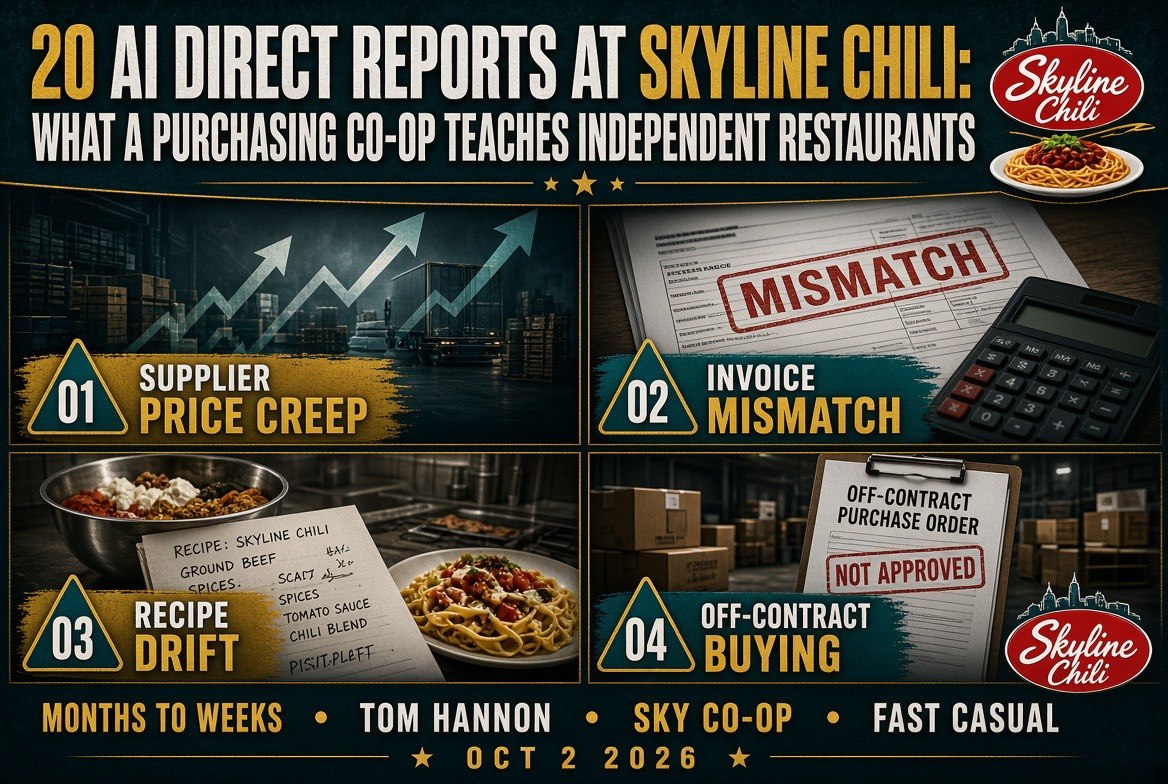
20 AI ‘Direct Reports’ at Skyline Chili: What a Purchasing Co-op Teaches Independent Restaurants
⚡ Expert Summary:
Skyline Chili’s purchasing co-op, Sky Co-op, put 20 AI agents to work as what founder Tom Hannon calls “direct reports” — software that monitors the business continuously rather than waiting to be asked a question. The headline result is specific: margin leaks that used to surface in months now surface in weeks. It did not require replacing staff, and it did not require a seven-figure technology budget. Here is what an independent operator can actually copy.
Most restaurant AI stories are about ordering kiosks or drive-thru voices. This one is different, and it is the more useful kind of story for an independent owner. It is about cost, not revenue. It is about a co-op, not a chain. And it is about software that watches rather than software that chats.
Skyline Chili’s purchasing co-op, known as Sky Co-op, built a set of roughly 20 AI agents that function as monitoring staff across the business. In Fast Casual’s reporting on October 2, 2026, founder Tom Hannon described them as “direct reports”: each one owns a defined patch of ground and reports problems rather than waiting for someone to ask.
What Sky Co-op Actually Built
The distinction that matters is between a tool that answers and a tool that notices. A chat assistant answers when a manager asks. A monitoring agent runs on a schedule, compares what it finds against what should be true, and speaks up when the two diverge.
Hannon’s framing of “direct reports” is deliberate and it is worth stealing. A direct report does not require you to remember to check on them. They own an outcome and escalate when it slips. Twenty of them working a purchasing co-op means twenty defined areas of the business are being watched at all times, not twenty software seats being paid for.
The Margin Leak Problem This Solves
Margin leaks in a restaurant are rarely dramatic. They are a supplier price that crept up two percent without a conversation, an invoice that does not match the delivery, a recipe that drifted from spec because a substitute ingredient got swapped in months ago and never got swapped back.
None of these are visible in a weekly P&L review. They accumulate quietly under the noise of a busy service, and by the time they show up in a monthly report the money is already gone. The reporting on Sky Co-op puts the change plainly: issues that were taking months to surface are now caught in weeks. That compression is the entire value proposition, and it has nothing to do with how clever the model is.
| Leak Type | How It Hides | What Monthly Review Misses |
|---|---|---|
|
Supplier price creep |
Small increases spread across many line items | The trend line looks flat month to month |
|
Invoice mismatch |
Charged quantity differs from delivered quantity | Reconciled late, or never reconciled at all |
|
Recipe drift |
Substituted ingredients never re-spec’d on the cost sheet | Plate cost no longer matches food cost reporting |
|
Off-contract buying |
Managers buying outside the agreed supplier for speed | Blends into general food cost variance |
Every one of those four leaks is invisible on any single day and obvious in a trend. That is exactly the shape of problem monitoring software is built for, and exactly the shape of problem a human reviewing reports once a month will keep missing.
Why a Purchasing Co-op Is the Right Place to Test This
A co-op buys on behalf of many independent operators. That means it sees pricing across a wide set of restaurants at once, which makes anomalies statistically obvious. If one member is paying meaningfully more for the same product, that is not noise, it is a signal.
It also means the savings scale. A leak caught across a co-op is worth many times what the same leak is worth in a single location. This is the structural advantage independents almost never get to use, and it is the reason this story is worth more attention than another kiosk rollout.
Monitoring Agents vs. Chat Assistants: A Real Comparison
| Factor | Chat Assistant | Monitoring Agent |
|---|---|---|
|
Who starts it |
A manager with a question | Runs on its own schedule |
|
What it produces |
An answer to what was asked | An alert about what changed |
|
Value when busy |
Unused during a full service | Keeps working regardless of workload |
|
Misses |
Anything nobody thought to ask about | Nothing it was not configured to watch |
|
Setup burden |
Low, works immediately | Higher, each agent needs a defined scope |
|
Best fit |
Ad-hoc research and quick questions | Recurring cost and compliance checks |
The honest tradeoff is in the setup row. A chat assistant is useful the day you sign up. A monitoring agent is only as good as the scope you define for it, which means the first week is configuration rather than results. That is the price of something that works without being asked.
What an Independent Operator Can Copy Without a Co-op
The co-op gives scale, but the pattern does not require one. An independent with two or three locations can run the same logic manually before buying anything: pick the four or five numbers that would hurt most if they moved without you noticing, and check them on a fixed schedule rather than when something feels wrong.
Supplier pricing on your top ten items by spend. Invoice-to-delivery accuracy on those same ten. Plate cost for your five best-selling dishes. Those three checks, done weekly, catch most of what the Sky Co-op agents are catching, just with a person doing the looking.
Where software genuinely earns its keep is consistency. A person doing a weekly check does it for six weeks and then gets a double shift and skips three. An agent does it every time. If your operation is small enough that a human will reliably do it, keep the human. If not, that gap is what you are buying.
What This Story Does Not Prove
It does not prove that 20 agents are necessary, or that the specific tooling is available to a single-location restaurant at a sensible price. It also does not include hard dollar savings figures, because none were published.
What it proves is narrower and still useful: monitoring beats asking for a specific class of problem, and the proof came from a purchasing co-op where the numbers are visible across many locations. If margin leaks that take months to surface are a real problem in your restaurant, and for most independents they are, the fix is a defined scope and a regular check, whether a person or a program performs it.
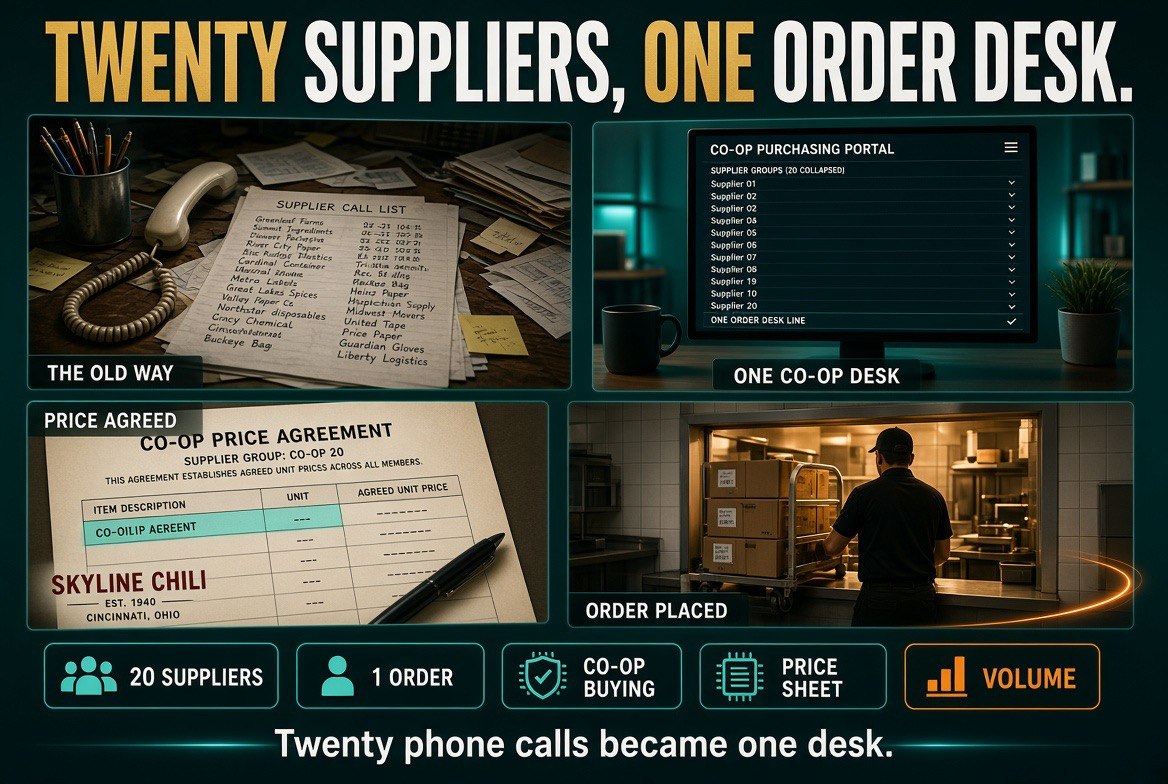
Twenty supplier calls became one order desk. That is the actual product a purchasing co-op sells an independent restaurant — not software, but a single point of negotiation.
Why This Beats Buying Another Dashboard
Most restaurant software sells reporting. You buy the system, it collects data, and it hands you a dashboard that someone is supposed to look at. The failure mode is identical every time: the dashboard is only as useful as the attention it gets, and attention is the scarcest resource in a restaurant.
Monitoring agents invert that. Instead of producing a report that waits to be read, they produce a signal that arrives whether or not anyone was thinking about supplier pricing that week. Hannon’s twenty direct reports are not twenty dashboards, they are twenty people who will tell you the moment something moves.
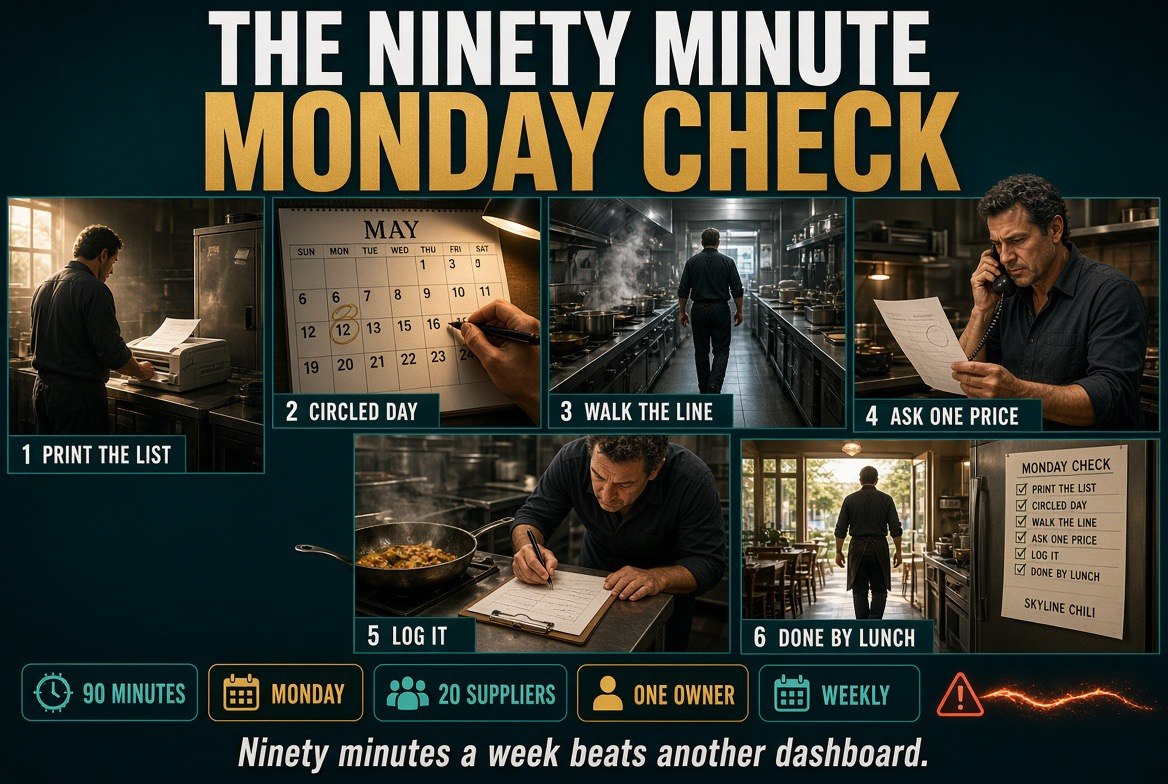
The whole system is a printed checklist and ninety minutes on a Monday. No dashboard, no subscription — which is exactly why an independent kitchen can actually keep it running.
The Weekly Check an Independent Can Start Monday
Before buying anything, run the manual version for four weeks. Pull your top ten items by spend and compare this week’s unit price to what you paid four weeks ago. Pull invoices for those ten and check delivered quantity against billed quantity. Recompute plate cost for your five best sellers using current supplier prices rather than the numbers you set when the menu launched.
That is roughly ninety minutes a week. If it finds nothing in a month, you have bought yourself confidence cheaply. If it finds a supplier price that climbed eight percent with no conversation, you have found the budget for the real thing plus the proof you needed it.
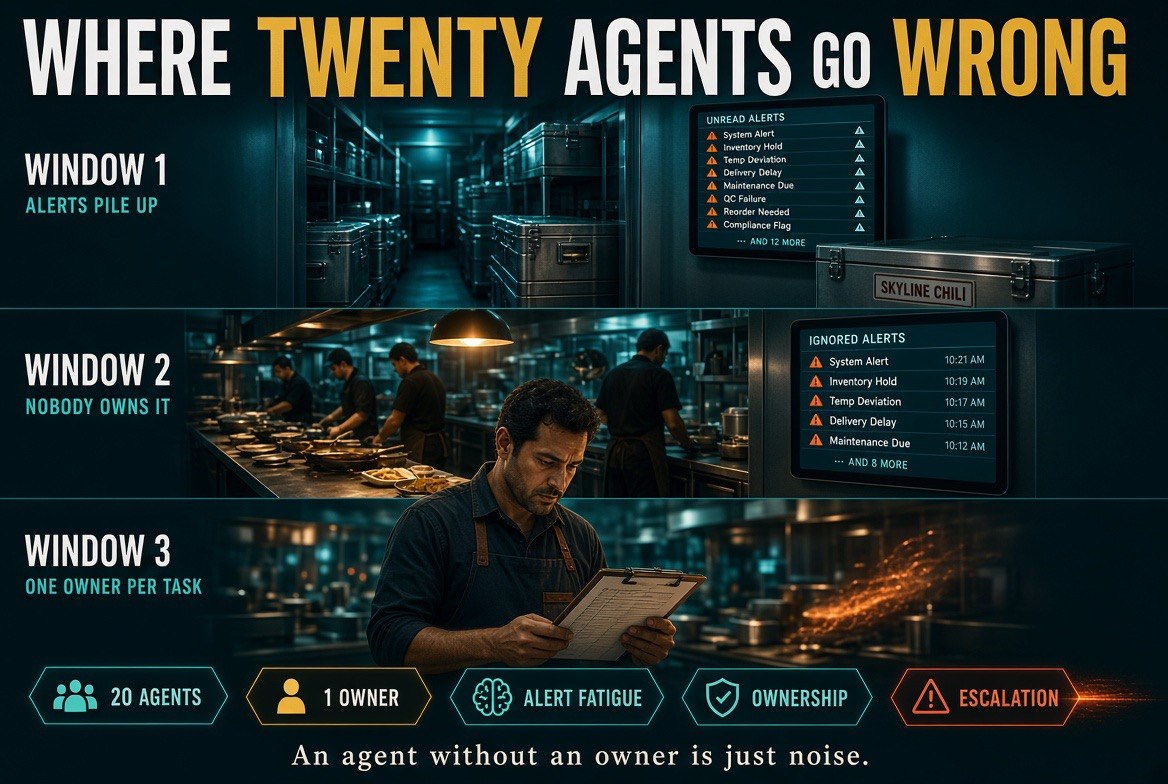
Twenty agents do not fail because the models are bad. They fail because no one owner is assigned to each alert — so the notifications stack up and the work quietly stops.
Where the Twenty-Agent Model Could Go Wrong
Agents that watch and report are only useful if the reports are short and actionable. Twenty agents each sending a daily digest is worse than no monitoring at all, because it trains everyone to ignore the channel. The discipline that makes this work is scoping an agent tightly enough that its alert is either a real problem or silence.
The second risk is ownership drift. If no human is accountable for acting on an alert, the agent becomes decoration. A direct report that raises a problem nobody closes is not a saving, it is a subscription. Assign each monitored area to a person the same way you would assign a station.
Frequently Asked Questions
What did Skyline Chili’s purchasing co-op build?
Sky Co-op, the purchasing cooperative behind Skyline Chili, deployed roughly 20 AI agents that founder Tom Hannon describes as “direct reports.” They monitor defined areas of the business and report changes, rather than answering questions on request. The reported result is that margin issues surface in weeks instead of months.
What is the difference between a monitoring agent and a chatbot?
A chatbot waits for a person to ask a question and answers it. A monitoring agent runs on its own schedule, compares current data against expected values, and alerts when they diverge. Chatbots are best for research; monitoring agents are best for recurring cost and compliance checks.
Can an independent restaurant use this approach without a co-op?
Yes. Pick the four or five numbers that would hurt most if they moved unnoticed, such as supplier pricing on your highest-spend items and plate cost on your best sellers, and check them on a fixed weekly schedule. Software adds consistency for operators who cannot guarantee a human will do the check every week.
What kinds of margin leaks do monitoring agents catch?
Common ones include slow supplier price increases spread across line items, invoices that do not match what was delivered, recipe cost sheets that were never updated after an ingredient substitution, and purchasing outside the agreed contract. Each is nearly invisible on any single day and obvious in a trend.
Does this require replacing staff?
No. The Sky Co-op example is about adding continuous monitoring, not cutting people. The agents cover checks that were previously done sporadically or not at all. Where a human does the checking reliably, keeping the human is the better economics.

About Barak Schurr
Barak Schurr built and exited a major ticketing platform, ran global operations at Eventbrite, and now focuses on one question: which AI tools actually help independent restaurant owners run leaner and grow faster. He writes from the operator’s perspective — no vendor spin, no theory, just what’s real in 2026.
Email:
[email protected]
More Resources for Restaurant Operators