Get the AI Restaurant Quick-Start Guide — Free
The 5 AI tools independent US restaurant owners are using right now to cut labor costs and answer every call.
Meadow AI’s $7M Digital Secret Shopper: What Independent Restaurants Get
⚡ Expert Summary: Seattle startup Meadow AI just raised $7 million to scale software that watches your restaurant through cameras and microphones, then tells your staff what to fix while the customer is still standing there. It is a “digital secret shopper” that runs every shift instead of once a quarter. For an independent operator, this is the first real answer to a problem chains solved years ago and you never could: knowing why a customer had a bad experience, not just that they did. Here is what it actually does, what it costs you in practice, and whether a single-location restaurant should care yet.
Ask any independent restaurant owner how their last shift went and you will get an honest answer built on instinct. Ask them why a specific customer left unhappy last Tuesday at 7:40pm and they will guess. The cameras recorded it. Nobody watched it. The gap between the recording and the correction is where money quietly leaks out of a restaurant, every single day.
Meadow AI just raised $7 million to close that gap, and the pitch is worth understanding even if you never buy the software. Because the problem it names is real in every independent restaurant, whether or not the solution fits.
What Meadow AI Actually Does
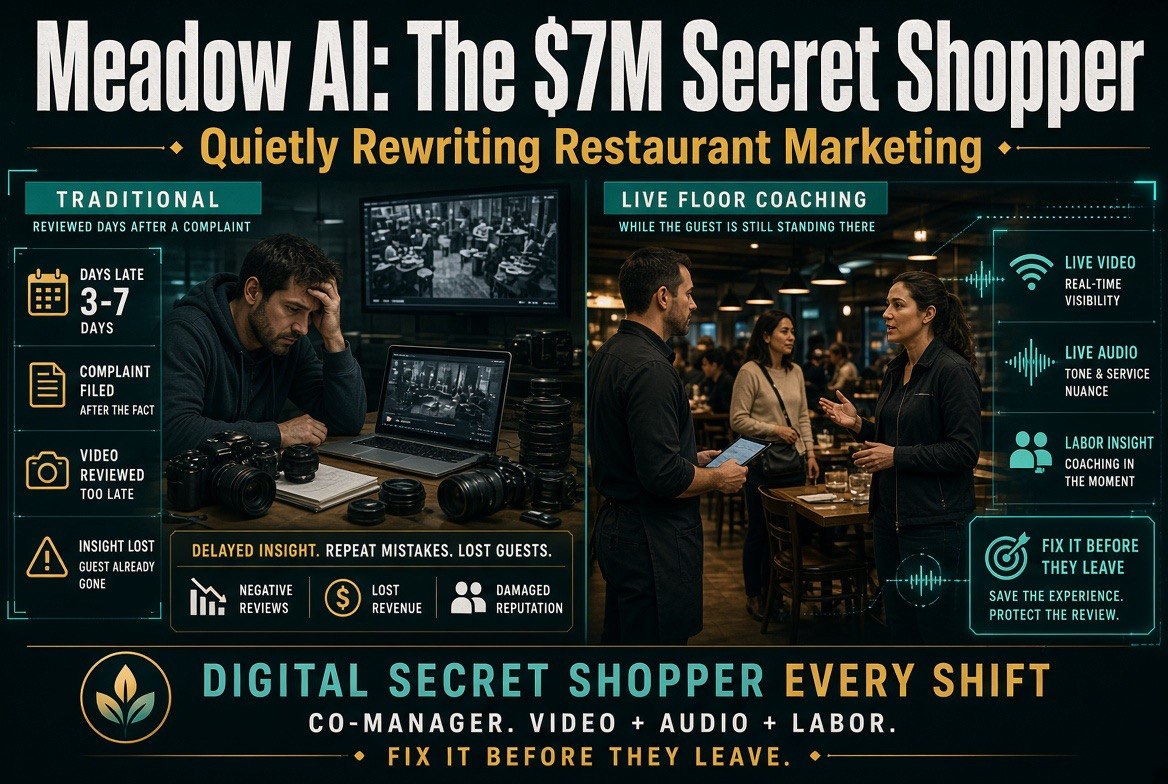
Meadow AI describes itself as an AI “co-manager.” It ingests three streams of data that already exist in your restaurant: video, audio, and your labor and inventory systems. It then continuously watches for the things that make customers leave unhappy — long lines, slow service, tables going ungreeted, staff standing idle while the pass backs up.
The critical difference from a standard camera system is timing. Traditional video is forensic: you review it after a complaint arrives. Meadow generates live prompts and coaching to frontline employees while the customer is still on-site, which is the only window where the correction still saves the sale.
It also automates administrative work — the repetitive tasks that pull your manager off the floor and into the back office during peak service.
| Factor | Traditional Camera Review | Meadow AI Co-Manager |
|---|---|---|
| When you learn about it | After a complaint or a bad review | While the guest is still on site |
| What you learn | That something looked wrong | Why the experience broke down |
| Who acts on it | You, usually days later | Your staff, in the moment |
| Coverage | Only what you happen to review | Every shift, continuously |
| Admin load | Reviewing footage manually | Repetitive admin tasks automated |
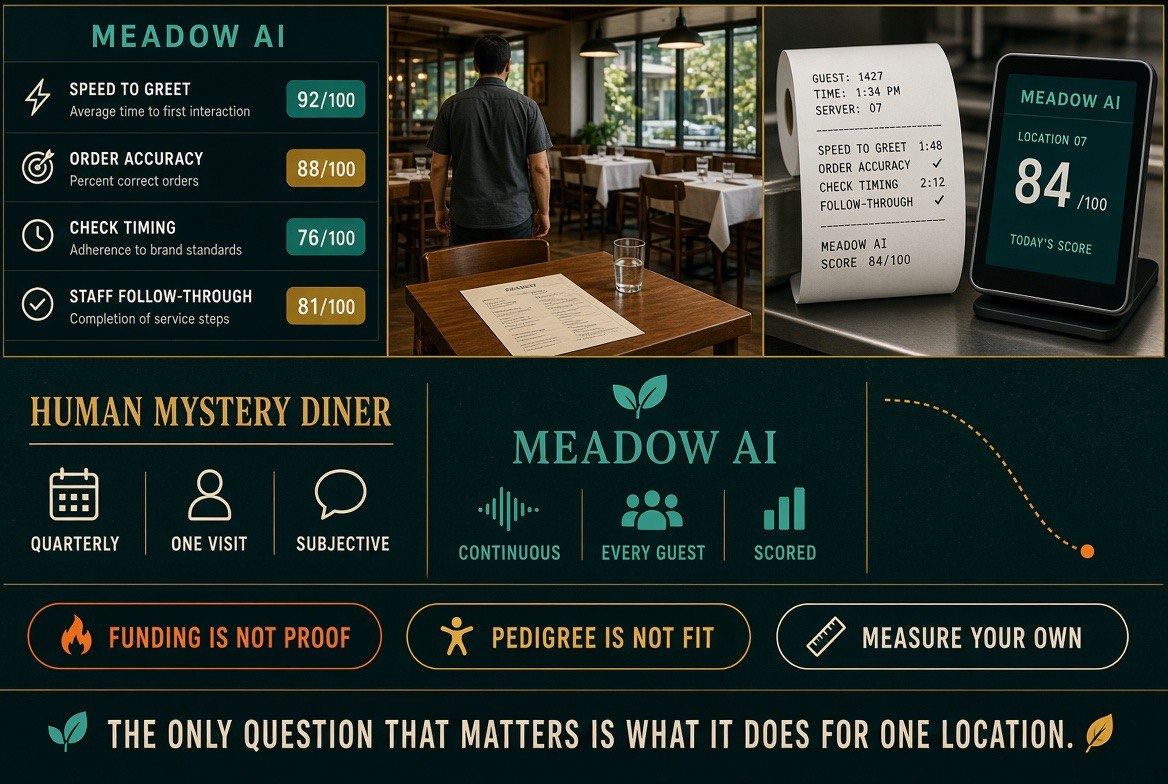
What the $7M buys: a continuous audit of the guest experience scored row by row, against a human mystery diner that shows up once a quarter — and the caveat that funding and pedigree are not proof it fits one location.
The Problem It Names Is Real for Every Independent Restaurant
E-commerce operators have it easy in one specific way. They can see the entire customer journey — which page, which click, which moment the cart was abandoned. A restaurant has almost none of that. Your POS tells you what was bought. It cannot tell you that the guest waited eleven minutes for a menu, or that nobody greeted the four-top that eventually walked out.
Meadow’s CTO put the gap plainly: physical businesses generate an enormous amount of information, but most operators still lack a real-time understanding of what is happening across their locations. That is a fair description of nearly every independent restaurant in operation today.
The blind spot costs money in ways that never appear on a report. An ungreeted table does not show up as a lost sale. A slow line does not appear as a refund. The revenue simply never arrives, and because there is no negative number to look at, nothing gets fixed.
What the Company’s Numbers Say — and What They Do Not
Meadow reports strong early traction, and the figures are worth reading carefully because they set expectations for the whole category.
| Metric | Reported Figure | What It Means for You |
|---|---|---|
| Funding raised | $7M seed, $13M total | Well capitalised, not a side project |
| Brands on platform | More than nine | Early, small base — a warning on maturity |
| Contracted ARR | Over $3 million | Signed, not yet fully live |
| Live ARR | Over $1.4 million | The real number — under half of contracted |
| Year-on-year growth | 6x software growth | Fast, but off a very small base |
The distinction between contracted and live ARR is the one to hold on to. The company has $3 million signed and $1.4 million actually running. That is not a criticism — deployments of this type take time — but it tells you the product is still being proven in the field, not coasting on years of standardised rollout.
Why a CRO From Toast Matters More Than the Funding
The most strategically interesting part of the announcement was not the money. It was the hire: Tanvir Bhangoo, formerly VP of Enterprise Solutions at Toast, joining as chief revenue officer to lead expansion across restaurant and retail accounts.
Toast is the dominant POS platform for independent restaurants. Someone from that organisation arriving at Meadow tells you exactly where the company is pointing its sales effort, and it tells you the buying motion will look familiar. If you already run Toast, expect this category to arrive in your inbox through the same channels that already reach you.
It also signals the shape of the offer to come. Enterprise-focused revenue leadership generally means annual contracts, tiered pricing and a sales process, rather than a self-serve tool you switch on this afternoon.
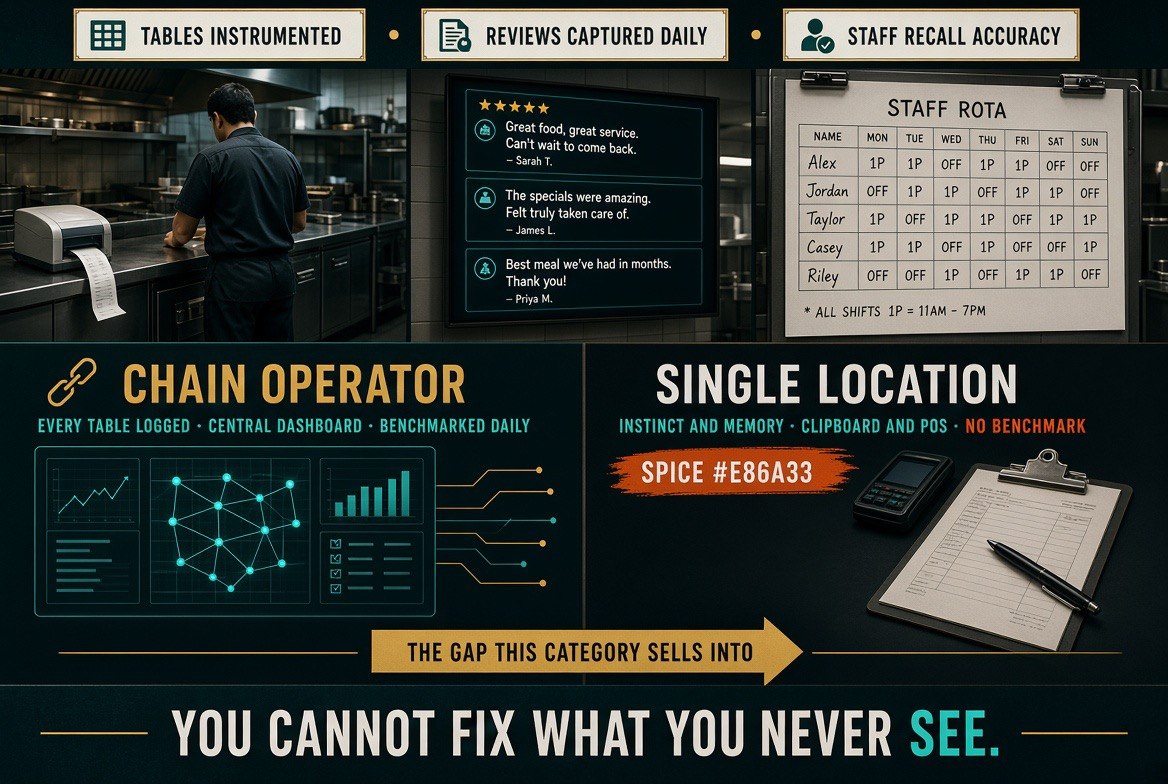
The gap this category sells into: a chain logs every table, benchmarks daily and sees it all on one dashboard — a single location runs on instinct, a clipboard and whatever the POS happens to remember. You cannot fix what you never see.
What This Means in Practice for a Single-Location Restaurant
The honest answer is that this is not yet a tool for you to buy.
| Your Situation | Is This For You Now? | What to Do Instead |
|---|---|---|
| Single independent location | No — built for multi-site brands | Fix greeting and wait times manually this week |
| 3-9 locations | Maybe — this is the target market | Ask about pilot pricing on one site |
| Fast casual, high volume | Strongest fit — speed is the product | Worth a serious look |
| Fine dining, low covers | Weak fit — service is already personal | Your floor manager is the system |
| Owner not on-site daily | High value — this replaces your eyes | Best use case in the whole category |
The Two Things To Get Right Before You Consider This Category
If you run multiple sites, or you are hoping to, two issues deserve attention before you take a meeting.
The first is staff consent. You are putting cameras and microphones on the floor and issuing live coaching to employees. How you introduce that decides whether it reads as support or surveillance, and the difference is entirely in how you frame it. Operators who have rolled out cameras well did it with their team, explaining what is measured and why. Operators who did it badly created a floor where people perform for the camera and stop thinking.
The second is data governance. Video and audio of staff and guests is sensitive, and who processes it — and where — matters both legally and for trust. Before signing anything, you want a plain-language answer about what is recorded, what is stored, how long it is retained, and who can see it. A vendor that cannot answer that cleanly is not ready for your restaurant.
Where This Category Is Heading
Meadow says its software grew sixfold over the past year and projects another fivefold over the next twelve months. Take the projection as a projection. But the direction of travel is clear and it is not confined to one company.
The chain restaurants solved operational visibility a decade ago with area managers, mystery diners and reporting layers that a single independent cannot afford. What is happening now is that those capabilities are being rebuilt in software, at a price point that will eventually reach smaller operators.
The practical thing to do today is not to buy. It is to make sure you know the baseline, so you can tell later whether any of these tools is genuinely finding problems you did not already know about. Walk your own floor this week and watch for the three things this software is built to catch: guests waiting to be greeted, lines running long, and staff idle during a rush. If you can spot those yourself, you have a baseline. If you cannot, that is your finding, and it is worth more than any software.
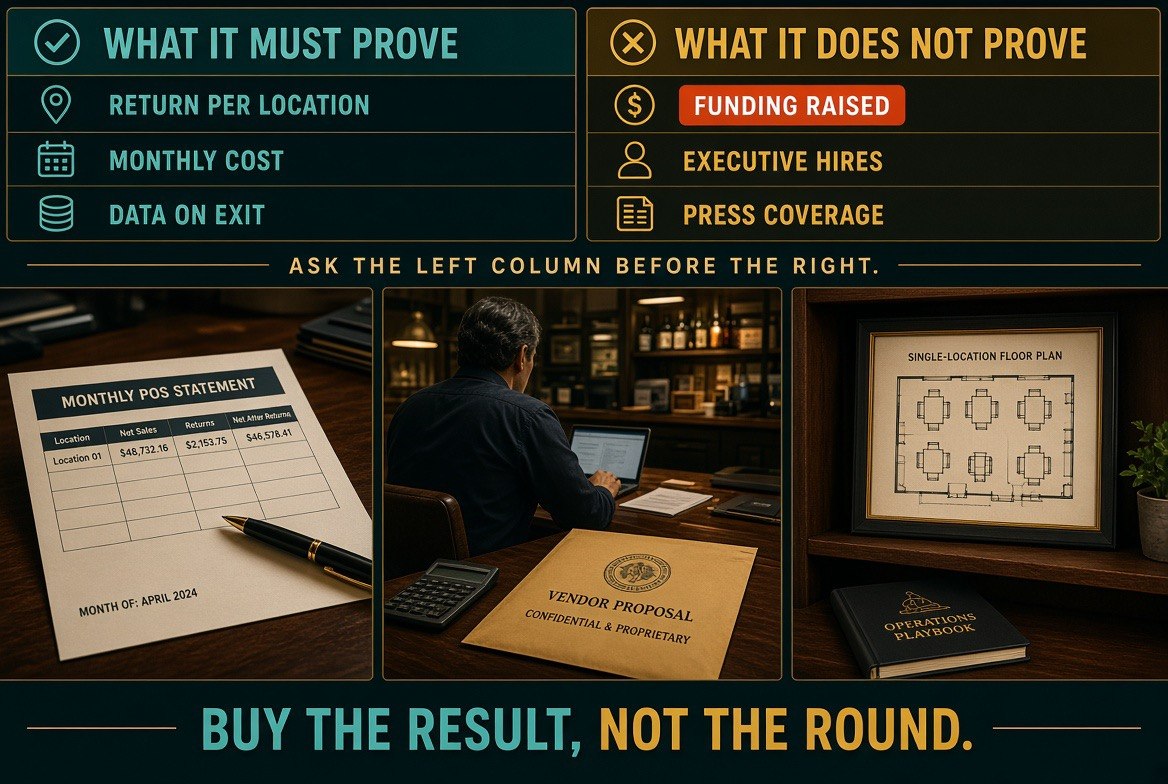
Ask the left column before the right: return per location, monthly cost and what happens to your data on exit matter more than funding raised, executive hires or press coverage. Buy the result, not the round.
The Cost Question You Should Actually Ask
Meadow has not published pricing, which is normal at this stage and also the single most important unknown for an operator doing the maths.
Think about what the software has to beat. In a restaurant, the cost of a missed greeting or a slow line is not one transaction, it is the lifetime value of a guest who decides not to return. If your average guest visits twice a month and spends a meaningful amount per visit, a single recovered regular is worth several hundred dollars a year. Recover a handful of those a month and almost any reasonable subscription pays for itself.
That is the case for the category. The case against is subtler and it is worth stating plainly: software that tells you what you are doing wrong creates an obligation to act. If you buy it and nobody responds to the prompts, you have added a cost and a distraction while changing nothing. The tool only produces value when a manager owns the alerts and does something with them during service.
Before any demo, decide who on your team owns the responses. If the answer is “me, eventually,” you are not ready for this category regardless of what it costs.
What a Good Rollout Looks Like If You Do Move
Multi-site operators who get value out of systems like this tend to follow the same sequence, and it is worth understanding before you are in a sales conversation.
Start with one location, not all of them. Pick the site with the clearest operational problem so the signal is unambiguous. If the software surfaces issues you already suspected and shows you a few you did not, you have something real. If it reports that everything is fine at a site you know is struggling, you have your answer too, and you learned it cheaply.
Set the baseline first. Record a week of normal operation before you act on any prompt, so you can tell the difference between genuine improvement and the novelty effect of staff knowing they are being watched.
Introduce it to your team honestly. Tell them what it measures and why you are running it. The operators who try to hide the monitoring are the ones who end up with a floor that performs for cameras and an owner who trusts numbers that mean nothing.
Review monthly against revenue, not against prompts. The software will generate activity. What matters is whether guest experience scores, review sentiment or repeat visits move. Activity is not a result.
The Honest Verdict
Meadow AI is a well-funded, well-founded company chasing a real and underserved problem. Founded in 2023, backed by $13 million, built by repeat founders who exited a real estate technology business to Compass and who hired engineering leadership from MIT and Nordstrom. The people are serious and the problem is genuine.
The product is also early. Nine brands, $1.4 million in live ARR, and a sales motion that is only now being built around a former Toast executive. That is a company finding its commercial footing, not a mature platform with years of standardised deployments behind it.
For the independent single-location operator reading this, the value of the announcement is not a purchase decision. It is a preview. The operational visibility that chains have always been able to afford is being rebuilt as software, and it will reach your price point eventually.
Until then, the three things this software watches for — greeting, wait time, idle staff during a rush — cost nothing to watch yourself. Walk your floor this week and look for them honestly. You may find that the most valuable operational improvement available to you right now is not a subscription at all. It is knowing what your restaurant actually looks like when you are not standing in it.
Frequently Asked Questions
What is Meadow AI?
Meadow AI is a Seattle startup founded in 2023 that builds an AI “co-manager” platform for physical retailers and restaurants. It ingests video, audio, labor and inventory data to monitor service speed, team execution and store conditions, then sends live prompts and coaching to staff while customers are still on site.
How much did Meadow AI raise?
It raised $7 million in a seed round led by Ulu Ventures, with participation from York IE, Flying Fish, TenOneTen Ventures, Leadout Capital and Wedbush Ventures. The round included conversion of $6 million in SAFEs from earlier pre-seed financing, bringing total funding to $13 million.
Is this useful for a single independent restaurant?
Not yet. It is built for multi-site brands and is sold to enterprise accounts. The company has more than nine brands on the platform. If you run one location, the practical benefits are achievable manually by watching greeting times and wait times during peak service.
What are the risks of adopting this kind of system?
Two stand out. Staff consent and how the rollout is framed — support versus surveillance, a distinction set entirely by how you introduce it. And data governance: video and audio footage of staff and guests is sensitive, so you need clear answers on what is recorded, retained and who can access it.
Does it replace the POS system?
No, and it does not compete with it. Your POS tracks what was purchased. Meadow is aimed at why a customer had a poor experience — waiting too long, going ungreeted — which the POS cannot capture. The two answer different questions.

About Barak Schurr
Barak Schurr built and exited a major ticketing platform, ran global operations at Eventbrite, and now focuses on one question: which AI tools actually help independent restaurant owners run leaner and grow faster. He writes from the operator’s perspective – no vendor spin, no theory, just what’s real in 2026.
Email: [email protected]
More Resources for Restaurant Operators