Get the AI Restaurant Quick-Start Guide — Free
The 5 AI tools independent US restaurant owners are using right now to cut labor costs and answer every call.
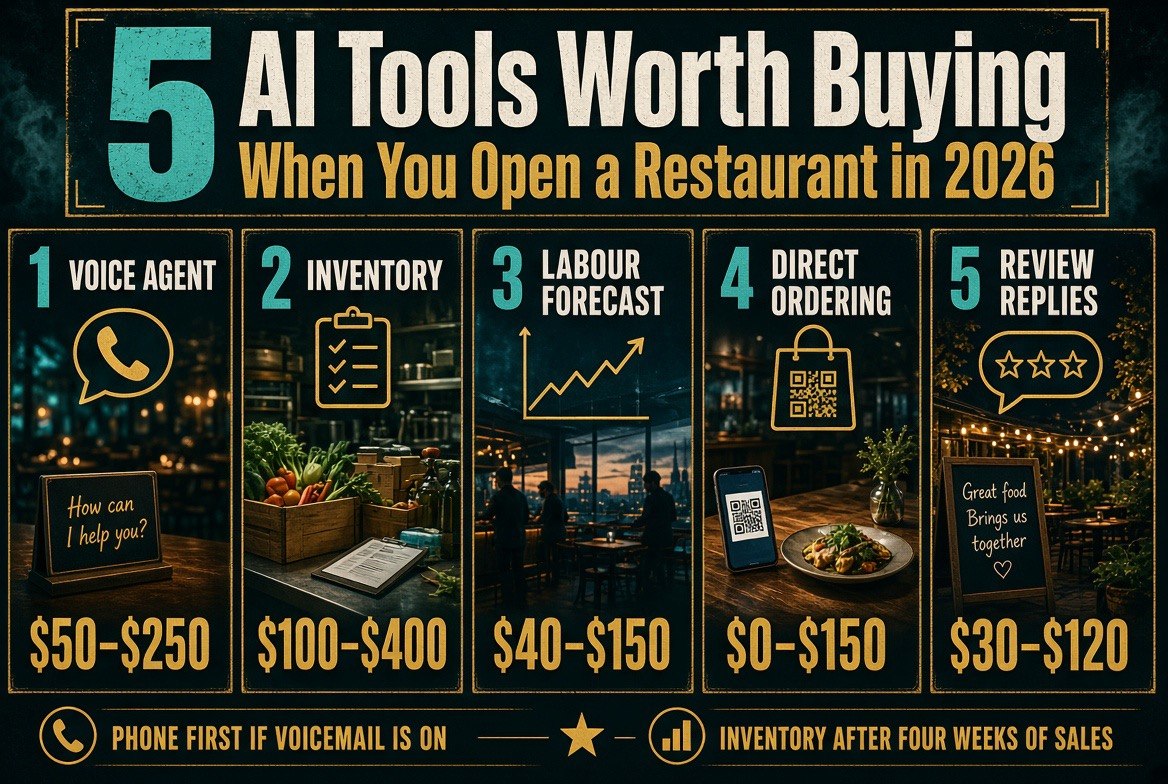
5 AI Tools Worth Buying When You Open a Restaurant in 2026
⚡ Expert Summary: A new restaurant does not need five AI tools because five is a good number. It needs one tool per job that is genuinely bleeding money — missed calls, food waste, labour overruns, third-party delivery fees, and unanswered reviews. US independents that buy in that order and stop there spend roughly $300 to $600 a month and cover the five jobs that eat a margin. Owners who buy a “stack” instead of a solution end up paying for overlap and using none of it by month three.
Two restaurants open on the same block in the same month. Both owners read the same listicle promising eleven AI tools and a ChatGPT workflow.
The first buys five subscriptions in week one because each demo looked impressive. By month three the POS-integrated inventory tool is fighting the standalone inventory tool over which one owns the count, the scheduling app is sending texts the manager already sends by hand, and the owner has stopped logging into three of them. Total spend is around $700 a month. Nothing changed.
The second buys one tool — a phone agent — because they miss nine calls a week during service and can prove it. Thirty days later they add inventory, because the waste report told them exactly where the money was leaving. They never buy the other three, and they keep the two.
The difference is not budget. Both owners had the money. It is buying one job at a time and refusing to buy a second job until the first one shows a number.
The Rule That Saves You the Most Money
Every tool in this article does one job. That is deliberate, because the expensive mistake in restaurant software is buying capability you cannot connect to a cost. A tool earns its place when you can name the specific loss it reduces and see that number move within a month.
Before you buy anything, write down your five biggest leaks. Almost every independent lands on some version of this list: calls going unanswered, food going in the bin, labour hours that do not match sales, a third-party delivery partner taking 20 to 30 percent, and reviews sitting unanswered long enough to hurt weekend covers. Those are the jobs. If a tool does not touch one of them, it is the wrong purchase this year.
The Five Jobs, and One Tool for Each
| Job | What the Tool Does | Typical Monthly Cost | The One Thing It Will Not Fix |
|---|---|---|---|
| 1. Answer the phone | A voice agent answers, takes orders and reservations, and hands complex calls to a human | $50 to $250, often per-minute on top | A bad menu. If your items are confusing to a person, they are confusing to an agent |
| 2. Count the stock | Tracks inventory against sales and flags variance, waste, and theft | $100 to $400 depending on locations | Discipline. It will tell you that you are over-portioning; it will not stop you |
| 3. Schedule the labour | Forecasts covers from history and builds a schedule against projected sales | $40 to $150 per location | Your hiring problem. Understaffing is a people issue, not a forecasting one |
| 4. Take direct orders | Your own ordering and booking channel, so you keep the customer relationship and the margin | $0 to $150 plus card fees | Delivery demand. Direct ordering wins pickup and repeat customers, not new ones |
| 5. Answer the reviews | Drafts replies to every review in your voice and flags complaints worth acting on | $30 to $120 | A real problem in the kitchen. A reply cannot fix food that arrived cold |
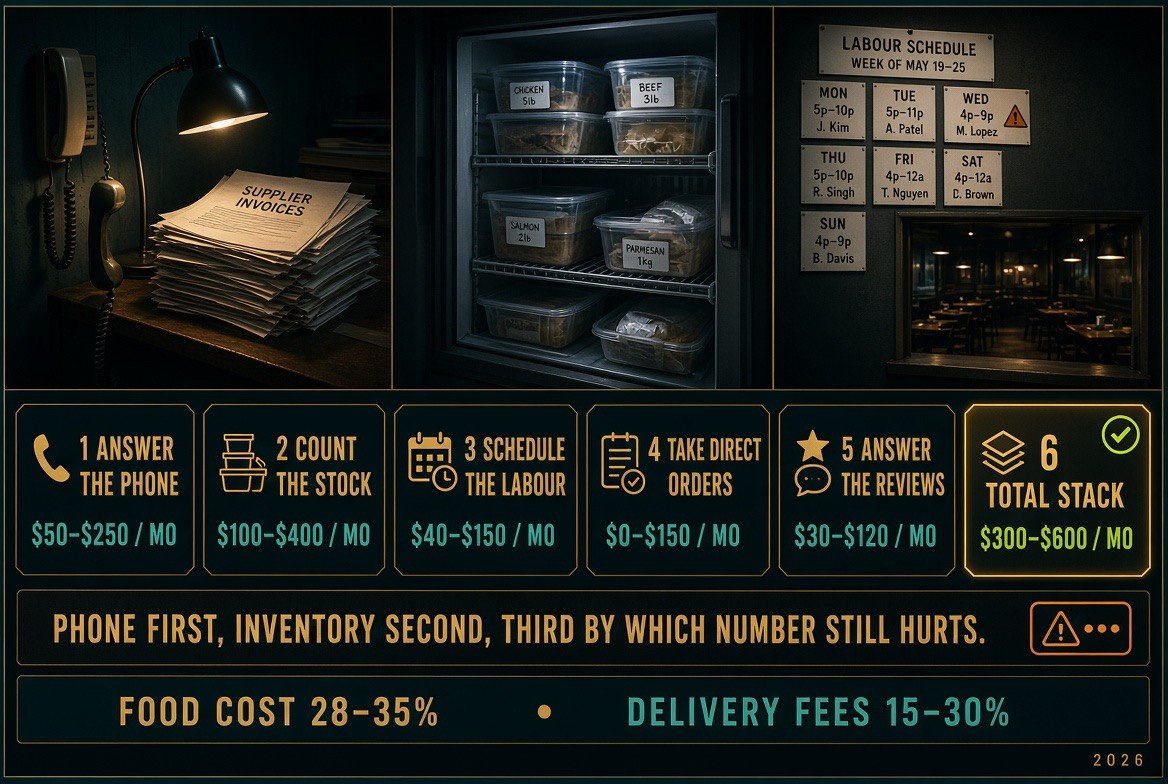
The five jobs a new restaurant should buy for, with the real monthly cost band for each one from this post.
1. The Voice Agent — Your Highest-Value First Purchase
This is the one tool that pays back fastest for most independents, and the reason is arithmetic. A missed call during a Friday service is not a lost phone call, it is a lost cover, and a lost cover is a table that someone else sold. A restaurant missing ten calls a week at an average check of $28 is not losing a rounding error; it is losing thousands a month in revenue that never appears in any report.
A voice agent answers every call, including the ones during the rush, takes orders and reservations, and transfers anything complicated to a person. Modern setups can book straight into your reservation system and read your actual menu and hours, which is where the quality difference shows up. The category has matured enough that the distinction between a phone agent and a general chat assistant matters — see the broader comparison of AI phone answering for restaurants before you sign anything.
Buy it first if: you have voicemail on and nobody checking it. That is your cheapest proof of value.
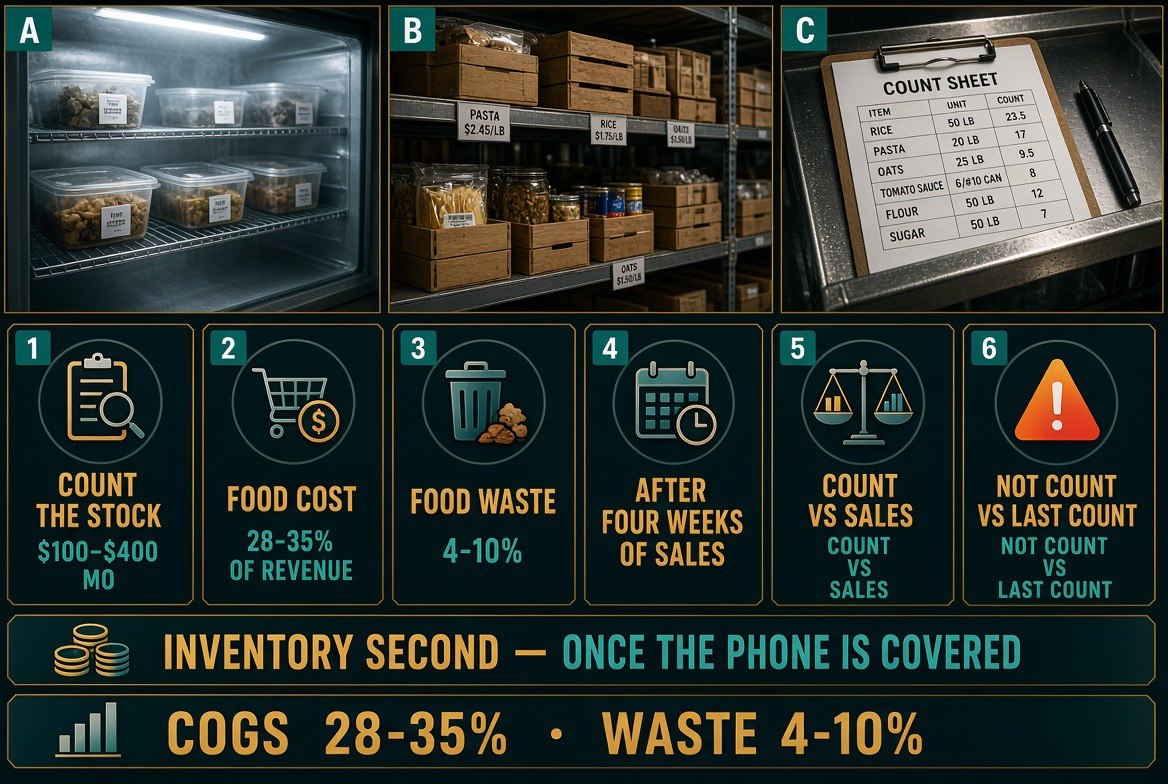
Where the quiet money goes: count against sales, not against last count — food cost plus waste is the variance that matters.
2. The Inventory Agent — Where the Quiet Money Goes
Food cost is 28 to 35 percent of revenue for a typical US independent, and the difference between a well-run kitchen and a badly-run one is often only a few points. That gap does not come from theft. It comes from over-portioning, spoilage, and the walk-in full of product nobody is tracking.
An inventory tool watches purchases against sales and tells you where the variance is. The value is not the count — it is the interrogation. When the system says you sold 90 portions of short rib but bought 130, you have a question you can answer in a week instead of a year.
Watch out for: buying inventory that overlaps with your POS. If your POS already tracks depletion reasonably well, the standalone tool needs to be meaningfully better, not just prettier. The deeper problem of data locked inside one vendor’s ecosystem is exactly why you should confirm export before you commit.
3. Labour Forecasting — The Tool Managers Actually Feel
Labour is the other line that decides whether a month works. Scheduling software that forecasts from your own sales history — not a generic industry curve — will show you the Tuesday where you had three servers for forty covers, and the Saturday where two people handled a hundred and twenty. Both are failures, in opposite directions.
The honest limitation: forecasting is easy, flexibility is hard. If your staff cannot be called off without a fight, a smarter schedule is just a more precise description of your problem. Buy it when your team is stable enough to work short shifts.
Buy it when: your sales fluctuate more than 18 percent week to week. Below that, a calendar and discipline does the job.
4. Direct Ordering — Take Back the 30 Percent
Third-party marketplaces charge between 15 and 30 percent, and for many independents that fee is the difference between a delivered order being profitable and being a favour. A direct ordering channel does not replace delivery apps on day one — it takes back the customers who already know you.
Run it as a trade, not a war. Put a card in every bag that points regulars to your own site, and price the direct channel a little sharper so the choice is obvious. The economics of doing this well are worth studying in detail; the breakdown of AI online ordering and third-party fees covers the break-even math.
Buy it when: you are doing more than roughly $2,000 a month through delivery platforms. Below that the setup effort outweighs the saved fee.
5. Reputation Replies — Cheap, and Worth Doing Properly
Reply speed affects bookings, because prospective diners read responses to bad reviews as a signal about how the place behaves when something goes wrong. A tool that drafts a reply in your voice and flags the complaints that repeat is genuinely useful — not because writing “thank you for your feedback” is hard, but because doing it consistently at 11pm after a close is.
The trap is using it as a mask. Review data is the cheapest customer research you will ever receive, and a tool that helps you respond faster is only worth it if you also read what it is summarising. One recurring complaint about wait times is a scheduling problem, not a communications problem.
Buy it when: you have more than 50 reviews and an owner who stops reading them. That is most restaurants by month six.
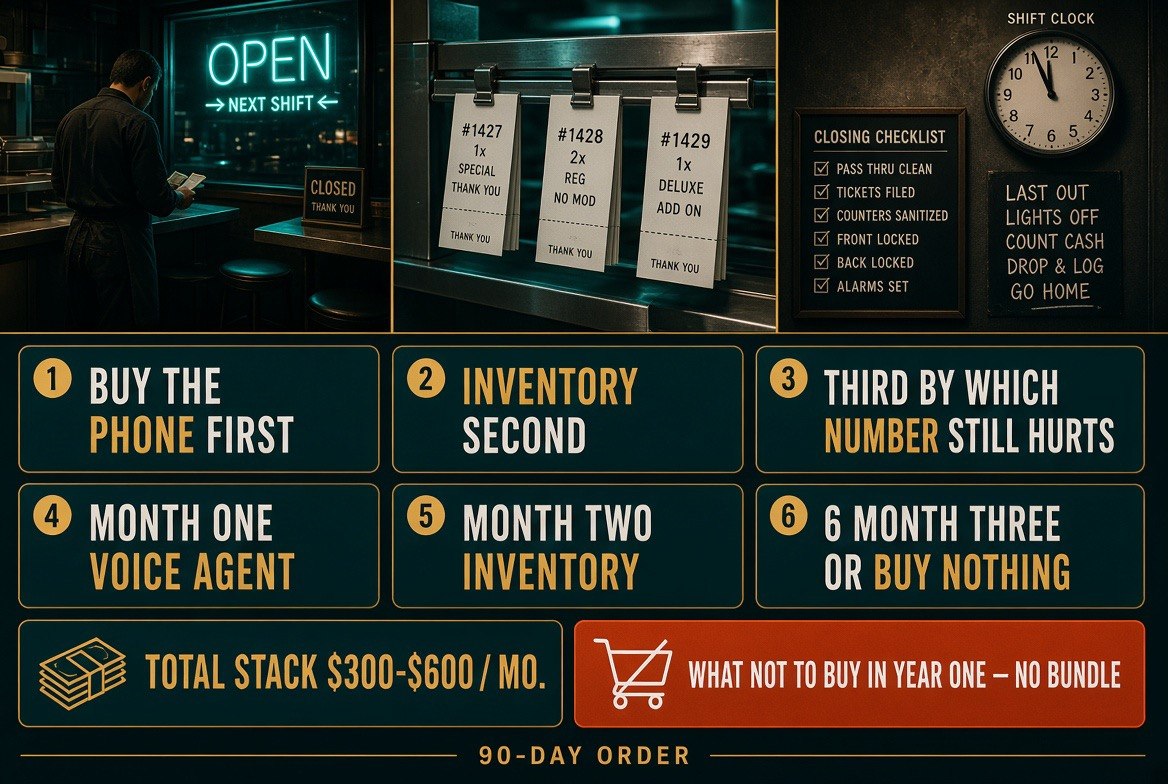
The order that matters more than the tool list: phone first, inventory second, and the third only by which number still hurts.
Only Can Afford One?
| Your Situation | Buy This First | Payback You Should Expect |
|---|---|---|
| Dine-in, phone-heavy, no host | Voice agent | Four to eight recovered covers a week |
| Food cost creeping, no idea why | Inventory agent | Two to four points of food cost in 60 days |
| Heavy delivery volume | Direct ordering | 10 to 20 percent of platform orders moved in-house |
| Labour overruns every week | Labour forecasting | Two to five scheduled hours a week recovered |
| Rating slipping, no time to reply | Review replies | Cheap, and it protects weekend covers |
What Not to Buy in Year One
Skip anything that needs a data cleanup project before it does anything useful. Skip tools that promise to replace your POS in month one, because migrating the system that takes your money during a soft opening is how restaurants lose a weekend. Skip anything with a twelve-month contract you cannot exit in thirty days, because you do not yet know which jobs you actually have.
Skip, above all, the bundle. Vendors sell suites because suites are easier to sell than single jobs; the suite bundles features you will not use in year one alongside the one module that matters. Buy the module.
The 90-Day Order
Month one: the voice agent, because the loss is measurable and the setup is fast. Month two: inventory, once you have four weeks of sales to compare against. Month three: whichever of the remaining three matches the number that is still hurting — and if none of them does, buy nothing and bank the difference. The target is $300 to $600 a month for the whole stack, and a restaurant that spends $600 on tooling that touches five real jobs is in a better position than one spending $1,200 on four of them.
For a wider view of where the category is heading, the shift toward AI in the kitchen at the chain level is worth reading for context, not for imitation. Chains solve scale problems. You have a margin problem, and margin problems are solved one job at a time.
Frequently Asked Questions

About Barak Schurr
Barak Schurr built and exited a major ticketing platform, ran global operations at Eventbrite, and now focuses on one question: which AI tools actually help independent restaurant owners run leaner and grow faster. He writes from the operator’s perspective — no vendor spin, no theory, just what’s real in 2026.
Email: [email protected]
More Resources for Restaurant Operators