Get the AI Restaurant Quick-Start Guide — Free
The 5 AI tools independent US restaurant owners are using right now to cut labor costs and answer every call.
xtraCHEF Founders Launch Tandem: AI Agents That Work Inside the Systems Your Restaurant Already Runs
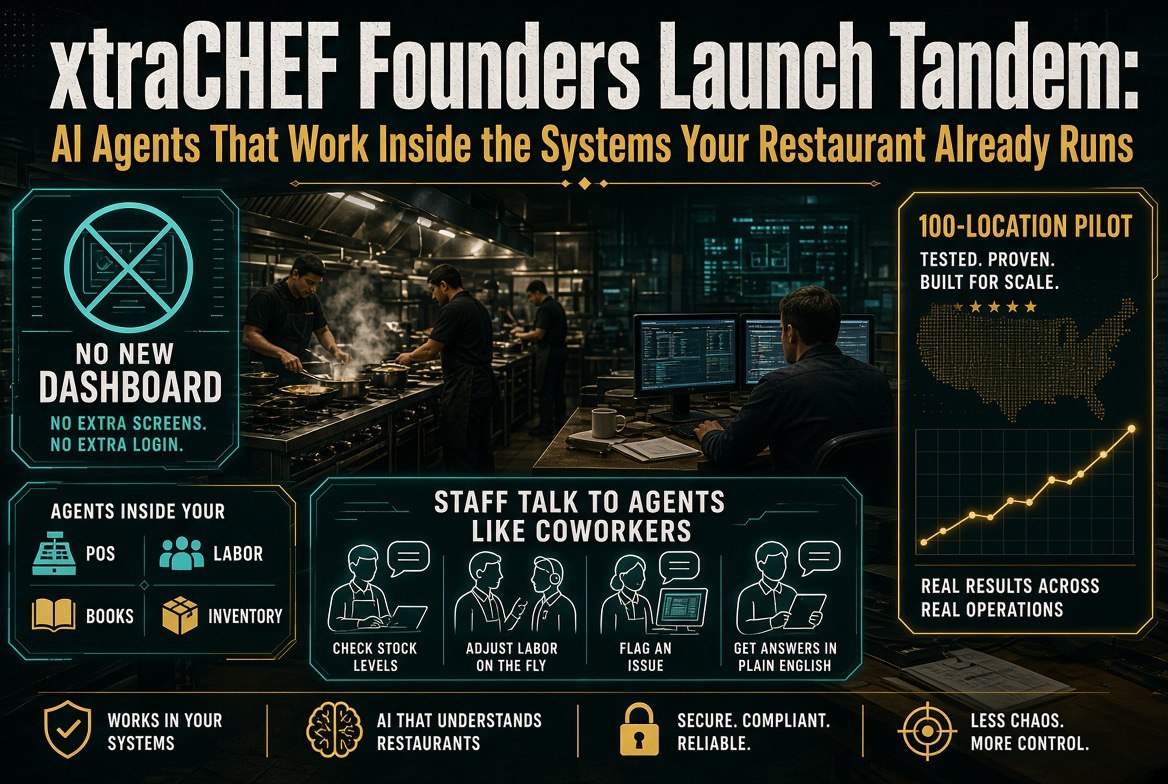
⚡ Expert Summary: Andrew Schwartz and Bhavik Patel — the co-founders of Toast-acquired xtraCHEF — launched Tandem on Tuesday, an AI company building agents that work across your existing POS, labor, accounting, inventory and purchasing systems instead of adding another dashboard. Michelin-recognized chef Michael Schulson joined as Founding Partner. The company is already piloting across 100 restaurant locations.
Most restaurant technology asks you to log into one more place. Tandem is betting that the opposite approach wins: agents that reach into the systems you already pay for, find what needs attention, and take action — while your managers talk to them like coworkers.
It is a strong thesis, and it is coming from people with actual restaurant operator credibility. Schwartz and Patel built xtraCHEF from the ground up alongside thousands of operators before Toast acquired it. They have seen what restaurant software does well and exactly where it falls apart. Their conclusion is blunt: the last generation of restaurant tech digitized the work — it did not remove it.
Who Is Behind Tandem
Three names matter here, and each one explains a different part of the product.
Andrew Schwartz is Co-Founder and CEO. He co-founded xtraCHEF, the restaurant back-office and invoice automation platform that Toast acquired. In the launch announcement he framed the thesis directly: restaurants do not need another system to log into or another dashboard to manage.
Bhavik Patel is Co-Founder and CPO/CTO, leading technology, AI and engineering. He was CTO and co-founder at xtraCHEF, where he built the platform that eventually became part of Toast. His framing is the more technically interesting one — he argues the shift is away from software that stores data or presents it, toward systems that understand context, reason across multiple sources, and help execute the work.
Michael Schulson is the Founding Partner. He is the founder of Schulson Collective and one of the country’s most accomplished chefs and restaurateurs, and he is joining to shape product strategy around what operators actually deal with day to day. His involvement is the detail that separates Tandem from the pile of restaurant AI announcements that arrive with no operator in the room.
| Leader | Role at Tandem | Background | What they bring |
|---|---|---|---|
| Andrew Schwartz | Co-Founder & CEO | Co-founder, xtraCHEF (acquired by Toast) | Operator-side product instincts |
| Bhavik Patel | Co-Founder, CPO/CTO | CTO and co-founder, xtraCHEF | Platform architecture and AI engineering |
| Michael Schulson | Founding Partner | Founder, Schulson Collective | Real kitchens, real operating constraints |
That combination — restaurant tech exits, deep AI engineering, and a chef who runs actual restaurants — is the reason this launch is worth your attention rather than a bookmark. Most AI restaurant pitches have one of those three. Tandem has all three on the founding team.
What Tandem Actually Does
Here is the operational problem Tandem is aimed at, described accurately: a restaurant runs across an increasingly fragmented technology ecosystem — point-of-sale, labor, accounting, inventory, purchasing, reservations, delivery, marketing and more. All that software digitized the restaurant. It did not stop your managers from manually moving information between platforms, analyzing data by hand, spotting problems late, and completing repetitive administrative work.
Tandem is being built for that gap. Rather than another dashboard, it builds AI agents designed to work across the systems restaurants already use. Those agents analyze information, flag what needs attention, automate repetitive workflows, and take action across the business. Tandem also positions itself as a multiplayer workspace, so your human employees can communicate with their agentic coworkers rather than filing tickets into a black box.
The stated strategy is deliberately narrow at first: introduce agents around specific high-value workflows, then connect those capabilities across the restaurant organization. That is a more credible plan than a full-suite replacement, and it is the plan that matches how operators actually adopt technology — one painful process at a time.
| Factor | Traditional restaurant stack | Tandem’s agent model |
|---|---|---|
| Where the data lives | POS, labor, accounting, inventory each in their own silo | Agents pull across all connected systems |
| Who moves information | Your managers and admin staff, manually | Agents handle the repetitive movement |
| Finding problems | Reports read weekly; issues surface late | Agents flag what needs attention as it happens |
| Acting on findings | Manager logs into each system separately | Agents take action across the business |
| Interaction model | Dashboards you go look at | Multiplayer workspace — staff talk to their agents |
The integration stance is the part to pay closest attention to. Tandem says it is developing integrations across the restaurant technology ecosystem so its agents work with the systems operators already rely on, rather than asking restaurants to rip out the stack. For an independent operator, that is the difference between a project and a replacement.
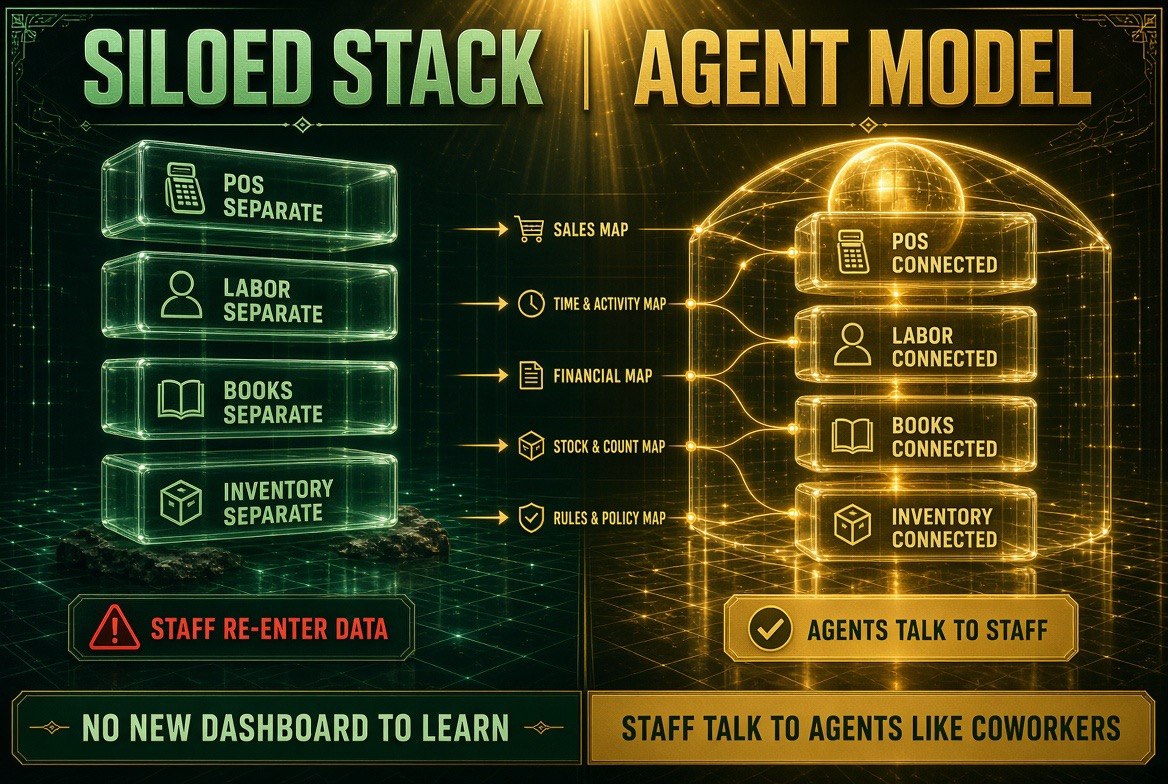
The distinction that matters: Tandem does not add another dashboard. It connects the POS, labor, books and inventory systems you already run, so the agent layer talks to staff instead of staff re-typing numbers between screens.
The 100-Location Pilot: What It Tells You
Tandem has closed an initial seed financing round to speed up product development, grow the team, and support early deployments. More useful than the funding headline: the company says it is already working with operators across 100 restaurant locations through a pilot program, with a growing waitlist of restaurant groups wanting in.
Read that number honestly. One hundred locations is a real pilot, not a press-release fantasy — but it is still a pilot. There is no published pricing, no self-serve signup, no public case study with measured labor-hour savings yet. If you run one or two locations, you are currently looking at a platform you may have to wait for, not one you can buy this month.
The seed capital is earmarked for engineering and product teams, deeper integrations, and faster deployments with restaurant groups. Those are the three things that have to work before a platform like this is safe to build your operations around.
What to Watch Before You Believe the Pitch
AI agents that “take action across the business” is an exciting sentence and a serious operational question. Before you connect anything, the same due diligence applies that you would use for any new system touching your numbers.
- Named integrations, not “the ecosystem.” Ask exactly which POS, labor, accounting and inventory platforms are live versus planned. Confirm your own stack is on the live list.
- What actions can an agent take without approval? There is a wide difference between an agent that drafts a purchase order for your review and one that sends it. Get that boundary in writing.
- Who owns the data, and where does it go? Agents reading across your systems see your margins, labor rates and vendor pricing. Understand the data agreement before you sign.
- Measured outcomes from the pilot. Ask for hours saved per location per week and error reduction, not testimonials. Real pilot data exists at 100 locations — request it.
- Failure behavior. Ask what happens when an agent misreads an invoice or a sales figure. A system that takes action also needs a clean rollback and an audit trail.
None of these are reasons to dismiss Tandem. They are the questions you ask any vendor whose software is going to touch your bank account and your payroll — and the founders’ xtraCHEF history suggests they will have good answers.
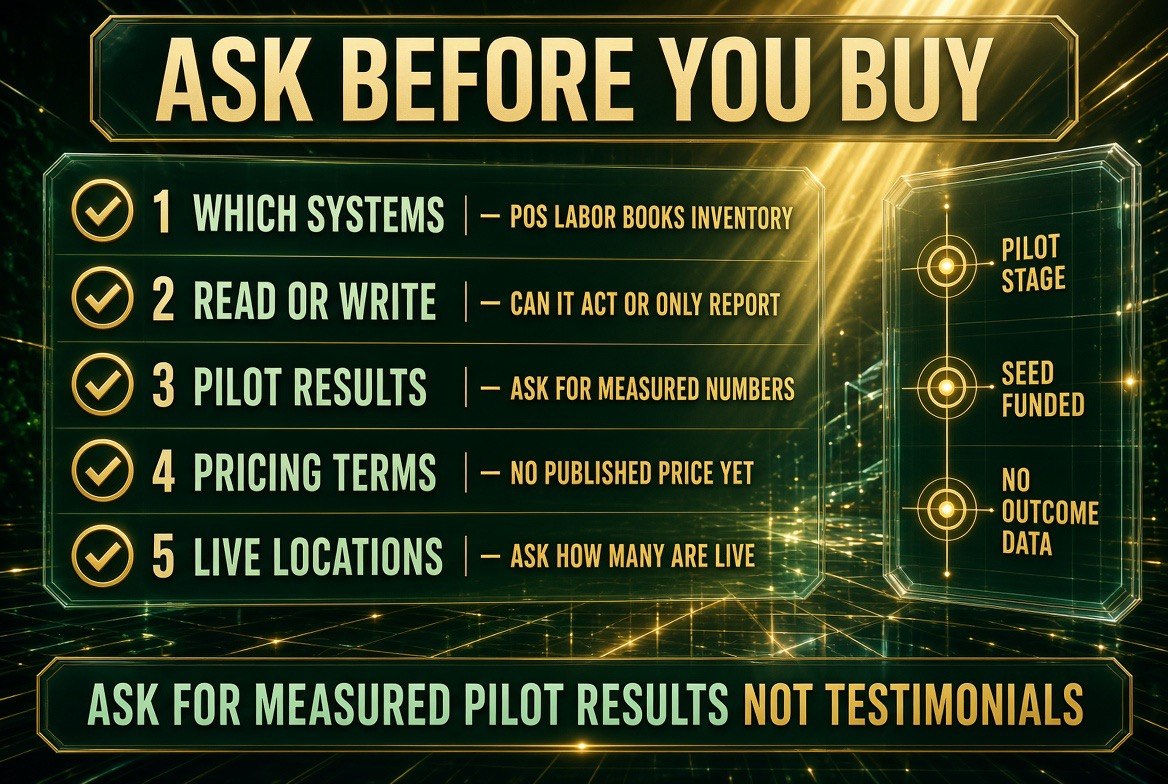
The five questions that separate a real deployment from a demo: which systems the agents reach, whether they can act or only report, measured pilot results, actual pricing terms, and how many locations are genuinely live.
Why This Launch Matters Beyond Tandem
The larger signal here is about where restaurant technology is heading. Schwartz put it directly in the announcement: the last generation of restaurant technology was about digitizing workflows and putting software into every part of the restaurant. The next generation, in his framing, is about intelligence and action — technology that understands the business and actively helps run it.
Whether Tandem wins or not, that shift is already underway across the industry. Square and Toast are pushing AI into ordering and back-office work, and every major platform is racing to add an assistant layer. The difference with Tandem is that it is starting from the operator’s problem instead of the platform’s feature list.
For an independent restaurant owner, the practical takeaway is not “buy Tandem.” It is that the tools you already pay for will keep adding agent capabilities through 2026 and 2027, and the operators who learn how to delegate repetitive work to software now will be the ones who get real leverage out of it when their existing vendors catch up.
Start smaller than you think you need to. Pick the single most painful manual process in your restaurant — invoice entry, schedule reconciliation, or nightly sales reporting — and learn what it takes to hand it off. Tandem is one answer to that question. The question itself is the thing that matters.
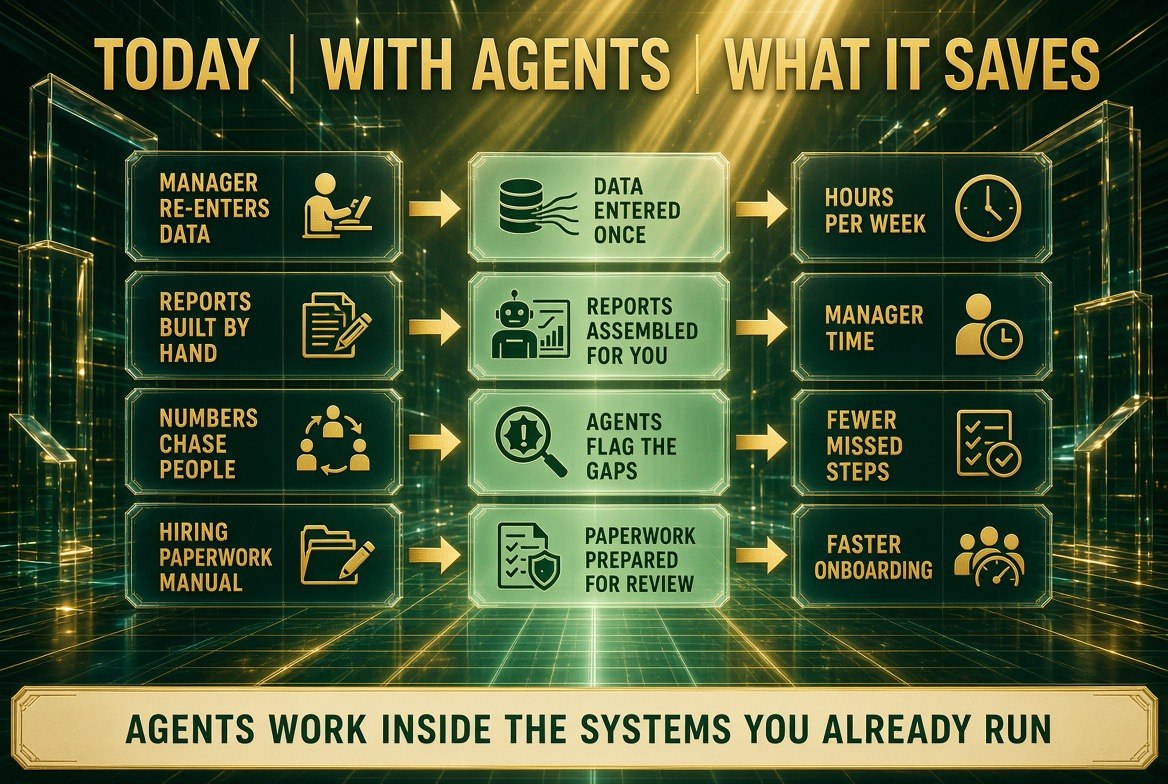
Where the labour relief actually lands: data entered once instead of re-entered, reports assembled instead of hand-built, and hiring paperwork prepared for review rather than started from a blank page.
Frequently Asked Questions
What is Tandem and who founded it?
Tandem is an AI platform built specifically for the restaurant industry, developing agents that work across restaurant systems to automate operational and administrative tasks. It was co-founded by Andrew Schwartz (CEO) and Bhavik Patel (CPO/CTO), the co-founders of restaurant technology company xtraCHEF, which was acquired by Toast. Chef and restaurateur Michael Schulson joined as a Founding Partner.
Do I have to replace my existing POS and restaurant software to use Tandem?
No. Tandem says it is building integrations across the restaurant technology ecosystem so its agents work with the systems operators already rely on, rather than requiring restaurants to replace their existing stack. You should still confirm which specific integrations are live before committing.
How much does Tandem cost?
Tandem has not published pricing. The company has closed an initial seed financing round and is running a pilot program across roughly 100 restaurant locations, with a waitlist for restaurant groups. Expect pricing discussions to happen directly with the company.
Is Tandem available to independent single-location restaurants?
Not publicly yet. Tandem’s current focus is its pilot program with restaurant groups and operators across about 100 locations, along with a growing waitlist. Independent operators should expect to join the waitlist and evaluate the platform as integrations expand.
What happened to xtraCHEF — does that affect Tandem?
xtraCHEF was acquired by Toast, and Tandem is operated by AI Labz Inc. as an independent company. The xtraCHEF background matters because it is where Schwartz and Patel learned how restaurant operators actually use back-office technology, which shapes Tandem’s approach.

About Barak Schurr
Barak Schurr built and exited a major ticketing platform, ran global operations at Eventbrite, and now focuses on one question: which AI tools actually help independent restaurant owners run leaner and grow faster. He writes from the operator’s perspective — no vendor spin, no theory, just what’s real in 2026.
Email: [email protected]
More AI Resources