Get the AI Restaurant Quick-Start Guide — Free
The 5 AI tools independent US restaurant owners are using right now to cut labor costs and answer every call.
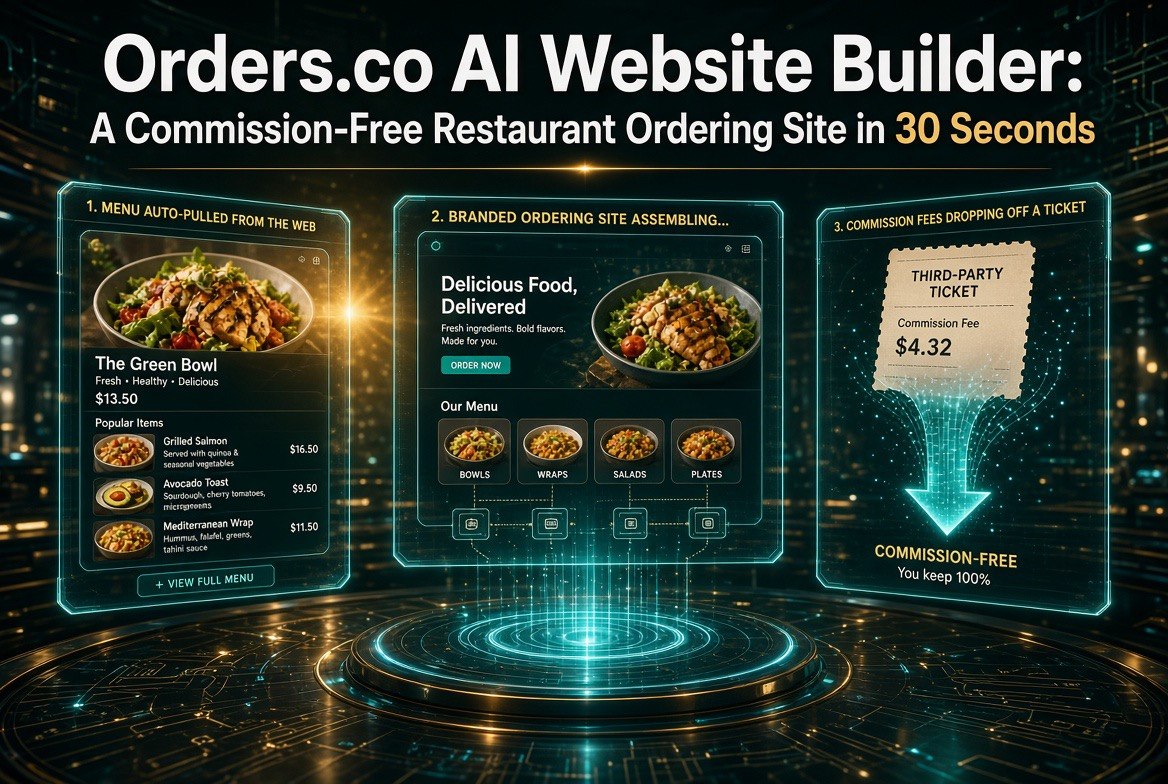
Orders.co AI Website Builder: A Commission-Free Restaurant Ordering Site in 30 Seconds
⚡ Expert Summary: Orders.co launched an AI-powered Restaurant Website Builder that generates a branded, commission-free online ordering site in under 30 seconds — automatically pulling your menu from the web instead of asking you to upload it. It bundles direct ordering, one-click menu sync across third-party platforms, AI loyalty and marketing tools, and a $29/month entry plan for restaurants doing fewer than 2,500 online orders a year. Orders.co reports a 54% increase in direct online orders, 30% higher retention, 20% lower acquisition costs, and 15% higher average order value. For an independent operator paying 15–30% commission on every third-party order, that is the entire ballgame.
Here’s a number every independent restaurant owner knows in their gut and nobody wants to say out loud: you’re paying somewhere between 15% and 30% of every third-party delivery order to a company that owns your customer relationship.
On a $38 order, that’s $6 to $11 walking out the door. Not to food cost, not to labor, not to rent — to an app you don’t control, on a customer list you’ll never see. You did the cooking, the packaging, and the handoff. They collected the customer.
That’s the problem Orders.co is attacking with a new AI-powered Restaurant Website Builder that generates a branded, commission-free ordering site in under 30 seconds. The pitch is blunt: stop paying rent on your own customers. Build the site, own the order, keep the margin.
The interesting part isn’t the “AI website builder” label — those words have been stapled to everything for two years. The interesting part is what it automates and what it costs to try.
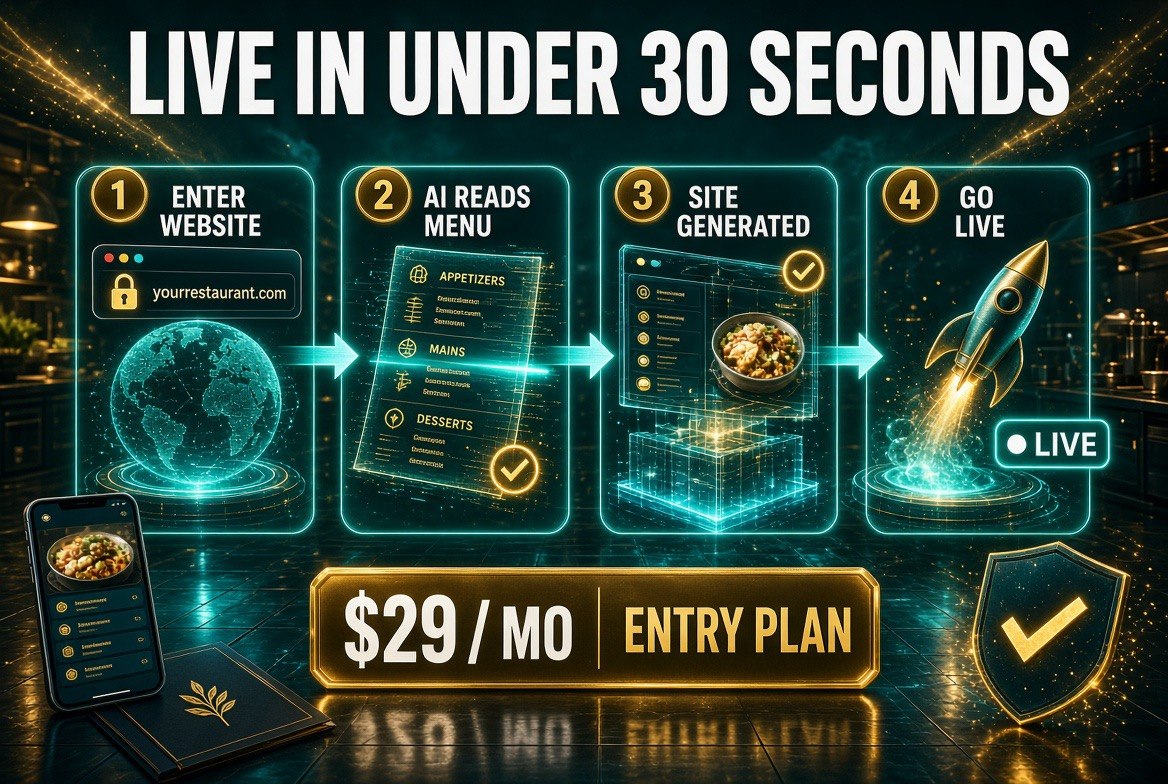
The four steps, start to finish: enter your website address, the AI reads your existing menu, the site generates itself, and you go live. Entry plans start at $29/month for operators doing under 2,500 online orders a year.
What “Under 30 Seconds” Actually Means for a Restaurant Owner
Most restaurant owners have tried to build a website. The typical story goes like this: you buy a template, spend a weekend fighting a page builder, realize your menu needs to be rebuilt as a separate PDF, hire someone for $800, and then discover eighteen months later that the online ordering widget on it never worked properly on phones.
The friction isn’t design. It’s the menu. A menu is a living document — prices change with your food costs, items go to 86 when the distributor shorts you, seasonal specials come and go. Rebuilding that inside a website editor is the step where most owners give up and go back to letting the apps handle it.
Orders.co’s builder attacks that specific bottleneck. Its AI automatically finds your menu online — from your existing site, from a delivery platform listing, from wherever it currently lives — and builds the whole thing out from there, handling design and functionality together. You’re not uploading a spreadsheet. You’re not typing sixty menu items into a form on your phone between lunch and dinner service.
That’s the real story behind the 30-second claim. It isn’t that a website takes 30 seconds to be beautiful. It’s that the part that normally kills the project — menu ingestion and setup — is handled automatically, so the operator never hits the wall that stops them.
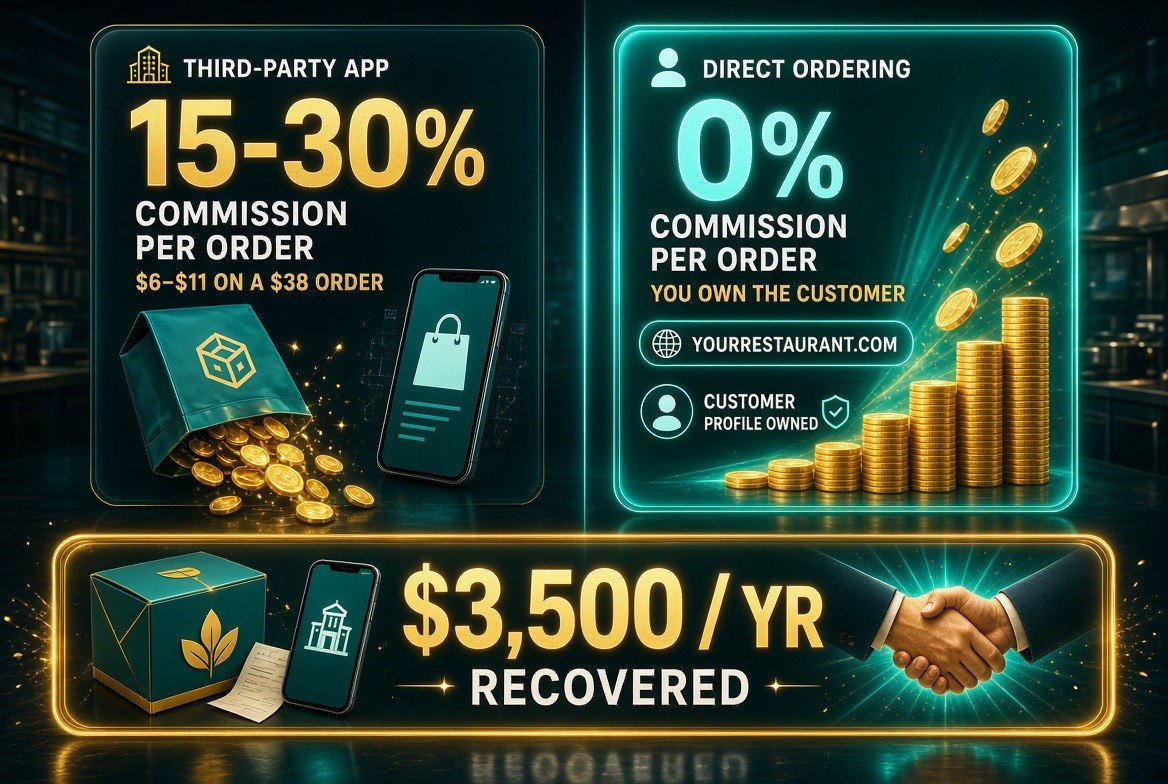
The whole argument in one image. Third-party apps take 15–30% of every order — $6 to $11 on a $38 ticket. A direct ordering site takes nothing, and the customer relationship stays yours.
Commission-Free Direct Ordering Is the Whole Point
Everything else in this product is plumbing that supports one economic claim: orders placed through your Orders.co site belong to you, and no third-party commission comes out of them.
Run the math on a modest independent restaurant doing 1,200 third-party orders a year at a $35 average ticket and 25% commission. That’s $10,500 in annual commission. If even a third of those orders migrate to a direct channel, you’ve recovered roughly $3,500 a year — and you’ve gained the customer contact data for the ones that moved, which is worth more than the commission savings over a two-year horizon.
The honest caveat, and any operator who’s tried this knows it: you don’t get the marketplace’s discovery. Nobody opens your website browsing for dinner. The third-party apps are expensive because they’re a customer acquisition channel, and building a direct site doesn’t replace that demand — it captures the customers who already know you and would order again. That’s the pool you’re moving, and it’s a much bigger pool than most owners assume. Repeat customers are the ones most likely to follow you off the apps, because they’re already choosing your food deliberately.
| Factor | Third-Party Delivery App | Orders.co Direct Ordering Site |
|---|---|---|
| Commission per order | Typically 15–30% of the ticket | None beyond your subscription |
| Who owns the customer data | The platform, not you | You — you get the contact and order history |
| Discovery / new customer flow | Strong — marketplace browse and search | Weak — you drive your own traffic |
| Menu updates | Frequently separate per platform | One change syncs across channels |
| Setup lift on the owner | Platform onboarding, one per app | AI pulls the menu automatically |
The Menu Sync Problem Nobody Talks About
Ask a multi-location operator what actually consumes their week, and “updating the menu” will show up before almost anything else.
Here’s the nightmare scenario, and it happens constantly. Your wing supplier raises prices 9%. You update your in-store POS. You update your own website. You forget the DoorDash listing. You forget the Uber Eats listing. Three weeks later a customer calls furious because the price they were charged on one app doesn’t match the price on another, and your staff has to eat the difference to avoid a bad review.
Now multiply that by a menu change every few weeks, across every platform you’re on, and you’ve identified a genuinely large hidden labor cost. It’s the kind of thing that doesn’t show up on a P&L but eats hours of a manager’s week and occasionally costs you a customer.
Orders.co’s answer is one-click sync across your website and third-party platforms. Change the price once, and it propagates. If you’ve ever spent a Sunday afternoon correcting menu prices in four separate dashboards, this feature alone justifies looking at the product, regardless of how you feel about the AI branding.
The AI menu management angle is worth calling out separately from the sync. The system parses your menu structure — categories, modifiers, upcharges, combos — rather than treating it as a flat list of names and prices. Modifiers are where restaurant tech usually breaks, because “add chicken +$4” and “no onions” are structurally different things, and platforms that flatten them into text notes create chaos in the kitchen. Getting modifiers right is unglamorous and it’s the difference between a tool your staff tolerates and one they fight.
Loyalty and Marketing: Converting App Customers Into Your Customers
This is the strategic layer, and it’s the part most owners skip when evaluating ordering tools.
A commission-free ordering site with no loyalty program is just a cheaper checkout page. It doesn’t change customer behavior — it only changes where the same order gets placed, and only for customers who already know to look for you. The real prize is moving people off the apps permanently, which requires giving them a reason to order direct.
Orders.co bundles loyalty and promotional tools into the site, with the explicit goal of shifting third-party app customers to direct. The mechanism is the same one that’s worked in restaurants for a century: reward the repeat behavior you want. Buy nine, get one free. A members-only special. A dollar off when you order through our site instead of the app.
Orders.co reports 30% higher customer retention through these loyalty programs. Treat that as a vendor figure rather than a verified independent number, but the underlying logic is sound and well-documented in restaurant marketing generally. A customer with a loyalty account orders more often, and a commission-free channel makes each of those orders worth materially more to you.
There’s a second-order benefit worth naming: a direct ordering site turns your customer list into an actual asset. You can email them. You can send a push notification about a slow Tuesday. You can market to your own customers without paying a platform for access to them, which is a capability that has quietly disappeared for most independents over the past decade.
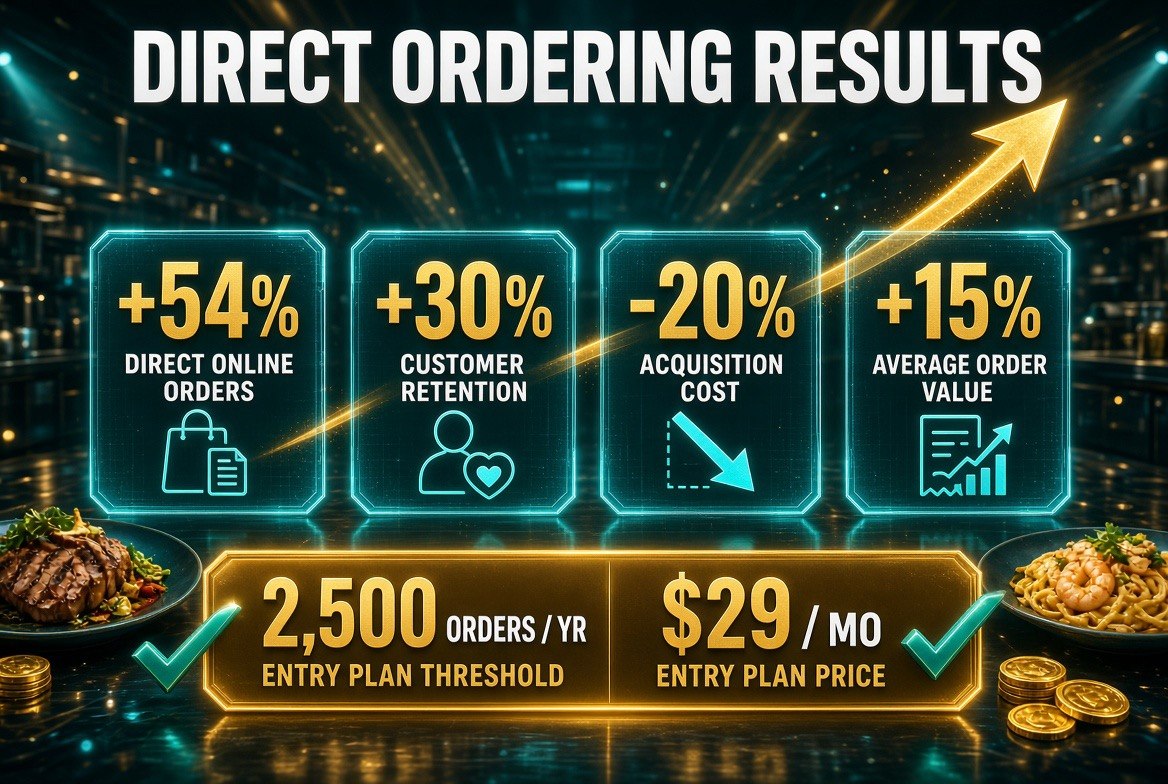
The results Orders.co reports once operators move orders direct: +54% direct online orders, +30% retention, −20% acquisition cost, +15% average order value. The $29/mo entry plan applies to restaurants doing under 2,500 online orders a year.
What It Costs — and the Threshold That Matters
Orders.co publishes a $29 monthly plan (billed annually) aimed at restaurants doing fewer than 2,500 online orders annually. That’s roughly 48 orders a week. If you’re above that, they route you to their regular packages, which are priced higher and quoted on a demo.
Put $29 a month in context. At 25% commission, you break even on this plan by moving about four $35 orders a month off the third-party apps. Four orders. For an independent restaurant doing meaningful delivery volume, that is not a high bar — and everything past it is straight margin recovery plus owned customer data.
Whether the $29 tier is genuinely sufficient for your operation is a separate question. Restaurants above the order threshold should expect to talk to sales and get a real number. If your volume is high, the pricing conversation matters more than the 30-second build claim, and you should push hard on exactly what the next tier costs before committing to anything annual.
| Reported Metric | Change | What It Means for Your Operation |
|---|---|---|
| Direct online orders | +54% | Volume shifting away from commissioned channels |
| Customer retention | +30% | Loyalty programs driving repeat visits |
| Customer acquisition cost | −20% | Owned channels replacing paid marketplace spend |
| Average order value | +15% | Upsell and combo prompts working at checkout |
Who This Is Actually For
Read the feature list honestly and a profile emerges.
This fits an independent restaurant that already has meaningful third-party delivery volume, has no direct ordering channel of its own or has one that nobody uses, and has a menu that changes often enough that multi-platform updates are a real burden. Single-location or small multi-unit operators in that position are the core audience, and the $29 threshold plan is clearly designed to get them in the door.
It fits less well if you’re a high-volume operation — the pricing conversation changes completely above 2,500 annual online orders — or if you already run a strong direct channel through your POS provider and don’t want a second system. And if you’re doing almost no delivery volume at all, the commission savings that justify the whole product don’t exist yet. Fix demand first.
Worth noting for anyone comparing options: a few POS vendors bundle their own branded ordering sites, and a few restaurant-tech startups have shipped AI website builders recently. The category is getting crowded fast, which is good for operators. Compare on three things — commission structure, whether your customer data is yours, and how the tool handles menu modifiers — because those are the parts that determine whether the site actually earns money or just looks nice.
The Bottom Line for Independent Operators
The marketing claim is “site in 30 seconds.” The business claim is “stop paying commission on customers you already earned.” Only the second one matters, and it’s a real problem with real money attached.
An independent restaurant doing 1,200 third-party orders a year at a 25% commission is handing over roughly $10,500 annually for the privilege of serving people who already chose their food. Moving even a third of that volume to a commission-free channel is a five-figure decision over two years — and it comes with something more durable than savings, which is a customer list you own.
The automation is genuinely useful, but don’t buy the demo. Before you commit to anything annual, get answers to four questions. What’s the real monthly cost at my order volume? Is my customer data exportable if I leave? How does the system handle modifiers and combo pricing? And how does menu sync actually behave when a third-party platform changes its own schema?
Restaurants that answer those four questions well end up with a direct channel that pays for itself. Restaurants that skip them end up with a $29 subscription and the same commission bill they had before.
Frequently Asked Questions
What is the Orders.co AI Restaurant Website Builder?
It is an AI-powered tool from Orders.co that builds a branded, commission-free online ordering website for a restaurant in under 30 seconds. The system automatically locates the restaurant’s menu online and generates the full site from it, handling design and ordering functionality together. It includes direct ordering, one-click menu sync across third-party platforms, and integrated loyalty and marketing tools.
How much does the Orders.co website builder cost?
Orders.co publishes a $29 monthly plan, billed annually, aimed at restaurants doing fewer than 2,500 online orders per year — roughly 48 orders a week. Restaurants above that threshold are directed to the company’s regular packages, which are priced higher and quoted through a demo. At a 25% third-party commission, the entry plan pays for itself by moving about four $35 orders a month to direct.
Will a commission-free ordering site replace third-party delivery apps?
No. Third-party apps provide marketplace discovery and new customer acquisition that a restaurant’s own website does not. A direct ordering site captures customers who already know the restaurant and would order again, which is typically a large pool of repeat business. The realistic strategy is running both — using the apps for discovery and moving repeat customers onto a commission-free channel where you own the customer relationship.
How much can an independent restaurant save by moving orders to a direct channel?
It depends on volume and commission rate. A restaurant doing 1,200 third-party orders a year at a $35 average ticket and a 25% commission is paying roughly $10,500 in commissions annually. Moving one third of that volume to a commission-free channel recovers about $3,500 per year, plus the customer contact data for every order that migrated, which has additional long-term value for repeat marketing.
What is the biggest hidden problem with managing a restaurant menu across platforms?
Keeping prices and item availability synchronized across every platform. A single supplier price increase may require updates in the POS, the restaurant’s own website, and several delivery app listings. Missing one creates price mismatches that staff must absorb to avoid bad reviews. Orders.co addresses this with one-click menu sync that propagates a change across the website and third-party channels at once.
What should a restaurant owner ask before buying an AI website builder for online ordering?
Ask what the actual monthly cost is at your order volume, whether your customer data is exportable if you leave the platform, how the system handles modifiers and combo pricing, and how menu sync behaves when a third-party platform changes its schema. Also confirm who owns the customer relationship and whether loyalty program data stays with the restaurant. Those four answers determine whether the site earns money or just looks good.

About Barak Schurr
Barak Schurr built and exited a major ticketing platform, ran global operations at Eventbrite, and now focuses on one question: which AI tools actually help independent restaurant owners run leaner and grow faster. He writes from the operator’s perspective — no vendor spin, no theory, just what’s real in 2026.
Email: [email protected]
More Resources for Restaurant Operators