Get the AI Restaurant Quick-Start Guide — Free
The 5 AI tools independent US restaurant owners are using right now to cut labor costs and answer every call.
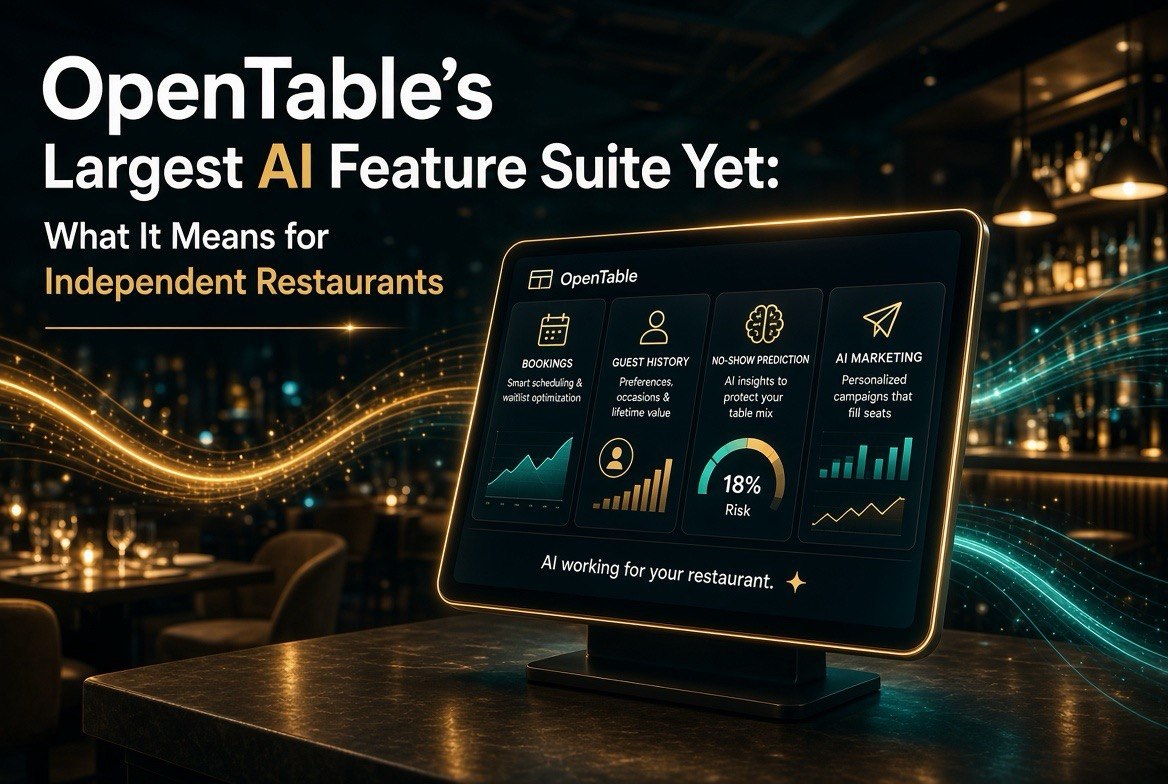
OpenTable’s Largest AI Feature Suite Yet: What It Means for Independent Restaurants
⚡ Expert Summary: On August 26, 2026, OpenTable announced what it calls its largest suite of new and updated product features for restaurants, with expanded AI and automation tools at the center. First reported by PR Newswire and covered by Food & Beverage Magazine and MarketScreener, the launch signals that the reservation giant is pushing beyond booking into the day-to-day workload that independent U.S. operators juggle — reservations, guest communication, waitlists, and the endless manual follow-up that eats staff hours. For a single-location independent restaurant in the U.S., the real question isn’t whether AI is coming to your stack; it’s which of these automation tools actually save you a body’s worth of work each week.
If you run an independent restaurant, you already know the pattern: a new reservations feature drops, you skim the press release, and you move on because you’re understaffed and behind. OpenTable’s announcement on August 26, 2026 deserves more than a skim. This isn’t a single feature — it’s a coordinated push of AI and automation tools aimed at the operational workload most operators don’t have time to fix. Understanding what’s actually in it, and what it replaces, matters more than the headline.
The context matters too. This lands weeks after OpenTable’s expanded AI voice tools hit the market, and it builds on a platform most U.S. independents already pay for. That’s the part worth paying attention to: the tools that were once “nice to have” AI extras are becoming the default way the platform works, which changes the math on whether you’re getting value from what you already pay.
What OpenTable Actually Announced
OpenTable framed the release as its largest suite of new and updated features for restaurants, with AI and automation threaded through the guest experience and the back office. The through-line is consistency: software that handles the repetitive, high-volume parts of running a restaurant so the operator and the team can focus on the dining room.
- Expanded AI guest communication — automated responses and follow-ups that keep guests informed without a staff member typing every message.
- Smarter reservations and waitlist management — tools that adjust to real demand patterns instead of fixed rules.
- Automation of repetitive booking tasks — the confirmations, reminders, and no-show management that quietly consume hours.
- Deeper automation across the guest journey — fewer manual steps between a guest’s first inquiry and their seat at the table.
That list reads generic until you map each item to a task you actually do. The value of this release isn’t the AI — it’s the staffing math. Every automated booking confirmation, every reminder sent without a staff member, every no-show handled quietly is a task that used to be done by a person who could have been doing something higher-value.
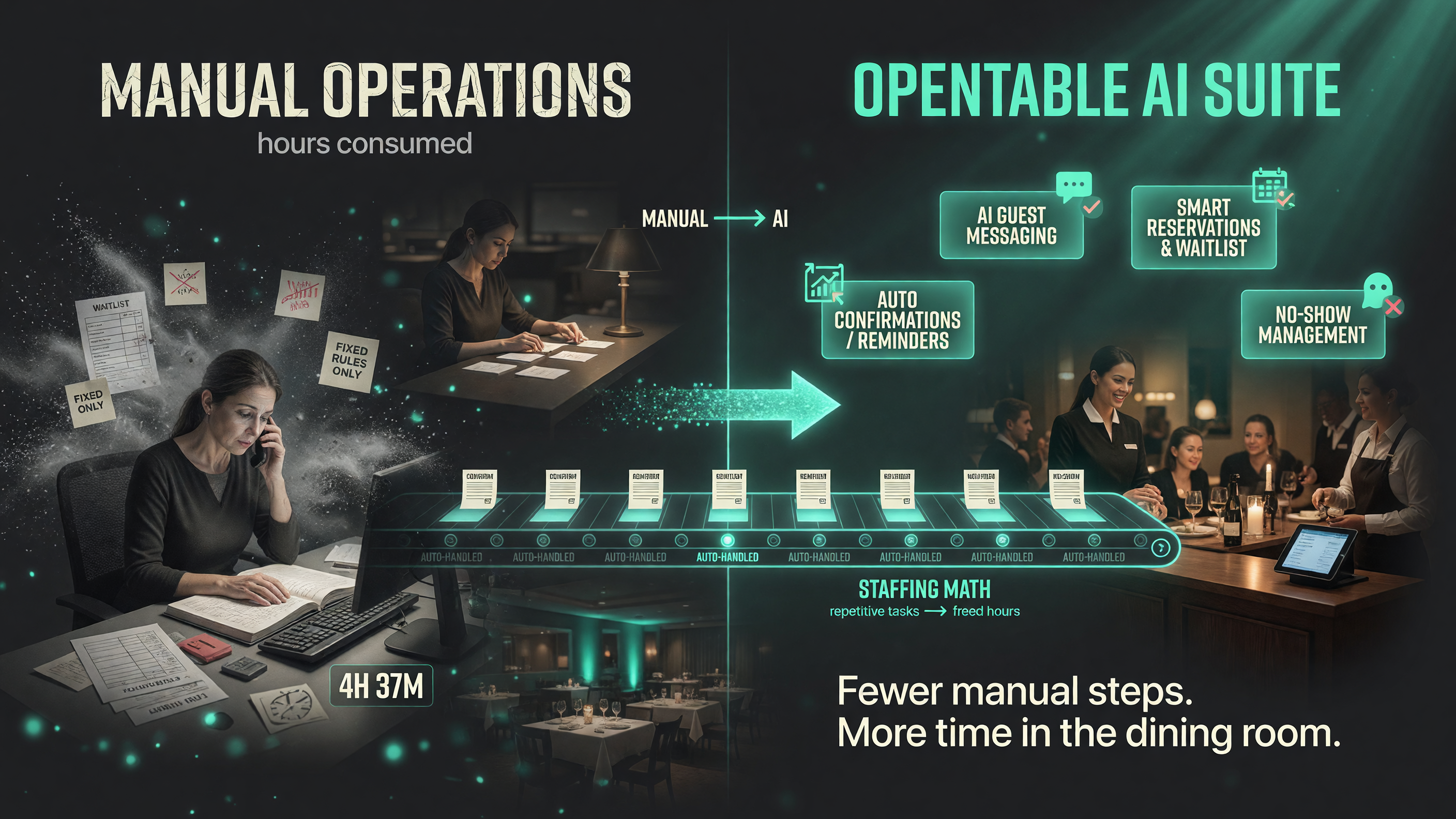
OpenTable’s AI feature suite vs. manual operations: the value isn’t the AI — it’s the staffing math.
The Labor Math an Owner Actually Feels
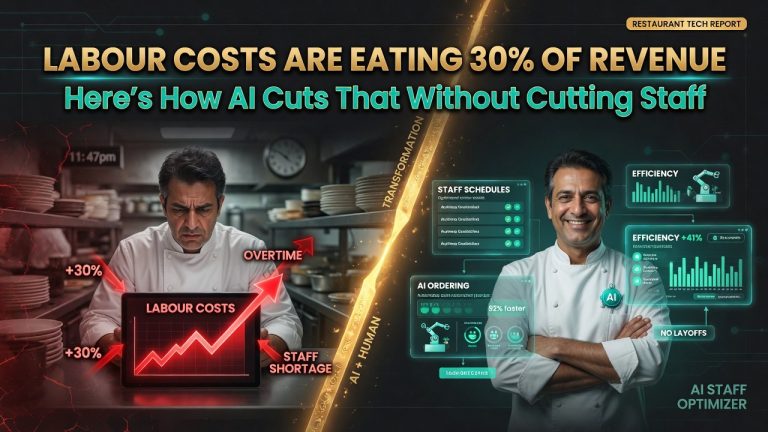
Every AI feature announcement ultimately fails or succeeds on one question an operator asks themselves at 1am: does this save me a body’s worth of work? The honest answer for most of OpenTable’s automation is that it doesn’t cut a full position — but it does buy back a meaningful share of one in the busy hours, which is where the real cost lives.
Consider what a typical independent weekend shift involves on the reservations side. Confirmations to send, waitlist updates to relay, no-show follow-up, a handful of special requests to acknowledge, and a steady stream of questions about hours and directions. Done manually, that’s scattered minutes across an already fractured afternoon — minutes that come out of prep, out of the line, or out of the owner’s one pocket of breathing room. Stacked over a year, those minutes become a recurring tax on the operation. Automating the confirmations and reminders quietly removes a large share of that tax without the owner having to think about it again.
The reason this lands differently for independents than chains is structural. A chain spreads the cost of a host manager, a call desk, or a reservations coordinator across dozens of locations, so the per-unit burden is thin. An independent carries the whole load on one or two people, and that load shows up as overtime, as missed service touches, or as an owner operating on fumes. When the platform absorbs the repetitive 80% of the booking conversation, it’s not theoretical efficiency — it’s a direct reduction in the workload that causes burnout and turnover in the front of house.
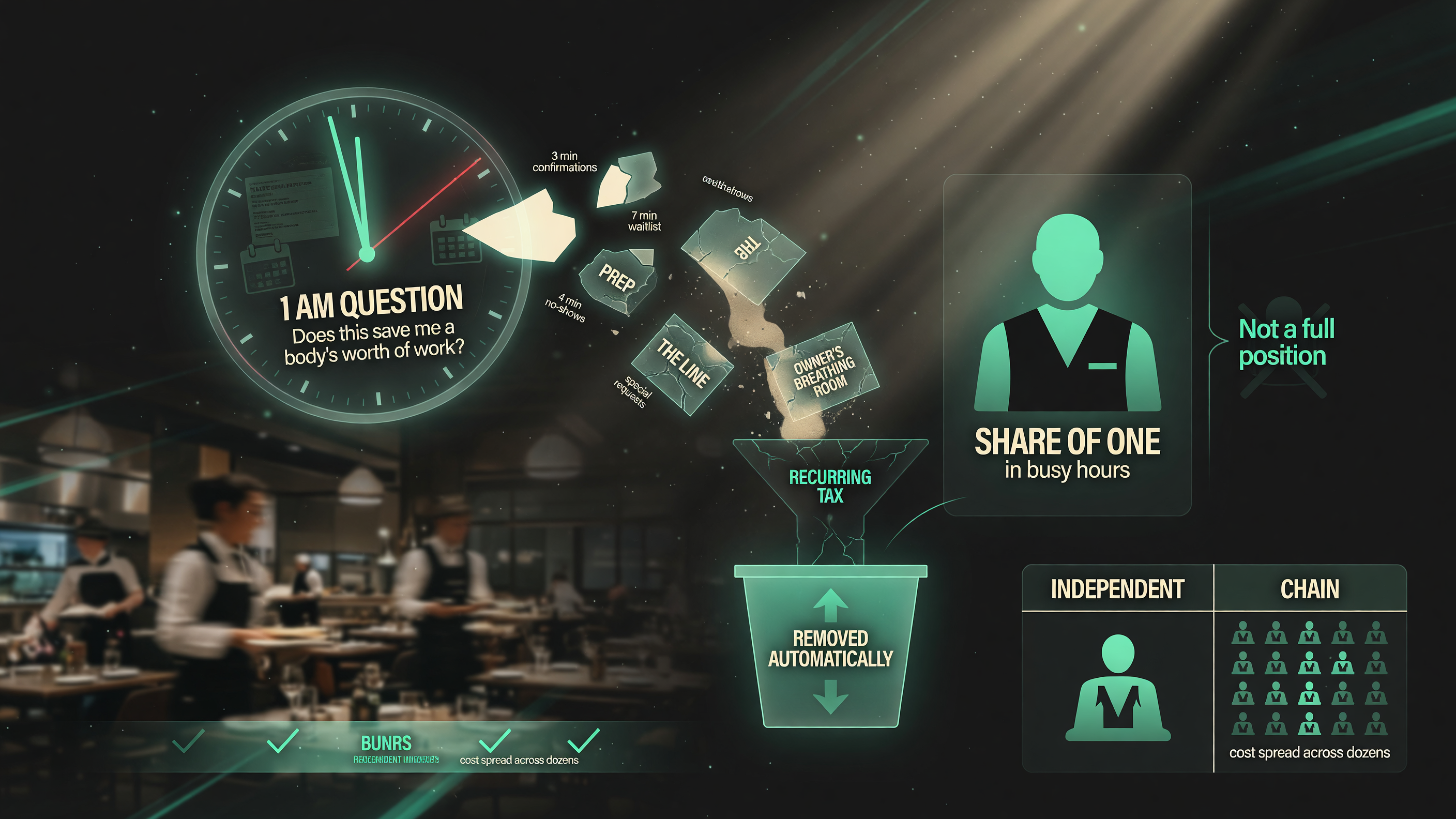
The 1am question: does automation save a body’s worth of work — or at least a meaningful share of one in the busy hours?
What “Automation” Should and Shouldn’t Mean at Your Place
There’s a real difference between automation that earns its keep and automation that annoys guests. The line is the same one good hosts have always drawn: automate the predictable, humanize the personal. A confirmation, a reminder, a waitlist update — these are expected, low-emotion messages that guests want handled quickly and reliably. Handing those to the platform is a service improvement.
What shouldn’t be automated is the stuff that builds loyalty — the birthday a regular mentions, the anniversary table, a regular’s standing preference. Those moments are why a guest keeps coming back to an independent rather than eating at any number of near-identical options. If your automation system touches those in a generic way, you’re spending your best currency (personal connection) to save a few seconds. Keep the high-touch moments human, and let the software own the predictable volume. That split is how an independent gets the efficiency without surrendering the hospitality.
It’s also worth being deliberate about rollout. You don’t have to switch every feature on at once. Turn on the one or two that address your clearest bottleneck, watch a few real shifts, and add more only after they prove out against live demand. A suite launch is an invitation to choose, not a mandate to accept everything.
It’s also worth setting a review cadence once you do turn features on. Automation that runs quietly is easy to forget about — and a forgotten automation can drift into annoyance (over-messaging guests, double-booking edge cases, or nudging regulars who don’t need a nudge). Block a short check-in two weeks after you enable a feature, then monthly: look at whether the confirmations are landing, whether no-shows actually dropped, and whether any guest feedback turned negative. Treat the tools as living systems you manage, not as set-and-forget switches, and you keep the efficiency without the guest-relations tax.
Why This Matters More for Independents Than Chains
Chains have dedicated labor for this work — host managers, call centers, and software teams that stitch tools together. An independent owner is the reservations manager, the marketer, and often a line cook in the same shift. The AI automation OpenTable is rolling out directly targets the workload that lands on that one person’s shoulders.
There’s a second, quieter benefit: consistency. When a reservation platform handles the repetitive communication, the guest experience stops depending on whether the shift was understaffed or the host was juggling three tables. The software doesn’t get tired, forget a confirmation, or drop a message at 9pm. For an independent trying to compete on service without hiring more bodies, that consistency is the actual product.
There’s also the question of what a platform like OpenTable can do that a small operator simply cannot replicate with a whiteboard and a reservation book. A table-turning metric, a wait-time estimate, a guest who books at 11:40am and needs a table by noon — the data from a busy week generates hundreds of small decisions. A human host makes them as best they can between other duties. An automated system makes them against a consistent set of rules, every time, without a dip at 2pm or a gap when the rush hits. That consistency is not a luxury feature; for a single-location operation it is often the difference between running a comfortable floor and running a scramble.
And it stacks with the labor reality most independents are living through in 2026. Hiring and holding front-of-house staff is harder and more expensive than it was a few years ago, and the cost of a vacancy lands directly on the remaining team. When the reservation platform absorbs the repetitive communication and waitlist work, an owner does not need to backfill that hour with another hire — the software holds the line. That is the practical, unglamorous reason AI automation matters more for a two-person front of house than for a corporate chain with a call center.
Traditional Operations vs. AI-Assisted Operations
| Operational Task | Traditional (Manual) | AI-Assisted (OpenTable Model) |
|---|---|---|
| Booking confirmations | Staff sends each one, or relies on the guest to confirm | Automated, consistent, sent at the right time |
| Reminders & follow-ups | Manual, often skipped during busy service | Triggered automatically based on the booking |
| Waitlist management | Whiteboard + walkie, depends on the host | Adjusts to demand, guests updated in real time |
| No-show handling | Reactive; table sits empty, revenue lost | Automated reminders cut no-shows before they happen |
| Guest communication | Depends on the shift, the host, and available time | Consistent, branded, handled by the platform |
The right column isn’t a luxury — for the routine tasks that happen dozens of times a day, it’s the difference between an operation that scales and one that breaks the moment someone calls in sick. A reservation platform that automates the repetitive 80% means the human effort goes where it earns: the dining room, the food, the hospitality that can’t be automated.
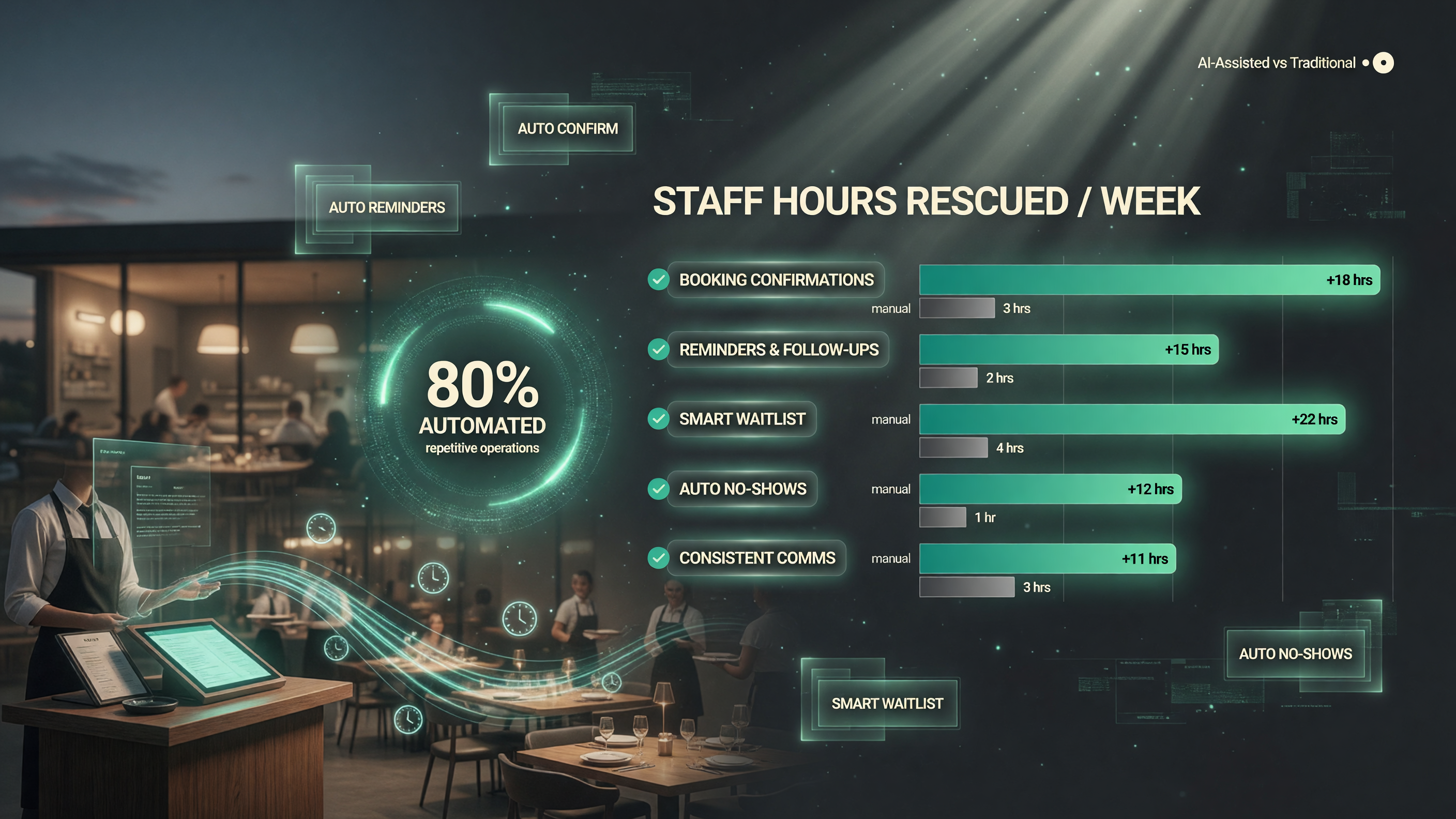
Staff hours rescued per week by automating the repetitive 80% of booking, waitlist, and guest-communication tasks.
How to Know If It’s Worth It for Your Restaurant
Not every feature in a platform update will matter to your operation, and you shouldn’t pay for what you won’t use. Before you lean in, bench-test what the AI automation actually replaces at your place. The screen below is what I’d run any operator through.
- List the tasks that actually drain hours. Write down the three most repetitive guest-facing tasks you did last week — confirmations, reminders, menu questions, no-show follow-up.
- Count the minutes. Be honest about how many staff-hours those tasks consumed. That number is the ceiling on what the automation is worth.
- Test the feature against your busiest shift. A demo at 2pm isn’t proof. Run the automation during a real Saturday push and watch whether it holds.
- Check what your guests feel. Automation should feel like better service, not a robot. If guests notice the change in a negative way, dial it back.
- Protect the human high-touch. Use the automation on the repetitive stuff, but keep personal service for birthdays, VIPs, and special occasions — that’s where you win loyalty.
| Approach | Best For | Watch Out For |
|---|---|---|
| Automate the repetitive 80% | Understaffed independents, high call/booking volume | Losing the human touch on routine moments |
| Keep the high-touch manual | Hospitality-first spots, VIP and occasion guests | Staff running out of hours for what matters |
| Adopt only what you’ll use | Operators with a clear labor bottleneck | Paying for features that never touch your workflow |
OpenTable’s largest feature suite yet is a signal about where the industry is heading: AI and automation are becoming the default layer of restaurant software, not an add-on. For an independent U.S. operator, the smart move is to test the automation against your real workload, keep the human moments human, and let the software absorb the repetitive tasks that currently cost you staffing hours. That’s how AI earns its keep in a restaurant — by giving the team back the time to be hospitable.
Frequently Asked Questions
What did OpenTable announce on August 26, 2026? OpenTable announced its largest suite of new and updated product features for restaurants, centered on expanded AI and automation tools for guest communication, reservations, waitlists, and repetitive booking tasks. It was first reported by PR Newswire.
Is this different from OpenTable’s AI voice tools? Yes. The earlier AI voice rollout focused on answering calls and booking by phone. This suite is broader, spanning AI guest communication and automation across the guest journey — not just voice answering.
Is OpenTable’s AI automation useful for an independent restaurant? Yes, especially for understaffed independents. The automation directly targets repetitive tasks — confirmations, reminders, waitlist updates, no-show handling — that consume staff hours, letting the team focus on the dining room instead.
What does AI automation in restaurants actually cost? It depends on your existing reservation platform and plan. For operators already on OpenTable, the automation sits on top of the platform you already use, so the question is whether the added features justify their cost against the staff hours they save.
Will AI automation replace restaurant staff? No. The point is to automate the repetitive, low-judgment tasks so the human team can focus on hospitality, service, and the guest experience — the parts that can’t and shouldn’t be automated.

About Barak Schurr
Barak Schurr built and exited a major ticketing platform, ran global operations at Eventbrite, and now focuses on one question: which AI tools actually help independent restaurant owners run leaner and grow faster. He writes from the operator’s perspective — no vendor spin, no theory, just what’s real in 2026.
Email: [email protected]
More AI Resources for Your Business