Get the AI Restaurant Quick-Start Guide — Free
The 5 AI tools independent US restaurant owners are using right now to cut labor costs and answer every call.
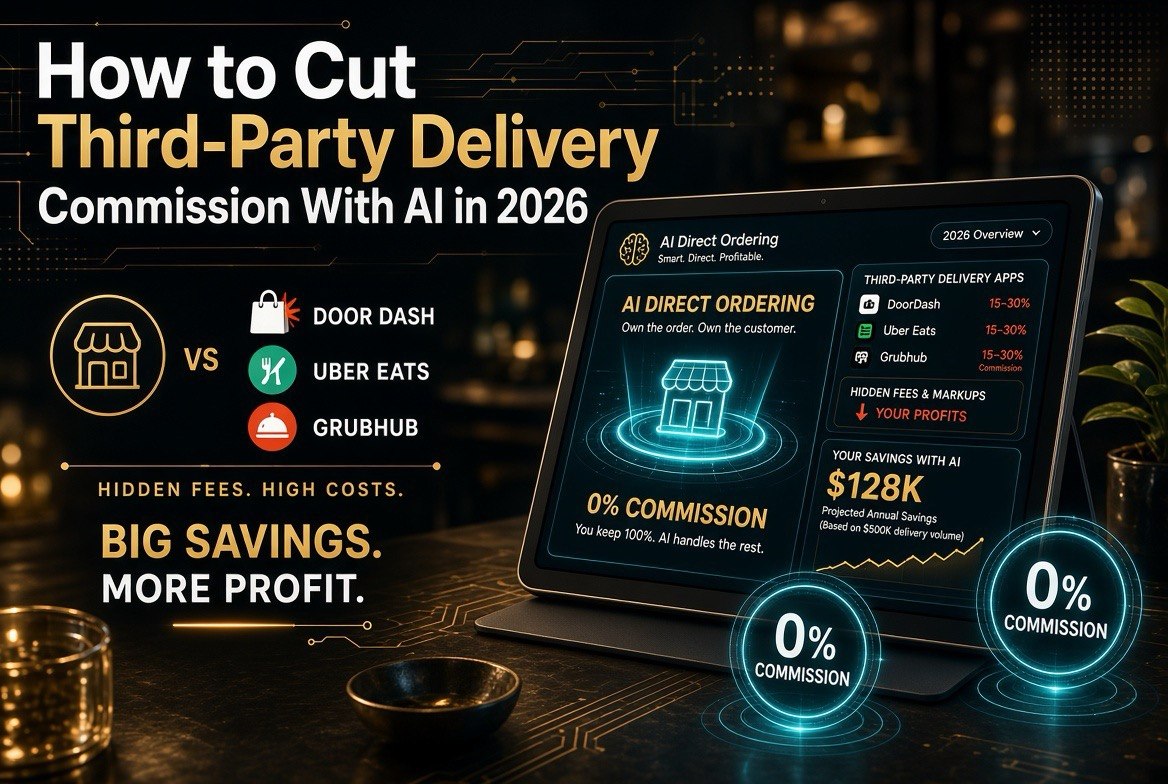
How to Cut Third-Party Delivery Commission With AI in 2026
⚡ Expert Summary: Third-party delivery apps still take 15-30% of every order, and for most US restaurants that is the single biggest leak in their profit. The fix is not to delete the apps; it is to shift your repeat and loyal customers to a direct, AI-powered ordering channel where the commission is near zero. This guide walks through a practical, step-by-step plan to cut delivery commissions with AI — starting with the low-effort wins and building to a full owned-channel strategy.
If your restaurant runs delivery through DoorDash or Uber Eats, you already know the sting: the platform takes a percentage of every order regardless of your food costs, labor, or rent. On a $30 order, a 25% commission is $7.50 gone before you pay for ingredients. For an independent US restaurant doing a few thousand dollars a month in delivery, that can quietly add up to $1,000 or more a month handed to the apps.
The good news is that 2026 AI tools make it practical for an independent operator to claw much of that back. You do not need a marketing agency or a web developer. You need a plan that moves your most valuable customers — the repeat ones — onto a channel you control, then uses AI to keep them coming back directly.
This guide is the practical companion to our comparison of the best AI online ordering platforms, which explains which tools to choose. Here, we focus on execution: the exact steps to cut your third-party delivery commission in 2026, in order of effort and impact.
Why the Commission Leak Is Worse Than You Think
Before you start cutting, it helps to see the full cost. DoorDash commissions run from 15% on its basic delivery plan up to 25% on Plus and 30% on Premier, with pickup around 6%. Uber Eats charges roughly 20% on Lite, 25% on Plus, and up to 30% on Premium, with pickup near 7%. Those percentages sit on top of payment processing and occasional promo fees.
The hidden cost is that these fees scale with your success. The more you push delivery, the more you pay. And because the apps own the guest relationship, you pay again every single time that customer reorders through the same app — even the loyal ones you brought in yourself. That is the leak an owned, AI-assisted channel plugs.
One framing keeps this simple: marketplaces are for discovery; your own channel is for profit. A new customer who finds you on DoorDash is a discovery win. A regular who reorders every Thursday through DoorDash is a profit leak — that is exactly the order AI tools can help you capture directly.
How to Cut Third-Party Delivery Commission With AI, Step by Step
Below is the exact sequence independent US operators are using in 2026. Do them in order — each step layers on the last.
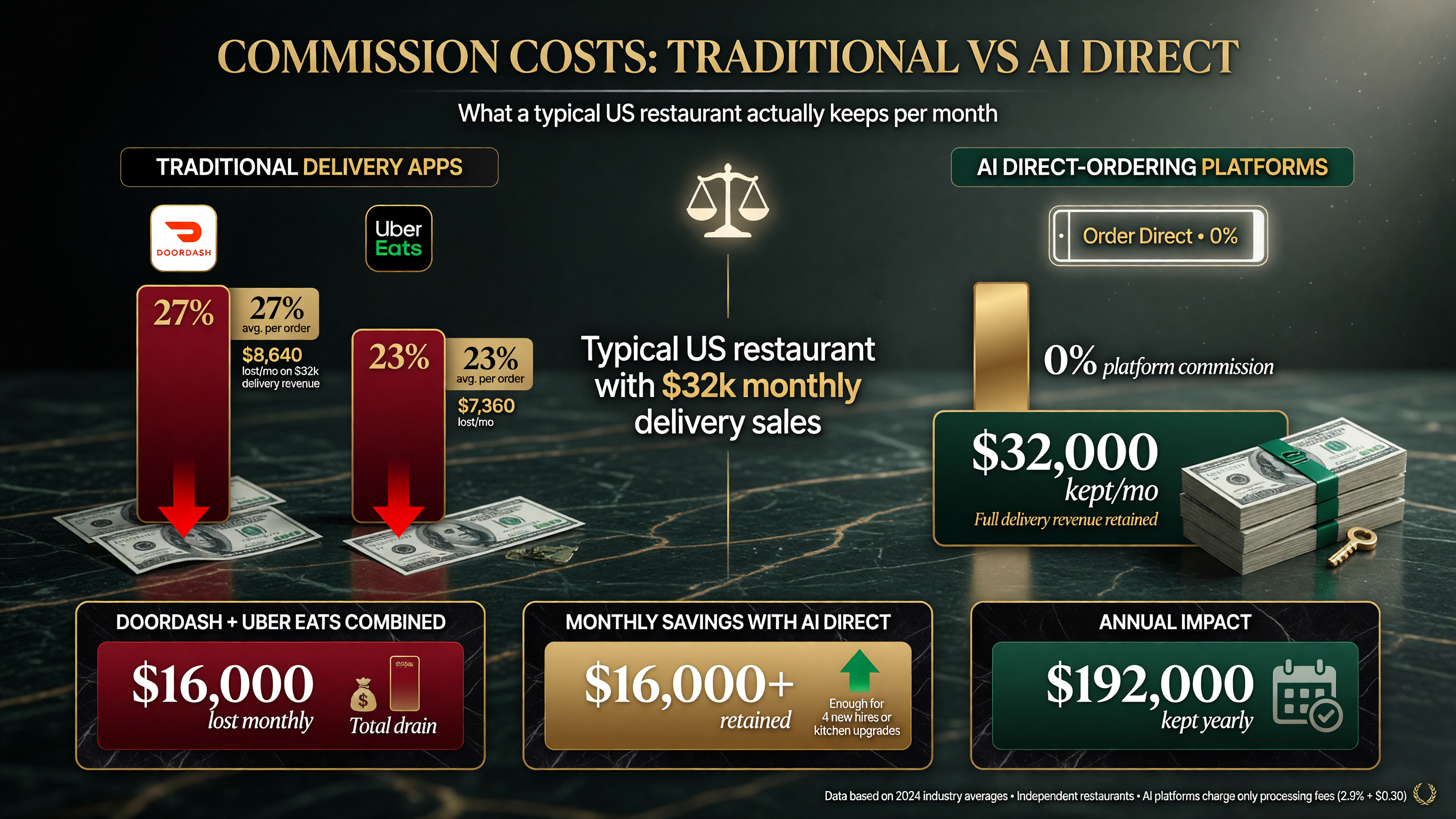
DoorDash commissions run from 15% on basic delivery to 30% on Premier, and Uber Eats from 20% to 30% on Premium — but an AI direct-ordering channel charges 0% platform commission, so the restaurant keeps the full order value instead of handing 15-30% to the app.
Step 1: Measure Your Real Commission Leak
You cannot fix what you cannot see. Pull your last three months of delivery sales and average the effective commission rate you actually paid, not the advertised tier. Look at your gross delivery revenue, the commission and fees charged, and how many of those orders came from repeat customers.
The number that matters is repeat-order value: the delivery sales from customers who already know you. That is the pool AI can realistically move direct. A typical independent might find 30-50% of delivery sales are repeats — and that is the slice you are handing to the apps at 25%.
Use this quick math: monthly delivery sales × your effective commission rate = monthly leak. A restaurant doing $6,000 a month at 25% is leaking about $1,500 a month. Even recovering half of that on a direct channel is $750 back — before counting the customer data you begin to own.
Step 2: Set Up a Direct Ordering Channel (Your 0% Commission Storefront)
A direct ordering channel is a branded page where customers order straight from you, not through a marketplace. AI-driven platforms like Owner.com and ChowNow handle the technical heavy lifting. In 2026 these platforms build your site, sync your menu, and run marketing with AI assistance — no web designer required.
Owner.com charges about $249-$499 per month with 0% commission on direct orders. ChowNow runs roughly $119-$449 per month at 0% commission. Compare those monthly fees against the $1,500-plus monthly leak, and the return is usually obvious.
If you are not ready for a subscription, even a simple in-house ordering page with your point-of-sale terminal for pickup can start capturing some direct volume. The key is to have some channel you control, ready before you start driving traffic to it in later steps.
For choosing between the platforms, our dedicated guide on the best AI online ordering tools lays out the owner-operators of each. Start there if you have not picked one yet.
Step 3: Shift Pickup Orders Off the Apps First
Pickup is the easiest win. Apps still charge a pickup fee (6-7%) even though no delivery driver is involved. Put QR codes at your counter, on tables, and in to-go bags that open your direct ordering page. Train your staff to invite customers scanning the box or checking out to order direct next time for a small perk, like a free side.
Pickup is low-risk to move because the logistics (the customer walks in) already exist. Every pickup order that moves from the app to your direct channel instantly saves that 6-7% fee. It is the fastest real saving you can capture in the first week.
Step 4: Build an AI-Powered Loyalty and Reorder Loop
This is where the compounding savings begin. The goal is to turn app-ordered regulars into direct-channel regulars who reorder on their own. AI platforms help by automatically sending reorder reminders, personalized offers, and upsells based on each guest’s order history.
When a guest buys a pizza and salad on Tuesday, an AI email or SMS on the following Tuesday says: “Same order? Reorder in one tap.” That one tap happens on your own channel at 0% commission instead of 25%. Over a month, a handful of reorder loops can shift a meaningful chunk of your repeat delivery volume.
Step 5: Capture Guest Data You Actually Own
The deepest reason to leave the apps is data. Through the apps you rent access to your customers; you do not own their names, emails, or numbers. An AI CRM built into a direct platform captures that data the moment someone orders from you directly. That list is an asset that lets you keep re-engaging guests without paying a per-order toll.
Use AI to segment that list — “night regulars,” “family orders,” “lapsed three weeks” — and to draft the messages that bring each group back. Every reorder on that list is a direct, low-commission order you would otherwise have paid the apps for.
Step 6: Promote Your Owned Channel With AI Marketing
Your direct channel only pays off if people actually use it. AI marketing tools (built into platforms like Owner.com and ChowNow, or via assistants) handle local SEO, targeted ads, and review management, pushing new local customers toward your direct ordering page instead of your marketplace listing.
Budget time here. It takes several weeks of consistent in-store signing, QR placement, and email/SMS cadence to build the direct habit. The AI does the repetitive work; your job is to keep reinforcing the message that ordering direct is cheaper and better for everyone.
Step 7: Keep the Apps for Discovery, Manage the Split
You do not delete DoorDash or Uber Eats overnight. They remain your fast path to new customers, especially for a location without strong local awareness. In 2026 the smart play is a deliberate split: use the apps for discovery and new guest acquisition, and push repeat and loyal volume onto your direct channel.
As your direct channel grows, shift more of the mix off the marketplaces. The commission you save is not just profit — it is budget you can reinvest in your own marketing, staff, or menu. A 20-30% shift of delivery volume off the apps is a realistic, meaningful first target for most independents.
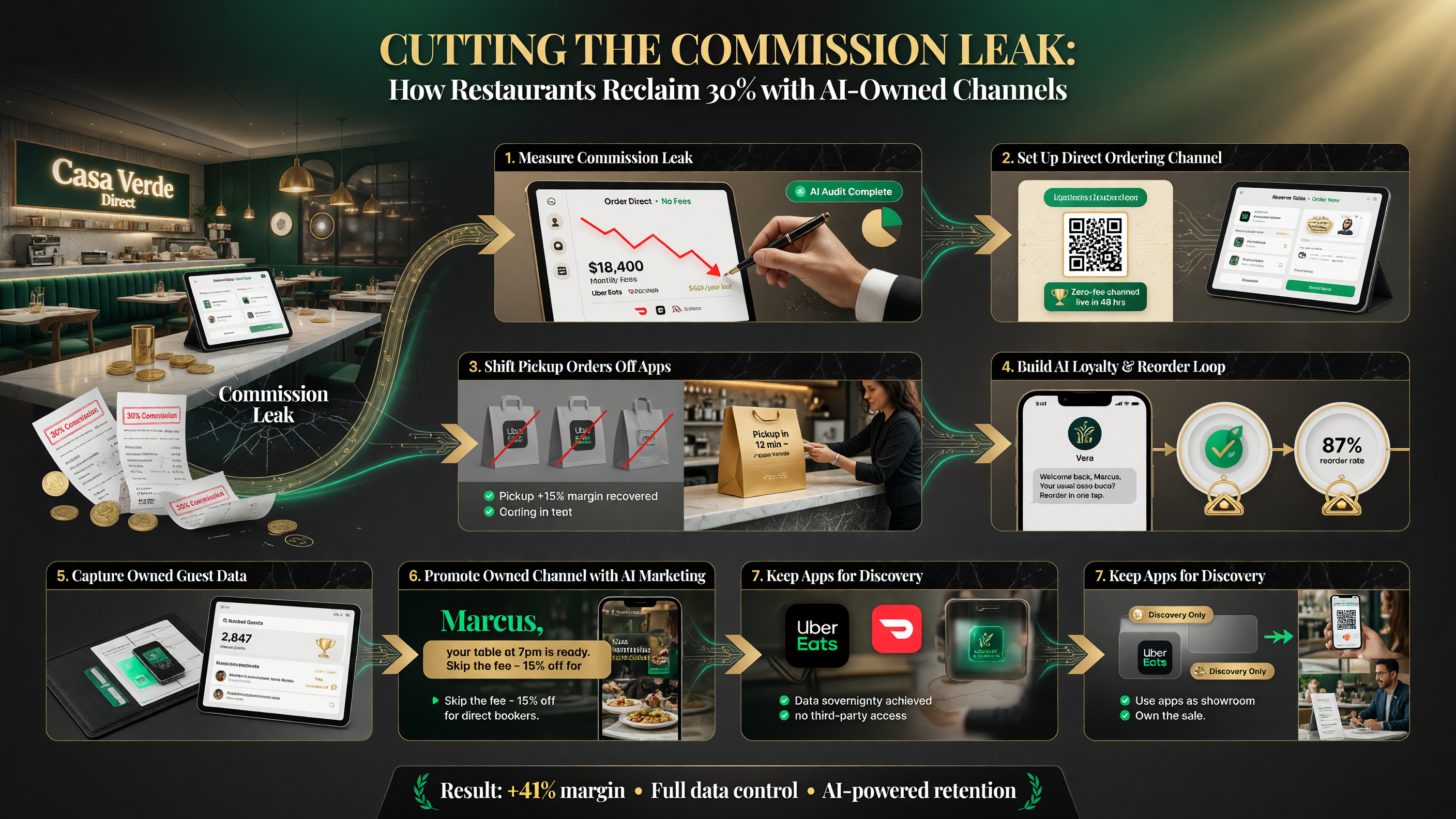
The seven-step playbook runs from measuring your real commission leak to keeping the apps purely for discovery — a 20-30% shift of delivery volume off DoorDash and Uber Eats is a realistic first target that most independents can hit with an owned, AI-assisted channel.
What Each Saving Looks Like
Here is how the different methods stack up, so you can prioritize where to start.
| Method | How It Cuts Commission | Effort | Best For |
|---|---|---|---|
| Direct ordering platform | Moves repeat orders off 3PD to a ~0% commission channel | Medium setup | Any volume, best once >$3-5k/mo online |
| AI-powered loyalty & reorder | Turns one-off app orders into repeat direct customers | Medium | Restaurants with a steady regular base |
| Pickup-first promotion | Captures pickup orders direct, avoiding 15-30% delivery fees | Low | Dense urban or walk-in locations |
| Owned-channel marketing | AI email/SMS drives customers to direct instead of the apps | Medium | Restaurants with captured guest data |
| Hybrid split | Keeps 3PD for discovery while steering regulars direct | Low-Medium | Most independent operators |
The table above is a starting framework. Every operation is different, and the right mix depends on your volume, location, and customer base. The good news: the two highest-impact moves — pickup-first and repeat reordering — are also the lowest effort.
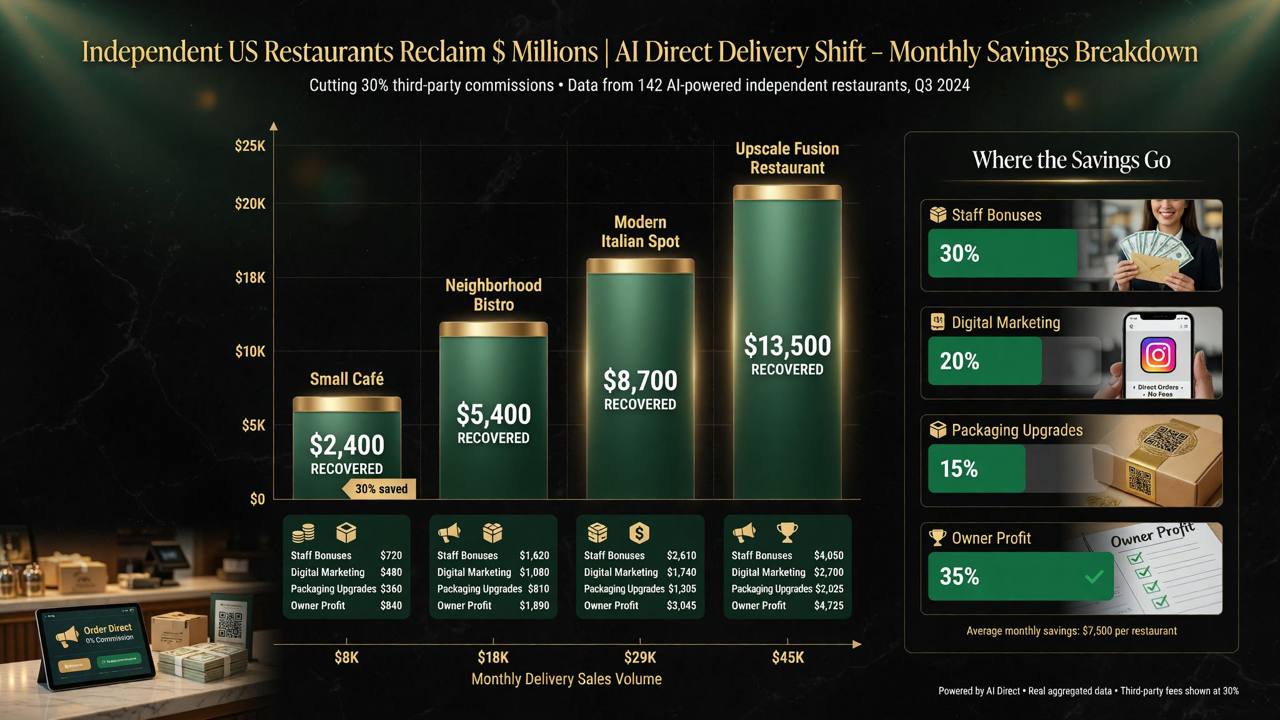
Independent US restaurants in this breakdown recover $2,400 to $13,500 a month by cutting roughly 30% in third-party commission — an average of $7,500 per restaurant — and most reinvest that cash into staff bonuses, digital marketing, and packaging before it ever hits owner profit.
The AI-Specific Leverage
The biggest returns come from the AI-specific actions that attack recurring leaks automatically. The table below maps the most common commission leaks to the AI fix and a realistic monthly saving, so you can see where automation pays off fastest.
| Commission leak | AI fix | Typical saving per month |
|---|---|---|
| 25% on repeat delivery orders | AI reordering prompts to shift regulars direct | Up to 20-30% of repeat order value |
| High pickup fees via apps | QR-code direct pickup ordering | 6-7% per pickup order |
| Guest data locked in 3PD | AI CRM captures emails/phones for direct marketing | Recurring, compounding |
| Ad spend on 3PD boosts | AI-driven local ads to owned channel | Varies by market |
These are the four biggest recurring leaks AI directly attacks. Notice the theme: AI is not replacing your team; it is automating the repetitive parts of moving and keeping customers on your own channel, and it is doing it at machine speed and scale.
Common Mistakes to Avoid
- Deleting the apps too fast. Cutting off discovery is worse than paying commission. Move repeat volume first; keep marketplaces for new customers.
- Building a channel nobody is pushed to. A direct ordering page with no traffic saves nothing. Budget time for QR codes, in-store signs, and email/SMS cadence.
- Ignoring the data. The biggest long-term win is owning your guest list. Do not let that slip.
- Chasing every new tool. Pick one direct platform, one loyalty loop, and run it well before adding more.
- Forgetting pickup. Pickup is the fastest, lowest-risk saving. Start there even if you keep delivery on the apps.
FAQ
How much commission do DoorDash and Uber Eats charge in 2026?
DoorDash charges 15% on its basic delivery plan, 25% on Plus, and 30% on Premier, with pickup around 6%. Uber Eats charges roughly 20% on Lite, 25% on Plus, and up to 30% on Premium, with pickup near 7%.
Can AI actually cut my third-party delivery commission?
Yes. AI tools make it practical to shift repeat and pickup customers to a direct, near-zero-commission ordering channel, and to keep them returning with automated reorder, loyalty, and marketing. The commission reduction comes from moving volume off the marketplaces, with AI handling the heavy lifting.
How fast can I see savings from switching to direct ordering?
Pickup-first changes can save instantly, often within the first week. Repeat-reorder savings build over a few weeks as the direct habit forms. A reasonable target for most independents is recovering 20-30% of delivery commission within the first 60-90 days.
Do I have to stop using DoorDash and Uber Eats?
No. The smart play is hybrid: keep the marketplaces for discovery and new customers, and steer repeat and loyal customers to your own direct channel where the commission is near zero. As the direct channel grows, shift more volume off the apps.
What is the cheapest way to start cutting delivery commission?
Start with pickup. Put QR codes that open a direct ordering page on your counter, tables, and to-go bags, and invite customers to order direct. Then add a low-cost direct platform (like ChowNow from about $119/month) once you want repeat-reorder and marketing automation.
How much can an independent restaurant save per month?
A restaurant doing $5,000-$6,000 a month in delivery at a 25% effective commission is paying about $1,250-$1,500 a month to the apps. Moving even half of that to a direct channel can return roughly $750 a month before the platform’s flat fee — and you begin owning customer data that compounds.

About Barak Schurr
Barak Schurr built and exited a major ticketing platform, ran global operations at Eventbrite, and now focuses on one question: which AI tools actually help independent restaurant owners run leaner and grow faster. He writes from the operator’s perspective — no vendor spin, no theory, just what’s real in 2026.
Email: [email protected]
More Resources for Restaurant Operators