Get the AI Restaurant Quick-Start Guide — Free
The 5 AI tools independent US restaurant owners are using right now to cut labor costs and answer every call.
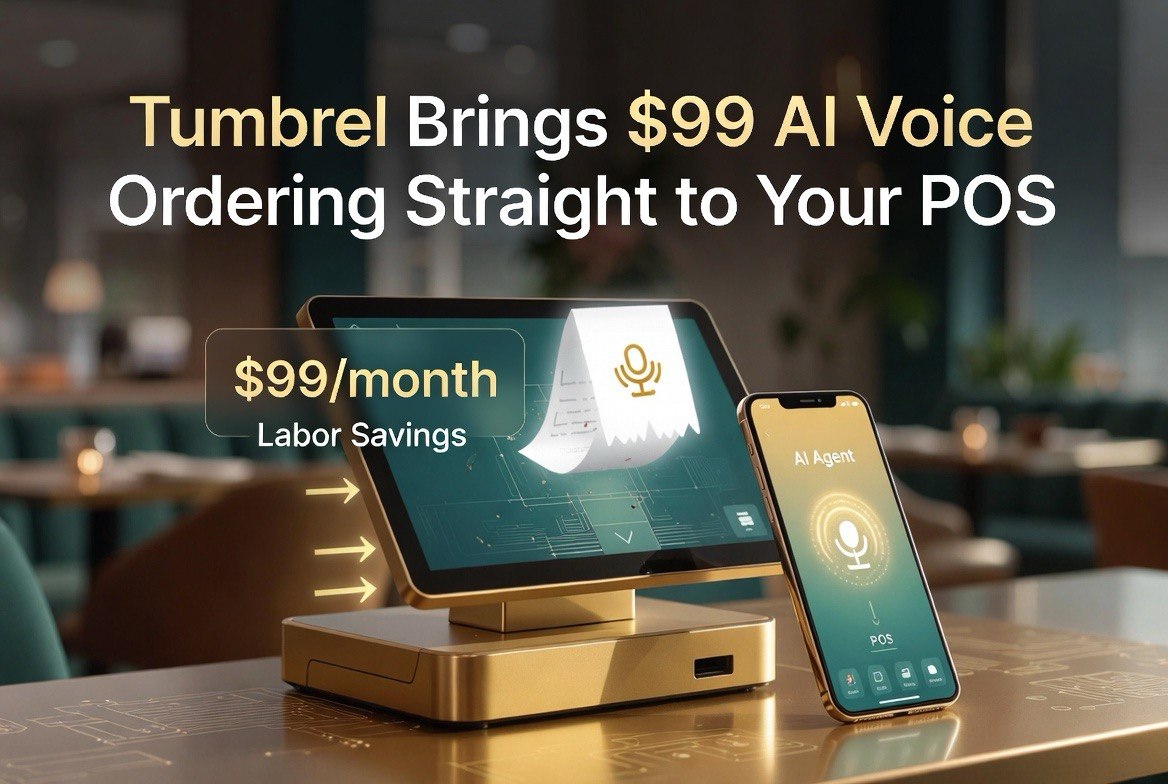
Tumbrel Brings $99 AI Voice Ordering Straight to Your POS
⚡ Expert Summary: Tumbrel is rolling out an AI voice-ordering system priced at $99 per location that plugs directly into your existing POS, and early operators say it can be live in under a week even on the busiest phone lines. The pitch is a direct answer to the two things that kill independent restaurants every quarter: labor costs on the phone and missed calls that turn into lost tickets. Instead of paying a part-time host $16–$20 an hour to answer the same ten questions all day, the AI picks up, takes the order, confirms it, and drops it straight into your POS where the kitchen already works. For a single location that is under $120 a month after tax breaks, which for most diners is roughly the cost of two walk-out tables; for a three-store group it starts to look like real money back on the P&L. The catch is that voice AI is only as good as the integration, and a $99 tool that can’t talk to your kitchen printer is just an expensive voicemail, so the POS requirement is the thing to check before you sign.
What Tumbrel Actually Is
Tumbrel is a phone-answering AI purpose-built for restaurants, not a general chatbot bolted onto a phone line. It answers the restaurant’s inbound calls, handles the standard guest questions that eat up staff time, takes delivery and pickup orders, and writes them directly into the POS so a human never has to re-key a ticket. The pricing model is flat: $99 per location per month, which is notable because most voice-ordering vendors charge a percentage of every order or a setup fee plus a higher monthly rate. For an independent restaurant the flat number makes the math easy to defend to an owner who has been burned by “per-transaction” pricing before.
The other claim worth paying attention to is the deployment time. Tumbrel says a location can be up and running in under a week, which matters because the restaurants that adopt voice ordering are usually the ones already drowning in calls, and a vendor that needs a four-week onboarding is not solving a problem, it is moving it. If the POS integration is the long pole, a week is a realistic claim only when the vendor has native connectors rather than a manual ticket-forwarding setup.
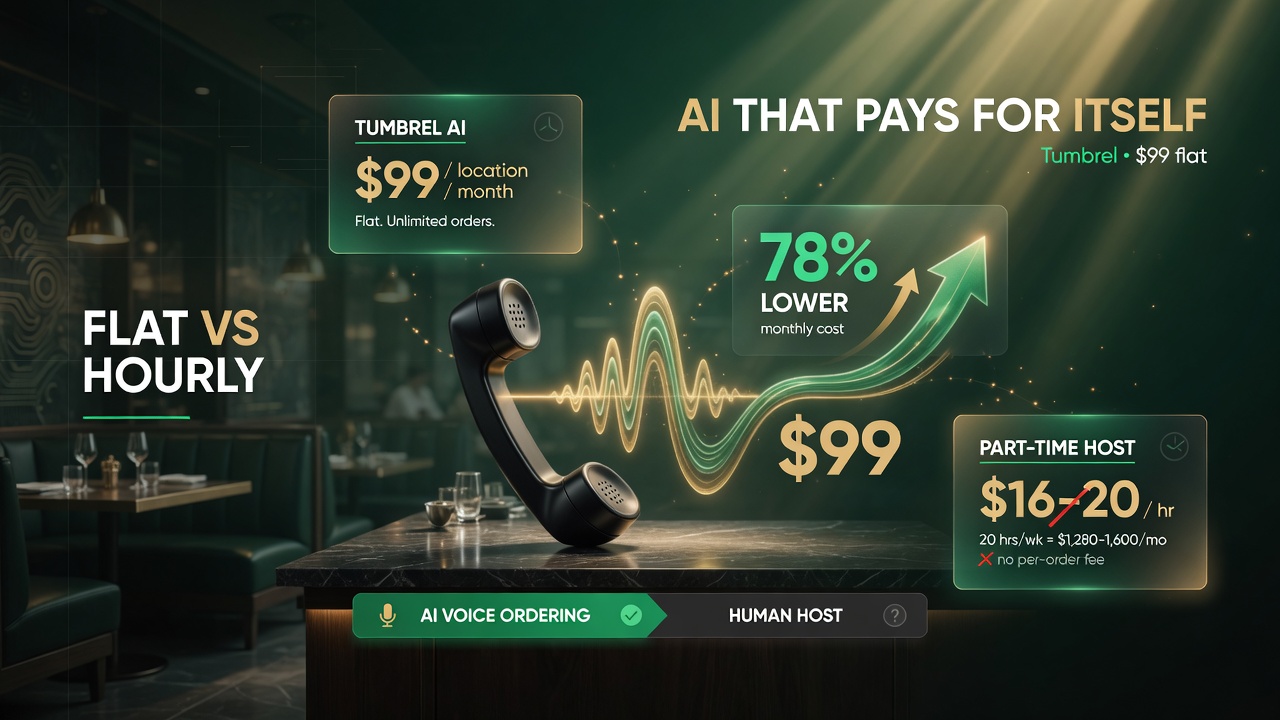
The pricing math that makes voice AI easy to defend: Tumbrel at a flat $99 per location per month with no per-order fee versus a part-time host at $16-20/hour. At 20 hours a week the human runs $1,280-1,600 a month, so the AI is typically over 70% cheaper for the same phone coverage.
Why Phone Calls Still Matter in 2026
Delivery apps have trained guests to order on a screen, but the phone has not gone away. Across the US, a large share of takeout and delivery orders still come through a live call, especially from repeat customers who want to modify a dish, ask whether a table is ready, or confirm a gluten-free option. Every one of those calls that rings more than twice is a ticket on the edge of being lost. A busy Friday night with two hosts covering a dining room and a phone line is exactly where orders fall through the cracks, and where a second line goes unanswered.
The real cost is not the call, it is the call that never gets answered. Studies in the restaurant industry have repeatedly tied missed or abandoned calls to lost revenue, and an unanswered phone at 6:00 PM on a Saturday is not a minor annoyance, it is an order that went to the place down the street. Tumbrel’s entire value proposition rests on this: keep the phone answered, keep the caller on the line, and turn the call into a ticket without burning labor.
Think through what actually happens on a busy shift. The host is seating a walk-in, the bartender is shaking a drink, and the phone rings a fourth time. Someone finally picks up halfway through the caller’s order, repeats it back twice, and keys it into the POS while a table waits for menus. That is not a customer-service failure, that is a staffing math problem, and voice AI is the staff the phone never needed a chair for. The operators who deploy it are not replacing a person so much as finally giving the front of house an extra set of hands that never calls in sick and never walks out mid-service.
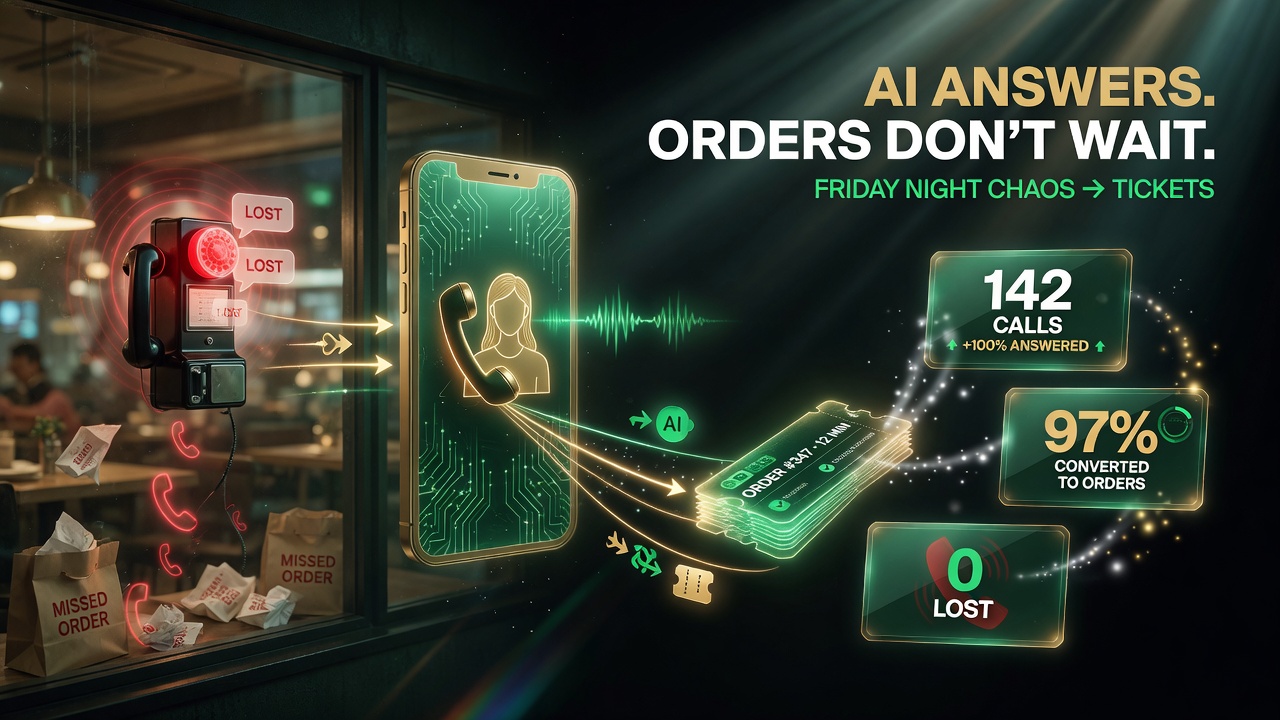
The whole point of phone automation is the call that does not get lost. Where a busy Friday night can push missed calls into genuinely lost tickets, an AI that answers every line and converts the caller into an order keeps revenue that used to walk to the place down the street.
How the POS Integration Changes Everything
The single most important detail in the Tumbrel pitch is the POS integration, because that is what separates voice AI from an answering service. When the AI takes an order and drops it straight into the POS, three things happen at once. First, the order appears in the kitchen exactly like every other ticket, so the line cooks do not learn a new workflow. Second, there is no human transcription step where an order can be misheard and repeated, which is where most phone-order mistakes actually come from. Third, the guest gets a normal confirmation with the correct total and pickup time, which builds trust on the very first call.
For the operator, the integration also means the AI knows the menu, the hours, the locations, and the modifiers. It can answer “do you have outdoor seating” and “what time do you close on Sundays” from the same source of truth the kitchen uses, instead of from a static script that drifts out of date the day the menu changes. The POS as the source of truth is the entire reason a $99 tool can be accurate enough to trust with real orders.
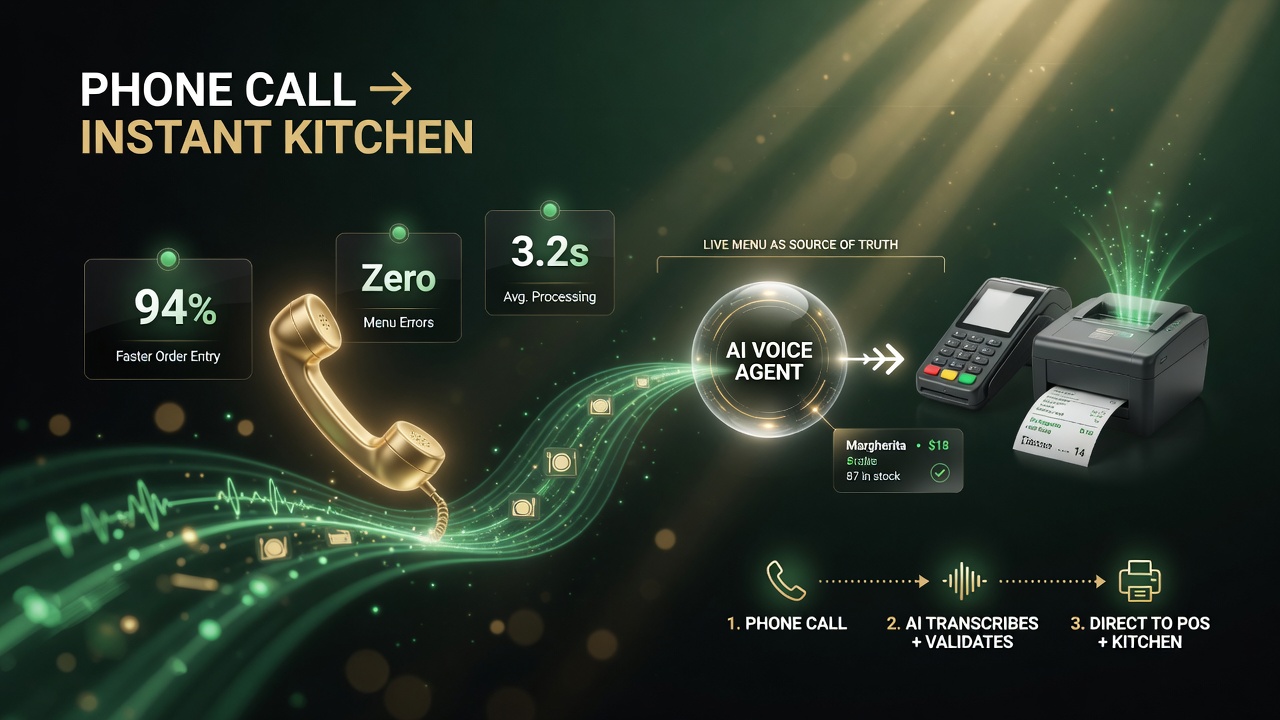
Native POS integration is what separates Tumbrel from an answering service: the AI takes the call, validates the order against the live menu, and drops the ticket straight into the POS so the kitchen sees it like every other order. No re-keying, no transcription errors, no menu drift.
What Tumbrel Is Built For
Tumbrel is aimed squarely at independent and small-chain restaurants, the segment that has the least tolerance for per-order fees and the most need for labor relief. A single-unit diner that takes 30 phone orders a night is the perfect profile: high call volume, thin staffing, and a menu stable enough that an AI can learn it quickly. The $99 price is not a loss leader for the enterprise; it is the product for the owner who has been told voice AI is “only for big brands” and wants to see the line item on the P&L.
Multi-location operators get a different benefit, consistency. A three-store group can roll the same phone experience across every location, so a guest calling the north store hears the same behavior as the south store, and the kitchen sees the same ticket format. For franchisors that consistency is worth more than the fee, because it standardizes the customer experience without adding a corporate phone team.
What It Does Not Do (and Why That Matters)
It is worth being clear about the boundaries, because restaurants have been burned by over-promising AI vendors. Tumbrel does not replace your kitchen staff, your front-of-house team, or your delivery drivers. It answers the phone, and that is the entire job. It will not bus tables, it will not upsell dessert, and it will not hand-write a thank-you card to a regular. The value is narrow on purpose: take the single most repetitive, labor-hungry task in the front of house and automate it cleanly.
That narrowness is actually a strength for adoption. The restaurants that succeed with voice AI are the ones that deploy it on exactly one well-defined job and let their people do the work that needs judgment. If you expect Tumbrel to run your guest experience, you will be disappointed; if you use it to catch the calls that currently go to voicemail, it pays for itself quickly.
What to Watch Out For
The first thing to verify is whether Tumbrel connects to your actual POS. Not every system has a native connector, and the “$99 and live in a week” promise realistically applies to the POS you already use. Check the compatibility list before you buy, because a $99 tool that requires you to change your POS is not a $99 tool, it is a project. This is the question that separates the vendors who understand restaurants from the ones who just bolted voice AI onto a generic call center: a real restaurant voice tool speaks the language of line items, modifiers, and kitchen printers, while a generic one treats every order like a support ticket.
The second is call quality on complicated orders. AI voice systems have improved dramatically, but a guest with a heavy accent, background noise, or a 12-item order with six modifiers is the real-world test. Ask for a recording of a real order on a busy line, not a curated demo of the easiest possible call. The difference between a demo and a Friday night is where the disappointment usually lives.
The third is what happens when the AI cannot handle a caller. If the tool escalates to a human or politely asks the guest to hold, you need to know which, because a customer who waits 40 seconds and then gets disconnected is angrier than one who reached voicemail in the first place. The escalation path is a detail investors in honesty will ask about, and so should you.
How to Try It
Start with one location and one POS you know works. Run Tumbrel in parallel with the existing phone line for a week and compare the tickets you capture against what your staff previously logged. Watch the two numbers that matter most: how many calls are now answered, and how many of those become orders in the POS. If both climb with a month of real call volume, the $99 pays for itself and you scale it to the next store. If the numbers stay flat, the tool is not earning its keep with your guests, and you have lost very little to find that out.
Frequently Asked Questions
How much does Tumbrel cost for restaurants?
Tumbrel is priced at $99 per location per month with no per-order fee in the core plan. That compares favorably to percentage-of-order voice vendors, and it makes the payback math simple for a single unit: if the AI captures just a couple of lost takeout orders a week, it more than covers the monthly fee.
Does Tumbrel work with my existing POS system?
Tumbrel’s core value depends on a native POS integration so orders drop straight into the kitchen. Check the compatibility list for your POS before subscribing; the flat-rate price and fast deployment assume the integration is native rather than a manual forwarding setup.
How long does it take to set up Tumbrel voice ordering?
Tumbrel says a location can be live in under a week when the POS integration is in place. The setup involves connecting the phone line, loading the menu, and configuring business hours, which is fast for the restaurants that already operate on a supported POS.
What does Tumbrel’s AI actually handle on the phone?
The AI answers inbound calls, handles common guest questions like hours and reservations, and takes pickup and delivery orders that it writes directly into the POS. It is built to automate the repetitive front-of-house phone work rather than replace kitchen or dining-room staff.
Is a per-location monthly fee better than per-order pricing?
For high-volume independent restaurants, a flat $99 per location is easier to budget than a percentage of each order. The flat model rewards capturing more calls without punishing growth, which is the opposite of per-order fees that scale against your own success.

About Barak Schurr
Barak Schurr built and exited a major ticketing platform, ran global operations at Eventbrite, and now focuses on one question: which AI tools actually help independent restaurant owners run leaner and grow faster. He writes from the operator’s perspective — no vendor spin, no theory, just what’s real in 2026.
Email: [email protected]
More Resources for Restaurant Operators