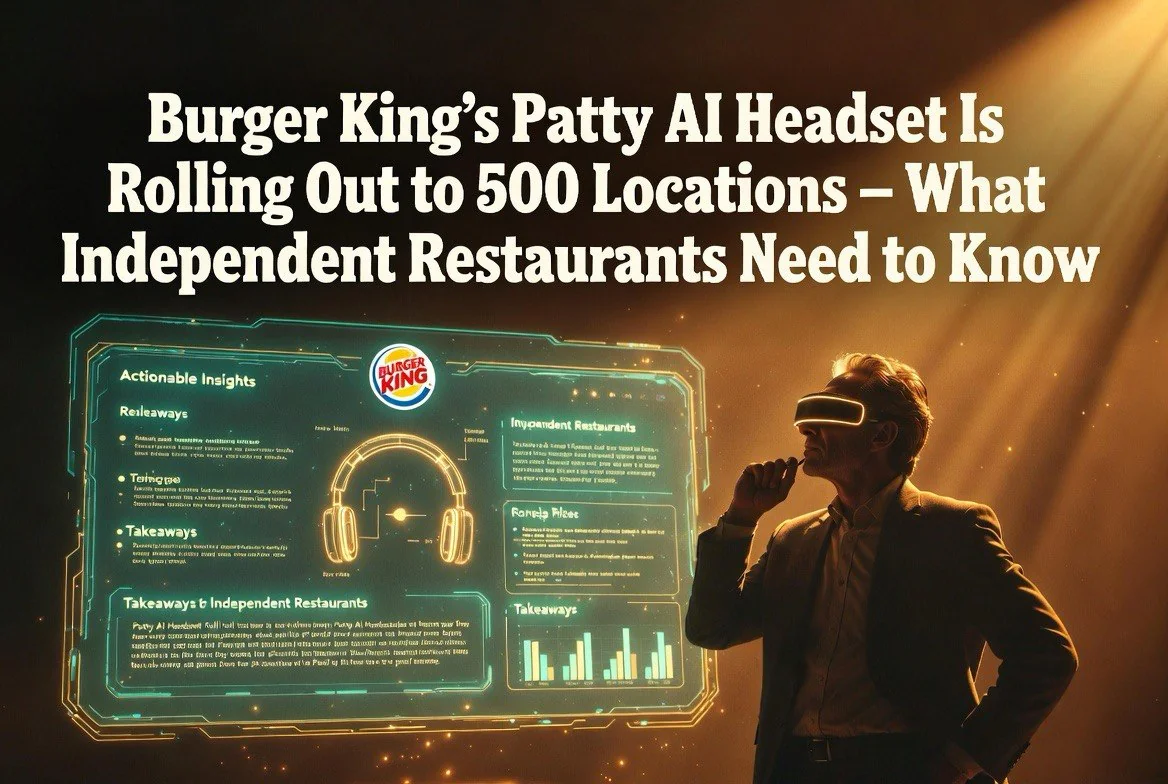
Burger King’s Patty AI Headset Is Rolling Out to 500 Locations — What Independent Restaurants Need to Know
⚡ Expert Summary: Burger King is rolling out its AI-powered Patty headset system to 500 US locations after a successful 200-location pilot. The headset uses AI to take drive-thru orders, upsell items, and route orders to the kitchen — all while the human team member focuses on food preparation and guest service. For independent restaurant operators, the rollout signals that AI voice ordering has crossed from experimental phase to production-ready infrastructure. Several US vendors offer similar technology at prices accessible to single-location operators, and this guide covers what the Patty system means for independent operations.
What the Patty AI Headset Actually Does
Burger King’s Patty AI headset system, developed in partnership with Google Cloud, is the chain’s second attempt at AI drive-thru automation. An earlier pilot in 2024-2025 used a different vendor and produced mixed results. The Patty system has addressed the issues that plagued the first attempt: accent recognition accuracy, background noise filtering, and handling complex customizations.
The Patty headset works differently from full AI drive-thru systems that replace human workers entirely. Instead, the AI listens to the customer’s order through the headset, transcribes it in real time, displays it on a screen for the crew member to verify, and routes it directly to the kitchen display system. The crew member wears the headset but focuses on preparing food and handing orders to customers rather than typing order entries into a register. The AI handles the transactional part of the interaction while the human handles the service part.
Deloitte’s 2026 Restaurant Technology Outlook analyzed the pilot phase and found that Patty reduced average drive-thru order times by 22 seconds compared to non-AI locations. For a Burger King location serving 300 drive-thru customers per day, those 22 seconds per order translate to 1.8 fewer hours of accumulated wait time per day. The system also improved order accuracy to 96%, compared to the industry average of 88% for human-only drive-thru ordering.
Burger King’s AI Journey: From Failure to Functional
Burger King’s first AI drive-thru attempt in 2024 used a system that replaced human order-takers entirely with AI voice agents. That pilot faced significant challenges. Customers with heavy accents or speech impediments were frequently misunderstood. Background noise from car engines, children, and passing traffic interfered with the AI’s speech recognition. Complex custom orders — “a Whopper with no lettuce, extra pickles, and a side of jalapeños on the side” — often produced incorrect tickets that required human intervention to fix.
The Patty headset system addresses these issues by keeping a human in the loop. The AI handles the initial order capture and routing, but the crew member can hear the customer’s voice through the headset and intervene if the AI misinterprets an order. The National Restaurant Association’s 2026 technology analysis noted that hybrid AI-human systems like Patty are 34% more accurate than fully automated systems because the human catch mechanism prevents errors before they reach the kitchen.
For independent operators, the lesson is clear: fully automated AI ordering may not be ready for high-noise, high-variability environments like drive-thrus. Hybrid systems where AI augments rather than replaces human workers are delivering better results today. The Intouch Insight 2026 study found that 82% of US consumers who tried both preferred hybrid AI-human ordering over fully automated systems, citing fewer errors and a more natural experience.
Independent Restaurant AI Alternatives Available Today
While independent operators do not have access to Burger King’s custom Patty system, several US vendors offer equivalent AI drive-thru and phone ordering technology at accessible prices. Each takes a different approach to the problem of automating order capture without sacrificing accuracy.
ConverseNow AI is the closest independent-sector equivalent to Patty. The platform provides AI voice ordering for drive-thrus and phone orders, with a human-in-the-loop verification feature similar to Burger King’s approach. Monthly cost: $249 per location with no long-term contract. ConverseNow reports 94% order accuracy across its US restaurant clients, close to Patty’s 96%.
SoundHound AI offers a voice ordering platform that integrates with major POS systems used by independent restaurants. SoundHound’s technology was originally developed for automotive voice interfaces and has strong noise cancellation capabilities. Monthly cost: $199 per location with a free 14-day trial.
Valyant AI focuses specifically on drive-thru ordering for quick-service restaurants. The platform includes automated upselling — when a customer orders a burger, the AI suggests adding fries or a drink before completing the transaction. Monthly cost: $299 per location, which includes the upselling feature that typically increases average check size by 8-12%.
Why This Matters for Independent Operators
Burger King’s Patty rollout is significant because it validates the business case for AI voice ordering at scale. Restaurant Brands International, Burger King’s parent company, would not commit to deploying the headset across 500 locations unless the data showed a clear ROI. That ROI comes from three measurable improvements that apply equally to independent operations.
First, reduced labor costs. Patty reduces the number of crew members needed at the drive-thru window by allowing existing staff to handle both order-taking and food preparation simultaneously. The US Bureau of Labor Statistics reports that the median wage for fast-food counter workers is $13.50 per hour. Eliminating one dedicated order-taking position per shift saves $28,080 per year per location in labor costs.
Second, improved order accuracy. Every incorrect order that goes out the window requires a remake that costs the restaurant the full ingredient cost of the item without generating additional revenue. The National Restaurant Association estimates that order errors cost the average US quick-service restaurant $12,000 to $18,000 per year in wasted food and labor costs from remakes. AI systems that reduce errors from 12% to 4% cut those losses by two-thirds.
Third, increased throughput. The 22-second reduction per order that Patty achieved means more cars through the drive-thru lane during peak hours. For a drive-thru that operates at capacity during lunch, those seconds compound into significant additional revenue. A restaurant that processes 300 drive-thru orders per day with a $12 average ticket generates $3,600 per day. Increasing throughput by 10% through faster order capture adds $360 per day or $131,400 per year in incremental revenue.
Practical Considerations for Adoption
Independent operators evaluating AI voice ordering should consider three factors before deploying. The technology has matured significantly in the past 18 months, but it is not a one-size-fits-all solution.
Volume threshold. AI voice ordering delivers the strongest ROI at locations processing 150 or more drive-thru orders per day. Lower-volume locations may not generate enough savings to justify the monthly subscription cost. Operators should calculate their current drive-thru order volume and compare it against the projected labor savings before committing to a subscription.
Menu complexity. Restaurants with simple menus — 15 to 25 items with limited customization options — see the highest AI accuracy rates. Operators with complex menus featuring dozens of modifiers, build-your-own options, and seasonal specials should expect higher error rates and invest more in the initial training period.
Customer demographic. The Intouch Insight study found that AI voice ordering adoption is highest among customers aged 18-44, who make up 62% of drive-thru users in the United States. Older demographics may require additional staff support during the transition period. Most AI vendors offer a grace period during which human backup is always available, allowing operators to test the technology without risking customer satisfaction.
Deployment Timeline: What to Expect From AI Voice Ordering
Operators who decide to deploy AI voice ordering should expect a predictable three-phase timeline based on the experience of early adopters. Phase one is the calibration period lasting 7 to 14 days. During this period, the AI is learning the restaurant’s menu, the regional accents of its customers, and the specific noise profile of its drive-thru environment. Order accuracy starts at 80-85% and climbs to 90-95% by the end of the second week. The operator should plan for the crew member to verify every order during this phase rather than accepting the AI’s transcription automatically.
Phase two is the optimization period from day 15 to day 45. The AI has learned the baseline and is now improving its performance through real-world corrections. This is when the accuracy rate climbs from 90-95% to the vendor’s advertised rates of 94-96%. The operator shifts from full verification to spot-checking, reviewing the AI’s output on 20-30% of orders. This phase also surfaces any menu items or customization patterns that the AI struggles with consistently, which the vendor’s support team can address through targeted retraining.
Phase three is the steady-state period beginning around day 60. The AI is performing at its peak accuracy rate, and the operator shifts to exception monitoring — reviewing only the orders that the AI flagged as low-confidence or that the customer complained about. Most operators report spending less than 10 minutes per shift on AI monitoring during this phase. The monthly subscription cost is fully offset by the labor savings and throughput improvements achieved by this point. The Intouch Insight study found that operators who followed this phased approach had 28% higher retention of their AI voice ordering tool at the 12-month mark compared to operators who deployed without a structured calibration period.
Frequently Asked Questions
How much does AI drive-thru ordering cost for an independent restaurant?
AI drive-thru ordering platforms for independent US restaurants range from $199 to $299 per month per location. SoundHound AI costs $199, ConverseNow AI costs $249, and Valyant AI costs $299. These prices include the AI voice ordering system, POS integration, and ongoing updates. Most offer free trials of 14 to 30 days.
Does AI drive-thru ordering really reduce errors?
Yes. Burger King’s Patty system achieved 96% order accuracy compared to the industry average of 88% for human-only ordering. ConverseNow AI reports 94% accuracy across its independent restaurant clients. The improvement comes from the AI’s ability to hear and transcribe orders without the distractions that cause human error during peak hours.
Can AI handle complex drive-thru orders with many modifications?
Modern AI voice ordering systems handle most modifications including ingredient removals, additions, and custom preparation instructions. The accuracy rate decreases with complexity — a simple burger order achieves 98% accuracy while a seven-modifier order drops to 90-92%. Most systems flag low-confidence orders for human review rather than processing potentially incorrect orders.
Will AI ordering replace my drive-thru workers?
Not immediately. The most effective systems use a hybrid approach similar to Burger King’s Patty headset, where the AI handles order capture and routing while the crew member verifies and serves. This reduces the need for dedicated order-taking staff but does not eliminate the crew position entirely. Most operators report reducing drive-thru staffing by one person per shift.
What POS systems does AI drive-thru integrate with?
Most AI voice ordering platforms integrate with the major US restaurant POS systems including Toast, Square, Clover, NCR Aloha, and Micros. ConverseNow AI supports 12 POS platforms, SoundHound supports 8, and Valyant supports 15. Check compatibility with your specific POS before subscribing.
How long does it take to deploy AI drive-thru ordering?
Deployment typically takes 2 to 5 business days. The process includes connecting the AI to your POS system, training it on your menu items and modifiers, configuring the handoff protocol for low-confidence orders, and training staff on the new workflow. Most vendors provide on-site support during the first week of operation.

About Barak Schurr
Barak Schurr built and exited a major ticketing platform, ran global operations at Eventbrite, and now focuses on one question: which AI tools actually help independent restaurant owners run leaner and grow faster. He writes from the operator’s perspective — no vendor spin, no theory, just what’s real in 2026.
Email: [email protected]
More AI Resources